No more patent maximalism because US courts are tossing out a large proportion of granted patents (as do courts in Europe)
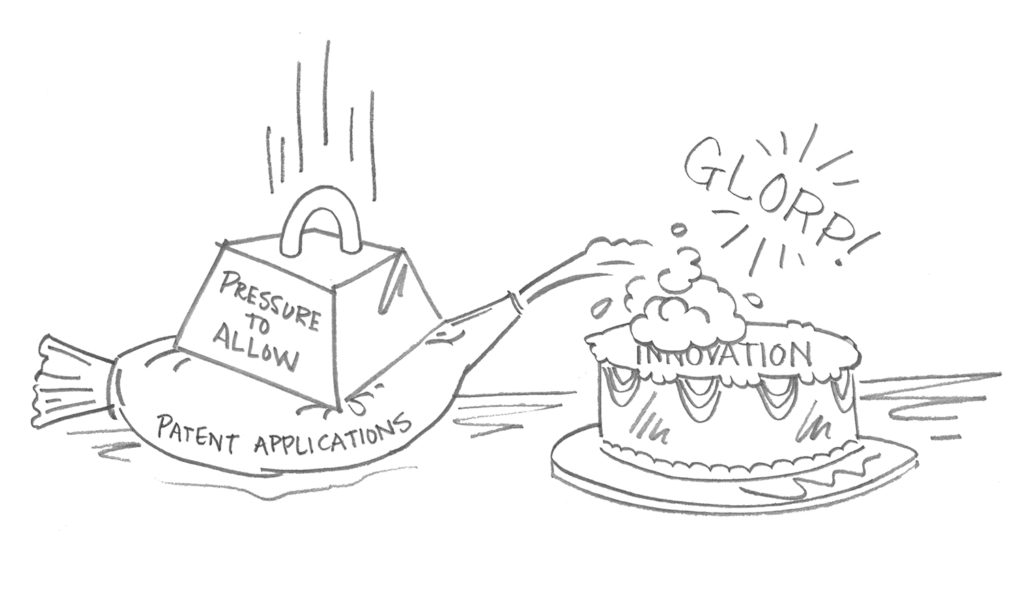 Credit: Matt Levy/CCIA
Summary: The United States is seeing the potency of patents -- especially software patents (which make up much of the country's troll cases) -- challenged by courts and by the Patent Trial and Appeal Board (PTAB)
PATENTS (as originally conceived and foreseen) are not inherently evil, but if patents become applicable to everything under the Sun, then they serve no purpose other than to limit virtually every human activity, sometimes even natural activity (like patents on seeds, which increasingly limit reproduction).
Techrights opposes software patents because the discipline of software development cannot coexist with software patents. Just ask programmers about it. One programmer,
Florian Müller, sent me a link this morning to
an article I first saw last night. In it, Fenwick & West (which we cite a lot in relation to
Alice) is claimed to have said 370 software patents have been invalidated by US courts (there's much more of that in PTAB as well) after
Alice. Here are the key parts:
Two years ago, when the U.S. Supreme Court invalidated Alice Corp.’s handful of patents on the concept of an electronic escrow arrangement, it ruled that taking abstract ideas—apparently including established methods of doing business like escrow—and implementing them on a computer doesn’t meet the standard of intellectual property. In its unanimous decision, written by Justice Clarence Thomas, the high court refused to precisely define what makes something an “abstract idea.” “We tread carefully,” Thomas wrote of the new standard for patents. Since then, however, lower courts, and the U.S. Patent and Trademark Office, have been using some pretty heavy boots.
Courts have invalidated more than 370 software patents under the new standard, according to data compiled by law firm Fenwick & West. District and appellate courts have thrown out two of three patents brought before them since Alice Corp. v. CLS Bank.
This means that there's far lower an incentive to even
bother suing with a software patent (or patents), never mind apply for one.
There have been lots of articles about Apple patents this week, mostly because of "iWatch". Some articles mentioned software patents explicitly in that context. To give just one example, this
new article states that "this latest [Apple] patent is more software orientated" and as longtime readers probably know, Apple has been using software patents against Linux since 2010 (in the courtroom;
deterrence against Palm's Linux-based operating system, using patents, predates that).
The good news is that reprieve is on the way and a lot of software patents are on their way out. The other day someone came to our main IRC channel and said, "the uspto is trying to stop my patent prosecution [...] I dont know what to do... who can help me? [...] i have a software patent that the uspto is trying to stop" (suffice to say, the
USPTO has been the most pro-software patents among courts, boards and other 'compartments' in this profit-driven system).
The above story is not unusual. We have been hearing such stories for a while, but this one is a firsthand account. Here is a
new very long rant from SightSound. "We’re the guys who invented the download music store, showed it all to Steve, and got rolled by Apple," says the summary. Notice the use of the term "Death Squad for Patents" in the headline. "Death Squad" is a term popularised by the patent microcosm, which equates quality control/patent assessment with execution. It's quite revealing, isn't it? It's rather likely that just as companies that sue Apple with software patents lose their case/s, so will Apple. Software patents are a dying breed. It's easy to just file a patent lawsuit; winning one is another matter altogether, especially in this software patents-hostile atmosphere. That's why the number of patent lawsuits fell sharply, based on firms that watch these figures closely.
Reaching out to the
ITC (embargo using patents, even before the facts are known!), ResMed has just initiated "lawsuits in Germany and New Zealand, and to the US International Trade Commission against Fisher & Paykel Healthcare" [
1,
2,
3,
4,
5,
6]. This particular case is not about software but about a device. Suffice to say, Germany does not (formally) have software patents altough in practice it's most friendly towards them in Europe. As for New Zealand, it's
the latest battleground on this matter, probably
along with India where this matter seems to be settled.
ۤ 101 in the US threatens to eliminate software patents in what is probably their last remaining home. Fish & Richardson PC has published
this new analysis about the
Court of Appeals for the Federal Circuit (CAFC), in which it says:
Patents that employ functional claiming even without using the words “means” will likely encounter greater scrutiny in the courts in light of this growing line of cases. That scrutiny is becoming more prominent under Section 112 jurisprudence, but is also apparent in the growing body Section 101 case law. The Court commented in the recentElectric Power Group, LLC v. Alstom S.A., No. 2015-1778 (Fed. Cir. Aug. 1, 2016) decision, in affirming a finding that a software patent is ineligible under €§ 101:
The district court phrased its point only by reference to claims so result-focused, so functional, as to effectively cover any solution to an identified problem…. Indeed, the essentially result-focused, functional character of claim language has been a frequent feature of claims held ineligible under €§ 101, especially in the area of using generic computer and network technology to carry out economic transactions.
Let's face it, ۤ 101 has changed everything. Matt Levy's
latest cartoon shows that he too now realises that patent scope, not just patent trolls, is a problem. In fact, patent trolls are often a symptom (or residue or side-effect) of patent scope gone awry, not to mention Texas courts openly bragging about pro-plaintiff bias. The cartoon from Levy is very much applicable to the EPO under Battistelli as well. Under pressure to grant patents all the time (the more, the merrier) they spoiled the whole system. "The GAO recently did a study on patent quality," Levy explains. "It found that part of the reason so many patents are low quality is the pressures patent examiners are under to allow more patents."
We
already wrote about
this study and explained how it relates to the
EPO.
IP Watch has just published
this guest post in which it's suggested that number of unique patent assertions (e.g. lawsuits) is declining. AIA is cited as a possible cause. To quote:
Since AIA became effective in September of 2012, numerous studies have suggested the rise of patent litigation. While some surmised the post AIA joinder rule is causing the rise, many studies simply relied on just the number of cases filed per year to draw a conclusion about rising litigation.
We decided to take an additional step and look at another metric that may give us a better sense of the litigation landscape: the number of unique patent assertions per year. Essentially, this metric tells us how many unique patents are believed (by their owners) to be infringed in the US market.
As we know, after AIA, a single patent may now be asserted more than 100 times (e.g., Shipping and Transit LLC has filed more than 150 cases against many companies which, in most cases, only a single patent asserted (US7,400,970)). In our study, we counted this or similar cases once, because only a single patent was involved. As you can see in the above chart, the number of unique patents has been declining over the years.
2015 saw the highest number of filings. However, in terms of unique patents asserted, 2015 actually represented the lowest level since 2010. The number of unique patents asserted in 2015 had declined more than 23% from 2010.
It seems likely that AIA, together with PTAB that it brought, reduced confidence in all sorts of ludicrous software patents. The patent microcosm is obviously in denial about it, but the figures speak for themselves. here is Quinn Emanuel Urquhart & Sullivan LLP piggybacking or cherry-picking
Enfish to pretend software patents are in tact (the
tiring old spin). To
quote their so-called 'analysis' (shameless self-promotion): "As two recent decisions from the Federal Circuit demonstrate, the law on patent-eligible subject matter, 35 U.S.C. €§ 101, remains largely unsettled. These decisions, Enfish and TLI Communications, represent some of the Federal Circuit’s most recent attempts to grapple with the appropriate application of €§ 101. Although these decisions are both software patent cases, they speak to issues that affect €§ 101 jurisprudence across a wide range of technologies, from software to diagnostic procedures to molecular biology protocols. In particular, Enfish and TLI Communications embody the recent judicial tendency to collapse the €§ 101 inquiry into the novelty inquiry under 35 U.S.C. €§€§ 102 and 103."
But those are just two decisions among hundreds of others ruled in the opposite way. As we
noted earlier this week, PTAB's influence on CAFC (or vice versa) causes a certain panic in the patent microcosm. "For its part in the case,"
wrote Patently-O about one case, "the Federal Circuit affirmed the PTAB determination without opinion" (there's not much to argue about). "The patents at issue in the case are U.S. Patent No. 6,315,921 and U.S. Patent No. 6,395,195. They relate to an oxygen absorber used in meat packaging."
PTAB is dealing not only with software patents, but when it deals with software patents they have very slim chance of survival because of ۤ 101/
Alice. Here is
Patently-O remarking on PTAB again while citing
Halo [
1,
2]. To quote: "The Third Edition ads substantial coverage of managing litigation to deal with parallel proceedings at the PTAB, pleading standards, patentable subject matter, claim construction, enhanced damages following Halo, and reasonable royalty disputes. The treatise also covers recent developments in ANDA and biologics litigation, design and plant patent litigation, and litigation at the Federal Court of Claims. The appendices provide case management checklists and exemplars of patent management filings."
MIP has also
just mentioned Halo, noting that the "Federal Circuit and district court rulings since the Supreme Court’s Halo decision have made it clear a jury finding alone is enough for a judgment of willfulness. But an enhanced damages determination should ultimately be made by the judge weighing factors yet to be clarified."
This case mostly impacts patent trolls that want to hop from one company to another and hoard money by shakedown. The
following situation, as mentioned before by
Patently-O, deals with scope of patents and how they're self-limiting or self-invalidating (if the specified scope is too broad). It's another case of patents that should not have been granted in the first place or are far too narrow to be useful. To quote the
National Law Review: "This decision is an important reminder of the care that should be taken with all claim language, and indicates that extra caution may be warranted whenever any “consisting of” clause is used. It is not clear whether Multilayer could have modified the Markush clause with open-ended language, such as by reciting that “the inner layers comprise a resin selected from the group consisting of ….” Some examiners raise indefiniteness rejections when a claim uses both “comprising” and “consisting of ” language, but not all combinations of such “open” and “closed” language are improper."
What this basically says is that you cannot get a patent to cover everything under the Sun or claim in an
ad hoc fashion that it magically covers unspecified claims. Any patent system which places no restrictions on scope would be self-deprecating. To give two more examples of cases covered by
Patently-O, in
one case there was "key prior art in the obviousness case [...] Chinese patent publication that discloses minocycline..."
In
another case the lawsuit got thrown out because the plaintiffs "waited a year to serve the motion. Courts hold that the motion should be served as soon as practicable. As a result, the court held the motion was properly denied as having been served in an untimely fashion."
"Frivolous" is the word
Patently-O uses to describe this lawsuit; another way might be SLAPP, as the intention is to discourage some activity, later (a year later) to be followed by a surprise motion. What is this, Mafia tactics?
⬆
