
Bonum Certa Men Certa

Appalling Press Coverage Regarding the Unitary Patent (UPC)

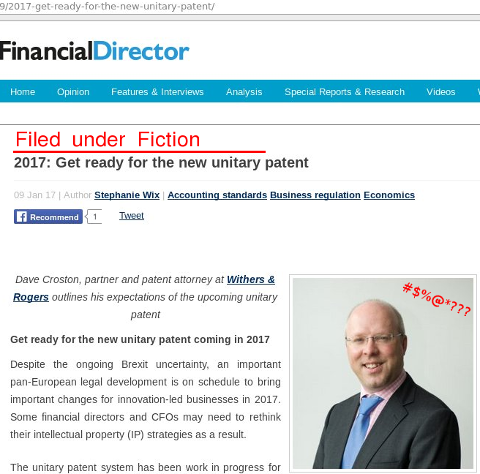
Dave Croston in Financial Director
One example of plenty more fake news about the UPC (e.g. [1, 2, 3]), courtesy of those who stand to profit from legal Armageddon


Summary: How the media has lied (and keeps lying) about the UPC, which the European public neither needs nor wants, putting aside serious constitutional issues that are associated with the UPC

PUTTING ASIDE the issue of UPC censorship/deletionism in the media -- a subject we explored here before -- we continue to see a lot of EPO-leaning spin in the wake of Germany's barrier to the UPC [1, 2, 3]. It's more obnoxious than anything that the same people who conspired in secret to create this mess are now dominating the media, hijacking blogs, deleting comments, and telling off people who contradict or debunk their propaganda.


Watch this new piece titled "Germany delay probably not the end of the UPC" -- a piece which extensively quotes people with financial stake in the UPC. It quotes Team UPC's Wouter Pors a lot, for example: "Wouter Pors, head of Bird & Bird’s IP practice in the Netherlands, explained that the Bundesverfassungsgericht has the authority to issue an order blocking the president from signing in a law."

Where are the opponents of the UPC? They were not even approached for a comment. There is zero balance there. People who want to profit using the UPC (at the expense of everybody else) refuse to believe it's dead; that's hardly surprising. Where are the voice of reasons though? Totally omitted from this article, as usual...

Looking around for more coverage of this, we are finding little less than sites controlled if not owned by patent law firms. In fact, patent firms that actively wage a coup (to replace the current system with the UPC) are dominating all the blogs and some responded to the breakdown with potentially paid-for placements like these [1, 2] from William Fry and CMS Hasche Sigle.

One former Kat said that "it could be" the end of the UPC, but that's just because he tends to be more honest than most and he occasionally links to us regarding the UPC (albeit he does not agree with the relatively abrasive tone).

Almost all UPC opponents prefer to remain anonymous and it's easy to see why. They don't want to receive abuse. A German complaint was filed anonymously, but we think we know who filed it. Character assassination would ensue of the identity of the complainant was known.

Now that Germany must decide whether the UPC is constitutional at all (it's not, for reasons we covered here before), one person said he expects a "decision in perhaps 6 or 12 months."

That's a very long time. To quote in full: "A few people have asked about timing. From what I gather the Court proceedings have already been expedited, which means a decision in perhaps 6 or 12 months. Still before the date of Brexit but getting uncomfortably close."

"Remember that Spain raised this very complaint (incompatibility of the UPCA with EU law)," said another comment. It's part of an ongoing discussion (in uncensored comments) about the legality of the UPC (or absence thereof). Reproduced below are the relevant comments in case IP Kat (i.e. someone like Bristows) decides to 'vanish' them: [G&P refers to Gordon and Pascoe]

Firstly, the current UPC Agreement is the only one currently on the table. There is no amended Agreement, and there may never be.

Secondly, if the current Agreement does not comply with EU law (because, as argued by G&P, it is incapable of creating a court that forms "part of the national legal order" of EU Member States), then it would be irresponsible to bring it into force... as it would be unworkable from the off.

Also, just because the UPCA Member States are all currently EU Member States, it does not necessarily follow that the UPC (under the current UPCA) will form "part of the national legal order" of the EU Member States. Indeed, it would be absurd if the status of the Member States was the only relevant factor.

For example, why should the UK's departure from the EU suddenly remove the UPC from the national legal order of other EU Member States? Conversely, why should the mere fact that all signatories are EU Member States mean that an international agreement is capable of creating a court forming part of the national legal order of those states? Does there not need to be something more than just a common status of the participants to properly "embed" the UPC in the national legal order?

Remember that Spain raised this very complaint (incompatibility of the UPCA with EU law) in one of their cases - and that complaint was only dismissed because it was inadmissible, not because it was wrong.


"Secondly, if the current Agreement does not comply with EU law (because, as argued by G&P, it is incapable of creating a court that forms "part of the national legal order" of EU Member States), then it would be irresponsible to bring it into force... as it would be unworkable from the off."

Indeed it would, if that were correct. Except that this is not quite what G&P are saying. There is more than one way to provide the safeguards required in order to comply with EU law.

One is if the UPC itself were part of the national legal order of the contracting EU member states. Article 267 TFEU and the rest of EU law would then apply directly, with no need to say more. But it isn't, as you point out. As stated by G&P it's an international agreement, and the fact that it is common to the contracting EU member states doesn't change that.

So the way in which the current UPCA provides the necessary safeguards is by stating explicitly that the UPC is common to a number of EU Member States (Article 1). And by imposing obligations on the UPC as a court common to those EU Member States (Articles 20-23). Including an obligation to make references to the CJEU in accordance with Article 267. (See G&P paragraph 15).

This is not a direct application of EU law (including Article 267 TFEU), but instead it hard-codes the same obligations into the UPC itself.

The other side of the coin (currently) is that the CJEU automatically has jurisdiction to receive references and decide questions of EU law, because the UPC is common to a number of EU Member States, and the CJEU has jurisdiction over all those Member States. No need to hard-code anything.

However, this current form of the UPCA needs amendment after Brexit. G&P's proposed amendments keep the hard-coded obligations, but adapt them to the new situation that one of the contracting states is no longer an EU Member State. As previously, this is not a direct application of Article 267 etc.

Unfortunately the CJEU would no longer have jurisdiction automatically, as its jurisdiction is limited to EU Member States (G&P paragraphs 80, 84, 85). This is why G&P say that a separate agreement is needed, with the EU as a party. The CJEU's jurisdiction also now needs hard-coding.


One minor point: is it not a little odd that there are references in Articles 21 and 22 UPCA that only seem to make sense if the UPC does form part of the national legal order of the EU MSs?

For example: "as part of their judicial system" (Art. 21); "as any national court"; and "in accordance with Union law concerning non-contractual liability of Member States for damage caused by their national courts breaching Union law".

It appears to me that the drafters of the UPCA tried hard to create a "Benelux-type" court that the CJEU's Opinion 1/09 indicated was OK. But now it seems necessary to argue that the drafters were unsuccessful in their efforts, and that the UPC complies with EU law by way of a novel mechanism.

I can at least concede that the UPC is very obviously different from the Benelux Court. This is not least because the UPC is an alternative to the national courts, rather than a court that is "plugged in" to the national legal systems by way of appeal / remittance links.

However, I have my doubts over whether the proposed novel mechanism for complying with Article 267 TFEU would work. That is, given that the CJEU can only accept references from "any court or tribunal of a Member State", is there not a risk that the CJEU - despite the safeguards that you mention - would find that the UPC is not a court "of a Member State", and thereby refuse to accept preliminary references from that court?

Of course, I do not rule out the possibility that the CJEU will find a reason why the current UPC set-up is compliant with EU law. However, as the CJEU has not yet given the system the "thumbs up", we cannot be certain that they will do. In this respect, do you not worry that the arguments in G&P's opinion could perhaps undermine a crucial point for EU law compliance (namely the ability for the UPC, as a court "of a Member State" to make references to the CJEU)?

More importantly, do you not worry about the risks of "going live" with a system that is not guaranteed to be compliant with EU law and where there are no guarantees that the UK can remain in that system post-Brexit? I understand the temptation to press on given that we are now so close to realising a long-held wish amongst certain sections of the IP community in Europe. Nevertheless, given the lack of guarantees on important points (especially when there are lingering, and well-reasoned doubts on those points that cannot yet be dismissed), I cannot help thinking that pressing on regardless generates huge - and frankly unacceptable - uncertainty for rights holders (and interested 3rd parties).


What we advise readers is, ignore pieces written by firms with stake in the UPC, so-called 'reports' (puff pieces/PR) that extensively quote those firms, and stacked panels that include liars from the EPO. Sadly, nowadays comments about the UPC are being deleted from numerous prominent blogs, but those comments which miraculously remain almost unequivocally voice pessimism about the UPC. Professionals in the field evidently don't believe what Team UPC is saying and there are surveys that show that.

Recent Techrights' Posts

Slop's Achilles Heel: It Increases the Workload, Not Just Costs
Set aside its inability to scale well
Improving techrights.org
Technical debt (like 17 years with WordPress) is something that's better to address early, not later
Laos Leaving GAFAM Behind, Gradually
Yesterday evening it was measured at 10% for GNU/Linux at one point
China Says Goodbye to Microsoft
It is hardly surprising that Windows is shedding off userbase all around the world
 
Instant Impact: GNU/Linux Skyrockets to 10% in China Days After Policy Changes
Let's see what the 'aftermath' looks like by year's end
Links 19/08/2026: Timothy James King (AmigaDOS) Dies, GitHub Goes Offline, Finland Wants to Shun Social Control Media
Links for the day
Mass Layoffs at Dropbox, Blame the Debt, Not Slop Hype
The debt of Dropbox Inc., which isn't an imaginary (estimated) thing, is over 4 billion dollars
Microsoft is 'Angel of Death' to Developers (Even Its Own), 'Voluntary' Layoffs Happening Again
From what we are hearing and reading, there are 'voluntary' layoffs again
Over at Tux Machines...
GNU/Linux news for the past day
IRC Proceedings: Tuesday, August 18, 2026
IRC logs for Tuesday, August 18, 2026
Gemini Links 19/08/2026: Shirts, Handwriting, and Fights in Geminispace
Links for the day
They Were Wrong All Along
Two women combined won't deliver a healthy baby in just 4.5 months
A "Tech Journalist" Would Not Cover Vote on LLMs as a Sex Issue
For a moment there you have to pause and wonder, is this a "Tech Journalist" or the Daily Stormer?
20,000 by Year's End
The "New Techrights" will have 20,000 pages by year's end
Last Night GNU/Linux Measured at 9% in Africa
Nighttimes in Africa are times when GNU/Linux usage on desktop/laptop devices typically surges, based on Clownflare [...] It changes in favour of GNU/Linux
Gemini Links 18/08/2026: Google Bait and Switch (Getting College People 'Hooked' on 'Cheap' Storage, Then Backups Gone), a "Question of E-mail"
Links for the day
Bluesky is in Trouble
Bluesky is a private company (unlike Bluesky Digital Assets Corp. in Toronto, that one runs a pyramid scheme!), so it's hard to know for sure just how much money it is losing
Links 18/08/2026: US Abandons South Korea, New Legal Disputes Over Slop Plagiarism in the Music Scene
Links for the day
Linux Losing Interest in Users' Freedom, Pursues DRM Instead
"Linux" is (or was, as GNU/Linux) meant to empower - not artificially restrict - the users
GNU/Linux in Ecuador and Colombia: Growing, Still Below International Average
locals turn away from Windows and try GNU/Linux instead
IBM is Dead or Dying. Now It Asks Workers to 'Resign' Voluntarily.
To save face, to pretend no layoffs are happening (as it might alarm shareholders) [...] We keep hearing more and more stories like that
Links 18/08/2026: Sergey Brin Controlling State Policies, "Dario Amodei's (Anthropic) Wife Is Closely Linked to Jeffrey Epstein"
Links for the day
SBS News Interviews Daniel Pocock
The locals say this PR stunt (by the bigot, Farage) was a waste of money
Clownflare Sees One in 7 Web Requests in Libya Originating From GNU/Linux
GNU/Linux has taken a (foot)hold there
Openwashing and Manifestos Composed in Private by Dictators With Deliberately Addictive (and Subsidised, Bundled) 'Tech'
It's long, so make a cuppa first
SLAPP Censorship - Part 153 Out of 200: Decades of Debt, Weaponising Borrowed Money to Try to Put Their Critics in Debt
they've always had a financial report by now
Over at Tux Machines...
GNU/Linux news for the past day
IRC Proceedings: Monday, August 17, 2026
IRC logs for Monday, August 17, 2026
Gemini Links 18/08/2026: Solar Power, Kipple and Impermanence, Catastrophe Ethics
Links for the day
Evri (HermesUK) is Now Run by Bots and Hallucinating Scammers
Years ago they virtually removed support and tried chatbots instead
Less Technology, More Life
Technology is being associated (sometimes rightly) with physical and mental problems
Google Search Has Gotten Worse (a Lot Worse)
getting worse
Birthday in 80 Days
we'll start decorating and party online with our community
Loans and Massive Debt at Microsoft, This Won't End Well.
Microsoft running out of money to pay salaries (to the point of paying people for 'voluntary' layoffs) is a positive sign?
Gemini Links 17/08/2026: Life in Plain Text, Mimicking KARL, Release of Jugulans, Avoiding Slop
Links for the day
Clown Storage Without Backups
Setting up several reliable copies of the data, plus several off-site backups (this data is nowhere as sensitive as medical data), should only cost a few grand
FreeCAD is Becoming Slop-ware, Use LibreCAD Instead
It has regular releases and "Qt5 is mandatory" now [...] they at least audit what they add
Cuba and Venezuela High in Adoption of GNU/Linux
some of the "communist" nations
Links 17/08/2026: Myanmar’s Cholera Outbreak, China Sends Commercial Vessels Through Arctic
Links for the day
GAFAM Loyalty Has Come to an End, Morale Low, People Whose Future is Uncertain Choose to Become "Lifers"
morale is low and there's no loyalty anymore
SLAPP Censorship - Part 152 Out of 200: Injunctions Do Not Cover Criticism, They Have Scope
self-incriminating communications
Clownflare Sees About Quarter of Web Requests in Ireland Coming From GNU/Linux
Well, in Ireland it seems like many people adopted GNU/Linux
Clownflare: In Australia and New Zealand GNU/Linux Peaks at Over 10% During Working Hours
That right there is interesting in its own right
Slowing Down by Intention
At the moment we have 6 or 7 ongoing series
Gemini Links 17/08/2026: Chamboree, Partial Solar Eclipse, Lady Macbeth
Links for the day
Links 17/08/2026: "Bluesky Is Down Again!" and "Anti-Social Media"
Links for the day
Over at Tux Machines...
GNU/Linux news for the past day
IRC Proceedings: Sunday, August 16, 2026
IRC logs for Sunday, August 16, 2026