Persistence if not extension of Battistelli's notorious strategy of broadening patent scope
Credit/source: JUVE
Summary: António Campinos continues Battistelli's tradition of shredding the Convention on the Grant of European Patents (EPC); it's all about generating as much assertion (e.g. litigation, shakedown) activity as possible, serving to bring Europe's productive industries to a halt
THE existence of software patents in Europe in spite of the EPC and software patents in the U.S. in spite of 35 U.S.C. ۤ 101 is the fault of U.S. Patent and Trademark Office (USPTO) and EPO management. Both are nowadays run by pretty clueless people, or what's sometimes referred to as kakistocracy. The USPTO had a new chief, appointed by Donald Trump, replacing Michelle Lee earlier this year. Contrariwise, the Federal Circuit is still run by a lady who's undoing much of the damage done by the corrupt (he got caught) Judge Rader. Will Trump replace her too? The Patent Trial and Appeal Board (PTAB) was run by the same man for a couple of years until Trump's newly-appointed Director moved him, possibly as part of his war on inter partes reviews (IPRs). These people just really dislike patent quality. All they want is litigation and an ocean of low-quality patents.
We've been patiently observing today's and yesterday's news about software patents. That mostly focused on the EPO because
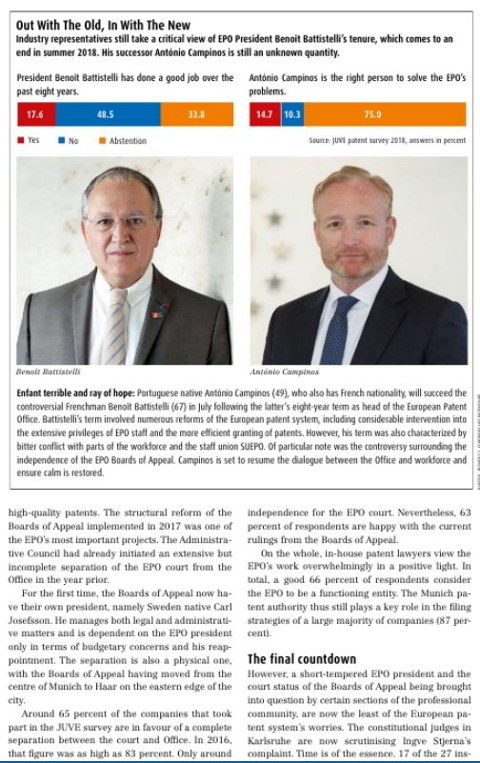
António Campinos seems like a pretty big fan of such patents. Not that he ever developed software or anything remotely like it; he's a career-climbing banker. He's a "money man" --
to the point of firing staff if he can get the work done on the cheap elsewhere (EU work done outside the EU).
The EPO has come up with terms other than "CII" -- terms by which to refer to "software patents in Europe" without mentioning the S word (software). Another stupid/brain-dead buzzword (or term) that's exploited by proponents of software patents (along with "AI", "4IR" and other nonsense) is "IoT". EPO examiners need to watch out for that. Here's a
new tweet that says: "IoT or Internet of Things technology is dramatically changing and is expected to be an extensive one in the coming decade. Find out the challenges to be faced while patenting in IoT Technology from the adjoining link: https://resources.sagaciousresearch.com/patent-drafting-challenges-in-iot-domain …"
They're basically promoting hype, not substance. IoT Evolution World (blog) has
just published something to that effect as well. So software patents are merely dodging their name (negative connotation); they nymshift a lot and hide behind buzzwords, media hype etc. Some more software patents are
now disguised as "in or on a car" (new article by Admire Moyo, ITWeb's business editor).
"An idea may be an invention if existing technologies are combined in a way that is novel, or used in a way that is novel," the EPO
has just said. They use buzzwords and hype to make fundamental and old ideas seem novel. Go ahead and define "novel" (typically just a synonym for new). EPO management also routinely misuses words like "technical", then it grants patents on maths, life, and nature.
"Registration for our Patenting Blockchain conference is now open,"
the EPO added, so here we have the EPO openly advertising and advocating for patents on software, using the hype
du jour.
OIN staff (the
people who repost the "Microsoft loves Linux" lie and write FRAND blog posts) were at this related conference/workshop of the EPO. This guy says he's representing "the FOSS community," which is actually incompatible with these patents. To
quote him: "Representing the #FOSS community at @EPOorg at the #blockchain scoping workshop. Feel a bit exotic in the room :-) Great discussions however, and an eager audience on all sides."
So here we have OIN helping the EPO's software patents agenda, as one might expect from OIN. They also participate in IAM events with a similar agenda.
One angle we wish to mention but not to dwell too much on is patent law firms' support for this agenda, which may mean more litigation and therefore 'business' for them. Aaron Gin (McDonnell Boehnen Hulbert & Berghoff LLP) wrote [
1,
2] that "EPO Releases Patentability Guidance for AI-based Applications" and Gregory Rabin (Lundberg & Woessner,
highly vocal proponents of software patents) wrote [
1,
2] that "EPO Provides Patentability Guidance for AI-based Applications". They couldn't be happier. Only hours ago Marks & Clerk, a longtime proponent of software patents,
published the usual marketing spam in that news site from Scotland. They had done it before. "Patent applications for AI-related inventions is key" was the headline of an article signed by: "Graham McGlashan is a Chartered (UK) and European Patent Attorney for Marks & Clerk LLP."
So the patent lawyers/attorneys are apparently journalists now, as well...
Notice the abundance of buzzwords. From just one paragraph: "From smart meters to smartphones, technology continues to have a positive impact on our everyday lives with advancements being felt in almost every area. Welcome to the ‘fourth industrial revolution’, or industry 4.0 as many have labelled it, which is now in full swing across the globe, heralding a new era of technological development characterised by digitalisation and the storage and management of big data. Fundamentally, it is expected to disrupt the global economy. Industry 4.0 refers to the impact that increasingly sophisticated software, and in particular artificial intelligence (AI) software, will have on that economy. From energy to automotive to medtech and biotech, there are few areas which will be immune to AI-based disruption and the race is most certainly on globally to deliver the technologies that will define the next industrial revolution. Examples include Internet of Everything (IoE) and machine to machine (M2M) technologies underpinning factory environments, allowing machines to become increasingly automated and self-regulating, in turn realising smoother processes and freeing up workers to focus on other tasks."
Chris Milton (J A Kemp)
wrote that the "EPO has published its yearly update to the Guidelines for Examination, which will come into force on 1 November 2018."
James Ward, David Lewin, David Brown and Magnus Johnston of Haseltine Lake LLP then
wrote about shallow EPO examination, a.k.a. "Early Certainty". To quote:
In mid-2016 the EPO introduced "Early Certainty from Opposition", announcing that streamlined internal workflows would apply to first-instance opposition proceedings as from 1 July 2016: see notices in the EPO Official Journal, May 2016, A42 and A43. A stated intention was to reduce the time needed for a first-instance decision in "straightforward" cases to 15 months from expiry of the opposition term. Perhaps reasonably enough, no attempt was made to define "straightforward".
Intended or possible effects of EPO-internal "streamlining" on requirements to be made of parties to proceedings were not particularly spelled out in the May 2016 notices. They indicated that the term to be set for the patentee to respond to the notice(s) of opposition would be 4 months, extendible only in exceptional cases, as was previously so (see e.g. Rule 132 EPC). In the November 2016 version of the Guidelines for Examination at the EPO, a passage was amended to emphasize that extensions would be granted "only in exceptional, duly substantiated cases". This was maintained in the November 2017 version of the Guidelines (Part E, Chap. VIII, 1.6 Extension of a time limit).
The notices also indicated that the time between issue of a summons to oral hearing and the hearing date would now normally be at least 6 months (up from 4 months) and that the deadline for final written submissions would now normally be set at 2 months before the hearing (rather than 1 month). These changes were incorporated into the November 2016 Guidelines and maintained in the November 2017 Guidelines (Part E, Chap. III, 6. Summons to oral proceedings; Part D, Chap. VI, 3.2.
IAM is still helping the EPO with its software patents agenda (trashing the EPC -- the basis upon which the EPO was founded).
In Twitter it
wrote: "Computer implemented inventions are a big focus of the new @EPOorg examination guidelines which kick in on 1st November."
It's an article by James Sunderland ("UK and European patent attorney | Haseltine Lake, London") and it's titled
"Latest EPO Guidelines bring substantial revisions, with CIIs a major focus" (there's that term "CII" again). To quote:
Each year since 2012, the EPO has updated its Guidelines for Examination to follow changes to the European Patent Convention and its rules, and also to reflect developments in case law and evolution in EPO policies and practices. The 2018 edition of the Guidelines, that will come into force on 1st November 2018, includes extensively revised sections and newly added sections.
The revisions relate to computer implemented Inventions, inventive step assessment in opposition, unity and more.
While, as the name suggests, the Guidelines are not binding, they do set out the day-to-day practice to be adopted by examiners. Familiarity with them is important for a European patent attorney: they are the best tool we have for understanding how an examiner is likely to approach an issue and an argument solidly based on their content is unlikely to be dismissed.
So the
EPO's management promotes software patents in clear defiance of many things, including the EPC. Law/litigation firms are happy, but scientists and techies simply don't count. The EPO doesn't care about those people.
Arnie Clarke
published the following article yesterday; it's about "late-filed submissions in EPO oppositions" and it says:
T0969/14 is the latest in a long line of decisions which make it clear that the EPO Boards of appeal will not accept late filed requests which could have been filed in first instance proceedings, whether or not the submission of such requests might be perceived as a procedural abuse.
One of the consequences of decisions like this is a proliferation of auxiliary requests in first and second instance opposition proceedings. This, in turn, is being used by patentees to justify certain procedurally abusive behaviours in oral proceedings which are disadvantageous to opponents.
How has this has come about, and what can the EPO do to redress the balance?
Campinos -- like Battistelli -- is really tightening the screws or knocking some more nails into the Boards' coffin. They don't want oppositions aplenty, at least not successful ones, as that would reveal the sharp decline in patent quality.
Last but not least we have another law firm, Inspicos A/S,
writing about the problem-and-solution approach as follows:
The European Patent Office uses the well-established problem-and-solution approach when assessing inventive step (cf. Guidelines for Examination at the EPO G.VII 5). A crucial part of this analysis is the starting point, known as the "closest prior art".
The selection of the closest prior art document is important, as it may prove easier to arrive at the claimed invention from one document than from another document. Selection of a particular document as the closest prior art generally sets the course for an assessment of inventive step.
There have been various approaches to selecting a document as the closest prior art. For many years, the Boards of Appeal at the EPO seemed to hold the opinion that there was one – and only one – document which could constitute the closest prior art. During EPO examination proceedings, and especially EPO opposition proceedings, parties before the EPO made great efforts to persuade EPO examiners that their choice of closest prior art was the correct one. Once the relevant document had been identified, arguments which started from other documents (however valid) were typically not accepted.
[...]
In the most recent update to the EPO Guidelines for Examination (valid from November 1 2018), this approach has been refined once again. With reference to decision T320/15, multiple inventive step attacks from multiple starting points are only allowed if the documents selected are "equally valid springboards". In particular, opposition proceedings are not seen as "a forum where the opponent can freely develop as many inventive step attacks as he wishes in the hope that one of said attacks has the chance of succeeding."
So the EPO promotes the lie and even propaganda that challenges or refutations of bogus patents are "attacks". That's because today's EPO management works for lawyers, not science. It's about litigation, but not justice. One more article of interest deals with EP 2937734B1, which was granted less than a couple of years ago and is
already being used in lawsuits:
In the patent battle between Nikon and ASML in relation to which 11 cases were pending before the District Court of The Hague, the Court recently ruled on case three.
Nikon is holder of European patent EP 2937734B1, granted on December 28 2016. It has 18 claims with independent product claim 1 and independent process claim 15. Both independent claims incorporate feature 1.6: "The reference (MFM) is covered with a light-transmissive material". The reference is provided on the substrate (wafer) that is used for detecting a projection position of the pattern image to be projected on the wafer. The parties agree that the other features in the claim are present in ASML's machine, but dispute the presence of feature 1.6.
To prove infringement Nikon referred to a publication of ASML and Zeiss from 2010 and a patent application of ASML from the same year. These publications, however, do not disclose anything about the actual features in the machines that ASML is currently selling in 2018.
This case isn't about software. However, if Campinos gets his way, then in the coming years we might see plenty more abusive lawsuits (meritless) over algorithms. Examiners at the EPO are certainly aware that such a thing would further damage Europe's software industry.
⬆
