
EditorsAbout the SiteComes vs. MicrosoftUsing This Web SiteSite ArchivesCredibility IndexOOXMLOpenDocumentPatentsNovellNews DigestSite NewsRSS

11.05.08

Ideas Are Not a Property, Devices May Be

Posted in Intellectual Monopoly, Law, Patents at 9:00 am by Dr. Roy Schestowitz

“IP is often compared to physical property rights but knowledge is fundamentally different.”

Professor Joseph Stiglitz

ONE of the best writers on the issue of intellectual monopolies, among others like Mike Masnick, is Glyn Moody. He has no mercy when he sees an unjust system and yesterday he published this post in IDG about patents and the notion of “property”.

As long-suffering readers of this blog will have noticed, one of my favourite hobby-horses is that the whole idea of “intellectual property” is a trick, designed to plug into the warm and fuzzy feeling most people have about the idea of property, and aiming to cover up the fact that what we are really dealing with here are intellectual monopolies – of which few people are fans.

Also from Glyn, a prelude to another financial collapse caused by paper-thin monopolies? It seems possible. As pointed out in the comments, however, not patents are involved, but something a little more reasonable in this case.

The fact remains that the system was corrupted to the point where simple abstract ideas can be considered ownership, but this era appears to be ending, eliminating along with it billions of dollars in imaginary assets.

Your Business Method Patent Has Just Been Invalidated

[...]

This ruling raises a ton of questions like that across literally thousands of patents. And it is a good thing too because business-method patents tend to be overly broad and abused.

Dana Blankenhorn puts forth the assessment of Bruce Wieder, who comments on the impact of the Bilski ruling [1, 2, 3, 4, 5, 6, 7].

“Because there’s no categorical exclusion of these things they probably ought to look at those individual patents to see if they have any value. But you have to look at it patent by patent.”

That’s the word from Bruce Wieder, who heads the patent practice over at Dow Lohnes PLLC in Washington. As always this new legal decision is really great for lawyers.

So what will they be looking for? According to Wieder the court set a simple test. “Business method patents must be tied to a machine,” one that does real transformations of something. You can’t just patent the idea.

For software it’s the same thing. “You have to look at what the software does.” The court gives the example of a machine that cures rubber. You can patent the machine, but not the software timing the process.
The world is at least moving in the right direction. It has been a long time since that last happened.

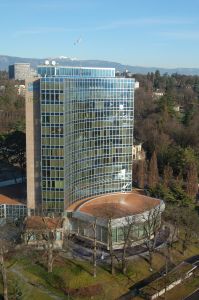
WIPO
WIPO (World Intellectual Monopolies
Organisation), Geneva, Switzerland

Share this post: These icons link to social bookmarking sites where readers can share and discover new web pages.
  • Digg
  • del.icio.us
  • Reddit
  • co.mments
  • DZone
  • email
  • Google Bookmarks
  • LinkedIn
  • NewsVine
  • Print
  • Technorati
  • TwitThis
  • Facebook

If you liked this post, consider subscribing to the RSS feed or join us now at the IRC channels.

Pages that cross-reference this one

2 Comments

  1. Jose_X said,

    November 5, 2008 at 9:58 pm

    Gravatar

    Some patent machine madness and a possible way forward:

    I was going to mention earlier that if general purpose computers with attached peripherals end up being ruled as legit machines depending on the patent, then would it be acceptable to put the thing together on your own if you own the various components already using them for legal uses? Note that the software itself would not be patentable. [See example here http://boycottnovell.com/2008/10/30/bilski-decision/#comment-32129 ]

    One argument is that it would be illegal, ie, the combination would be a patent violation, but then that would seem to mock the idea of a patent since a patent would be granting a monopoly to something whose components would be fairly well understood/unprotected “inventions”.

    One ruling recently said you couldn’t put together two obvious items in combination and get something patentable, but what about 3 or 4? If 1 and 1 obvious leads to obvious, then 1 and 1 and 1 is obvious by induction. Ie, 1 and 1 was shown to be obvious, so now that same 1 and 1 together with another obvious 1 would also be obvious, at least it would once the first two were put together.

    This argument might point to how courts might ultimately rule. A combination of 3 obvious items might be non-obvious if no one could find an intermediate obvious use for 2 of these or if such use would have the addition of the 3rd item be non-obvious.

    The value here is that perhaps existing patents can be shown to be “obvious” if we can break down the invention components into a series of steps, all such steps shown to be obvious constructions from the 2 component parts. This would apply to all patents.

    Patent laws are horrible. They kill growth and cleverness in people for the sake of giving the first person to put that combo together (and file for a patent) a monopoly for 17+ years. Imagine if every person coming up with a mathematical theorem patented it so that no one could leverage that theorem in their own future proofs for 17 years. That would kill mathematics and science and much more as we know it. But why not allow it for mathematical algorithms yet then allow “inventors” to gain that huge anit-social power grant when they make some aspect of the invention physical/machine? Why kill technological advancements? Frequently, it’s actually the abstract ideas/algorithms the ones that require the greatest craftiness. So we don’t allow patenting of the truly difficult for the sake of social advancement in math etc, yet we then allow the patenting of the frequently more obvious physical device inventions [though maybe this won't be allowed in the future if we can show a clear "proof" to the courts as indicated in the earlier paragraphs above].

    Presumably a just reason for granting patent monopolies would be that further advancement along those lines would not be likely in the short term (17 years) and we would want to help subsidize the investments that led to such a discovery/invention. I think this would make some sense for some of the inventions that have been patented over the years. But then this fails horribly for sw patents for the most part (if not in all cases) because the sw industry has shown that basic inventions and inventions supported by past inventions happen frequently — lead to better products for end users frequently. Meanwhile, FOSS has shown these inventions have real value to users/society and to businesses (eg, Red Hat) at *nominal costs* to those contributing to the development.

    A basis for granting any patents should be that it could not be used to restrict products if those products could be shown to be derivable and mass produced at a low investment by those (eg, inventors) taking part. For example, if they came up with the invention pretty much on their own (and can show clear progression of evolution of ideas) and at an affordable cost and could then get it into the hands of users also affordably.

    I think future arguments before the courts (and before Congress, if laws need to be adjusted) should focus on the unaffordability condition and on the lack of a clear recipe understandable by many practitioners as two prerequisites for granting a patent and for validating a granted patent. Perhaps, based on the recipe and cost functions, if a threshold was met and the patent was granted/upheld, a suitable monopoly period and potential royalty conditions would be determined by the PTO/courts ..or perhaps these limits and allowance would only be determined by the courts (not the PTO), once a challenge was filed, in order to help relive the PTO of such burden for each patent granted.

  2. Jose_X said,

    November 5, 2008 at 10:37 pm

    Gravatar

    I added a bit more explanation within a comment titled “Affordability or having been broken into clear recipes should trump patent rights” here http://www.groklaw.net/article.php?story=20081105132651542#comments

What Else is New


  1. The New York Times Publishes Factually-Flawed Patent Propaganda Benefiting Microsoft and Apple

    Eamonn Fingleton is rewriting history in the US' top newspaper, insinuating that patents contributed to the rise of software duopolists


  2. Software Patents Eligibility Likely to be Decided by SCOTUS

    Analyses suggest that an escalation by appeal to SCOTUS is likely to be the next stage in 'Bilski 2.0'


  3. Does Bill Gates Try to Flush GNU/Linux Down the Toilet in Kerala?

    Renting Microsoft software rather than using Free (as in freedom, or libre) software?


  4. Links 21/5/2013: Handbrake Turns 0.9.9, NetBSD 6.1

    Links for the day


  5. Links 20/5/2013: First Salifish Smartphone, Mageia 3 Released

    Links for the day


  6. Microsoft Corruption (Illegal Tenders) Stopped by European Court

    Microsoft cannot bypass public tenders, based on a ruling from a court of law in Europe


  7. Not Satire: Microsoft Wants to Show the World How Security is Done

    Software security 'standard' to be led by the company which made insecurity an acceptable engineering practice?


  8. Microsoft is Struggling to Maintain Industry 'Standards'

    With Microsoft's common carrier and browser share down considerably Microsoft finds itself increasingly irrelevant and it tries subversive means of making another comeback


  9. Microsoft Entryism and Bribery Get the Microsoft Way Implemented

    A recollection of very dirty tactics from Microsoft, which uses money to oppress, overthrow, and even hijack its opposition


  10. Patent Policy Laundering in the European Union and New Zealand

    How the so-called 'free' trade agreements help spread patent policy which favours software patents


  11. Ongoing Focus on Patent Litigation and Patent Trolls Reduces Focus on Software Patents

    The problem with increased focus on the players that use software patents litigiously and the litigation itself


  12. Andrew Y. Schroeder Shows That Patent Lawyers Are Sociopaths

    Bully and law misuser is trying to get his way with foul language, intimidation, and sheer lack of professionalism


  13. IBM-backed Book on 'Open Innovation'

    OpenForum Europe (OFE), which helps IBM's turf wars in Europe, releases a new book filled with its talking point


  14. Joseph E. Stiglitz Criticises the Patent System

    More critical words about the patent system and the way it is harming lives


  15. Senator Schumer Should Focus on Software Patents, Leaving Patent Trolls (Side Effect) Aside

    Reform in the USPTO and the US courts should focus on patent scope and not patent holders


  16. Links 20/5/2013: Plenty of Linux News, Google/Android Announcements

    Links for the day


  17. IRC Proceedings: May 12th, 2013-May 18th, 2013

    IRC logs for May 12th, 2013 (and subsequent days until May 18th, 2013)


  18. Microsoft Spin Regarding Skype Spying Does Not Withstand Scrutiny

    Microsoft's response to allegations that Skype is spying on all users is full of holes


  19. MPEG-LA Ruined the Licence of WebM, Made it Less Freedom-Respecting

    The Microsoft-, Nokia-, and Apple-backed patent troll appears to have ruined the freedom assured by Google's multimedia format, which was previously made free only after public pressure


  20. Microsoft-controlled Nokia is Lobbying to Enable Bans on Android Imports (Linux Phones as a Whole in Danger)

    Nokia is shown lobbying for embargoes while it is also suing -- with limited success -- Android handsets makers


  21. Courtroom and New Book Recognise That Software Patents Correspond to Mathematics and Mathematics Abused in Court

    Important observations about the nature of computer-implemented 'inventions', or software patents


  22. The Reality Distortion Field of Patent Lawyers Helps Impede Abolition of Software Patents

    How widespread coverage and talking points from the tiny minority which is patent lawyers have contributed to biased and at times utterly distorted reporting on the subject of software patents around the world


  23. Eugene Kaspersky Says Patents Harm Innovation

    Some more criticism of the patent system and software patents in particular, courtesy of Eugene Kaspersky


  24. UEFI Restricted Boot Good for Microsoft Agenda, Not for Security

    News and analysis of UEFI 'secure boot' (lockdown), including the new role played by the Microsoft-funded SUSE


  25. Anniversaries

    Sites that deal with patents and with FUD as well as their respective ages


  26. EFF, Newegg, and the Canadian Patent System All Take a Stance Against Software Patents

    Hostility towards the practice of patenting software is seen in a nonprofit organisation, a corporation, and a government branch responsible for patenting


  27. Microsoft's Fake 'Open Source' Front is "Pushing Software Patents" (Updated)

    Microsoft's front group which pretends to support Free/Open Source software (FOSS) is using a guest post to entertain the idea of software patents inside Free/Open Source software


  28. Links 17/5/2013: 0.9 Billion Android Activations, New Devices, Android Studio

    Links for the day


  29. Links 16/5/2013: Firefox 21 Out, Android 4.3 Foreseen

    Links for the day


  30. More Android FUD From Former Microsoft Staff in CBS

    New examples of anti-Android sentiments being spread by the Apple- and Microsoft-funded media conglomerate, CBS, which pays current and former Microsoft staff to act as "journalists"


RSS 64x64RSS Feed: subscribe to the RSS feed for regular updates

Home iconSite Wiki: You can improve this site by helping the extension of the site's content

Chat iconIRC Channel: Come and chat with us in real time

Recent Posts