
This just in via
The New York Times:
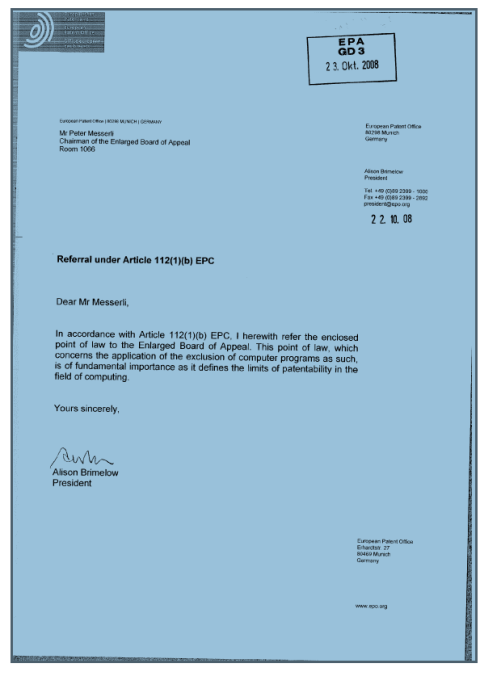
Alison Brimelow, president of the European Patent Office, has referred the deeply contentious question about how to assess the patentability of software-related inventions to her office's top appeals body, the enlarged board of appeal (EBoA), the EPO said late Friday.
[....]
In November 2006 Neal Macrossan, an Australian entrepreneur software developer, lost an appeal against the U.K. Patent Office's rejection of his patent application. He wanted patent protection for a method for producing documents "for use in the formation of a corporate entity using a data processing system."
On the same day the U.K. Court of Appeal threw out a challenge against a patent owned by IT company Aerotel for a computer program that created a new network infrastructure for a group of computers.
The three judges presiding over the cases considered the first a business method, and therefore unpatentable, while the second was seen as a patentable hardware change. Another U.K. judge called for a referral to the EPO's top appeals body to clarify the law concerning software patentability.
Referral to the enlarged board of appeal (EBoA) is something that FFII supported and it can be found in their Web site. There is also a page done by the Bio-activists of Greenpeace which explains what they did when the issue of life patents went to the EBoA. For context relating to this example, here is
an old press release.
Greenpeace calls European Union to ban patent on Indian Wheat
Say No To Patents On Life!
New Delhi, India — Say No To Patents On Life! Greenpeace calls on European Union to Ban Patent on Seeds; 'Chapati Chor' Monsanto to be targetted by Indian Farmers
Greenpeace calls on European Union to Ban Patent on Seeds; 'Chapati Chor' Monsanto to be targetted by Indian Farmers
New Delhi, India — Say No To Patents On Life! Greenpeace calls on European Union to Ban Patent on Seeds; 'Chapati Chor' Monsanto to be targetted by Indian Farmers
Greenpeace calls on European Union to Ban Patent on Seeds; 'Chapati Chor' Monsanto to be targetted by Indian Farmers
New Delhi 30 January 2004: Greenpeace activists today confronted Mr. Stephano Gatto, Counselor, Trade and Economic Affairs European Commission and briefed him about Monsanto’s role in blatant bio-piracy of Indian wheat. The activists demanded that the European Union ban patenting of seeds and close all loopholes in the existing law that is abused by multinational agro-science companies to patent plants, animals as well as their genetic resources.
“It is imperative that Europe Union takes an uncompromising stand against monopolies on seeds and not allow multinationals like Monsanto to appropriate biological diversity of the south with back-door patenting,” said Dr. Ashesh Tayal, Scientific Advisor, Greenpeace India.
Greenpeace had filed legal opposition against Monsanto’s patent on a variety of Indian wheat at the European Patents Office (EPO) in Munich on 27th January. Greenpeace investigations of the patent reveal that it is incorrectly recorded as an invention while there is evidence that Indian farmers have bred, cultivated and processed wheat for baking purposes long before Monsanto filed its patent.
Greenpeace has been mobilizing farmers and consumers community around the world with a post-card campaign targeting Monsanto and Indian Government demanding revoking of the wheat patent. Greenpeace has also been holding round-tables with Farmers groups to counter the threat to Indian bio-diversity from Multinational corporations.
“We definitely expect the wheat patent to be revoked in total. Further steps have to follow. Earlier Monsanto had taken a patent where they claimed even the use of the flour to make chapatis. These patents shows that companies systematically are trying to convert patent law to an instrument to gain control over all aspects of agriculture, from farmer’s seed to people’s food,” said Dr. Christoph Then, Patent Expert of Greenpeace Germany.
“In reaction to Greenpeace opposition to the wheat patent, Monsanto officials in India have claimed that the company is out of the cereal business in Europe and the patent therefore is of no consequence. If this is so, they need to immediately withdraw the patent. We urge Monsanto to stop these attempts of bio piracy. Farmers in India are deeply outraged and feel cheated. These varieties are developed by our farmers after years of hard field work and it is high time that Government of India woke up and took action” said Krishan Bir Chaudhary of Bharat Krishak Samaj.
By challenging this patent on traditional Indian wheat, Greenpeace is throwing a larger challenge to the monopolistic patent system that operates in Europe, which allows for life forms to be patented.
For further information, please contact:
Dr Ashesh Tayal, Scientific Advisor, Greenpeace India at atayal@dialb.greenpeace.org or at +91 98455 35404
or Divya Raghunandan, GE Campaigner at draghuna@dialb.greenpeace.org or at +91 98455 35406.
Getting back to Alison Brimelow, here is the
full document that she sent [PDF] with the covering letter and the document as HTML below. Thanks to
Tony Manco for the conversions, including this
paged version for better viewing.
⬆
Contents
1
Summary of the referral
2
Definitions
3
Questions to be referred
4
The legal framework
Page 1 of 18
1.
SUMMARY OF THE REFERRAL
Even in the 1960s, as the founding fathers of the European Patent Office drafted a new
European patent law, it was clear that the patentability of computer programs was a
complex issue. Legislative attempts to change or clarify the law in this field have met with
more controversy than success, although Article 52 EPC was amended to state that
inventions ‘in all fields of technology’ are patentable, thus making an implicit requirement
explicit.
As the EPC was drafted, the feeling was that it was better not to define the exclusion
precisely in law, but rather that the matter should be left in the hands of the EPO and the
national courts. This flexibility is important as technology develops and new technologies
emerge. Nevertheless, to quote a working group in 1972: “it was stressed that a matter as
important as computer programmes should not be left in a state of prolonged uncertainty
pending legal developments”1. Diverging decisions of the boards of appeal have indeed
created uncertainty, and answers to the questions arising from these decisions are
necessary to enable the further, harmonious development of case law in this field.
Currently there are concerns, also expressed by national courts and the public, that some
decisions of the boards of appeal have given too restrictive an interpretation of the breadth
of the exclusion. It is clear that the European Patent Office should have the leading role in
harmonising the practice of patent offices within Europe.
The four questions have been chosen to look at four different aspects of patentability in
this field. Firstly the relevance of the category of the claim is questioned. The next three
questions concern themselves with where the line should be drawn between those aspects
excluded from patentability and those contributing to the technical character of claimed
subject-matter: the second question concerns the claim as a whole; the third, individual
features of a claim; the fourth, relevant for defining the skills of the (technically) skilled
person, concerns the activity (programming) which underlies the resulting product
(computer program).
It is hoped that the referral of these questions to the Enlarged Board of Appeal will lead to
more clarity concerning the limits of patentability in this field, facilitating the application of
the law by examiners and enabling both applicants and the wider public to understand the
law regarding the patentability of computer programs according to the EPC.
1 5th Meeting of the Inter-Governmental Conference for the Setting up of a European System for the Grant of
Patents, held on 24-25 January and 2-4 February 1972, BR/168 e/72 eld/KM/gc, p14, 36
Page 2 of 18
2.
DEFINITIONS
A computer program is a series of steps (instructions) which will be carried out by the
computer when the program is executed.
A computer is understood to include not only devices which are generally thought of as
such, for example desktop PCs, but any programmable apparatus (such as a mobile
phone or an embedded processor).
The term ‘computer program’ (‘program’ for short) is synonymous with ‘software’ and a
‘program for a computer’.
For the purposes of this referral, the methods referred to in hypothetical examples are
intended to be methods which can be implemented wholly by computer.
Page 3 of 18
3.
QUESTIONS TO BE REFERRED
3.1.
QUESTION 1
CAN A COMPUTER PROGRAM ONLY BE EXCLUDED AS A COMPUTER
PROGRAM AS SUCH IF IT IS EXPLICITLY CLAIMED AS A COMPUTER
PROGRAM?
I
Background
In the 1990s, applicants started to formulate claims for their computer implemented
inventions in terms of the computer program, e.g. ‘Computer program for carrying out
method X’ or ‘Computer readable medium for storing a computer program for carrying out
method X’. The latter formulation and equivalents are referred to as a computer program
product claims (CPPs). These formulations are clearly important for applicants as they are
routinely included in patent applications in the field of computer technology.
In this field, claim formulations along the following lines are common:
- methods
- systems (i.e. computer systems)
- computer-implemented methods
- computer programs
- computer program products, storing a computer program.
However, the substance of these claims, i.e. the underlying method to be performed by a
computer, is often identical.
Recently, in the light of an England and Wales Court of Appeal judgement, the UK
Intellectual Property Office issued a practice notice2 stating that it seemed likely that few
claims to programs or programs on carriers would avoid the exclusion from patentability of
programs for computers as such. In practice they rejected nearly all such claims.
In response to a growing dissatisfaction from applicants, a set of test cases were
constructed to have the issue decided by the UK courts, and the practice notice was
overruled in this respect3. Thus the importance of such claim formulations for applicants is
apparent.
II
The diverging decisions
Regarding decision T 1173/974, the subject-matter of the application that was subject of
the appeal related to recovering resources in a computer system. Independent claims
defining a method for resource recovery in a computer system and a computer with means
for carrying out the method were found to be allowable by the Examining Division.
2 Practice notice dated 2 November 2006, point 14:
www.ipo.gov.uk/patent/p-decisionmaking/p-law/p-law-notice/p-law-notice-subjectmatter.htm
3 Practice notice dated 7 February 2008:
www.ipo.gov.uk/patent/p-decisionmaking/p-law/p-law-notice/p-law-notice-subjectmatter-20080207.htm
4 T 1173/97 - Computer program product/IBM (OJ EPO 10/1999, 609)
Page 4 of 18
The application was refused only because of two further independent claims directed at a
corresponding computer program product. The Examining Division followed the EPO
Guidelines valid at the time which stated that a computer program claimed by itself or on a
carrier, irrespective of its contents, is excluded from patentability under Art. 52(2) and (3)
EPC. The Division considered that economic considerations and international
developments (e.g. TRIPS and new practices of other patent offices) could not be taken
into account.
The Board was not bound by the Guidelines and in this decision it chose not to follow
them. It noted that TRIPS may not be directly applied to the EPC; nevertheless it was
taken into consideration and found not to preclude the patenting of computer programs.
The Board then set about interpreting the exclusion from patentability of programs for
computers as set out in the EPC.
From the combination of the two provisions (Art. 52(2)(c) and (3) EPC), the Board decided
that the legislator did not want to exclude from patentability all programs for computers
(Reasons, 4). In other words, the Board found that of all computer programs, there existed
a subset (computer programs as such) which was excluded from patentability. Those
computer programs which were not in this subset were not excluded from patentability.
The Board further concluded (Reasons, 5.2-5.4) that programs for computers are
patentable when they have technical character; technical character being an essential
requirement for patentability. It considered this to be in line with the exclusion of
Art. 52(2)(c) EPC and the requirement that the exclusion be interpreted narrowly
(Art. 52(3) EPC).
Decision T 424/035 concerned an application disclosing a method of providing expanded
clipboard formats for transferring data between formats. The clipboard is a storage area
used in the common computer commands ‘cut’, ‘copy’ and ‘paste’.
In this decision, the Board distinguished a method implemented in a computer system from
a computer program. The former was described as a sequence of steps that are actually
performed on a computer and achieving an effect. The latter was described as a sequence
of computer-executable instructions which just have the potential of achieving such an
effect when loaded into, and run on, a computer. Thus a computer implemented method
can never be a computer program as such. The Board then introduced a claim category of
‘computer program’ (Reasons, 5.1).
III
The divergence
T 1173/97 placed the emphasis on the function of the computer program (does the
claimed program have technical character) rather than the manner in which it is claimed
(e.g. as a computer program, a computer program product or a computer-implemented
method). It noted that a computer program or computer program product does not directly
disclose a technical effect in physical reality; this only becomes the case when the
computer program is run on a computer. However, it saw no reason to distinguish between
5 T 424/03 - Clipboard formats/MICROSOFT
Page 5 of 18
a direct technical effect and the potential to produce a technical effect (an indirect technical
effect) (Reasons, 9.4).
On the other hand, T 424/03 placed emphasis on the manner in which the computer
program is claimed. One can consider the case of a method ‘x’ which is suitable to be
implemented on a computer. Following the reasoning of this decision, only a claim of the
form ‘computer program for method x’ could possibly be excluded from patentability as a
computer program as such, whereas claims of the form ‘computer implemented method x’
or ‘computer program product storing executable code for method x’ would not be
excluded (irrespective of the nature of the method x).
IV
Consequences
In the field of computer technology, innovation frequently lies in the particular method
performed by a computer program while executed by conventional hardware.
Consequently, the exclusion of computer programs as such under Article 52(2) and (3)
EPC should be of key importance in this field. However, if one were to follow the reasoning
of T 424/03, overcoming the exclusion of programs for computers would become a
formality, merely requiring formulation of the claim as a computer implemented method or
as a computer program product.
Page 6 of 18
3.2.
QUESTION 2
(A) CAN A CLAIM IN THE AREA OF COMPUTER PROGRAMS AVOID
EXCLUSION UNDER ART. 52(2)(C) AND (3) MERELY BY EXPLICITLY
MENTIONING THE USE OF A COMPUTER OR A COMPUTER-READABLE
DATA STORAGE MEDIUM?
(B) IF QUESTION 2 (A) IS ANSWERED IN THE NEGATIVE, IS A FURTHER
TECHNICAL EFFECT NECESSARY TO AVOID EXCLUSION, SAID EFFECT
GOING BEYOND THOSE EFFECTS INHERENT IN THE USE OF A
COMPUTER OR DATA STORAGE MEDIUM TO RESPECTIVELY EXECUTE
OR STORE A COMPUTER PROGRAM?
I
Background
It is established that if the subject-matter of a claim has technical character, then it is not
excluded from patentability under Art. 52(2) and (3) EPC. However, in the case of claims in
the area of programs for computers (worded, for instance, explicitly as programs for
computers or as methods carried out by computers), there is uncertainty about when
exactly features can confer technical character to such claims.
The very purpose of a computer program is to be executed by a computer, and to be
executed by a computer it must be stored on a computer-readable data storage medium.
Even though both the computer and the data storage medium are without doubt technical
apparatus, the implicit use of a computer or data storage medium cannot be sufficient to
avoid exclusion of computer programs as such. Otherwise the exclusion would be
rendered void.
II
The diverging decisions
T 1173/97 found (see section 3.1) that a computer program must be considered to be
patentable when it has technical character (Reasons, 5.3).
In determining what constituted ‘technical character’ for a computer program, it was
assumed that programs for computers cannot be considered as having technical character
for the very reason that they are programs for computers (Reasons, 6.1). Thus the
physical modifications of the hardware (causing e.g. electrical currents and the switching
of transistors) deriving from the execution of the instructions given by programs for
computers cannot per se constitute the required technical character. The technical effect
had to be found in the further technical effects deriving from the execution (by the
hardware) of the instructions given by the computer program.
Thus the conclusion of the Board was (Headnote): “A computer program product is not
excluded from patentability under Art. 52(2) and (3) EPC if, when it is run on a computer, it
produces a further technical effect which goes beyond the ‘normal’ physical interactions
between program (software) and computer (hardware)”. The Board further noted that
(Reasons, 13, 5th paragraph), regarding the exclusions under Art. 52(2) and (3) EPC, it
Page 7 of 18
does not make any difference whether a computer program is claimed by itself or as a
record on a carrier.
T 258/036 (Headnote I) found that any method involving technical means is an invention in
the sense of Art. 52(1) EPC - i.e. is not excluded from patentability under Art. 52(2) and (3)
EPC. This position was supported by various subsequent decisions including T 424/03
(Reasons, 5.1, 2nd paragraph) and T 1284/047 (Reasons, 2).
III
The Divergence
Method claims are, in essence, a series of instructions or steps which are to be carried out
by any capable entity (this could be a person, a machine, a combination thereof or indeed
a computer). A computer implemented method corresponds to the specific case of the
entity for carrying out the steps being a computer. In the same way a computer program is
a series of instructions or steps, constituting a method, whereby the instructions or steps
are carried out by a computer. Thus claims for a computer program and a computer
implemented method can be seen as having identical scope. Following this line of thought,
the scope of a method claim would encompass a computer program for carrying out that
method. This was also the view given in T 38/868 (Reasons, 14).
Regarding T 1173/97, in its analysis of TRIPS (Reasons 2.3) the Board noted that Art.
27(1) TRIPS states that ‘patents shall be available for any inventions, whether products or
processes, in all fields of technology’. It interpreted this provision as not excluding
programs for computers. Consequently the Board must have equated programs for
computers to either a product or a process.
Further on in the decision, the Board indicated that the substance of a computer program
claim lies in the method which it is intended to carry out when being run on a computer
(Reasons, 9.6, 2nd paragraph, lines 1-3). As such it must be assumed that the Board
considered ‘programs for computers’ to be a type of method claim. This would also be in
line with G 2/889 (Reasons, 2.2) which defines the two basic types of claims as being
physical entities and physical activities.
Unlike an apparatus, which could be infringing whether it is actually operating or not, a
method is only (directly) infringed when the method is carried out, whether by a computer
or another entity. As such, it seems illogical to distinguish between computer implemented
methods and computer programs which will cause a method to be implemented.
The divergence arises when one considers the same method claimed in the form of a
computer implemented method or as a computer program. Following T 258/03, the former
claim form requires only that technical means are involved (the computer) in order for it to
be considered as having technical character. For the latter claim form, on the other hand,
this is not sufficient. In this case a further technical effect is required which must go
beyond the normal technical effects resulting from the involvement of a computer. Thus
different standards for deciding on patentability are applied to the same subject-matter.
6 T 258/03 - Auction method/HITACHI (OJ EPO 12/2004, 575)
7 T 1284/04 - Loan system/KING
8 T 38/86 - Text processing/IBM (OJ EPO 9/1990, 384)
9 G 2/88 - Friction reducing additive/MOBIL OIL III (OJ EPO 4/1990, 93)
Page 8 of 18
3.3.
QUESTION 3
(A) MUST A CLAIMED FEATURE CAUSE A TECHNICAL EFFECT ON A
PHYSICAL ENTITY IN THE REAL WORLD IN ORDER TO CONTRIBUTE TO
THE TECHNICAL CHARACTER OF THE CLAIM?
(B) IF QUESTION 3 (A) IS ANSWERED IN THE POSITIVE, IS IT SUFFICIENT
THAT THE PHYSICAL ENTITY BE AN UNSPECIFIED COMPUTER?
(C) IF QUESTION 3 (A) IS ANSWERED IN THE NEGATIVE, CAN FEATURES
CONTRIBUTE TO THE TECHNICAL CHARACTER OF THE CLAIM IF THE
ONLY EFFECTS TO WHICH THEY CONTRIBUTE ARE INDEPENDENT OF
ANY PARTICULAR HARDWARE THAT MAY BE USED?
I
Background
Regardless of the question whether exclusion under Art. 52(2) and (3) EPC can be
avoided simply by choosing an appropriate form of claim, it will always be necessary to
evaluate the effects caused by individual features or combinations of features to determine
whether they contribute to the technical character of a claim. Determining this contribution
is always relevant for evaluating the further requirements of the EPC (such as inventive
step). It is noted that no distinction is made here between those physical entities or
hardware that are inside a computer and those that are outside.
II
The diverging decisions
Decision T 163/8510 was concerned with a claim directed at a television signal which
inherently comprised the technical features of the TV system. The Board considered that
the non-exhaustive list of exclusions under Art 52(2) and (3) EPC could be generalised to
subject-matter which is essentially abstract in nature, which is non-physical and therefore
not characterised by technical terms. The Board found that the signal as claimed was a
physical reality which could be directly detected by technological means, which therefore
was not an abstract entity. Also in T 190/9411, the claimed system was found to make a
contribution to the art in a field not excluded from patentability because the difference (of
the claimed subject-matter over the prior art) manifested itself in the real world in a
technical effect on a physical entity.
Decision T 424/03, which was concerned with the transfer of data on a computer via a
clipboard, considered the method itself to have technical character (i.e. not only because it
was claimed as a computer-implemented method). This was because functional data
structures were used independently of any cognitive content in order to enhance the
internal operation of a computer system with a view to facilitating the exchange of data
among various application programs (Reasons, 5.2). According to claim 1 (Facts and
submissions, IV), these data structures (clipboard formats) are defined by their purpose
(‘text’, ‘file contents’ and ‘file group descriptor’). It is further specified that the selected data
10 T 163/85 - Colour television signal/BBC (OJ EPO 9/1990, 379)
11 T 190/94 - No headword
Page 9 of 18
is converted into the file contents clipboard format and stored as a data object, and that
the ‘file group descriptor clipboard format’ is used to hold a file group descriptor holding
descriptive information about the data object.
Following a similar line to decision T 424/03, decision T 125/0112 concerned a control unit
for a telecommunications apparatus, e.g. a car radio, whereby the characterising portion of
the claim related to how the microprocessor operated in response to user input via
buttons. The features of the claim that were novel over the prior art consisted of the use of
a single table for permitted operating states, rather than a plurality of tables (Reasons,
3.3). The Board accepted that the corresponding problem, as cited in the patent at issue,
was the ease of modification and therefore flexible applicability of the control module. It
likened the situation to that of a hardware interface, for which a similar problem would
clearly be seen as technical.
III
The divergence
According to decisions T 163/85 and T 190/94, a technical effect on a physical entity in the
real world was required. This was however not the case in T 125/01 and T 424/03. In
these decisions the technical effects were essentially confined to the respective computer
programs.
For T 125/01 this consisted of writing a program in such a way - via the choice of single or
multiple tables - that it can be easily extended. This did not affect the modification of the
hardware (a physical entity), but merely simplified the process of (re)programming the
control module to adapt the program to work with the modified hardware.
In T 424/03, the various clipboard formats which were seen as functional data structures
bore no relation to any technical features of the system in which they were used. The
effect of simplifying data transfer between or within applications is also an effect
independent of the hardware used.
In the case of features related to computer programs whose effects are confined to the
internal working of the computer, there is uncertainty about where the line is to be drawn
between technical effects and effects lying solely in the field of programs for computers, in
particular if the aspects relating to programming are claimed in any detail.
Following the reasoning of the latter decisions, it would appear that an inventive step could
be based on a programmer’s choice of elementary programming constructs (tables, loops,
subroutines, objects) which solely serve the efficient execution of the program or indeed
simplify the programmer’s work (e.g. using a subroutine rather than repeating lines of
code). It is therefore difficult to contemplate which aspects or effects of a computer
program could fall within the exclusion.
12 T 125/01 - Gerätesteuerung/HENZE
Page 10 of 18
3.4.
QUESTION 4
(A) DOES THE ACTIVITY OF PROGRAMMING A COMPUTER
NECESSARILY INVOLVE TECHNICAL CONSIDERATIONS?
(B) IF QUESTION 4 (A) IS ANSWERED IN THE POSITIVE, DO ALL
FEATURES RESULTING FROM PROGRAMMING THUS CONTRIBUTE TO
THE TECHNICAL CHARACTER OF A CLAIM?
(C) IF QUESTION 4 (A) IS ANSWERED IN THE NEGATIVE, CAN FEATURES
RESULTING FROM PROGRAMMING CONTRIBUTE TO THE TECHNICAL
CHARACTER OF A CLAIM ONLY WHEN THEY CONTRIBUTE TO A
FURTHER TECHNICAL EFFECT WHEN THE PROGRAM IS EXECUTED?
I
Background
Article 52(2) and (3) EPC defines a non-exhaustive list of subject-matter and activities
which, as such, shall not be regarded as inventions. This list includes programs for
computers. The Boards of Appeal have consistently grouped the excluded subject-matter
and activities under the heading ‘lacking technical character’ (e.g. T 1173/97, Reasons, 5.2
and T 258/03, Reasons, 3.1).
What is not specified in the EPC is whether, or under which circumstances, the activity
associated with creating programs for computers, i.e. programming a computer, is a
technical activity which is in principle patentable, or a non-technical activity which is as
such excluded from patentability.
The answer to this question affects the definition of person skilled in the art, and
consequently the nature of problems that can be presented as the objective technical
problem. Therefore, it is of key importance in the field of computer technology that there is
clarity concerning the skills attributable to the skilled person.
II
The diverging decisions
Decision T 1177/9713 was concerned with a computer implemented method of translation
between natural languages. The Board found (Reasons, 3, 7th paragraph) that
“implementing a function on a computer system always involves, at least implicitly,
technical considerations”. The reference to ‘computer routines’ makes clear that this
implementation consisted of programming the computer (Reasons, 7, 3rd paragraph):
“Choosing to apply one or the other [translation] principle has clearly consequences for the
technical implementation ... since the computer routines have to work differently”.
Furthermore, decision T 172/0314, emphasised (Reasons, 6 and 7) that the person skilled
in the art is a technical expert, to whom it is inappropriate to attribute professional
competence in non-technological fields. In this decision the Board defined the skilled
13 T 1177/97 - No headword
14 T 172/03 - Order management/RICOH
Page 11 of 18
person as a software project team, consisting of programmers (Reasons, 16). The
technical problem posed to this skilled person was the software implementation of the non-
technical order management method (Reasons, 20 and 21).
Contrary to these decisions, T 833/9115 (Reasons, 3.2), T 204/9316 (Reasons, 3.2) and
T 769/9217 (Reasons, 3.7, 5th paragraph) all considered that a programmer’s activity, i.e.
writing computer programs, falls within the exclusions set out in Art. 52(2)(c) EPC. The
decisions consider programming to be a mental act of the programmer.
III
The divergence
It seems that the former decisions view programming along the same lines as the
configuration of a technical apparatus. This would of course hold even when the method
that the computer is being programmed to carry out is non-technical in nature.
However, it has to be noted that modern (high-level) programming languages do their
utmost to render technical considerations unnecessary. The term ‘programming’ is broad
and ranges from writing in low-level languages (e.g. assembly language) which are
intimately linked to the hardware being programmed, to high level languages which are
truly isolated from any details of the hardware. Even such things as recording a macro
(recording a sequence of steps to be carried out on a computer, often in the environment
of an office application such as a word processor or spreadsheet) must be considered to
be a form of programming, even though this would generally be carried out by an expert,
or even a day-to-day user, of the office application rather than a technically skilled
computer expert.
The latter decisions place more emphasis on the link between the resulting product, which
is as such explicitly excluded from patentability, and the activity of producing it. Decision
T 1173/97 also gives an indication (Reasons, 11.4-11.5) that it implicitly agrees with the
point of view given in T 204/93. This is further supported by a statement by the United
Kingdom delegation in the travaux préparatoires18, according to which computer programs
were to be understood as a ‘mathematical application of a logical series of steps in a
process which was no different from a mathematical method’.
If a computer program is deemed to lack technical character (i.e. it is a computer program
as such), it could follow that the activity used to produce the program has to be considered
similarly non-technical in nature.
The effects caused by a computer program (which may or may not contribute to its
technical character) may occur when the program is executed (for instance how much
memory it occupies, how quickly it carries out the tasks for which it was programmed,
etc.). On the other hand, there may be effects relating to software development which
affect the programmer in his work (ease of maintenance of the program, flexibility,
portability, reusability etc.).
15 T 833/91 - No headword
16 T 204/93 - No headword
17 T 769/92 - General purpose management system/SOHEI (OJ EPO 8/1995, 525)
18 Minutes of the 9th meeting of Working Party I, Luxembourg, 12-22 October 1971, BR 135 e/71 prk, p50, 96
Page 12 of 18
It seems important to consider the actual tasks performed by a programmer. Would he be
responsible for the design of the technical system and the role that the computer program
plays therein, and thus be solving technical problems, or would the design be the task of
an engineer who would then pass on his (programming) requirements to the programmer?
Furthermore, does the answer depend on whether the considerations of a programmer
involve any technical details of the particular computer on which the program will run?
Page 13 of 18
4.
THE LEGAL FRAMEWORK
4.1.
CURRENT STATUS
Article 52 EPC reads as follows:
Patentable inventions
(1)
European patents shall be granted for any inventions, in all fields of
technology, provided that they are new, involve an inventive step and are
susceptible of industrial application.
(2)
The following in particular shall not be regarded as inventions within
the meaning of paragraph 1:
(a)
discoveries, scientific theories and mathematical methods;
(b)
aesthetic creations;
(c)
schemes, rules and methods for performing mental acts, playing
games or doing business, and programs for computers;
(d)
presentations of information.
(3)
Paragraph 2 shall exclude the patentability of the subject-matter or
activities referred to therein only to the extent to which a European patent
application or European patent relates to such subject-matter or activities as
such.
Article 52(2) EPC thus contains a non-exhaustive list of inventions not to be regarded as
inventions, whereby its scope is restricted by Article 52(3) EPC which allows only subject-
matter or activities referred to in paragraph 2 ‘as such’ to be excluded from patentability.
The wording of Article 52(3) EPC does not provide any guidance as to when an item
mentioned in paragraph 2 is to be regarded as an invention.
It is established understanding that an essential element of a ‘patentable invention’ is its
technical character. However, the term ‘technical character’ has not been defined in the
EPC. Although in older case law of the boards of appeal the requirement of a ‘technical
character’ was evaluated by the so-called contribution approach19, the current consensus
appears to be that this approach does not have a legal basis in the EPC20.
19 For example T 38/86 - Text processing/IBM (OJ EPO 9/1990, 384)
20 For example T 931/95 - Controlling pension benefits system/PBS PARTNERSHIP (OJ EPO 10/2001, 441),
Reasons, 2 and 6
Page 14 of 18
Programs for computers are included in the non-exhaustive list of items which as such are
not to be regarded as inventions (Article 52(2)(c) EPC)21. None of these items are defined,
and it is clear from the original travaux préparatoires that the legislator intended to merely
lay down general principles and leave the EPO and national courts to interpret these
terms22. Nevertheless, it was stressed that “a matter as important as computer
programmes should not be left in a state of prolonged uncertainty pending legal
developments which, in any case, could differ from country to country”23. It follows from
this that already in 1972 the legislator was aware on the one hand of the difficulties
concerning a definition of the term 'programs for computers', and on the other hand of the
importance of this (then upcoming) field of development, and wanted to create a unitary
legal basis.
4.2.
REVISION OF THE EPC (“EPC 2000”)
In 2000, a diplomatic conference was held to have the first major revision of the EPC. The
initial proposal24 stated that “[t]he list of items found in Article 52(2) EPC are simply
examples of non-technical ‘inventions’, which would remain unpatentable even in the
absence of this provision”; therefore it proposed to delete this paragraph. Similar thoughts
apparently resulted in the absence of such a paragraph in TRIPS25.
The Committee on Patent Law was unable to reach a conclusive opinion on this
proposal26. Nevertheless, the Administrative Council in its 81st meeting decided that the
paragraphs 2 and 3 of Article 52 EPC were to be kept in the Basic Proposal drawn up for
the Diplomatic Conference, but the reference to ‘programs for computers’ in paragraph 2
was to be deleted27. This was similar to the negotiations that took place in 197328.
Arguments put forward during the negotiations included references to the forthcoming EU
Directive on the protection of computer-implemented inventions, and that “the exclusion of
patentability of computer programs follow[s] from their lack of sufficient technical
character”29.
The Basic Proposal for the Diplomatic Conference reflects the negotiations and thoughts
of the preparatory meetings in particular by emphasizing the technical character of a
patentable invention and indicating that “[t]he Committee on Patent Law and the
21 However, programs for computers were not always included in the proposed list of exclusions - cf. for
example preliminary drafts of the EPC (2335/IV/65-E dated 22 January 1965 and BR/70/70 dated 21
December 1970)
22 Cf. Minutes of the 9th meeting of the Working Party I held from 12 to 22 October 1971, in Luxembourg,
BR/135 e/71 prk, p50, 96 and Minutes of the Munich Diplomatic Conference for the Setting up of a
European System for the Grant of Patents, Munich, 10 September to 5 October 1973, M/PR/I, p28, 18
23 Cf. 5th Meeting of the Inter-Governmental Conference for the Setting up of a European System for the
Grant of Patents, held on 24-25 January and 2-4 February 1972, BR/168 e/72 eld/KM/gc, p14, 36
24 Revision of the European Patent Convention, CA/100/00 e, p39, 6
25 “TRIPS und das Patentierungsverbot von Software ‘als Solche’”, Daniele Schiuma, GRUR Int 1998, p852
ff., 3-4
26 Minutes of the 14th meeting of the Committee on Patent Law, 3-6 July 2000, CA/PL PV 14 e, p26, 156
27 Minutes of the 81st meeting of the Administrative Council, 5-7 September 2000, CA/PV 81 e, p10, 72
28 Comments by CPCCI (Standing Conference of the Chambers of Commerce and Industry of the European
Economic Community), 2 April 1973, M/18, p160, 3
29 Minutes of the 81st meeting of the Administrative Council, 5-7 September 2000, CA/PV 81 e, p7, 51a
Page 15 of 18
Administrative Council have advocated the deletion of programs for computers from
Article 52(2)(c) EPC”30.
Although a broad consensus regarding the wording of Article 52 EPC had prevailed prior
to the Diplomatic Conference, the French Delegation re-introduced the reference to
“programs for computers” during the conference, concerned that removing this exclusion
might be seen as a broadening of the range of patentable subject-matter31. Similar
concerns were expressed by the German delegation, although it shared the view of other
delegations that the deletion of the exclusion would not imply any significant change in the
legal position32.
It was decided, in view of the possibility of future EU legislation on this matter, not to delete
the words “and programs for computers”. The one amendment to Article 52 that was
adopted was the addition in paragraph 1 of the statement that European patents shall be
granted “in all fields of technology”. The intention of this amendment was to enshrine
‘technology’ in the basic provision of substantive patent law, as well as aligning the article
with Article 27(1) TRIPS.
4.3.
TRIPS
The TRIPS agreement33 is aimed at setting common standards and principles concerning
the availability, scope and use of trade-related intellectual property rights, including patent
rights. However, it may not be applied directly to the EPC because the European Patent
Organisation itself is not a member of the WTO and is not a signatory of the agreement.
Justification for its applicability to the EPC based on Article 30 of the Vienna Convention is
questionable.
Article 27 TRIPS defines what constitutes patentable subject-matter. While paragraph 1
lays down the principle that patents shall be “available for any inventions, whether
products or processes, in all fields of technology” (emphasis added), paragraphs 2 and
3 provide for a possibility to exclude certain subject-matter. However, there is no reference
to an exclusion from patentability for programs for computers or similar. Computer
programs are to be protected as literary works under the Berne Convention of 1971
(Article 10(1) TRIPS), however, this does not imply that such programs cannot also be
patented.
Consequently, whether or not programs for computers are excluded from patentability
under TRIPS depends on whether programs for computers are defined as inventions in a
field of technology.
This uncertainty is reflected in the legal literature. Some scholars point out that, due to the
wording of the provision, signatories of TRIPS are free to decide whether software-related
inventions are patentable34. Other scholars point out that programs for computers contain
30 Basic proposal for the revision of the European Patent Convention, 13 October 2000, MR/2/00, p43, 3
31 MR/8/00, p2 ff.
32 MR/16/00
33 Agreement on Trade-Related Aspects of Intellectual Property Rights (Annex 1C of the Marrakesh
Agreement Establishing the World Trade Organization)
34 C.M. Correa/A.A. Yusuf, Intellectual Property and International Trade: The TRIPS Agreement, p199 f. and
Neef, in Busche/Stoll, TRIPs, Art. 27 Rdn. 33-34, p447 f.
Page 16 of 18
a technical element per se and therefore conclude that the list of non-patentable inventions
comprised in Article 52(2) EPC is a violation of TRIPS35.
As to the question whether some programs for computers can be considered to be
inventions, or whether such programs for computers have technical character, one has to
conclude that no guidance can be found in the TRIPS agreement.
4.4.
EUROPEAN UNION
In 2002, the Commission of the European Communities proposed a directive to regulate
the patentability of computer implemented inventions. According to Article 4 of the original
proposal36, member states should ensure that computer-implemented inventions are
patentable, providing of course that they are susceptible of industrial application, are new
and involve an inventive step. Article 4(2) states that a requirement of inventive step is the
presence of a technical contribution, i.e. the contribution to the state of the art must have
technical character.
According to a version of the directive proposed by the European Parliament in 200337, the
term ‘technical contribution’ was equated with the term ‘invention’. The use of natural
forces to control physical effects beyond the digital representation of information was said
to belong to a field of technology, whereas the processing, handling, and presentation of
information did not, even where technical devices were employed for such purposes. The
term ‘field of technology’ was defined as “an industrial application domain requiring the use
of controllable forces of nature to achieve predictable results”. These definitions use
aspects of the terms used on occasion by the German courts to define what is
patentable38.
As widely known, the legislative initiative of the European Commission failed when on 6
July 2005 the European Parliament rejected the proposed common position and declared
the legislative procedure closed39.
From the documents relating to the drafting of the proposed directive it appears that the
main differences between the positions of the European Council and the European
Parliament lay in the delimitation of the definitions set out in the directive. While the
proposal of the European Council contained rather broad definitions, the European
Parliament introduced some amendments which narrowed the scope of protection offered
through patents in the field of ‘computer-implemented inventions’, in particular in the area
of interoperability and data processing. One of the amendments proposed by the
European Parliament was the requirement that a patentable invention be in a ‘field of
technology’, and defined this as ‘requiring the use of controllable forces of nature to
achieve predictable results in the physical world’40.
35 “TRIPS und das Patentierungsverbot von Software ‘als Solche’”, Daniele Schiuma, GRUR Int 1998, p852
f., 8
36 “Proposal for a Directive of the European Parliament and of the Council on the patentability of computer-
implemented inventions”, COM(2002) 92 final, 20 February 2002
37 P5_TC1-COD(2002)0047 dated 26 March 2004 (OJ EU C 77 E, p230 ff., Article 2)
38 For example German Bundesgerichtshof decisions X ZB 15/67 “Rote Taube”, 27 March 1969 (GRUR
1969, 672 ff.) and X ZB 15/98 “Sprachanalyseeinrichtung”, 11 May 2000 (GRUR Int 2000, 930 ff.)
39 P6_TA(2005)0275 dated 6 July 2005 (OJ EU C 157 E, p265)
40 Recommendation for Second Reading, A6-0207/2005 of 21 June 2005, amendments 17 and 19.
Page 17 of 18
4.5.
CONCLUSION
The principle of protection of certain computer-implemented inventions by patents is in line
with the EPC and TRIPS, as well as with the various versions of the proposed EU
directive.
As mentioned above, Article 52 EPC was extensively discussed in the different forums
before and during the Diplomatic Conference leading to the adoption of EPC 2000. While
the technical nature of inventions was emphasised by introducing the reference to “all
fields of technology” in Article 52(1) EPC, paragraph 2 was not amended.
From the historical documents it appears that the authors of the EPC agreed that a
computer program could only be patentable if it had technical character. This view is
supported by the different comments given by delegates referring to the amendment of
paragraph 1. However, this technical character, necessary to avoid the exclusion laid
down in Article 52(2) EPC, was not defined.
Furthermore, the wording of Article 52(2) EPC provides no indication as to whether the
exclusion of certain items is based on the fact that the items mentioned lack the necessary
technical character or whether the exclusion is based on broader social or political
considerations. The possibility that some excluded items are indeed technical is left open
by the phrase “shall not be regarded as inventions”. Consequently, from the wording of
Article 52(2) EPC, no conclusion can be drawn concerning the question of whether a
computer program is technical or not.
In the absence of guidance from the law and its preparatory documents, and in view of the
existence of divergences of opinion regarding how the computer program exclusion should
be applied, it is considered appropriate at this stage to refer the questions set out in the
previous section to the Enlarged Board of Appeal for its opinion.
Page 18 of 18

Comments
zoobab
2008-10-25 19:30:53
http://www.grain.org/bio-ipr/?id=94