EditorsAbout the SiteComes vs. MicrosoftUsing This Web SiteSite ArchivesCredibility IndexOOXMLOpenDocumentPatentsNovellNews DigestSite NewsRSS

02.06.09

How Novell Helps Microsoft Attack GNU/Linux (Except for SUSE)

Posted in Fork, Free/Libre Software, GNU/Linux, Java, Microsoft, Mono, Novell, OpenOffice, SLES/SLED, SUN at 1:55 pm by Dr. Roy Schestowitz

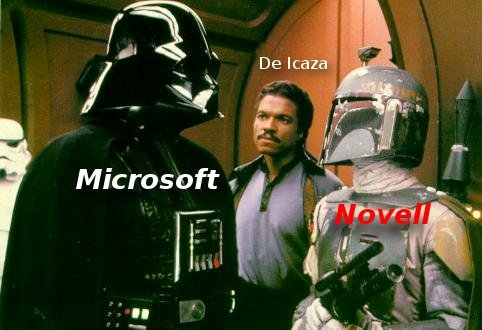
Darth Vader Microsoft
Picture by SubSonica

“Every line of code that is written to our standards is a small victory; every line of code that is written to any other standard, is a small defeat. Total victory [...] is the universal adoption of our standards by developers, as this is an important step towards total victory for Microsoft itself: “A computer on every desk and in every home, running Microsoft software.”"

Microsoft, internal document [PDF]

NOVELL IS A LARGE company with many different teams. Only a small portion of Novell (maybe about 10%) is directly associated with free/open source software and there are many who are stuck in between, including those who capitalise on what Novell labels “mixed-source” [1, 2, 3, 4]. Apart from those who build Free software (Greg Kroah-Hartman comes to mind, although there are downsides) and those who build hybrid software at Novell, there are those whose task seems to be to contaminate GNU/Linux with Microsoft’s intellectual monopolies, which only Novell is permitted to share (with paying customers). Miguel de Icaza is a prime suspect because he is helping Microsoft fight Free software while at the same type harming several companies that compete against Microsoft. He advances Microsoft APIs that are a trap.

Neil McAllister, who writes for IDG [1, 2], has defended Mono in a new column that they put in Slashdot’s front page. What gives?

Miguel de Icaza is himself something of a controversial figure these days. He’s a heavyweight among open-source developers, yet he works for Novell, the company that soured the Linux community by signing a patent-licensing agreement with Microsoft. Worst of all, he seems to have all but dedicated himself to projects related to Mono — in other words, to copying Microsoft technologies.

Yes, that is precisely what he is doing with Microsoft assisting his every step. Why would Microsoft help? Because it makes GNU/Linux stronger? Of course not.

Corporations help themselves, they don’t promote or support betterment of their competitors. As Microsoft's internal presentations indicate (required training to staff), “We are here to help MICROSOFT.”

So how does Mono harm Free software? It’s possible classify the issues as follows:

  • Control. Mono is inclined to evolve along the path of .NET, which gives Microsoft great control over its competitor/s (c.f. API wars mythology).
  • Dependency. Whereas many applications that mimic functionality can be interchanged easily, Mono resides beneath multiple applications, so its removal or change would have a cascading effect.
  • Software patents. We have it from the mouths of multiple Microsoft seniors (some public statements and some private which antitrust litigation exposed) that patents are part of the control mechanism.
  • Java/Sun. As hostile as Sun may have been towards GNU/Linux in the past, it is muchly required these days for its good work on projects like Java and OpenOffice.org. By wooing developers away from Java, Microsoft hopes to starve Sun along with its contributions to Free software.
  • Latch. Mono brings with it a raft of other technologies that permit Microsoft to control developers and control the Web (i.e. access to data). Moonlight is one example of this.
  • DRM. The war around de facto DRM standards is no secret because antitrust exhibits exist that shed bright light on it. Mono empowers .NET, which in turn enables and facilitates more widespread Windows DRM (denial of access to media).
  • Security. Mono inherits architectural issues not only from .NET but from Windows as well.
  • Philosophy. We are aware of GNU/Linux developers who are disguised by technological assimilation to a company that committed many crimes (the criticism of Microsoft has nothing to do with scale but mostly with behaviour). This repels and sometimes discourages development, not just casual use.
  • Novell. Copyrights and trademarks are to be owned by Novell; principal Mono-based projects are sponsored by Novell too. It would not have become a serious concern had Novell not expressed its commitment to Microsoft, to "IP peace of mind" (i.e. software patents as a selling point), even to OOXML. Mono gives Novell great control (leverage) over the desktop and its direction.

There are more points and we covered some of them last year.

Mono’s impact can transcend GNU/Linux. It’s an API war, not just a platform war. Novell is a privileged party. To whit:

“There is a substantive effort in open source to bring such an implementation of .Net to market, known as Mono and being driven by Novell, and one of the attributes of the agreement we made with Novell is that the intellectual property associated with that is available to Novell customers.”

Bob Muglia, Microsoft President

Novell employees are doing the same type of thing to OpenOffice.org [1, 2, 3, 4, 5, 6]. Rather than going strongly in defense of Sun’s Java, Novell is going against it. It also goes head-to-head against Sun’s OpenOffice.org with its Microsoft-esque fork, Go-OOXML. They are still stirring things up to generate dirt which harms the OpenOffice.org brand.

A second thing is what I think could be called the Too Many Evangelists syndrome. The way Michael [Meeks of Novell] put it, the major stumpers for Linux, like Alan Cox or Linus Tovalds, are themselves programmers. “With OpenOffice, the exact opposite is typically the case. Most the leads have had intangible contributions, and I think that’s a big part of the problem with OpenOffice in terms of attracting developers — that there are so many people who are not developers who are also very eager to tell everyone what to do.” The code base isn’t even the real issue, in his purview: every project has a potentially messy, outsized code base.

This has already been refuted. Novell is good at having its employees turn to their supposedly ‘personal’ blogs where they slam Microsoft’s competitors, including Java.

Star wars Vader
Picture by SubSonica

Share this post: These icons link to social bookmarking sites where readers can share and discover new web pages.
  • Digg
  • del.icio.us
  • Reddit
  • co.mments
  • DZone
  • email
  • Google Bookmarks
  • LinkedIn
  • NewsVine
  • Print
  • Technorati
  • TwitThis
  • Facebook

If you liked this post, consider subscribing to the RSS feed or join us now at the IRC channels.

Pages that cross-reference this one

What Else is New


  1. Red Hat Pays Microsoft-Linked Patent Troll Again, Refuses to Provide Details

    Another attack on GNU/Linux results in payment to trolls and silence from Red Hat, which keeps the FOSS community in the dark


  2. Microsoft Brings the Notion of Buying Games to End, Consumer Rights Groups Should Sue

    Not only is XBox eliminating the notion of owning and controlling one's console; new XBox paradigm aims to reduce one's control over purchased games, reducing buyers to temporary, transient consumers


  3. Links 24/5/2013: Fedora ‘Pidora’, CIvil Rights Debated in the US

    Links for the day


  4. Bill Gates Still Getting Richer Through For-Profit Investments, Now Wants to Brainwash Children in Schools in Favour of His Investments

    Some of the latest strategies used by the world's richest man to protect his investments and amass yet more money, adding to an ever-growing wealth while pretending it's a charity


  5. Microsoft Entryism and Its Effects on Corporate and Public Policy

    An aspect of Microsoft culture that ought not be overlooked because of its profound effect on society (private and public)


  6. Red Hat Should Follow Google's and Twitter's Footsteps on Patents to Avoid Becoming the Next Novell

    Red Hat continues to ignore my plea to defang the software patents it is applying for, potentially making them weaponised like Novell's and Sun's patents (e.g. Java at Oracle) upon buyout or another major event


  7. CAFC Decision Still Overridden by Overzealous Patent Lawyers in the Press, The Guardian and Other Corporate Press (CBS and AFP Included) Still Guard the Establishment

    Analysis of a sceptical kind of corporate press coverage regarding software patents in the US; great examples of how Microsoft- and Gates-funded press outlets tend to get it all wrong on the facts, smearing digital freedom fighters


  8. Software Patents Debate Still Open in New Zealand and the US

    In spite of distraction attempts, the debate over software patents continues to stress that there is a real danger


  9. WebM is No Ogg, It is Not Freedom-Respecting Anymore, Even in Countries That Have No Software Patents

    Why Google needs to fix the licence of VP9, or simply stop pretending that it should be the only de facto standard for multimedia


  10. Microsoft Violates Google Licences

    The champion of 'IP' and licensing (extortion) is not much of a champion after all, based on new reports, not just a lot of old ones


  11. Skype Teaches Us That All Microsoft Software Should be Assumed Spyware Unless Proven Otherwise

    The broader implications of Microsoft adding spying 'features' to Skype


  12. Links 23/5/2013: Threat to Civil Rights in UK, KDE 4.11 LTS

    Links for the day


  13. Links 22/5/2013: Debian GNU/Hurd, New Go Language Release

    Links for the day


  14. The FRAND Apple-Microsoft Conspiracy Attempts to Destroy Android/Linux, Ban Imports

    How Microsoft and Apple are using patents in bulk (sometimes acquired in unison, e.g. from Novell and Nortel) to artificially lower market saturation of the Android operating system or drive costs up


  15. Gates Foundation: Buying Influence for Bill's Ego and Bill's Profit

    New examples of power being acquired and investments (i.e. for profit) being funnelled into the beneficiaries


  16. Bill Gates Enters Financial Centres With His Goons Becoming US Budget Chief, Top Bankers

    How Bill Gates' staff is entering positions of financial power, indirectly giving Gates power over US (national and international) finance


  17. IBM Ignores Small Companies' Interests, Denies Patent Scope is a Problem, Focusing on Its Own Problems (Trolls) Instead

    How David Kappos and IBM (his longtime employer) continue to ignore the obvious problem which kills small businesses and everyone is complaining about


  18. The New York Times Publishes Factually-Flawed Patent Propaganda Benefiting Microsoft and Apple

    Eamonn Fingleton is rewriting history in the US' top newspaper, insinuating that patents contributed to the rise of software duopolists


  19. Software Patents Eligibility Likely to be Decided by SCOTUS

    Analyses suggest that an escalation by appeal to SCOTUS is likely to be the next stage in 'Bilski 2.0'


  20. Does Bill Gates Try to Flush GNU/Linux Down the Toilet in Kerala?

    Renting Microsoft software rather than using Free (as in freedom, or libre) software?


  21. Links 21/5/2013: Handbrake Turns 0.9.9, NetBSD 6.1

    Links for the day


  22. Links 20/5/2013: First Salifish Smartphone, Mageia 3 Released

    Links for the day


  23. Microsoft Corruption (Illegal Tenders) Stopped by European Court

    Microsoft cannot bypass public tenders, based on a ruling from a court of law in Europe


  24. Not Satire: Microsoft Wants to Show the World How Security is Done

    Software security 'standard' to be led by the company which made insecurity an acceptable engineering practice?


  25. Microsoft is Struggling to Maintain Industry 'Standards'

    With Microsoft's common carrier and browser share down considerably Microsoft finds itself increasingly irrelevant and it tries subversive means of making another comeback


  26. Microsoft Entryism and Bribery Get the Microsoft Way Implemented

    A recollection of very dirty tactics from Microsoft, which uses money to oppress, overthrow, and even hijack its opposition


  27. Patent Policy Laundering in the European Union and New Zealand

    How the so-called 'free' trade agreements help spread patent policy which favours software patents


  28. Ongoing Focus on Patent Litigation and Patent Trolls Reduces Focus on Software Patents

    The problem with increased focus on the players that use software patents litigiously and the litigation itself


  29. Andrew Y. Schroeder Shows That Patent Lawyers Are Sociopaths

    Bully and law misuser is trying to get his way with foul language, intimidation, and sheer lack of professionalism


  30. IBM-backed Book on 'Open Innovation'

    OpenForum Europe (OFE), which helps IBM's turf wars in Europe, releases a new book filled with its talking point


RSS 64x64RSS Feed: subscribe to the RSS feed for regular updates

Home iconSite Wiki: You can improve this site by helping the extension of the site's content

Chat iconIRC Channel: Come and chat with us in real time

Recent Posts