Another Interpretation of the Windows 7 Survey
- Dr. Roy Schestowitz
- 2009-07-20 15:46:51 UTC
- Modified: 2009-07-20 16:51:24 UTC
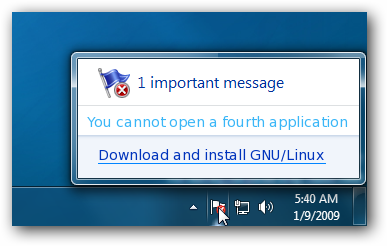
Summary: Very scarce adoption predicted based on very scarce response rate, which is biased
LAST week we
wrote about a survey which suggested a poor adoption expectancy for Windows 7. The
following article, titled "94% of companies will pass on Windows 7 upgrade until late 2010," gives good interpretation of what was found (or what was not found) by the survey.
The poll is a relatively small sample of all the companies out there, still it is 5% of those companies contacted. And to have 94% of them say they would not upgrade until sometime late in 2010 is really something! I think that’s more telling than the 60% who, today, say they won’t upgrade at all — as those mindsets could change given a successful migration, for example. But some are already anticipating the upcoming problems before they occur and have simply said “No, not before the end of 2010ââ¬Â³.
There is also this new essay called
"Microsoft Myopia Leads to Revisionist History." It is mostly an Apple versus Microsoft angle, though.
⬆

Comments
Jonathan Wong
2009-07-20 16:48:06
59% of those polled say that they have no plans to deploy Windows 7, even until the end of 2010. We shall not speculate whether they will deploy Windows 7 in 2011 or at all, and just assume they won't.
Simple mathematics then tell us that 41% plan to or will have Windows 7 deployed by Dec 2010, which is roughly a year (13 months and change) after the official release of Windows 7 (Official launch date is Oct 22, 2009).
So to give it some historical perspective, the adoption rate of Windows XP one year after it was officially released is about 12-14%. And we all can agree that XP ended up being a pretty successful OS.
Some food for thought.
Andrew Macabe
2009-07-20 18:53:49
Yggdrasil 2084
2009-07-21 03:14:04
Unlike taxes, there is no law forcing you to purchase or use Windows. Unlike death, you can avoid Windows without much difficulty if that's your choice. Your analogy is unfair and flawed.
Jose_X
2009-07-21 04:58:20
Keep in mind that those answering were a very small part of those asked (about 5% of those asked), and these people likely comprise a subgroup favorable beyond average towards Windows products. Ie, the 95% not answering will adopt at a lower level that is not known.
To consider for even a moment that the 41% "by the end of 2010" rate would apply to the other 95% is beyond being extremely optimistic; thus, associating this survey's 41% figure with XP's 10-12% is to ignore very important facts around this survey. In short, that 41% is expected to be an upper bound that likely won't be approached at all.
Further, I got the impression that the survey is about deploying Windows 7 not about migrating totally to Windows 7, so if 41% of people will deploy (on average) 15% of their workstations, that means the deployment rate would be 15% of 41%, which equals about 6% total.
Thus, assuming that 15% of total workstations (and assuming this prediction holds), we would have 6% deployments by Jan 1, 2011.
There are too many variables to say anything meaningful. Microsoft should have many very accurate polls. I'd wager they didn't like the down-to-earth results they got.
Jonathan Wong
2009-07-20 16:49:59
Yuhong Bao
2009-07-20 19:15:19