
Communicating With Freedom - Part III - Quibble Envisioned as a New and Easily Accessible Communications Platform Based on LibreJS
Need not be locally installed but can be locally run "in freedom"
In Part I we spoke about Quibble and in Part II we elaborated a bit, including the observation that it is breathing new life into LibreJS, a very important project for those of us who prefer to surf the "modern" Web in (relative) freedom. We plan to write things along those lines/themes in the future.
"As for covering Quibble," a developer of it has told us. "I would absolutely love that! I think coverage like this is one of the best ways to build trust and start spreading the word. If there’s interest in an embeddable, copyleft, peer-to-peer Discord-like platform, consisting of a JavaScript client, library, and protocol, and built entirely as free software in line with LibreJS standards, we’d be thrilled to have the opportunity to share it more widely."
This is closely connected to things we've covered here for decades, including secure transmission of information from whistleblowers - the 'lifeblood' of investigate journalism. It's important to make tools that are accessible, secure, easy to use, and easy to obtain. It is our theory, which is not entirely unsubstantiated, that states and proprietary software forces (lobbying/pressure groups) made such tools harder to make and get. Corrupt companies want to make it harder for whistleblowers to speak out (without being caught) - an interest shared by the average "modern" and "civilised" state, which is increasingly dominated by corporations anyway.
There's a very long history of the US Government (and more recently the EU) arresting people for seeking to develop communication tools that are impenetrable to states.
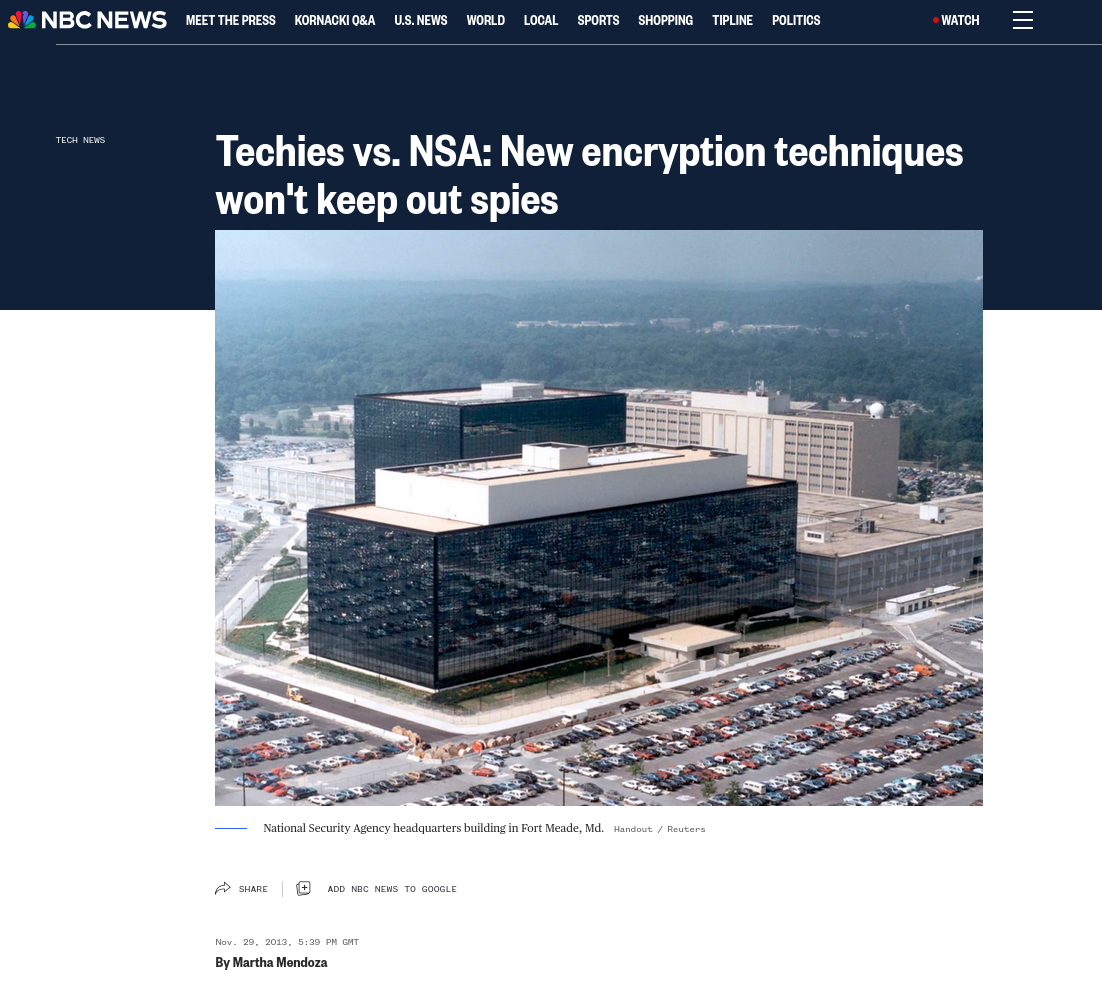
"The quality of these new programs and services is uneven, and a few have run into trouble. Nadim Kobeissi, developed encrypted instant messaging service Cryptocat in 2011 as an alternative to services such as Facebook chat and Skype. The Montreal-based programmer received glowing press for Cryptocat's ease of use, but he suffered embarrassment earlier this year when researchers discovered an error in the program's code, which may have exposed users' communications. Kobeissi used the experience to argue that shiny new privacy apps need to be aggressively vetted before users can trust them."
There is very substantial amount of information online about things that Phil Zimmermann had to go through because he had developed such tools in the previous century. Zimmermann is still around; GAFAM front groups like the EFF like to badmouth the potent tools and instead promote utter garbage. We've said for 2 years already that we have a long series about the EFF in the making; it's connected to the SLAPPs against us. Just remember that the EFF isn't what it wants you to think it is... the EFF is vendor-captured and it does not protect bloggers, it protects its sponsors. It even promotes slop for them. The EFF would gladly promote plagiarism and attack the work of journalists (whose work is being plagiarised) provided the plagiarist pays the EFF.
Anyway, we digress.
"As you know Quibble is just our inaugural project of Project Sine Iugum," we got told, "and we’d love the coverage to help introduce it properly, both the initiative and program. If helpful, I can also connect you with anyone you’d like for follow-up conversations, including people at Georgia Tech’s Open Source Program Office, which is incubating the project, as well as the paid student and volunteer student developers working on it here at Georgia Tech over the summer."
We plan to tell some interesting stories about how Richard Stallman (RMS) collaborates with Georgia Tech, where he gave his first speech at a US college since 2018. That acted as a springboard for further such talks in more US collages later in the same year.
"We have all kinds of ideas for building free software for the public good," we heard, "created by students themselves. Right now, though, we’re keeping our heads down and focusing on Quibble. But if it succeeds, we’ll have a working blueprint we can apply elsewhere."
Like we said before, there's already some early release/s, not a mere prototype. It's a real "product", not vapourware.
There's great potential herein, with Quibble becoming like the Apache or Kubernetes of portable communication toolsets (Matrix has attempted this as well). To quote: "We’ve discussed supporting existing free software projects and working on free healthcare software such as GNU Health, including encouraging institutions like Georgia Tech’s student health services to move away from Epic. (Which RMS talked about while here back in January, but didn't know Georgia Tech used them too)/ We’ve also talked about developing something like a “Free Dispatch System” that could help first responders avoid mass surveillance, Big Brother-style platforms from companies like Flock and Motorola. This would be the software that a 911/112 operator uses to direct Police/Fire/EMS to you, nowadays, it also includes maps, communications, unit/personnel tracking, etc. At this stage though, these are still just ideas."
This is still work in progress. "Our first priority is making sure we do our job well with Quibble," we heard. "We're all interested in hearing what you have to say about potential ideas for free software projects either student led/developed or contributed - we'd love to hear them!"
We've since then connected the team behind Quibble with The Cyber Show, which can help raise awareness/exposure in its audiocast.
At some stage we expect the FSF to lend its voice to Quibble, but it seems a bit premature to say too much about it.
Like we said at the end of May, the FSF really needs to become more active if not proactive in promoting those sorts of things.
Free society requires free speech and freedom of the press. █