
European Patent Office (EPO) Series: Different Strokes For Different Folks
Previous Parts:
Part 24
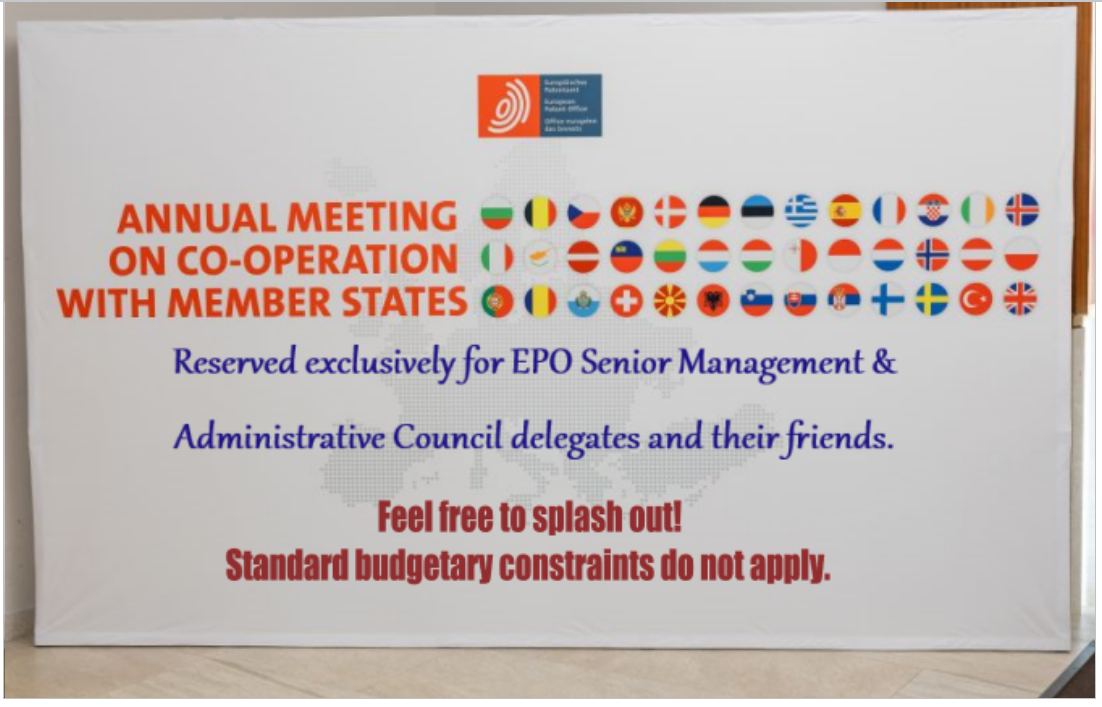
No sign of "austerity" at the 20th Annual Cooperation Meeting of the European Patent Network held on 11th-12th May 2026 in Split, Croatia.
As the European Patent Office experiences massive industrial action on a scale not seen since the days of the "Sun-King" Benoît Battistelli, the Organisation's political and managerial elite have been enjoying a rather different experience of "social dialogue".
The 20th Annual Co-operation Meeting, held amid the sunshine and postcard scenery of Split, offered the heads of Europe's national patent offices and EPO senior management yet another opportunity to congratulate one another on two decades of exemplary partnership.
Hosted by EPO President António Campinos and his Croatian facilitator, Ljiljana Kuterovac of the Croatian State Intellectual Property Office, the programme featured the expected ingredients of institutional harmony: warm self-congratulatory speeches, generous hospitality, elegant dinners and just enough Adriatic sea breeze to remind delegates that consensus is always easier with a glass in hand.
However, back at the coalface of the EPO's "production sites" in Munich, Berlin and The Hague, the menu for ordinary staff has been somewhat less enticing.
Staff representatives have spent months attempting to secure something considerably cheaper than a gala dinner: an honest negotiation on salaries and working conditions. Instead, they have encountered the EPO's preferred recipe for industrial relations – delay, procedural obstruction and the confident assumption that enough meetings about dialogue can eventually substitute for dialogue itself. Unsurprisingly, industrial action has become one of the few remaining ways of ensuring that EPO senior management notices that ordinary staff still exist.
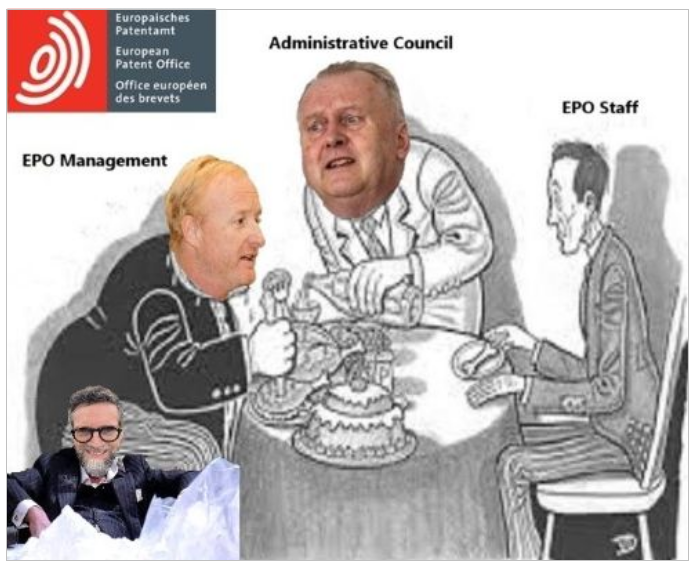
The 20th Annual Co-operation Meeting offered the heads of Europe's national patent offices and EPO senior management another opportunity to congratulate one another on two decades of exemplary partnership. For ordinary EPO staff the menu has been somewhat less enticing.
The Administrative Council, meanwhile, continues to perform its increasingly familiar role. Officially the Organisation's governing and supervisory body, it has become so adept at applauding and pandering to the Office's senior management that one occasionally wonders whether anyone remembered to distribute the oversight mandate. When inconvenient questions arise, the Council displays a remarkable instinct for looking the other way – preferably towards the dessert buffet.
At a time when EPO senior management and the Administrative Council display a remarkable unity in opposing the legitimate demands of EPO staff for a fair, transparent, and equitable salary adjustment mechanism, those same officials appear to have no difficulty finding ample resources to cover the costs of their own lavish shindigs.
As the cost of living continues to rise, EPO employees are expected to absorb a steady decline in their real income as their appeals for an equitable salary adjustment procedure are dismissed with contempt accompanied by the usual hackneyed arguments about "fiscal discipline", "budgetary prudence" and the need for restraint.
However, the selective application of "austerity" is glaringly obvious.
When employees seek a mechanism to prevent inflation from steadily diminishing the value of their salaries, they are told that the Organisation cannot afford it. When senior management officials and Administrative Council delegates decide to treat themselves to an annual networking junket, affordability suddenly ceases to be an obstacle.
In other words, EPO staff are being asked to accept a continual erosion of their purchasing power in the name of responsible governance, while at the same time observing that those advocating this policy with such intransigence spare no expense when it comes to funding their own extravagant beanfeasts.
The contrast is not merely striking; it is symptomatic of a toxic and dysfunctional managerial culture in which concerns about "fiscal prudence" only ever become relevant when they can be invoked as a pretext for opposing the legitimate demands of staff.
This disconnect risks undermining the organisation's credibility and moral authority. Public officials who demand and expect dedication, professionalism, and loyalty from their workforce cannot indefinitely ignore the growing gap between the principles which they claim to espouse and the priorities that they actually pursue as evidenced by their actions.
Such a disparity raises uncomfortable questions about whose interests the organisation truly serves and whether the burdens of "fiscal discipline" are being shared equally – or whether they are being unilaterally imposed exclusively on those with the least influence over the decisions being made.
The end result is an Organisation operating in two parallel universes.
In one, "social dialogue" is a celebrated European value, worthy of anniversary speeches, glossy brochures and seaside receptions. In the other, it is a phrase deployed largely for ceremonial purposes while staff are told, in effect, to stop complaining and meet their production targets.
Apparently, consultation is indispensable when dealing with forty national patent offices, but somehow optional when dealing with the people who actually examine Europe's patents.
The EPO's Croatian junket was intended to showcase European co-operation under the "leadership" of António Campinos but it also served as an unintentionally perfect demonstration of the EPO's governing philosophy under its current President: dialogue is a wonderful thing – provided it takes place between people who already agree with one another.
According to the official narrative, the Organisation has spent twenty years building an impressive European Patent Network. However, the facts on the ground show that it still has a long way to go when it comes to building a functioning relationship with its own staff.
That concludes our coverage of the EPO's 20th Annual Co-operation Meeting which took place in Split on 11th to 12th May 2026.
In the next part we will continue our coverage of the EPO President's activities following the Croatian junket and reveal how he paid another visit to Portugal to open a "firefighting technology" exhibition sponsored by the EPO and organised in collaboration with the Portuguese Institute of Industrial Property (INPI).
Stay tuned for more coming up soon... █