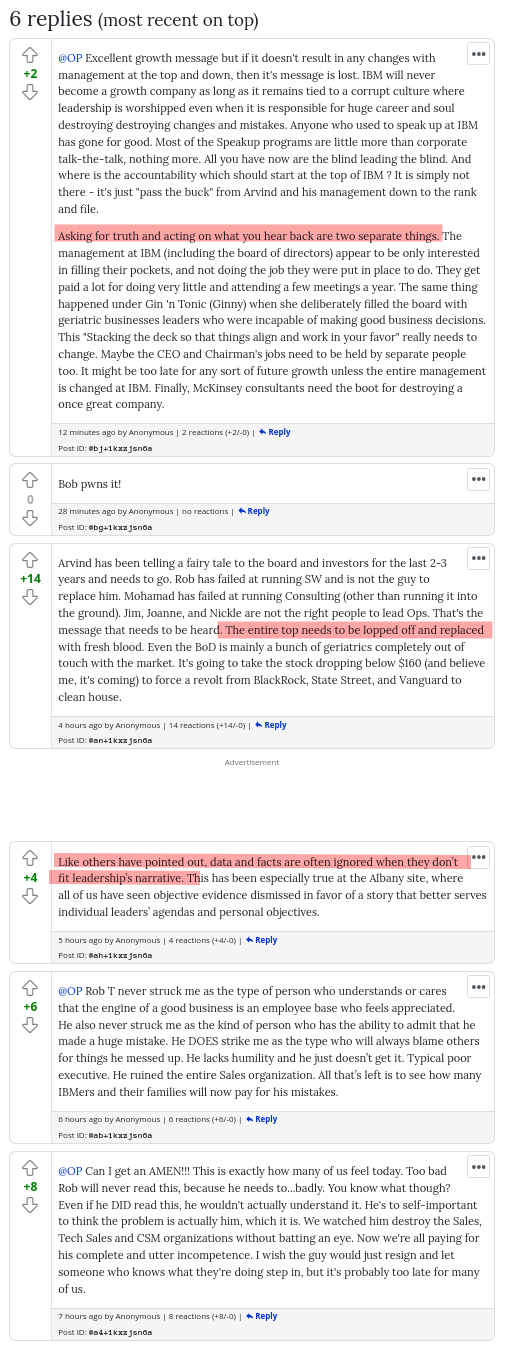
Nobody Will be Left Who Trusts IBM Anymore
"Most of IBM's goodwill is from acquisitions. It is purely an accounting generated entry being the difference between acquisition price paid and the fair market value of the assets acquired. It is rarely recoverable. Whenever I do analyst of companies I always strip out goodwill because there is no cash, tangible or even intangible asset (like software license rights - that is on the balance separately) sitting behind it that can be sold. If you strip out goodwill IBM is technical insolvent." -Hours ago
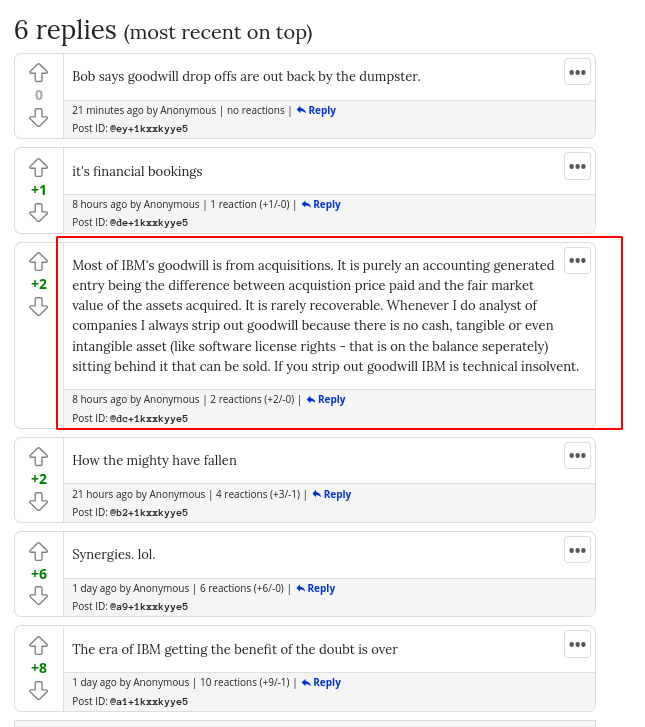
IBM is running out of "goodwill", as we explained last night. Who would still trust this company that is over 110 years old? Age alone does not imply credibility, not when the company makes many false promises that will never materialise and never materialised.
Even IBM's workers no longer trust IBM. Some existing or former IBMers comment today:
A few minutes ago someone explained that "IBM will never become a growth company as long as it remains tied to a corrupt culture where leadership is worshipped even when it is responsible for huge career and soul destroying destroying changes and mistakes."
This was a reply to:
Monday Growth message, July 20th 2026
“You saw our preliminary results… The first step is just to own it.” We already do. Every single one of us on the ground owns our number, every quarter, no matter how the goalposts moved that quarter. So let’s talk about ownership both ways: what exactly do you own here? Not the words “own it” in a Monday message : the actual outcome. What’s the consequence for you when the results miss? Who’s putting you on a PIP?
Nobody around you says this out loud, so I will: we had real leaders who could have told you this a year ago, and they didn’t leave for a better offer .... they got pushed out because they tried to correct you. You don’t get to say “no deflection, no excuses” while the people most likely to challenge the plan are the ones no longer in the building, because they challenged it.
Maybe IBM’s software problem isn’t the market, isn’t the customers, isn’t even the products. Maybe it’s you. Look at the CROs and software leaders actually winning out there right now. do you really think they run their orgs the way you run this one? Reshuffling structure every six months, pushing out anyone who isn’t aligned, surrounding yourself with people too scared to push back? That’s not how growth companies behave. That’s how companies behave right before they lose the people who could have saved them.
And look at how these decisions actually get made: under panic, not conviction. Every reorg lands like an emergency reaction to a bad quarter, not a plan anyone thought through. And somehow, in that panic, we’re the ones treated like zero, like we can’t understand a reorg, like we’re not agile enough, like we’re the ones resisting transformation. We are exactly those things. We adapt every single time you ask us to, on a shorter timeline than any of you have to answer for. What we’re fed up with is taking transformation advice from the worst-performing leadership in the room, delivered in a panic, and then being blamed when the panic doesn’t produce results.
And on that note: when you write “we are putting more attention on software consumption,” who exactly is “we”? You and McKinsey in a slide deck, or you and the people actually sitting in front of customers who could tell you months ago that this was coming? Because from where I sit, “we” hasn’t included us in a long time : it’s included consultants who get paid regardless of whether the plan works, and employees who inherit the plan with no say in it.
“Every Second Counts” is a good line for a kitchen sign. It’s a bad operating model for enterprise software. Nobody sells real value in one or two quarters. Value takes time to build because it’s built on trust, and trust takes longer to earn back than it takes to lose. Nobody deploys software in one or two quarters either, because deployment runs on the customer’s timeline and their business needs, not ours. If every second really counts, the first thing that should buy us is more discipline before changing structures, incentives, and coverage models mid-year : not less.
Here’s my Monday growth message back to you: a leader is accountable to the people below him, not just to the market above him. That means listening to employees and customers before restructuring around them, not after. It means being able to say “I was wrong” and “this is going to take longer than I promised,” out loud, without spinning it into a hype line for the next town hall. We show up accountable every day, on our numbers, on our customers, on our word. I’m asking you to show the same thing back .... not another recap of initiatives, but an honest account of what you got wrong and what you’re doing to fix it, including how it affects the people asked to execute it with less time and fewer resources than the plan pretends.
We’re not asking for perfection. We’re asking for the truth, and for someone to actually be willing to hear it.
The message was well received, and it has moreover invited comments as shown below. The common theme is, the management must be completely replaced as soon as possible and truth needs to come out. █