
European Patent Office (EPO) Series: "Operation Influencer"
Part 3
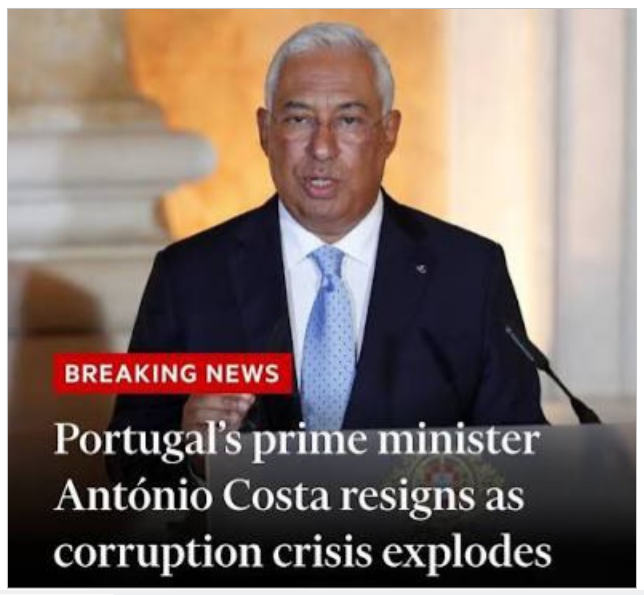
On 7th November 2023 António Costa announced that he
was resigning after eight years as Prime Minister and it seemed
that his political career had come to an abrupt end.
In the last part we provided our readers with an introduction to António Costa and his political career. We concluded by recalling that in 2023 Costa seemed to be headed for a top-level EU position in Brussels when something happened that appeared to bring his political career to an abrupt end.
In this part we will take a look at the "influence peddling" scandal that led to Costa's resignation as Prime Minister of Portugal on 7th November 2023.
Costa had led the Socialist Party to an impressive victory in the parliamentary election of January 2022, winning 120 out of a total of 230 seats in the National Assembly. This gave him an absolute majority but despite such an auspicious start, the government was plagued by instability. By the end of 2022, no less than 10 high-ranking government officials – either ministers or secretaries of state – had left their posts.
As the year drew to an end, the Minister for Infrastructure Pedro Nuno Santos and his secretary of state, Hugo Mendes, resigned amid an outcry over a € 500,000 severance payment made to a board member of the state-owned airline Transportes Aéreos Portugueses (TAP).
Around a half a year later, in May 2023, the new Minister for Infrastructure, João Galamba, submitted his resignation after becoming implicated in a further controversy about managerial severance payments at TAP.
However, this time Costa jumped to the defence of his minister and gave a televised address in which he said that although the scandal had adversely affected the government’s image, he could not accept Galamba's resignation because he believed that the minister was “not responsible for any mistake”.
Costa's decision to support Galamba was criticised by the Portuguese President, Marcelo Rebelo de Sousa, who was completely opposed to allowing Galamba to remain in office.
Six months later, on 7th November 2023, Costa's vigorous defence of Galamba and his snub to the President came back to bite him when the government was hit by an even more dramatic crisis which led to Costa himself resigning as Prime Minister.
The events of 7th November 2023 were the consequence of an official investigation into allegations of malfeasance, corruption of elected officials, and "influence peddling" connected with a number of large infrastructure projects, including lithium mine concessions near Portugal’s northern border with Spain, and plans for a green hydrogen plant and a data center in the southern coastal town of Sines.
The investigation – known as "Operation Influencer" – had been opened by the Portuguese Public Prosecutor back in April 2019 following an investigative report aired by the public broadcaster Rádio e Televisão de Portugal (RTP). In the RTP investigative report allegations were made about a concession contract for the exploration of a lithium mine in Montalegre in northern Portugal.
Around four and half years later, on 7th November 2023, the investigation had progressed to the point where the Public Prosecutor decided that it was time to launch a search, seizure and arrest operation in 42 locations, including the Ministry of Infrastructure, the Ministry of the Environment and Climate Action, and the official residence of the Prime Minister. A raid on the headquarters of the Portuguese Socialist Party was announced but was ultimately cancelled.
The investigative judge entrusted with the case issued arrest warrants for five people, including two individuals from Costa's inner circle, namely his chief of staff, Vítor Escária, and his adviser Diogo Lacerda Machado, a long-standing close personal friend who had previously been hired by Costa as a member of the government negotiation team dealing with the re-nationalisation of the TAP airline.
João Galamba, the Minister of Infrastructure, who had been vigorously defended by Costa a few months earlier despite the misgivings of the Portuguese President, was also named as an arguido (official suspect) in the investigation.
Somewhat ironically, back in April 2019, Galamba had posted a comment on Twitter denouncing the RTP investigative report which triggered the investigation as "manure" and "a disgusting matter". His comment – which he subsequently deleted – drew condemnation from RTP and the Journalists' Union.
In the case of Costa's chief of staff Vítor Escária, a sum of € 75,800 in cash was discovered in his office in the São Bento Mansion, the official residence of the Prime Minister. According to contemporaneous media reports, Escária's "cash stash" was divided up between a number of envelopes which were hidden on shelves between books and in wine crates. Escária claimed that the money was income received for work that he did in Angola and which was paid for in cash.
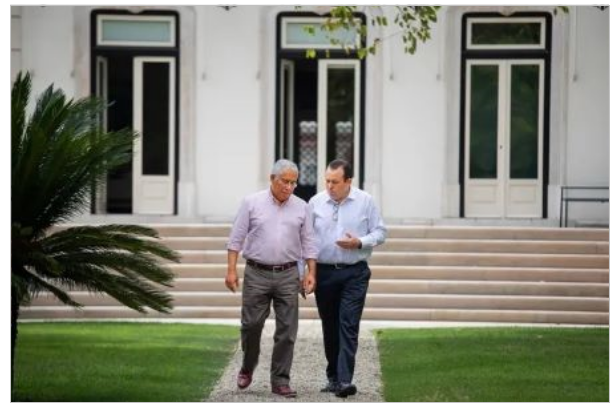
António Costa and his chief of staff, Vítor Escária, in the
grounds of the São Bento Mansion.
In January 2025, it was reported that Escária had also become an arguido (official suspect) in a spin-off investigation concerning suspected violations of state secrets. This new investigation was opened because, during the search of Escária's office, a pen-drive identifying hundreds of officials working in the SIS (secret service), the SIED (service of strategic and defence information), the judicial police and the tax authorities had been found.
But despite the fact that he had been relieved of his official duties by Costa and remained an official suspect in ongoing criminal investigation procedures, Escária managed to land on his feet in September 2025. As reported in the Portuguese media, he secured a prestigious new job as director of the Instituto Superior de Gestão ("Higher Institute of Management"), a private business school in Lisbon.
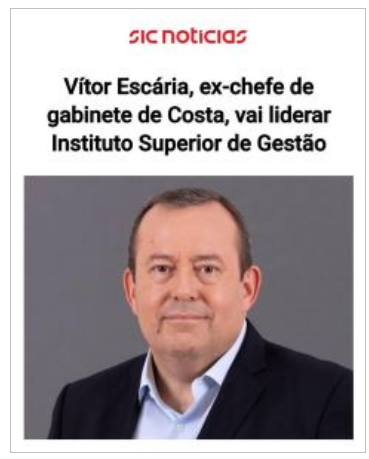
In September 2025, Portuguese media reported that despite being
an official suspect in ongoing criminal investigation procedures,
Costa's former chief of staff, Vítor Escária, had secured a new job
as director of the Instituto Superior de Gestão, a
private business school in Lisbon.
Returning now to the dramatic events of 7th November 2023, in a televised speech delivered a few minutes after two o’clock in the afternoon, Costa addressed the country and announced that he was resigning after eight years as Prime Minister.
Although he proclaimed his innocence, Costa said the gravity of the charges driving the investigation were “incompatible with the dignity of the office.”
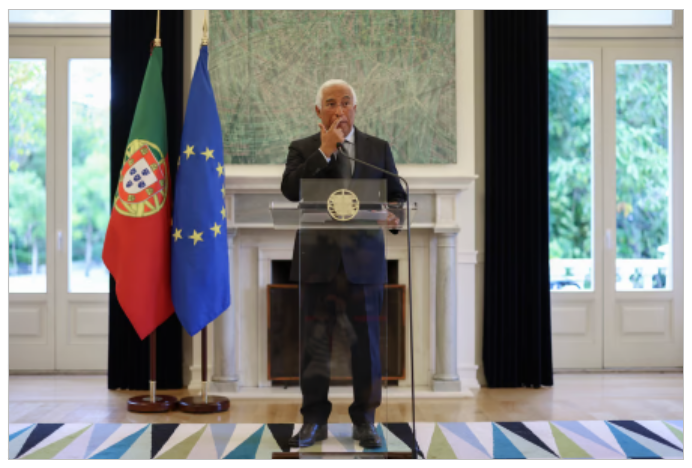
In a televised speech delivered in the afternoon of
7th November 2023 Costa announced that he was resigning
as Prime Minister.
At this point, despite the fact that Costa himself had not been charged with any crime, his prospects of securing a top EU job seemed to have gone up in smoke.
Addressing a press conference following his resignation, Costa declared that:
“I have already resigned as prime minister, I have already announced that I will not be a candidate for prime minister and, with the foreseeable duration of this judicial process, I will not, in all likelihood, hold any more public office”.
But as things turned out, Costa's political career was far from finished.
In the next part we will see how he managed to make a remarkable comeback when he was selected to become President of the European Council a mere six months or so after his resignation as Prime Minister of Portugal. █
Previously: