
European Patent Office (EPO) Series: Transcending Partisan Rivalry in the National Interest
Part 10
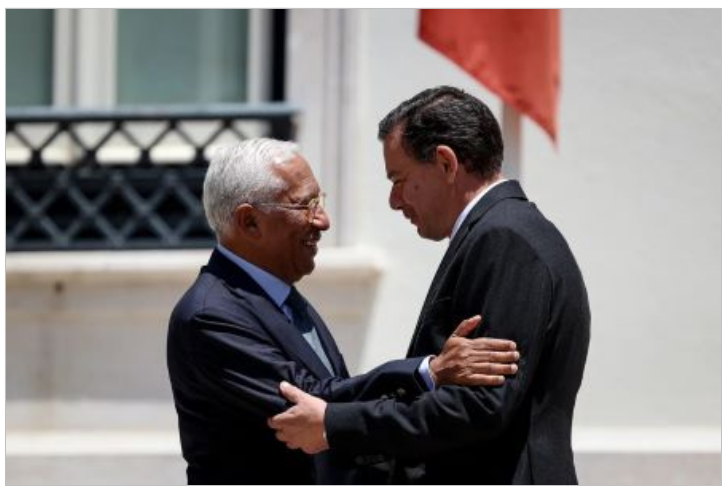
For his reappointment bid to succeed, Campinos needs to be able to rely on the support of both the Portuguese Prime Minister, Luís Montenegro (right), and the President of the European Council, António Costa (left).
Notwithstanding the fact that Costa and Montenegro are ostensibly competitors in terms of their party-political affiliations, they are known to enjoy very cordial personal working relationship which transcends partisan rivalry.
Following his sudden and unexpected resignation in November 2023, Costa stayed on as caretaker Prime Minister until the March 2024 snap election. After the election he welcomed his successor, the Prime Minister elect Luis Montenegro, to a meeting at the São Bento Mansion.
Soon afterwards, in June 2024, as reported by EuroNews in an article entitled "António Costa in line for EU top job, despite judicial woes", the newly appointed Prime Minister, Montenegro, expressed his "unwavering support" for Costa's bid to become President of the European Council:
"Montenegro has described Costa as the best candidate for the job and vowed to do everything in his power to support his bid, an endorsement considered pivotal in giving credibility to Costa’s claim to the Council presidency."
Since Costa assumed office as President of the European Council in December 2024 he has held frequent meetings with Montenegro in Brussels to discuss matters of common interest.
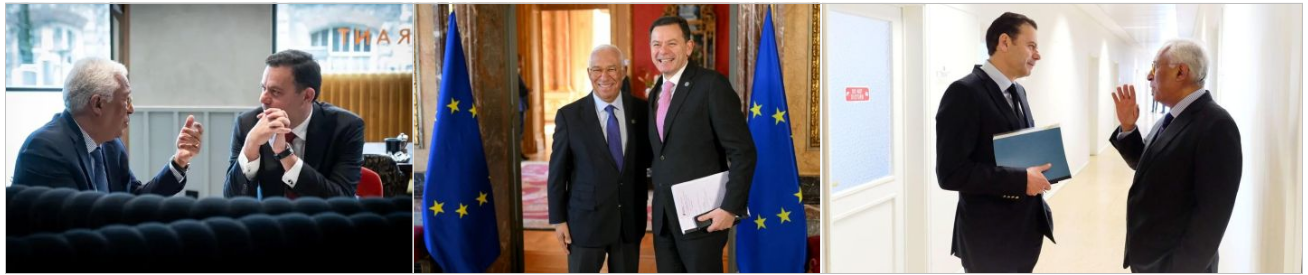
Since Costa assumed office as President of the European Council on 1st December 2024 he has had frequent meetings with Montenegro in Brussels to discuss political matters of common interest.
All things considered there is no reason to suppose that Costa and Montenegro could not or would not agree to follow a common "bipartisan" line when it comes to the question of whether or not to support Campinos.
The key question here is whether or not the reappointment of Campinos is perceived to be in the national interests of Portugal.
Up until now, Campinos has generally been regarded as a Portuguese "asset" on the international stage.
His initial appointment as chief executive of the EU trademark agency in Alicante – originally known as OHIM and later rebranded as EUIPO – took place in 2010 at a time when the European Commission was headed by José Barroso, the former Portuguese Prime Minister and erstwhile Maoist student radical.
That could have been a mere coincidence but, on the other hand, it's not beyond the bounds of possibility that Barroso could have played an active role behind the scenes in sponsoring the appointment of his compatriot Campinos as President of the OHIM/EUIPO in 2010.
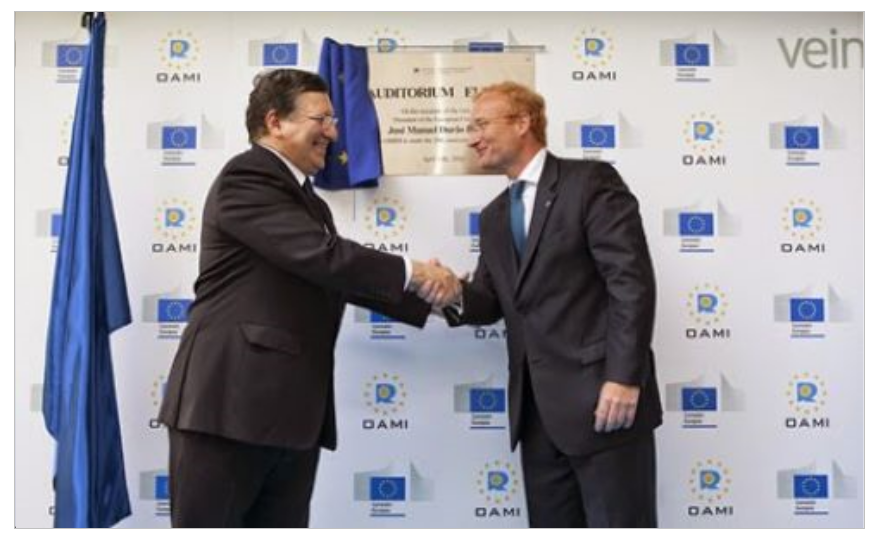
OHIM President António Campinos (right) welcoming the President of the European Commission, José Barroso (left), during the latter's visit to Alicante in 2014 to mark the 20th anniversary of the OHIM. It has been speculated that Barroso may have played an active role behind the scenes in supporting the appointment of his compatriot Campinos as OHIM President in 2010.
It is worth recalling here that, when Campinos left the EU trademark agency in Alicante and moved to the EPO in Munich, he used his new position to interfere in the 2023 EUIPO succession race which was triggered by the decision of the EUIPO Management Board not to renew the appointment of Christian Archambeau. The purpose of this interference in EUIPO affairs by Campinos was to lobby on behalf of his Portuguese compatriot and protégé, João Negrão, who started his career in Alicante in 2010 as chef-de-cabinet to Campinos.
Negrão's appointment as Executive Director of EUIPO in 2023 resulted in a situation in which the current heads of both the EUIPO and the EPO are of Portuguese nationality. This represents a significant achievement in terms of bureaucratic empire-building in European supranational institutions and there is no reason to assume that the Portuguese political establishment would have any particular desire to see a change in the status quo in this regard.
All other things being equal, it's very likely that the "Brotherhood of São Bento" would be inclined to support Campinos in his bid to secure reappointment at the EPO.
But what if all other things are no longer equal? More specifically, what if the former "asset" has in the meantime become a "liability"?
We will return to this question in due course in the final part of our series but before doing so we want to revisit the meeting which took place between Campinos and Costa in Brussels on 3rd February 2026 to take a closer look at the members of the entourage which accompanied the EPO President to that meeting. █
Previously: