
EditorsAbout the SiteComes vs. MicrosoftUsing This Web SiteSite ArchivesCredibility IndexOOXMLOpenDocumentPatentsNovellNews DigestSite NewsRSS

01.30.10

GNU/Linux Yawns at Apple’s Large iPhone (Without the Phone Functionality)

Posted in Apple, DRM, FSF, GNU/Linux, Intellectual Monopoly, Open XML, OpenDocument, UNIX at 11:31 am by Dr. Roy Schestowitz

Summary: Further analysis (hopefully the last) of Apple’s “disappointing” product and how it compares to many GNU/Linux counterparts

A FEW days ago we showed how Apple had generated hype about its rather disappointing new product. Dave Rosenberg, a Mac enthusiast, calls it “important but disappointing”. They probably didn’t send him a free one, so he does not feel obliged to hail it. Yesterday we showed that even fans of Apple were disappointed by iPad, so it’s not just the opinion of one person. There are of course iPhone lovers like Stephen O’Grady (it’s fair enough that some people believe in accepting DRM without resisting), but he too has his doubts. There are even cartoons on the subject.

Is Apple running out of ideas and jumping the shark? Probably not, as Apple did have some other products which were total flops and neglected before they rose to fame. Every company occasionally makes such mistakes (Microsoft released Windows Vista for example). Can the Apple iPad challenge Linux-powered products that predate it? This question is being addressed here and here:

The kit, Amazon said, will comprise of sample code, ample documentation and, most importantly, a Kindle simulator that will allow developers to “build and test” their application in a virtual platform that mimics 6-inch Kindle and 9.7-inch Kindle DX in Mac, PC, and Linux environments.

Worth mentioning is the story about Apple’s total disregard for other people’s intellectual monopolies. Apple must have known that “iPad” as a trademark was already taken and there is a battle going on over it right at this moment.

Fujitsu: ‘iPad? That’s ours’

In addition to ignoring support for Adobe Flash, multitasking, and a few other niceties in its new iPad, Apple seems to have ignored one other important detail: it doesn’t own the name “iPad.” Fujitsu says it does.

That’s a good opening. Apple’s iPad is basically a toy without even some features of other phones (a lot of phones multitask for example). CNN dares to put “Oversized iPhone” in the headline, which is rather telling. A German reader of ours told us last night: “the ipad is a bad joke from a technical point of view. but usability seems to be good and innovative”

SJVN has already explained why GNU/Linux still beats Apple on technical grounds (not fake, theatrical hype) and a new article from Jim Zemlin’s blog has something similar to say:

You might expect the Executive Director of the Linux Foundation to state with full confidence that Linux-based competitors will crush the iPad. Linux *can* compete in one area. $499 – $829 may be a breakthrough price for Apple and their margins, but it’s no comparison to the price competition Linux-based devices can offer. Vendors creating Tablets, slates, phones or other devices do not have to pay the per-unit pricing of other platforms. Apple products command a premium and Jobs will never cannibalize their pricing power.

Also in the news:

Apple’s iPad vs Notion Ink’s Adam tablet with Ubuntu: battle of two worlds

The “desktop” is easy to use in both environment, very similar application startup and indicators. The Ubuntu OS will run several applications in parallel while you will be able to use only one app ata time on the iPad. (see about this later)

Eight ways Android and Linux tablets can beat Apple’s iPad

Apple’s newly announced iPad has been touted as “magical,” “amazing,” and “revolutionary” by company officials. But, key deficiencies in the device provide opportunities for competitors, who can craft better tablets that run Linux or Android.

Acer promises cloudbook, app store and ereader

Acer’s cloudbook will be one of the first to the shelves, expected to ship around September in the US and in Europe shortly afterwards. Unlike Acer’s existing Linux netbooks, this product will run Chrome OS only, to keep battery life long and prices low. The company already offers netbooks running Android or other Linux variants, but always as a second option alongside Windows. Users can then rely on the Linux element for fast boot-up, low power and optimal web performance, and turn on Windows for more high power apps. Google claims Chrome OS, which is an ultralite browser-based OS – just an overlay on a very basic embedded Linux system – will bridge the divide and make Windows unnecessary, as the powerful services and heavy duty data will be held in the cloud.

Even last night we gave some new examples of GNU/Linux-powered tablets. The market is full of them because they work well, not because the vendors are “fans” of GNU/Linux.

Silicon Valley Watcher complains that Apple continues to distance itself from standards with each new device, the latest being iPad:

But over the past ten years, since the introduction of the iPod, iPhone, and now the iPad, Apple is becoming less and less open, it using fewer standard components and chips, and far fewer Internet technologies common to Mac/PC desktop and laptop systems.

The iPhone and iPad, for example, doesn’t support common Internet platforms such as Adobe Flash or Microsoft Silverlight. That means you cannot watch streaming video from Hulu, or Netflix.

And while iPhone chips are available from other manufacturers, the iPad runs only on the A4 processor — an Apple designed chip that no one else can buy.

As we explained before, Apple is also a proponent of OOXML (being a friend of Microsoft) and people keep complaining about it. One person wrote this week: “iWork on iPad still doesn’t support ODF”

This is a shame because Apple embraced UNIX but it seems to deviate from universality. Timothy Lee, a notable and effective critic of intellectual monopolies, has published “the case against the iPad” where he states that Apple also fights freedom of information:

Apple is fighting against powerful and fundamental economic forces. In the short term, Apple’s technological and industrial design prowess can help to prop up dying business models. But before too long, the force of economic gravity will push the price of content down to its marginal cost of zero. And when it does, the walls of Apple’s garden will feel a lot more confining. If “tablets” are the future, which is far from clear, I’d rather wait for a device that gives me full freedom to run the applications and display the content of my choice.

Update: I guess I’ve been brainwashed by my iPhone not to notice this, but the other glaring flaw, as this post explains, is the lack of standard ports. The net effect of this is, again, to give Apple complete control over the platform’s evolution, because the only way to interact with the thing is through the proprietary dock connector. Again, this made a certain amount of sense on the iPhone, where space, weight, and ergonomics are at a premium. But it’s totally unacceptable for a device that aims to largely displace my laptop. Hell, even most video game consoles have USB ports.

In the words of another person, “iPad is scary, but its strategy is moreso: #Apple unveiled by far the most restrictive platform ever seen.”

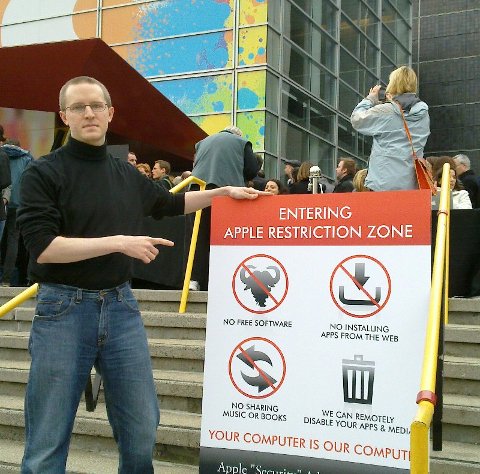
An ‘Apple Cult’ site (CultOfMac.com) has brought up the FSF’s campaign against the iPad, which is a good sign. It means that the issues are being raised and the most sensitive crowd is receiving a bit of increased awareness of what Apple does to the users’ rights and freedom. This is not a case of preaching to the choir or to the converted, so well done, FSF.

Novell’s Zonker denounces this great campaign from the FSF, but then again, he happily tells lies about the FSF by misquoting or misrepresenting. Novell is no friend of the FSF.

Share this post: These icons link to social bookmarking sites where readers can share and discover new web pages.
  • Digg
  • del.icio.us
  • Reddit
  • co.mments
  • DZone
  • email
  • Google Bookmarks
  • LinkedIn
  • NewsVine
  • Print
  • Technorati
  • TwitThis
  • Facebook

If you liked this post, consider subscribing to the RSS feed or join us now at the IRC channels.

Pages that cross-reference this one

What Else is New


  1. Links - Anti-Trust Roundups - Yahoo, Nokia, Barns and Nobel


  2. Links - MSNokia Passes Blame, Bill Gates pushes GMOs, Open Access news


  3. Links 7/2/2012: Firefox 11 Enters Beta, Canonical Disappoints KDE

    Links for the day


  4. IRC Proceedings: February 6th, 2012

    IRC logs for February 6th, 2012


  5. IRC Proceedings: February 5th, 2012

    IRC logs for February 5th, 2012


  6. Links 6/2/2012: PCLinuxOS 2012.02 and Mint KDE Reviews

    Links for the day


  7. Bill Gates Indoctrinates Youth in the United States and India, Critics Speak Out

    Backlash against the Gates Crusade to brainwash the young minds all around the world


  8. Bill Gates Uses Symbolic 'Donation' to Force Taxpayers to Pay Microsoft (of Which He Holds Shares)

    The Gates Foundation goes lobbying for Microsoft again, this time in Vietnam


  9. Monopoly as Innovation?

    Challenging the old misconception that patents are beneficial to anything but few multinationals and their patent lawyers


  10. Links 5/2/2012: Lenovo in India, Netrunner 4.1 is Out

    Links for the day


  11. IRC Proceedings: February 4th, 2012

    IRC logs for February 4th, 2012


  12. OpenStack, Microsoft, Junk Patents, Microsoft Copyrights, and Oracle Copyrights

    Another look at the OpenStack situation, why Microsoft should not be allowed to enter, and more about patent and copyright complications


  13. Apple, Which Started Patent Wars, Gets What It Deserves

    Apple products get banned (for the time being) after Apple decided to attack Linux-supporting competitors and then received some blowback


  14. Unitary Patent and the Emergence of More Junk Patents

    The rise of the junk patents and what we are taught about them by the news, including some news about the unitary patent in Europe


  15. Backlash Against Bill Gates' Lobbying for Patented Life

    GMO, a robbery of the right of reproduction (and a potential health hazard), is promoted by Bill Gates for profit, whereupon critics strike back


  16. IRC Proceedings: February 3rd, 2012

    IRC logs for February 3rd, 2012


  17. Links 4/2/2012: Ubuntu 12.04 Alpha 2 Preview, ACTA Backlash in Europe

    Links for the day


  18. A Glimpse at Executives Who Left the Sinking Novell Ship

    A roundup of news about former Novell staff and where that staff is moving these days


  19. Novell Makes New Software for Microsoft Windows and Office

    PR spin from Novell and money-grabbing moves that promote proprietary software rather than Free/Open Source software


  20. Links 3/2/2012: BT Vision Goes for Linux, Linux 3.3 With Android

    Links for the day


  21. Debt in Attachmate

    The company that bought Novell has a poor outlook, financial issues, and little signs of expansion/renaissance


  22. Longtime SUSE Executive Holger Dyroff Moves on, SUSE in a Bad State

    Key people continue to leave SUSE and the distribution is left without a compelling sales pitch


  23. Groklaw Update on Android Patent Cases and Response to FUD From Microsoft Lobbyists

    A few updates of greater importance where the Linux situation is discussed in the context of Android and Novell


  24. IRC Proceedings: February 2nd, 2012

    IRC logs for February 2nd, 2012


  25. Links 2/2/2012: DEFT Linux 7, Mozilla Firefox 10

    Links for the day


  26. IRC Proceedings: February 1st, 2012

    IRC logs for February 1st, 2012


  27. IRC Proceedings: January 31st, 2012

    IRC logs for January 31st, 2012


  28. IRC Proceedings: January 30th, 2012

    IRC logs for January 30th, 2012


  29. Bill Gates is Hijacking Open Source While Attacking It Using Lobbyists, Patents, and Patent Trolls

    Response to reputation laundering from Wired Magazine, the latest nonsense from Microsoft's lobbyist Florian Müller, an update on Microsoft's trolling against Android, and a little more of Apple's


  30. The Gates Foundation is Still Hijacking the Voice of the Poor and Effectively Runs Paid Advertisements Inside 'News'

    Money still the vehicle by which opinions get heard, so Bill Gates exploits this for fame, power, and profit


RSS 64x64RSS Feed: subscribe to the RSS feed for regular updates

Home iconSite Wiki: You can improve this site by helping the extension of the site's content

Chat iconIRC Channel: Come and chat with us in real time

Recent Posts