
EditorsAbout the SiteComes vs. MicrosoftUsing This Web SiteSite ArchivesCredibility IndexOOXMLOpenDocumentPatentsNovellNews DigestSite NewsRSS

03.19.10

Democracy is Not the Same as Freedom

Posted in GNOME, GNU/Linux, Google, Microsoft, Mono, Novell, Search, Ubuntu at 8:20 am by Dr. Roy Schestowitz

UDS (for Ubuntu Karmic)
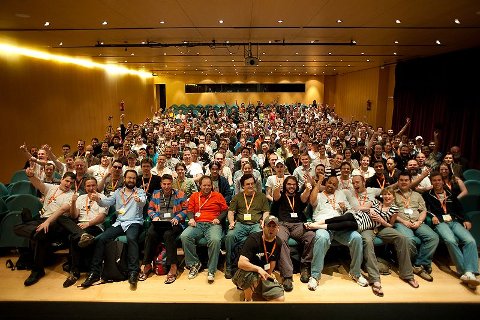
UDS Karmic Group Photo, by Kenneth Wimer

Summary: People have lost track of real mistakes that Canonical is making and instead they focus on buttons and themes

ANYONE who wishes to fork a GNU/Linux distribution can do just that, provided the GPL is obeyed and trademark law too. That’s the power of Free software. Some people conflate that with democracy, which is an entirely different — if not a Utopian — view of the world where everyone is said to be perfectly happy based on consensus (an impossibility). In some sense, “democracy” is just a word that people like to say.

Ubuntu GNU/Linux can’t be everything to everyone, which is why we defend its latest decision to change the theme and we have no problem with Mark Shuttleworth’s latest response, which led to resentment or at least suspicion. Linux development and Wikipedia editing are the same. People give advice and offer an opinion for all to see, but it’s a meritocracy, not a democracy.

Here is Shuttleworth’s controversial message in full (it more or less repeats what Jono Bacon has been telling us in the Boycott Novell IRC channel for several weeks).

On 15/03/10 23:42, Pablo Quirós wrote:
> It’d have been nice if this comment had been made
> some time ago,
> together with a deep reasoning on the
> concrete changes that are in mind.
>
> We are supposed to be a community,
> we all use Ubuntu and contribute to
> it, and we deserve some respect regarding
> these kind of decisions. We
> all make Ubuntu together, or is it a big lie?

We all make Ubuntu, but we do not all make all of it.
In other words, we delegate well. We have a kernel
team, and they make kernel decisions. You don’t get to
make kernel decisions unless you’re in that kernel
team. You can file bugs and comment, and engage, but
you don’t get to second-guess their decisions. We have a
security team. They get to make decisions about security. You
don’t get to see a lot of what they see
unless you’re on that team. We have processes to help make
sure we’re doing a good job of delegation, but being an open
community is not the same as saying everybody has a
say in everything.

This is a difference between Ubuntu and several other
community distributions. It may feel less democratic, but
it’s more meritocratic, and most importantly it means (a) we
should have the best people making any given decision, and
(b) it’s worth investing your time to become the
best person to make certain decisions, because you
should have that competence recognised and rewarded
with the freedom to make hard decisions and not get
second-guessed all the time.

It’s fair comment that this was a big change, and
landed without warning. There aren’t any good reasons
for that, but it’s also true that no amount of warning
would produce consensus about a decision like this.

> If you want to tell us
> that we are all part of it, we want information,
> and we want our opinion
> to be decisive.

No. This is not a democracy. Good feedback,
good data, are welcome. But
we are not voting on design decisions.

Mark

People keep arguing over something as unimportant as a default theme which any new user can trivially change. This is a waste of effort because Ubuntu’s real problems are different. We have a problem with Ubuntu’s attitude towards Mono* (dependency increases over time [1, 2]), its relationship with Yahoo!/Microsoft [1, 2, 3, 4, 5, 6], and some also criticise the company’s promotion of the music store/online storage (reasons vary and include the involvement of Amazon, DRM, patented formats, and so on). Here is another new rant:

Ubuntu One Music Store: Tops or Flop?

Music seems to be a viable income stream also under Linux. After Amarok and Rhythmbox have earned at least a few hundred bucks with Magnatune, Ubuntu is now breaking into the market as well.

What Canonical does here is fair enough and the company did try to establish a deal around Ogg. It’s not so simple to make the market fit minority demands, rather than popular demand driving the market.

We are generally optimistic about the next release of Ubuntu and in our daily links we include a lot of positive news about the distribution. Bruce Byfield says that this next release is “Ubuntu’s Most Innovative”, but in his article he also casts a mistake as a merit:

Early in Lucid’s development cycle, the Ubuntu Development Summit announced that The GIMP would be dropped from the default selection of software installed. Since The GIMP is widely considered an example of excellence in free software, the announcement created some controversy, but the decision was in keeping with Ubuntu’s general priorities. Not only does The GIMP take up considerable space on a CD, but, more importantly, its features far exceed what beginning users could need.

For those who do not know or remember, most users voted to keep The GIMP, but their opinion was ignored or at least just ultimately rejected by the ruling majority. That’s what meritocracy means and that’s fine. The problem is, does Canonical realise the consequence of its actions? By ignoring a majority opinion it creates the perception that Free software is not receptive to feedback. Nowadays, our reader Ryan keeps ranting about Ubuntu being the “same as Windows” (development- and feedback-wise) and last night he argued that “Ubuntu beat Rhythmbox up and stole their lunch money. They modified the referrer in Rhythmbox and now Magnatune owes them $100. Are they really so petty that they’re going to keep that money and deny it to GNOME?”

We previously explained why Canonical’s search deal with Yahoo!/Microsoft was merely a case of taking money away from Mozilla — money that was used to develop Firefox, Thunderbird, and other great software. Canonical will be paid by Microsoft (via Yahoo!) at the expense of Mozilla, which was paid by Google. That again is the type of thing worth criticising, not some petty issue to do with a default theme and buttons that can easily be changed.
____
* Some minutes ago, Popey from Ubuntu wrote: “Liking the new automatic sync feature in the latest Tomboy” (they just don’t see the problems with Mono).

Share this post: These icons link to social bookmarking sites where readers can share and discover new web pages.
  • Digg
  • del.icio.us
  • Reddit
  • co.mments
  • DZone
  • email
  • Google Bookmarks
  • LinkedIn
  • NewsVine
  • Print
  • Technorati
  • TwitThis
  • Facebook

If you liked this post, consider subscribing to the RSS feed or join us now at the IRC channels.

Pages that cross-reference this one

19 Comments

  1. satipera said,

    March 19, 2010 at 11:59 am

    Gravatar

    You have said in more detail and more eloquently more or less what I said in a comment on another site a few days ago. Incidentally it was a result of several similar type comments from Popey quite a long while ago now that led me to no longer follow his twitter feed. I am sure he will get over it.

    Dr. Roy Schestowitz Reply:

    Here is something that Popey posted today at 15:40 GMT (Twitter): “Nice article from @d0od “Why Mark Shuttleworth is right – Ubuntu is not a democracy and nor should it be” http://bit.ly/cT6d4V

  2. satipera said,

    March 19, 2010 at 12:47 pm

    Gravatar

    I have just read the article. At one point he complains about “passers by” who he says stamp their feet because they want to decide and later says that others are insulting the community, priceless.

    Dr. Roy Schestowitz Reply:

    To be honest, I’m on Ubuntu’s side when it comes to the whole “democracy” debate. it’s a tricky one.

  3. satipera said,

    March 19, 2010 at 2:08 pm

    Gravatar

    We can’t ask for anything more than consultation where it is possible, Canonical do try hard. They also understandably have to show leadership to move things on with Ubuntu. The problem is that when they are moving in a bad direction with something important and causing great concern like mono at the moment and perhaps something else in the future, Canonical are in the end going to do what they want. We should all be aware that this is the case and all we can do is chime in with an opinion but ultimately all any of us can do is like it or lump it.

    I think their design team should be left alone to do their work. But for some things although Canonical can they should not be saying Just leave it to us we know best and anyway it is not a democracy. It is the second time I have heard the phrase “not a democracy” from Canonical the last was about 18 months ago. I hope that it is not a sign that a more defensive and dismissive mind set has taken hold. They should be careful of the language they use, the last thing we want is for a them and us mentality to develop.

    Dr. Roy Schestowitz Reply:

    Jono has said this several times in the IRC channel; I was a little surprised that Mark couldn’t sense that it would cause a riot. I’m surprised he got involved at all.

  4. Agent_Smith said,

    March 20, 2010 at 10:05 am

    Gravatar

    Well, i got the post defending Mr. Shuttleworth in OMG Ubuntu.
    Then i respondend to it: crApple and M$ are tyrannies. And Ubuntu strives to copy, sometimes one, sometimes the other…

    Enough said…

    Dr. Roy Schestowitz Reply:

    Apple and Microsoft are no better at that.

    Agent_Smith Reply:

    Yep… And Canonical is copying their (M$ and crApple) worst habits…

    Dr. Roy Schestowitz Reply:

    Like what?

  5. Agent_Smith said,

    March 20, 2010 at 12:53 pm

    Gravatar

    Like deaf ears to NO MONO. Like deaf ears to “Don’t ditch Gimp”. Like changing Ubuntu to resemble, sometimes Winblow$ XP, sometimes MAC/OSX. Changing its structure, abolish xorg.conf, abolish inittab (maybe good to hide the CLI, but a nightmare to maintain). In my book, it’s tyranny to not hear the outcry. And the masses are crying out loud.

    Dr. Roy Schestowitz Reply:

    Yes, but it’s not exactly technical imitation of Apple and Microsoft (maybe just the mentality).

    Agent_Smith Reply:

    Exactly my point. Ubuntu is steering away from the community, and its head persons are only hearing YES MEN. The results are already being seen(Binghoo search pact), and will be worst in the future.

    Dr. Roy Schestowitz Reply:

    They hired from Microsoft and Novell. HR 101 mistake.

    your_friend Reply:

    There’s more than a faint wiff of Microsoft in this petty drama. There is elitism and bad advice straight from Microsoft people. Because Ubuntu is free software most of the bad decisions can easily be undone. Too much drama and too much work to undo bad decisions are bad for Ubuntu, so Microsoft is happy with all of this.

    Dropping GIMP creates two impressions of elitism. On the Ubuntu side, this is an insult to general users who are categorized as too stupid to use anything more complex than paint.net. The message is, “trust us we know what’s good for you.” The other impression of elitism is that the authors of GIMP do not listen to users and therefore GIMP is too complex for normal users. The first impression is true but the second one is false. GIMP is no more complex or difficult to use than a general purpose image manipulation tool should be. Part of the excellence of GIMP is the general layout and interface efficiency. While it’s nice to include more limited or task specific tools in a default install, it is insulting to tell users they are too stupid for a tool they have all said they want to keep. This is a bad sign, and a general flaw of the Gnome community – an insulting oversimplification that hampers user choice and efficiency. Ubuntu should at least offer the user choices while installing. The first choice is the one they have now, “trust us, we know what’s good for you.” The other choices would be the ones users clamor for.

    The Debian community’s net install solves these problems by offering users choices up front. They do this at the expense of image based install.

    It would be trivial Ubuntu to include an “extras” install step, where high demand options can be chosen from a menu and installed from repositories. The choices don’t have to be any more complex than Debian’s “advanced” install options that allow the installation of alternate desktops.

    The bigger issue is mono and Bing inclusion. This is neither a democracy a meritocracy issue, it is simple incompetence and corruption. Everyone is telling them it’s a mistake but they insist on doing it because they think they are so clever because they now have big, smart computer professionals from Microsoft and Novell on staff. They might as well ask Steve Ballmer how to commit corporate suicide and start calling users “whiners and complainers”.

    Dr. Roy Schestowitz Reply:

    No, the reason for this search deal is money. The problem is that they gain it at Mozilla’s expense.

    verofakto Reply:

    There’s more than a faint wiff of Microsoft in this petty drama.

    Child sex abuse scandals rocking the Catholic Church are evidence of the Devil’s presence in the Vatican, the Pope’s chief exorcist said yesterday.

    source.

    your_friend Reply:

    Libel and an interest in Catholic occult. Is verofakto really Laura DiDio? Who cares?

    Well of course Canonical is doing Bing search for money, that’s the point of selling out, but a little money won’t make it a good decision. People who tell you that selling out to Microsoft is a good idea are fools or people who want Microsoft to stay alive. The Bing choice is incompetence for both technical and political reasons. It’s inferior and it will do more FUD harm to Canonical’s bottom line than Microsoft will pay. Deals with Microsoft always go this way and are always a mistake. The more a company deals with Microsoft, the worse of they are. Just talking to Microsoft is a waste of time that can only lead to corruption. It’s better to do honest business and let Microsoft waste away.

  6. linuxcanuck said,

    March 22, 2010 at 9:39 am

    Gravatar

    I left Ubuntu a long time ago, but did not go far. I switched to Kubuntu which has all of the benefits of Ubuntu, but none of the liabilities. I have the largest repositories and community, but Canonical seems to leave us alone which suits me fine. I left Ubuntu because of Mono and because it seems that Ubuntu is for developers and not users. Ordinary users don’t want Tomboy and GNOME Do. Mono is in Ubuntu because it is controlled by developers. It is pitting the interest of the few against the majority and the few have all of the say. they talk about lack of CD space and remove the Gimp, but miss the obvious solution, remove Mono. It is far bigger than the Gimp.

    Kubuntu is Mono free. I can pick and choose which GNOME apps to install. I no longer have to install Mono and then remove it which salves the conscience.

    I can see why people are leaving Ubuntu. As a Kubuntu user I know what it is like to be the unwanted child, but it isn’t so bad. At least they leave you alone.

    I could go to another distribution altogether. I use several others, but that would desert the users in whom I still care. A distribution is more than a bunch of packages. I still believe in community, even if Shuttle worth does not.

What Else is New


  1. Links - Anti-Trust Roundups - Yahoo, Nokia, Barns and Nobel


  2. Links - MSNokia Passes Blame, Bill Gates pushes GMOs, Open Access news


  3. Links 7/2/2012: Firefox 11 Enters Beta, Canonical Disappoints KDE

    Links for the day


  4. IRC Proceedings: February 6th, 2012

    IRC logs for February 6th, 2012


  5. IRC Proceedings: February 5th, 2012

    IRC logs for February 5th, 2012


  6. Links 6/2/2012: PCLinuxOS 2012.02 and Mint KDE Reviews

    Links for the day


  7. Bill Gates Indoctrinates Youth in the United States and India, Critics Speak Out

    Backlash against the Gates Crusade to brainwash the young minds all around the world


  8. Bill Gates Uses Symbolic 'Donation' to Force Taxpayers to Pay Microsoft (of Which He Holds Shares)

    The Gates Foundation goes lobbying for Microsoft again, this time in Vietnam


  9. Monopoly as Innovation?

    Challenging the old misconception that patents are beneficial to anything but few multinationals and their patent lawyers


  10. Links 5/2/2012: Lenovo in India, Netrunner 4.1 is Out

    Links for the day


  11. IRC Proceedings: February 4th, 2012

    IRC logs for February 4th, 2012


  12. OpenStack, Microsoft, Junk Patents, Microsoft Copyrights, and Oracle Copyrights

    Another look at the OpenStack situation, why Microsoft should not be allowed to enter, and more about patent and copyright complications


  13. Apple, Which Started Patent Wars, Gets What It Deserves

    Apple products get banned (for the time being) after Apple decided to attack Linux-supporting competitors and then received some blowback


  14. Unitary Patent and the Emergence of More Junk Patents

    The rise of the junk patents and what we are taught about them by the news, including some news about the unitary patent in Europe


  15. Backlash Against Bill Gates' Lobbying for Patented Life

    GMO, a robbery of the right of reproduction (and a potential health hazard), is promoted by Bill Gates for profit, whereupon critics strike back


  16. IRC Proceedings: February 3rd, 2012

    IRC logs for February 3rd, 2012


  17. Links 4/2/2012: Ubuntu 12.04 Alpha 2 Preview, ACTA Backlash in Europe

    Links for the day


  18. A Glimpse at Executives Who Left the Sinking Novell Ship

    A roundup of news about former Novell staff and where that staff is moving these days


  19. Novell Makes New Software for Microsoft Windows and Office

    PR spin from Novell and money-grabbing moves that promote proprietary software rather than Free/Open Source software


  20. Links 3/2/2012: BT Vision Goes for Linux, Linux 3.3 With Android

    Links for the day


  21. Debt in Attachmate

    The company that bought Novell has a poor outlook, financial issues, and little signs of expansion/renaissance


  22. Longtime SUSE Executive Holger Dyroff Moves on, SUSE in a Bad State

    Key people continue to leave SUSE and the distribution is left without a compelling sales pitch


  23. Groklaw Update on Android Patent Cases and Response to FUD From Microsoft Lobbyists

    A few updates of greater importance where the Linux situation is discussed in the context of Android and Novell


  24. IRC Proceedings: February 2nd, 2012

    IRC logs for February 2nd, 2012


  25. Links 2/2/2012: DEFT Linux 7, Mozilla Firefox 10

    Links for the day


  26. IRC Proceedings: February 1st, 2012

    IRC logs for February 1st, 2012


  27. IRC Proceedings: January 31st, 2012

    IRC logs for January 31st, 2012


  28. IRC Proceedings: January 30th, 2012

    IRC logs for January 30th, 2012


  29. Bill Gates is Hijacking Open Source While Attacking It Using Lobbyists, Patents, and Patent Trolls

    Response to reputation laundering from Wired Magazine, the latest nonsense from Microsoft's lobbyist Florian Müller, an update on Microsoft's trolling against Android, and a little more of Apple's


  30. The Gates Foundation is Still Hijacking the Voice of the Poor and Effectively Runs Paid Advertisements Inside 'News'

    Money still the vehicle by which opinions get heard, so Bill Gates exploits this for fame, power, and profit


RSS 64x64RSS Feed: subscribe to the RSS feed for regular updates

Home iconSite Wiki: You can improve this site by helping the extension of the site's content

Chat iconIRC Channel: Come and chat with us in real time

Recent Posts