
EditorsAbout the SiteComes vs. MicrosoftUsing This Web SiteSite ArchivesCredibility IndexOOXMLOpenDocumentPatentsNovellNews DigestSite NewsRSS

01.28.11

Patents Roundup: Coverage From the United States, China, Vietnam, South Pacific, and Europe

Posted in America, Australia, Europe, Law, Microsoft, Patents at 3:09 am by Dr. Roy Schestowitz

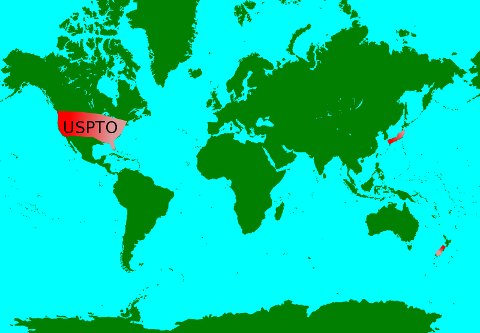
World Map patents

Summary: Reports on the continued attempts by Microsoft et al. to spread software patents to every corner of this planet

“Patents Roundup”-themed posts have become rather extinct recently, but since we view software patents as by far the greatest threat to software freedom (and over time more people agree with us), this post will provide a quick summary of news of relevance. Special gratitude goes to the likes of the FFII and Digital Majority, who help collect reports and research of interest.

United States

Let us start with the United States because this is the country where software patents are bred and spread to other countries.

“NYTECH.org Examines Software and Financial Patents” says this new report. Here are some scary numbers, especially if one assumes that an inventor must be aware of existing patents, as well as be familiar with academic publications in his/her field (this is a problem I personally face):

In 2009, out of a total of 295,219 patents granted, only a small number were for software, databases and financial methods. This is because patenting software or a business process is open to more variables than a new invention for a machine or physical manufacturing process. At last week’s New York Technology Council panel on technology patents, speakers tried to ascertain why these types of inventions have come under question since the advent of the computer, and why obtaining a patent for them is so costly, complicated and uncertain. Their reasoning was that that in general, it’s not totally clear what the exact difference is between a concrete idea and an abstract idea.

That’s why lines are being drawn, but how? And who does it serve? A limitless patent system is exceptionally good for patent lawyers, who thrive in a landscape that invites litigation and rewards applications.

Asia

The new article “China: A Country of Imitation to Innovation?” helps remind us that decreasingly will the US maintain its dominance over rising China using all sorts of intellectual monopolies, so what’s the point of them? It’s a huge, colossal, massive bubble.

The enforcement system in China is still new and developing, but the country is dramatically increasing the number of patent filings it wants to receive (up from 300,000 in 2009 to an estimated 2 million in 2015) and adding patent examiners at an astounding pace. China will enforce intellectual property rights as soon as doing so is in its national interest. That day will come sooner than most people expect.

For American companies, they must grasp the reality that patents are local—there is no worldwide patent. Companies that view the Chinese market as important must build intellectual property portfolios in China, not just the U.S., because Chinese companies are dramatically increasing their domestic (Chinese) patent filings at a rate far outpacing the patent filings of U.S. companies.

Compare China’s 300,000 patent filings to 295,219 patents granted in the US in 2009. It’s very revealing what goes on here.

Over in Vietnam, Doan Hong Son (from IPMAX Law Firm, i.e. lawyers) writes about all sorts of issues like TRIPS [1, 2, 3, 4] and the patent system in the EU. Doan Hong Son — like most lawyers in this position — is trying to promote the idea of software patenting in Vietnam. The title is telling because the phrase “patent protection” gets used (“protectionism” or “monopoly” would be better terms). From the article:

For instance, the Agreement on Trade Related Aspects of Intellectual Property Rights (TRIPS), an international agreement administered by the World Trade Organisation, provides that “computer programs, whether in source or object code, shall be protected as literary works under the Berne Convention”, which is the convention for copyright protection.

TRIPS does not, however, specifically exclude software from the allowable subject matter of patents.

A patent grants a limited monopoly, usually a term of 20 years, to the patent holder on an invention or idea, e.g., a new device or process that involves an inventive step that is not obvious to others skilled in the same field. While copyright protects the original expression of an idea (such as the source code or object code), patent protects the embodiment of the idea, the functional aspect of the software, independent of the form in which it is expressed. In this context, patent offers stronger protection than copyright because it may prevent others from using software embodying the same concepts, even if the software is independently developed and there is no copying of code.

[...]

In the European Union, meanwhile the European Patent Convention excludes computer software “as such” from patentable subject matters. However, that does not mean that patent protection is not available to computer software that meets the conditions of an invention, i.e., being new, having a potential industrial application, and involving an inventive step.

[...]A reading of Viet Nam’s Law on Intellectual Property would suggest that only copyright protection is available to software. Article 14 includes “computer software” as one of the “forms of copyright-protected works”, while Article 59 specifically excludes “computer software” from “subject matters” eligible for patent protection.

However, similar to other countries, some computer-related patent applications may still be granted so long as they are presented as a process (implemented via computer software); the process includes a machine, computer or other equipment; and a physical transformation takes place or some tangible/visible results are obtained. In fact, the National Office of Intellectual Property has granted a number of software-related patents, including a patent for “a system for payment by electronic means” and a patent for a software-related system for generating and facilitating the display of high-quality images in a web browser.

Europe has just loopholes, but on paper at least, software patents still have a mountain to climb.

New Zealand and Australia

It is the same in New Zealand (as in Europe) and over in Australia people are setting up new initiatives to drive software patents away. From the latest such effort: [via Dr. Glyn Moody]

Following on from the success of the letter to Kim Carr, signatures are now being collected on a paper petition to the Australian House of Representatives. This petition formalises our request to the parliament. Parliamentary rules require original signatures on paper.

Please sign the petition at an event such as Richard Stallman’s speeches in Australia or Software Freedom Day. Please download and print a copy of the petition and help collect signatures at your workplace or other local events.

Europe

The loopholes which exist in New Zealand and in Europe need to be closed, but there has been something rather rotten (general distrust) in the Commission recently. The Establishment press in the US rightly gives the Commission some scrutiny over the issue while the EPO keeps celebrating a sharp rise in patent applications (which may mean very much the opposite of innovation and rise of protectionists instead). This class partisanship in no way can be viewed as beneficial to the market at large. The European Parliament is meanwhile “fast-track[ing] vote on EU patent” according to a report which echoes what we wrote earlier this month:

The European Parliament will tomorrow (27 January) give its first green light to 23-country enhanced cooperation for the European patent, confirming a fast-track approach chosen by the European Commission despite a number of unresolved controversial issues.

The FFII cheerfully states:

Euractiv quotes #FFII procedural objections to the Unitary Patent http://bit.ly/i0E1DY

For those who are interested, the full text of FFII’s press release is available in their site, starting with:

The European Union advances on a super-fast track on the “enhanced cooperation” for unitary patent protection among a coalition of the willing after an envisaged Community Patent has once again failed to reach consensus in the Council, attributed to the linguistic divide.

Miscellany

The FFII’s president shares some more news links, such as “Secretive Company Sues The Cable Industry, Claiming It Owns Patents On VOD”; “Patents: Nokia GmbH and Others v IPCom GmbH & Co. [2011] EWCA Civ 6 (20 Jan 2011)” and “Judge says Apple, RIM not violating Kodak patent”. “Kodak loses initial patent battle against Apple and RIM,” says one report on this latter subject, which is not so much about software patents but is relevant for other reasons.

CAMERA MANUFACTURER Kodak has lost the first round in a patent infringement complaint it lodged against Apple and Research In Motion (RIM) almost a year ago.

Way back in February of last year the US International Trade Commission (ITC) launched an investigation into mobile phone digital camera components from Apple and RIM that bear a striking resemblance to Kodak’s. But after nearly a year’s deliberation the ITC has ruled against Kodak’s patent violation case.

Kodak is the classic example of a company that chose patent litigation over innovation. We covered this a month ago and generally watched the company in [1, 2, 3, 4].

The bottom line is, patents are a protectionist’s tool for ever-demising companies to extort their competitors when they win. Lawyers are just the cost of doing ‘business’ like that (Microsoft is choosing such a strategy right now) and when anti-patents companies/startups like Twitter get “sued over ‘community’ patent”, it is clear that software patents are not for the ‘small inventor’, they are for the software oligarchs (IBM, Apple, Microsoft, and so on). Software patents are not just a nuisance, they are one of the biggest threats to software development in general, be it free/libre or proprietary.

Share this post: These icons link to social bookmarking sites where readers can share and discover new web pages.
  • Digg
  • del.icio.us
  • Reddit
  • co.mments
  • DZone
  • email
  • Google Bookmarks
  • LinkedIn
  • NewsVine
  • Print
  • Technorati
  • TwitThis
  • Facebook

If you liked this post, consider subscribing to the RSS feed or join us now at the IRC channels.

Pages that cross-reference this one

What Else is New


  1. Links 23/5/2012: printerd, Mageia 2 Released

    Links for the day


  2. Links 22/5/2012: Google/Motorola Deal Secured, Chrome Passes IE

    Links for the day


  3. Links - Explorer Goes Down, Oracle Judge is Coder


  4. Links 21/5/2012: Linux 3.4 Released, Dream Studio 12.04

    Links for the day


  5. Articles Against Software Patents and Patent Trolls

    An accumulation of recent articles on matters such as patent trolls, which mostly use software patents based on a recent survey


  6. New Zealand (NZ) Patent Debates Expand

    The kiwi (NZ) press turns its attention to a patent controversy other than the question of software patenting


  7. AOL Helps Microsoft Infiltrate, Harm Open Source Communities, Feeds Facebook With Google-Hostile Patents

    Microsoft is preying on AOL funds and patents


  8. 'Piracy' and 'Discount' Propaganda Used to Kick Free Software Out of Governments in Favour of Microsoft Deals

    A look at new tactics and moves which omit freedom and autonomy from nations foreign to Microsoft


  9. Sun: Interoperability More Important Than Patents

    An old position paper from Sun Microsystems helps shows a certain resistance to patents such as those which Oracle uses against Android


  10. In Motorola Case, Microsoft Boosters Use Slashdot for Anti-Linux/Android Patent Propaganda

    Covering what's right/correct -- not what's wrong/incorrect -- about the Microsoft case against Motorola/Android


  11. Microsoft Tax on Everything

    The company which hardly pays any tax is busy trying to tax GNU/Linux, Android, and all hardware in the OEM channel


  12. Links 19/5/2012: Mandriva Linux Freed, New Linux Mint RC

    Links for the day


  13. Apple Patent Wars Make Android Devices Less Attractive, Everyone Suffers

    Bits of patent news regarding Apple and its patents


  14. Defeat for Software Patents in the United Kingdom

    Wise words from a prominent Linux figure and news from the UK


  15. BSA and IDC Systematically Lie to the Public, Distort Press Coverage

    IDC and the Business Software Alliance (BSA) liaise once again in order to give ammunition to lobbyists of proprietary and copyright conglomerates


  16. Links 17/5/2012: “Bio Computer” Runs Linux, Raspberry Pi Grows

    Links for the day


  17. IRC Proceedings: May 11th-May 16th, 2012

    IRC logs for May 11th, 2012 (and subsequent days until May 16th)


  18. IRC Proceedings: May 5th-May 10th, 2012

    IRC logs for May 5th, 2012 (and subsequent days until May 10th)


  19. IRC Proceedings: April 29th-May 4th, 2012

    IRC logs for April 29th, 2012 (and subsequent days until May 4th)


  20. Android Under Patent Attacks From Nokia, Microsoft, and Oracle

    A roundup of patent news involving Android and the US patent/copyright system, which facilitates ridiculous patents or lawsuits over APIs


  21. Helping OpenSUSE is Helping Microsoft Tax GNU/Linux

    A short wave of calls to refrain from OpenSUSE promotion, which through the upstream is helping Microsoft, the sponsor


  22. Microsoft May Face Federal Action for Blocking Rival Web Browsers on ARM

    Mozilla's call for action is taken seriously by people at The Hill (Washington)


  23. Links 16/5/2012: 125,000 GNU/Linux Machines for Pakistani Students, Android 4.0 Rollouts

    Links for the day


  24. Links 15/5/2012: Linux 3.4 is Near, Mandriva to Have More Releases

    Links for the day


  25. Links - TPP Meeting Infiltrated, More Protest Needed.


  26. Europe Rules Against Monopolies on APIs

    The case against Android notwithstanding, the highest European court rules that APIs cannot be covered by copyrights


  27. Microsoft Versus Education

    A bit of news/commentary on Microsoft in education (indoctrination)


  28. Patents Are Never 'Open Source'

    The disinformation tactic which ascribes patents to FOSS as seen in the news


  29. Signs of Progress: Work for Microsoft, Get Ostracised From Panels/Public Consultations

    Convinced monopolist Microsoft has its moles' voice invalidated, based on the conflict of interest (Microsoft versus the public)


  30. Links 14/5/2012: Linux Kernel 3.3.5, Wine 1.5.4

    Links for the day


RSS 64x64RSS Feed: subscribe to the RSS feed for regular updates

Home iconSite Wiki: You can improve this site by helping the extension of the site's content

Chat iconIRC Channel: Come and chat with us in real time

Recent Posts