
Bonum Certa Men Certa

Media Hostility Towards Patent Reform in the US, Software Patents on the Chopping Block

Remember that the EPO, a serial corrupter of the media, paid the Financial Times for puff pieces, e.g. regarding the UPC [1, 2]

Financial Times on patents
Contrary to the headline, Rana Foroohar advocates a worse US patent system


Summary: In spite of growing levels of productivity (or so-called 'innovation') after Alice, PTAB etc. voices of litigation -- not reason -- try to push things back to the golden era of patent trolls

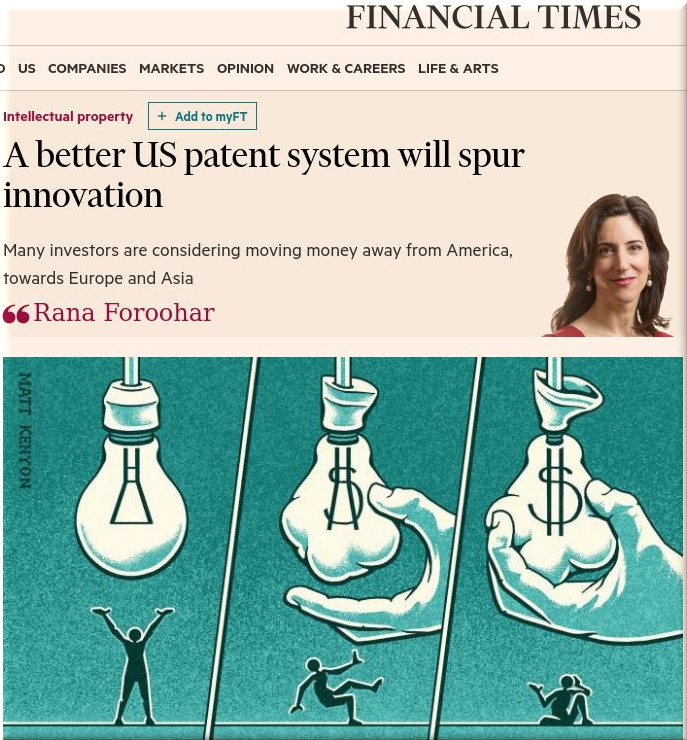
"Abetter US patent system will spur innovation," says a new headline from the Financial Times this weekend (behind paywall, use Google cache to bypass it). The title is very misleading. One may be tempted to think that it's pro-innovation, but it's actually pro-patent maximalism. It states that some "companies have business models that are very different from, say, life sciences companies or small software suppliers that depend on one or two patents. The iPhone, for example, incorporates technologies involving thousands of patents."


Many of these are hardware, design and software patents. And prices of phones have been artificially inflated, so some are incredibly expensive. Priced out of reach to most.

Here are some portions from Rana Foroohar's article, which is an attack on the status quo and a faint praise for corrupt people like Randall Rader (anti-PTAB, pro-trolls, pro-software patents) and officials-turned-lobbyists like David Kappos:

A number of companies began lobbying for even more anti-patent legislation. A worried Mr Kappos pushed back, but was eventually replaced by Michelle Lee — Google’s own former head of patent strategy. In recent years, the PTAB has become a “powerful shield” for those accused of patent infringement, leading former chief judge Randall Rader, who led the court in charge of patent appeals, to label it the “death squad” for IP.

Pushing back on patents has been great for Big Tech, which of course has its own IP to protect, but increasingly monetises data and IP created by others. But the US software supply chain, as well as life sciences, have been collateral damage. While the complexity of global business makes it tough to show clear causality between lax patent protection and the loss of innovation and jobs in the US, the trend lines do not look good. According to one study, the shifts in patent regulation have cost the US economy $1tn. Venture capital money into biotech is sharply down from 2015 to 2016.

Anecdotally many investors say they are considering moving money away from the US, towards Europe and Asia. That is worrisome, since these are exactly the kind of highly skilled jobs that the US should be looking to keep.

Still, the pendulum may be about to shift again. The Trump administration has nominated Andrei Iancu, an LA-based lawyer who has worked with clients in both pharma and Big Tech, to be head of the USPTO. The US Supreme Court will also soon hear a case questioning the legality of the entire non-court patent adjudication system.

It will be a chance for lawmakers to think about exactly what kind of digital ecosystem they want to create.


Foroohar went on to pushing the "China!" nonsense too. Like a megaphone of patent extremists.

"...now that the US Supreme Court €§ 101 is used to invalidate software patents every single week if not every single day it is getting difficult to deny a post-software patents reality in the US."What about software patents?

Well, Jeffrey Rowe, who says he "has more than 40 years of experience in all aspects of industrial design," wrote about the subject of software patents in the context of the USPTO. Having added Torvalds and Stallman videos to his article, he said this just before the weekend:

A couple years ago I got into a pretty heated discussion with a staffer from an engineering software company about whether software patents were still relevant (or is they ever were to begin with).

While proponents (usually with deep pockets) have touted their benefits, software patents have also been used in the software industry to suppress innovation, kill competition, generate undeserved royalties, and make patent attorneys rich. So I’ll ask again, are software patents still relevant?

It’s no secret that the engineering software business is extremely competitive, as it always has been. Without naming names, the engineering software business has also proven to be a very fertile and lucrative ground for lawsuits regarding patent infringement, reverse engineering, and outright copying and pasting blocks of code.


The latter thing is already covered by copyright law.

Incidentally, now that the US Supreme Court €§ 101 is used to invalidate software patents every single week if not every single day it is getting difficult to deny a post-software patents reality in the US.

Steve Lundberg, a longtime proponent of software patents (no, he doesn't write any software), will not cover all those cases wherein software patents collapse. Cherry-picking suits him better and the other day he covered a District Court case where a software patent remained in tact: [via Bastian Best]

The court denied defendant’s motion to dismiss on the ground that plaintiff’s network gaming patents encompassed unpatentable subject matter because the asserted claims were not directed toward an abstract idea.


If appealed upwards to the Court of Appeals for the Federal Circuit (CAFC), or even further up to the US Supreme Court, there's just about zero chance this patent will be upheld. But justice boils down to money in such a system, wherein patents are granted so easily and removing them is an expensive, laborious process which places all the burden on the defendant.

Want the "US patent system" to "spur innovation"? Then put an end to patent maximalism. Australia has done just that, having properly studied the subject (effects of patents on productivity).

Recent Techrights' Posts

Northern Africa: GNU/Linux Measured at Around 5%
by Clownflare
SLAPP Censorship - Part 159 Out of 200: Telling Courts False Information and Spoon-feeding Them Insults, Hoping or Expecting Them to Repeat These Insults
When lawyers trick courts into repeating something false
 
SLAPP Censorship - Part 160 Out of 200: In Astounding Repetition of Last Year, Brett Wilson LLP Deliberately Ignores Holidays of People It is Attacking and Crushes Principles of Access to Justice
Disconnected from the law
Links 24/08/2026: Vision and Skill, Doing Good, Chiperia Project
Links for the day
Over at Tux Machines...
GNU/Linux news for the past day
IRC Proceedings: Sunday, August 23, 2026
IRC logs for Sunday, August 23, 2026
Gemini Links 23/08/2026: Turning 60, PineTime, and Simulation Hypothesis
Links for the day
Will Your "Modern" New Car Still be on the Road in 2060?
Are people now expected to change a car as often as they replace a mobile phone and, if so, how fast would costs add up?
The Sniff Test
Be sceptical of "CoCs"
Cloudflare Sees a Quarter of Requests in China Coming From GNU/Linux Today
Will 23% ever be the average for GNU/Linux rather than a mere peak?
You Can Lose Some Battles and Still Win the War
Winning or losing isn't something for a scoreboard
GNU/Linux Usage Measured at 23% in Russia Today
the average was almost 10%
Things Not to Fear Missing Out on
Life is too short to pay attention to social control media
Gemini Links 23/08/2026: Exercising Again, Tackling Phone Addiction, and Putting Graal Online Back Online
Links for the day
PIPs and Lawsuits: On the Future of IBM Trying to Spit Out Its Own Staff at Minimal Cost
"I'd rather be laid off than be put on a PIP"
France: GNU/Linux Averaging at 7%, Peaked at 14% Today
When will 14% be the average?
Links 23/08/2026: Water Crises, Illegal Tariffs, and Carney Confronts US Over Patent Imperialism
Links for the day
Links 23/08/2026: Slop "Children's Stories Contain Bizarre Patterns" and "Butterflies at the One Garden"
Links for the day
Microsoft is in Double Trouble in Singapore
Android+GNU/Linux+ChromeOS are near 20%
The Slop Industry Bribed the Media to Pretend It Has Something New and Revolutionary. Now It Bribes Politicians Too. Anything to Avoid Scrutiny and Regulation.
borrowed money has long been used to bribe the media
"AGI" is Decades Old and It Never Found a Viable Business Model or Real, Actually Useful Use Cases
I keep reminding people of local firms (right here in Manchester) doing the same thing the media now calls "AGI"...
Over at Tux Machines...
GNU/Linux news for the past day
IRC Proceedings: Saturday, August 22, 2026
IRC logs for Saturday, August 22, 2026
Microsoft to Its Workers in April-May: You're Too Old, Go Away. Microsoft in August: Young People, Go Away.
What does this company even sell anymore?
Clownflare Data US-Centric
We are assuming that for national security reasons not many sites in Chinese (or based in China) outsource their traffic to Clownflare
Gemini Links 22/08/2026: Broken Car, Devuan, and Thundermail
Links for the day
Links 22/08/2026: Prince Harry, Elton John and Others Pay High Price for Frivolous Litigation in the UK
Links for the day
'Voluntary' Mass Layoffs at IBM/Red Hat
IBM does not want people to notice what truly goes on there
Another Round of GAFAM Layoffs, This Time Apple
Now Apple "is shutting down an entire Vision Pro team focused on developing gaming features for the mixed-reality headset."
Gemini Links 22/08/2026: The Bodyguard (1992), Minimalism, Backups, and IPFS
Links for the day
SLAPP Censorship - Part 158 Out of 200: Making Alliances With Men Arrested for Strangling Women Was Always a Terrible Strategy
They work for American slop companies
Links 22/08/2026: TikTok Settles With Feds, Harms Caused by Social Control Media Gaining Attention
Links for the day
New Data Shows Microsoft's XBox is Really Dying
XBox is a "burning platform"
Over at Tux Machines...
GNU/Linux news for the past day
IRC Proceedings: Friday, August 21, 2026
IRC logs for Friday, August 21, 2026