
Bonum Certa Men Certa

Improving the US Patent Office Requires Focus on the Quality (or Novelty) of Patents, Not Just Pendency


Pendency is a measure of service levels, but not of legal certainty

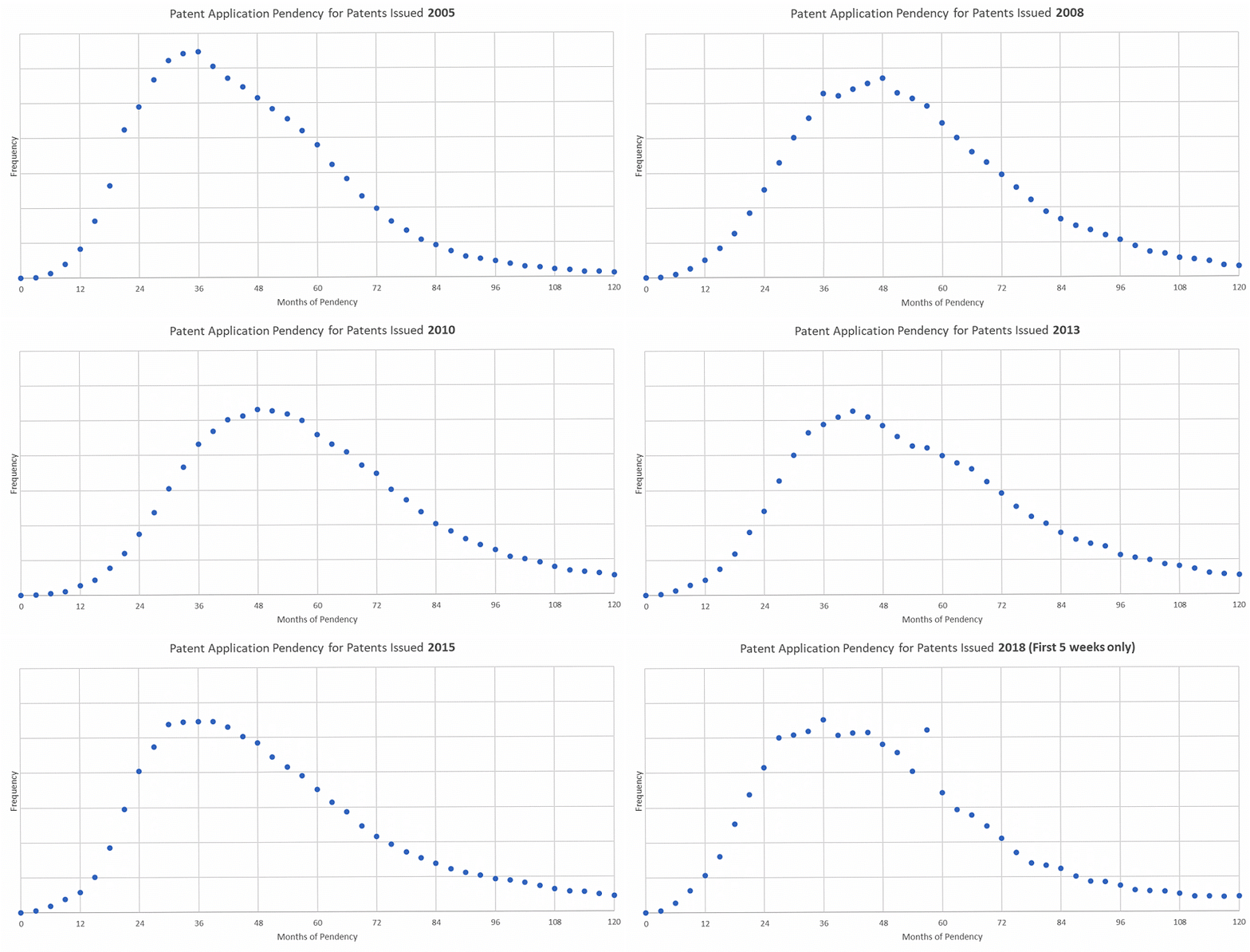
Application Pendency Since 2005
This is last night's animation of patent "Application Pendency Since 2005" (image HotLinked, not copied)


Summary: A look at tactics for patenting software at the USPTO and software patents which appear to have just been granted

THE USPTO is definitely improving, but why not strive for perfection? We are trying to help the USPTO with sincere input; we're not attacking the USPTO (or patents in general). We never did.


Why is the USPTO still granting obviously abstract software patents, even after Alice (SCOTUS)? That's what we thought upon seeing this new press release, which was later reposted in more and more sites. Isn't it perfectly obvious that these are software patents? It's barely even disguised as anything else. Wrinkl got not one such patent but three. Is someone at the Office asleep at the wheel? Or just trying to keep up with quotas? Either way, we were less surprised to see the usual articles where software patents are being disguised as "blockchain". "Blockchain Patents Filings on the Rise, Innovators Take the Lead," said one press release. "By definition," a person who promoted this press release told me, "blockchain patents are software patents. Need to see whether there is something patentable there!"

"Is someone at the Office asleep at the wheel? Or just trying to keep up with quotas?"Well, after Alice why would the courts tolerate such patents? The applicants mislead examiners through hype, hoping that some fancy new buzzwords will help old things seem rather novel. There's this new article titled "Blockchain Patents - Hope or Hype?"

To quote:

According to the Wikipedia, a blockchain is "a continuously growing list of records, called blocks, which are linked and secured using cryptography. Each block typically contains a hash pointer as a link to a previous block, a timestamp and transaction data. By design, blockchains are inherently resistant to modification of the data." And "for use as a distributed ledger, a blockchain is typically managed by a peer-to-peer network collectively adhering to a protocol for validating new blocks. Once recorded, the data in any given block cannot be altered retroactively without the alteration of all subsequent blocks, which requires collusion of the network majority." The Harvard Business Review also has an interesting article about blockchain technology.


That's just software.

There's another new article, this one titled "Internet of Things: Next Patent War Zone" (those are mostly software patents).

The Internet of Things, or IoT, has the characteristics to become the next patent war zone as new standards are adopted and the convergence of disparate technologies leads to new disputes. This convergence of technologies will likely result in an increase in litigation between both traditional competitors and companies that historically have not competed. While there are numerous legal issues associated with the emergence of IoT-enabled technology, patent lawyers and in-house counsel should be aware of three particular issues.


Disguised using buzzwords like "AI", "IoT", and "4IR" (the EPO's latest 'mask' for un-patentable things), software patents continue to be granted. Section 101 would zap them, sure, but that often requires a PTAB IPR (or European equivalents like an opposition/appeal) if not a lengthy and truly expensive court battle. The best solution is to ensure no such patents get granted in the first place (and applicants lack the incentive to even attempt that). The problem is, many patent lawyers are lying and giving false hopes to clients. They want to carry on pursuing software patents, often masquerading these using buzzwords, loopholes, and various tricks.

"They want to carry on pursuing software patents, often masquerading these using buzzwords, loopholes, and various tricks."Check out this press release titled "Call for Patents in xvc" (posted just before the weekend). To quote: "The software video compression company Divideon is today issuing a formal worldwide Call for Patents in the video codec xvc."

Those are software patents. Don't bother with this. Alice (Supreme Courts, 2014) makes them fool's gold and the only way to get something out of them is a patent troll like MPEG-LA, which effectively 'killed' MPEG as a de facto industry standard.

Recent Techrights' Posts

Over at Tux Machines...
GNU/Linux news for the past day
IRC Proceedings: Friday, July 10, 2026
IRC logs for Friday, July 10, 2026
Links 11/07/2026: Wednesday-Saturday News Catch-up
Links for the day
Prioritising High-Importance News
In order to fully catch up with news we'll not publish many new articles until next week
The Register MS: "AI" More Than 80 Times in One Article. But It's Not an Article, It's Sponsored Keyword-stuffed Page.
The Register MS is being paid to actively promoted this scheme
Over at Tux Machines...
GNU/Linux news for the past day
IRC Proceedings: Thursday, July 09, 2026
IRC logs for Thursday, July 09, 2026
Over at Tux Machines...
GNU/Linux news for the past day
IRC Proceedings: Wednesday, July 08, 2026
IRC logs for Wednesday, July 08, 2026
Over at Tux Machines...
GNU/Linux news for the past day
IRC Proceedings: Tuesday, July 07, 2026
IRC logs for Tuesday, July 07, 2026
Links 07/07/2026: Microsoft Cuts Doom "id Software" and Turkey Detains Journalists
Links for the day
Gemini Links 07/07/2026: Old Computer Challenge (OCC) and Hardware Tests
Links for the day
A Break From the Routine
What matters is what whistleblowers keep feeding information to us
SLAPP Censorship - Part 132 Out of 200: When You Cannot Pay a Million Pounds (1,335,520.00 United States Dollar) to Lawyers But Have a Strong Community
Techrights compensates for its fiscal poverty with a wealth of community spirit