If strikes and other actions did not have any impact, why would companies try so hard to prevent or stop them?
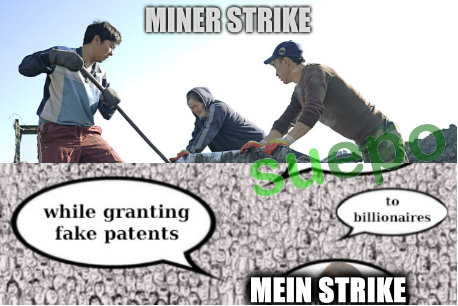
THE EPO's management, namely António Campinos and his friends (whom he hired for their connections, neither for their skills nor experience), seems desperate to stop tomorrow's strike. The "Strike Strangulation" [sic] of Benoît Battistelli was unlawful all along, but Campinos used this illegal thing for 3 years. Now he's trying to do the same thing in an ad hoc fashion. Careful what you wish for, Tony...
"The corrupt media still treats EPO corruption like it is some sort of “unauthorised scandal” which no publisher is permitted to write about."The latest "plot twist" was explained to SUEPO members earlier today. SUEPO Central unleashed the following publication, explaining that "[i]n view of the strike on 22 March 2022, Mr Campinos finally reacted to SUEPO’s claims expressed in the action plan. The industrial actions are showing their effect and have made the administration responsive. In a letter of 17 March 2022 (see Annex), Mr Campinos rejected the claims but invited on short notice SUEPO to meet members of his team. Management representatives came to discuss but were empty-handed. No progress can be reported from this meeting. However, we know that an exceptional meeting of the Board 28 is taking place today, Monday 21 March. Actions continue."
We're hereby reproducing the full text below.
21 March 2022 su22015cp – 0.2.1 – 0.3.2
Report on the SUEPO meeting of 18 March 2022
Actions continue
>In view of the strike on 22 March 2022, Mr Campinos finally reacted to SUEPO’s claims expressed in the action plan. The industrial actions are showing their effect and have made the administration responsive. In a letter of 17 March 2022 (see Annex), Mr Campinos rejected the claims but invited on short notice SUEPO to meet members of his team. Management representatives came to discuss but were empty-handed. No progress can be reported from this meeting. However, we know that an exceptional meeting of the Board 28 is taking place on Monday 21 March. Actions continue. This report provides more details.
Introduction
Management explained that the meeting should be considered as “informal” because, in their view, since the Tribunal’s judgment quashing the Circular on strikes, there is no official framework for de-escalating conflicts at the EPO anymore. We were surprised by this interpretation because the Tribunal actually found that the EPO strike regulations created a regime placing several limitations on the exercise of the right to strike (see here). In practice, these regulations did nothing else than increase conflict and resentment at the EPO.
In our view, management must consider SUEPO as a negotiation partner and enter into concrete discussions at any time to avoid industrial actions. Management admitted that the number of participants in the strike will be decisive for entering into negotiations.
On the demands of the action plan
The agenda of the meeting was set according to the SUEPO claims detailed in the action plan:
1. Revises the EPO Service Regulations so that they comply with fundamental rights and the principles of legitimate expectations and acquired rights and respect the terms of appointment of staff;
In the meeting, we explained that since 2012, the EPO has put in place illegal reforms, some of which were already considered by the Tribunal to breach the fundamental right of freedom of association (strike regulations, “social democracy” reform). In our view, it is time for the EPO to revise upfront its Service Regulations and not to wait for further ILOAT judgments. We cited in particular the Investigation Guidelines since 2012, the New Career System since 2014, the Sick Leave and Invalidity Reform since 2015 and the Salary Adjustment Procedure since 2020. We enquired in particular whether the EPO made any corrective action in the Investigation Unit after it was found to have unlawfully charged a single mother with babies (at the material time) with fraud by making an unfair and distorted analysis of the facts (see Judgment 4491).
Concerning the Investigation Unit, management refused to discuss in the meeting what it considered to be just an individual case. Concerning the New Career System and the Sick Leave and Invalidity Reform, management explained that for the time being, the EPO felt confident with positive opinions of the Appeals Committee (ApC) and saw no need for action.
We point out that the ApC had failed to identify the EPO’s breaches of the fundamental right to freedom association now clearly confirmed by the Tribunal (see Judgments 4430 and 4482). We strongly opposed the general attitude of the EPO since 2012 which consists in testing the limits of Employment Law and to feel only governed by the Tribunal.
2. Restores a deterministic career system including at least a seniority-based advancement along the standards of International Organisations and respecting the rights and legitimate expectations of EPO staff;
The Career System of the EPO is competition-based with no equivalent among International Organisations. In the meeting, we recalled that back in 2014, management explained in the Working Group that “if a staff member does not produce, he/she will not get a step”. The experience has now shown that even if a staff member performs, he/she does not necessarily get a career progression. This shows that the Career System is inherently dysfunctional and cannot be solved with quick fixes.
In addition, we explained that the punitive and arbitrary aspects of the system take in place more than ever. As more and more staff members have reached the last grade and step in their job group and are hence not eligible to steps and promotions anymore, their younger colleagues see their career opportunities being reduced because the percentage of 60% applies among those eligible only. We pointed at the quality of grants which fails to increase above 78% because of the “rat race” for rewards and the drop of production figures showing a general demotivation among staff. The more staff performed, the more detrimental reforms were imposed on them. What is the point in continuing to perform then?
Management answered that they pay attention to the results of Quality Audits and intend to put a strong focus on the motivation of staff. We asked that the administration urgently revives the Working Group on Career & Performance Management
3. Suspend the implementation of the “exception clause” and the “sustainability clause” of the new salary adjustment method with retroactive effect from 01.07.2019
In the meeting, we detailed again the flaws of the new salary adjustment procedure at the EPO which does not respect purchasing power parities and causes a detrimental loss of purchasing power for all staff at a time of high increases in costs of living. We explained that this method has no equivalent among International Organisations and that with its general freeze of salaries, the EPO scores below all benchmarks and treats EPO staff as third-class civil servants.
Management admitted that in some organisations, there are mechanisms to adjust salaries (even in the middle of the year) in the case of high increases in costs of living, but that such mechanisms are absent in the new procedure at the EPO. Management just repeated that the new procedure is in place for 6 years and pretended that nothing is possible before the end of its application. Management added that a procedure is there to avoid yearly discussions on salary adjustments. We note that in practice this new method triggers yearly unrest, yearly litigation and yearly strikes. It is high time to do something about it.
In the meeting, we referred to the letter dated 17 March 2022 of Mr Campinos (see annex, page 2/4) which states:
“It is also important to note that should the results of the underlying salary adjustment method in a given year be above the Eurozone plus 0.2 percentage points, the difference will be carried forward and may be used to increase the salary scales every three years.”
We explained that such an adjustment of the salary scales after three years was claimed by the staff representation in 2021 and the President had rejected the proposal. This new statement comes now in a letter of Mr Campinos in which the Administrative Council was in copy.
4. Reviews and eliminates the detrimental effects of the Education Reform.
In his letter of 17 March 2022, Mr Campinos attempted in a demagogic way to distort criticism of the Education Reform as being an opposition to equal treatment of national and non-national staff. It also pretended that the reform was globally balanced in terms of budget. This is entirely false. SUEPO had actually in the past supported litigation of non-nationals to become eligible to the scheme (see su08012mp) and it is the EPO which had vigorously opposed it in front of the Tribunal (see Judgment 2870). The Education Reform actually intends to make savings by reducing the yearly budget in the long-term by -4.8%, namely € -3.7 million (see CA/7/21, par. 59) and the decision was taken to do so at a time families were struggling with home-schooling during the pandemic.
In the meeting, we stressed that the ceilings for the reimbursement of childcare and education facilities, as well as for indirect costs are subject to a yearly adjustment according to the calculation for salary adjustment procedure. However, the freeze of salary adjustment has also frozen the ceilings at a time childcare and education costs for parents have increased. The situation concerns all places of employment. We pointed out the discrimination between sites created by the reform in view of the huge impact on staff in The Hague.
Management explained that they would agree to “have a look at individual cases” and asked for further information. But in their view, difficulties in the implementation of the reform are mainly linked to the “generous” transitional measures put in place. In our view, transitional measures are a right stemming from the legitimate expectations of staff and the problem is not the one of individual cases. What is required is a general increase of the ceilings. Finally, the reform remains difficult for staff to understand, especially because of the lack of clear definition of direct vs indirect costs.
Conclusion
After ignoring the industrial actions since 22 February, Mr Campinos has finally sent management representatives to a meeting conveyed at the last minute before the day of strike. Mr Campinos was not present in the meeting although his mandate is to restore social dialogue at the EPO and has not talked to SUEPO since November 2020. This first meeting did not bring tangible results as management did not table any concrete proposal yet. However, the actions have made the administration responsive and triggered discussions with the Council.
It is worth noting that management admitted that the number of participants in industrial actions would be decisive for on-going negotiations with SUEPO. The message is clear. If staff wants to improve their working conditions, staff must keep up the pressure.
Participate in the actions and strike on Tuesday 22 March. Defend your rights. Together we are stronger.
SUEPO Central
Date: 17.03.2022
Mr Ion Brumme Acting Central SUEPO chair By email: central@suepo.org
Your letter dated 22 February 2022
Dear Mr Brumme,
Thank you for your letter informing me of the outcome of the recent SUEPO ballot. We have taken note that 84% of the participating 1100 SUEPO members have voted in favour of action, which corresponds to less than 15% of our colleagues in the Office.
From the very outset, we would like to state that the Office fully supports the right of all staff to strike. While there are already many ways for colleagues to provide feedback - such as bilateral meetings with line management, Staff Feedback Schemes, staff consultations on specific issues, not to mention representation by elected Staff Representatives - the right to strike provides an additional avenue for our colleagues to make their voices heard.
However, while the Office supports this right entirely, the actual decision to strike must always be seen as a last resort. We would therefore like to respond to the subjects outlined by SUEPO. In this case, SUEPO has based the call for strike on four demands to the Office: revising the Service Regulations; restoring a career system with seniority-based advancement, suspending the new salary adjustment methods’ exception clause and sustainability clause with retroactive effect from 01 July 2019, and reviewing of the childcare and education reform, that has been adopted last year.
Firstly, we would like to underline that securing the long-term financial sustainability of the Office is at the heart of the reforms undertaken in recent years. As you are well aware, a funding gap of 5.8 billion Euro between our assets and liabilities was set to emerge in the 20 years following the 2019 Financial Study. As a self-funded organisation we have a responsibility to ensure that this gap is addressed, in order to guarantee our independence. Furthermore, we have a responsibility to address these liabilities so that we
are always in a position to meet our obligations to former, present and future generations of colleagues, and their families. They depend upon the Office’s financial health to provide a competitive and full social package and our responsibilities are also only set to grow further.
Contrary to SUEPO’s public claim, the original coverage gap of EUR 5.8 billion has not yet been met in its entirety. It remains substantial. However, the efficacy of the financial measures together with the evolution of the financial markets has helped to reduce the original gap between our assets and liabilities by around 50%, as we shall report to the Administrative Council later this month. We are therefore making good progress towards our goal, generating greater security and predictability for all our colleagues in what can only be classed as extremely volatile financial times – of which SUEPO, its members and indeed all staff are well aware in light of the pandemic and now, added to that, further global uncertainty caused by the conflict in Ukraine.
Among these measures, we would like to remind you that the Salary Adjustment Method adopted by the Administrative Council in 2020 is based on the method previously in place, and considers inflation, purchasing power parity and the increase in civil servants' salaries. The Office has kept the underlying method for the calculation of the salary adjustment and only caps the growth by the Eurozone inflation at plus 0.2 percentage points. Our income grows with the Eurozone inflation and so it is only prudent that our cost increases with the same level of inflation.
It is also important to note that should the results of the underlying salary adjustment method in a given year be above the Eurozone plus 0.2 percentage points, the difference will be carried forward and may be used to increase the salary scales every three years.
The second aspect of the exception clause is that it was also part of the former methodology (2014-2019), and it is not a new element. This clause is based on the case that we encounter a significant negative GDP in the contracting states. In this case the increase of the salaries will be put on hold. As the GDP of the contracting states was significantly negative in 2020 (a drop of more than 3%), the corresponding increase of the salary scales will be applied after the GDP recovers the value it had before 2020’s drop.
We would also like to underline that the salary adjustment method is a six- year method, and its impact should be considered in this period. Not every change in GDP or inflation can be mirrored instantly in the salaries. It will take at least a year to be considered in the actual salary adjustment. This is particularly true in the very volatile economic environment observed over the last two years.
We have also noted SUEPO’s wish to review the education and childcare scheme, which has been in force since 1 July 2021. In this regard it is important to remember why we embarked on this journey, namely simplification and fairness. Over the past 40 years since the introduction of the scheme, it had evolved into an uneven and partially outdated set of rules. It was complex, difficult to understand and to administer, and hence resulted in persistent litigation and a high number of internal appeals. But perhaps above all, the greatest concern has been the unfair treatment of national and non-national staff which simply did not reflect today's reality.
The new scheme rectifies all these shortcomings without adversely affecting children already in the education system, thanks to the implementation of the longest possible transition period. An additional 850 school children and 450 students now stand to benefit from the new education allowance. Furthermore, we would like to mention that the reform has been globally balanced in terms of budget. In fact during the first 14 years of the introduction of the new scheme, the cost for the Office will increase by 62 Million Euros, to be offset gradually. It has never been the aim of the Office to cut the cost of the education benefit but make it fairer and more accessible to more staff.
The Office also showed its commitment to careful preparation by extending the initial timeline by six months, holding detailed technical discussions, collecting staff feedback and, as mentioned before, by devising lengthy transitional measures. The transitional measures were developed carefully to cover a complete education cycle. The social dialogue discussions proved productive in delivering higher ceilings for Berlin and Vienna, and a second higher lump sum for the Young Childcare Allowance to take into account more expensive creche facilities. The Office has also moved quickly to solve any implementation issues, such as negotiating a new invoicing system with schools and offering advance payments to parents.
We have also noted the other demands on which SUEPO action is based, such as the reinstatement of a career system based on seniority, and therefore the implicit request to abolish the merit-based elements of the new career structure. The Office does not wish to discuss a matter that was implemented over six years ago. This is especially the case given that the merit-based career system now has a safeguard to leave no one behind: the budget for pensionable rewards includes an automatic step advancement (up to the last step of the grade) for eligible staff who have not been rewarded with a step advancement or promotion during the last four consecutive years.
Furthermore, there has been consistent and open social dialogue in determining the package of financial measures, the education and childcare allowance and other reforms. To cite a few of the many examples, there were four meetings of the working group specifically on financial measures in 2019, and then a further two in the course of 2020. Five meetings of the
Working Group on Education and Childcare Allowance Reform involving Staff Representatives were held in the course of 2020. A further four meetings were then held in the course of 2021.
Despite this extensive dialogue, and on the understanding that a strike must always be a last resort, the Office is amenable to a meeting to understand SUEPO’s concerns further. Our services are in touch to find a mutually convenient time on Friday 18 March or Monday 21 March.
Yours sincerely,
António Campinos
Cc: Mr. Josef KRATOCHVÃÂL, Chairman of the Administrative Council