
Bonum Certa Men Certa

The Latest Lies About the Unitary Patent (UPC) and CIPO's Participation in Those

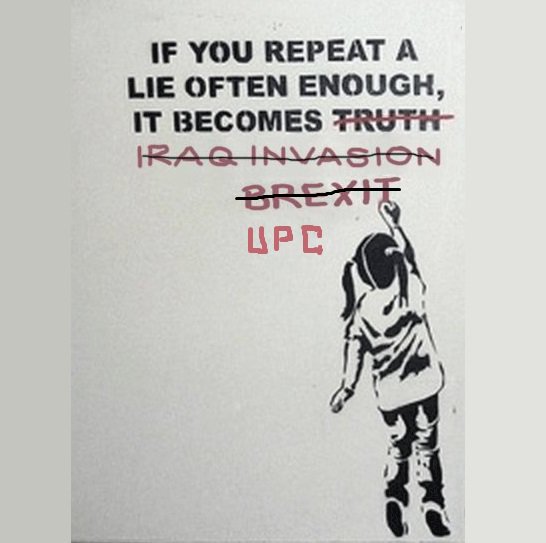
They got CETA, but they won't get UPC

UPC truth


Summary: Team UPC continues to overplay its chances, conveniently ignoring simple facts as well as the Rule of Law

THE EPO is quiet. So is SUEPO, the staff union of the EPO, whose Web site has not been updated for a while. On the UPC front, however, spin continues. Left unchallenged, some people out there might even believe it. Team UPC extravagantly lies, exaggerates, and places too much emphasis on perceived positives. Everything else is discarded, ignored, or ridiculed.

As we noted earlier this week, there's UPC propaganda coming to Canada pretty soon. We can't help but wonder, why would anyone actually pay to be lied to by Team Battistelli about the UPC in Montreal (Canada)? Maybe to make contacts/connections? A few days ago CIPO wrote: "Only 2 days left to register to the #Montreal roadshow with @EPOorg on Unitary #Patent & Unified Patent Court!"

That's just basically Battistelli's right-hand liar. She'll be spreading the usual lies there. They will have the audience believe that the UPC is coming very soon. Bristows is doing the same thing this week, with staff pretty much repeating themselves regarding Scotland (never mind the reality of Brexit).

IAM's chief editor also did his thing earlier this week. The UK-based IAM is perfectly happy that the EPO's declining patent quality (which IAM helps Battistelli deny) brings its beloved patent trolls to Europe. Joff Wild speaks of the UPC again, joined by the term "BigTech" with the usual whipping boy being "Google". Here are some portions:

And that brings me to patents. As everyone in the IP market knows, over recent year Europe has emerged as a much more important part of the equation for patent owners seeking to assert their rights. For multiple reasons – including the perceived quality of EPO-granted assets, speed to get a decision, the relatively low cost of litigating, the expertise of courts and, crucially, the availability of injunctions – the worsening environment for rights holders in the US is driving more companies to try courts in Germany, the UK and other European jurisdictions. Should the Unified Patent Court ever become a reality that process is likely to accelerate.

[...]

Where that leaves lobbying efforts that seek to water down or eliminate the UPC injunction regime, for example, remains to be seen. My guess is that as long as BigTech identifiably campaigns as BigTech it is unlikely to get much traction. Instead, what it needs are examples of small European companies falling foul of abusive patent litigants – the kinds of stories that it has always been possible to dig out in the US. The problem is that in Europe these are tough to find – precisely because the system is not troll-friendly. Getting around that may be a challenge that even the expertise of Silicon Valley’s best paid public relations advisers and lobbyists will struggle to meet.


Again, notice the term "BigTech". The patent trolls' sites (or patent maximalists) are openly demonising technology companies, e.g. those that protect PTAB. It makes it abundantly clear that they, the patent radicals, are against technology. We shall revisit the subject later this week.

The matter of fact is, UPC is a failed project. Even some insiders are willing to admit it now. The Boards of Appeal (BoA) need to stay and regulate patent quality, just like PTAB does at the USPTO. After Battistelli sent BoA judges to exile (as punishment, or simply to warn them) the EPO has the nerve to talk as if everything is fine and dandy. Earlier this week it wrote: "Oral proceedings at the new Boards of Appeal site are planned to start on 9 October" (but without independence for judges).

With Jesper Kongstad leaving in just over a week (end of this month), it remains to be seen if BoA has a future. If the UPC fails, which seems increasingly likely, many hirings will be needed for BoA (not UPC). Can the new (actually old) building in Haar facilitate growth? The only new building is in Rijswijk and Dutch media wrote about it some days ago. If there is something interesting in this Dutch article, it would be worth knowing. We try to keep abreast of the facts ahead of the 'grand' opening.

For those who are wondering where the UPC stands, not much has changed since we last wrote about it. Yesterday IP Kat summarised it as follows: "It has been confirmed that the complainant who filed the constitutional complaint against the ratification of the UPC Agreement in Germany was the attorney Ingve Stjerna. Stjerna has long been a vocal critic of the Unified Patent Court, and the complaint reflects some of his earlier criticisms."

Looking at some of the latest comments at IP Kat, people now debate whether the UPC is "an EU institution" (it most certainly is) and therefore the UPC (which explicitly requires "UK" amid Brexit) is dead by definition.

Here is a comment about that, relaying the question to the CJEU:

If it is not an EU institution, then I do not understand why in the the preamble of the UPCA the following is said:

RECALLING the primacy of Union law, which includes the TEU, the TFEU, the Charter of Fundamental Rights of the European Union, the general principles of Union law as developed by the Court of Justice of the European Union, and in particular the right to an effective remedy before a tribunal and a fair and public hearing within a reasonable time by an independent and impartial tribunal, the case law of the Court of Justice of the European Union and secondary Union law;

Furthermore Art 1 of the UPCA states: The Unified Patent Court shall be a court common to the Contracting Member States and thus subject to the same obligations under Union law as any national court of the Contracting Member States.

If I understand well, the TEU and TFEU should thus be clearly applicable. Or did I miss something?

Divisions of the UPC can bring forward prejudicial questions to the CJEU, but the the text governing the UPCA cannot be submitted to the CJEU. I fail to understand the logic behind such a position.

Could somebody explain.


They then went off on a CJEU tangent.

One person said about the UPC, "how can the provisions of that Agreement be used to “harmonise” patent law" (they can't).

Here's the comment in full:

It’s not that hard to understand, given the limits of the jurisdiction of the CJEU.

In essence, the CJEU can only review the legality of EU Treaties and the (legislative) acts of EU bodies. The UPCA is not an EU Treaty or legislative act, as it is instead an international agreement (that just so happens to be exclusively between EU Member States).

However, this is not to say that the CJEU will have no teeth when it comes to the effects of the UPCA. That is, pursuant to Article 258 or 259 TFEU, the CJEU will be able to assess whether the Member States that are party to the UPCA are fulfilling their obligations under the EU Treaties. Unfortunately for the public, however, such actions can only be commenced either by the Commission or another Member State.

This effectively means that a challenge by Spain (under Article 259 TFEU) might be the only hope of sorting out whether the actions of the UPC (or the Participating Member States) are compliant with EU law.

It remains to be seen which grounds could be raised by Spain under Article 259 TFEU. However, Article 118 (attributing the European Union with exclusivity regarding the creation of uniform IP rights) is an interesting possibility.

In C-146/13, the CJEU held that:
Notwithstanding the fact that the contested regulation contains no list of the acts against which an EPUE provides protection, that protection remains uniform in so far as, regardless of the precise extent of the substantive protection conferred by an EPUE by virtue of the national law which is applicable, under Article 7 of the contested regulation, that protection will apply, for that EPUE, in the territory of all the participating Member States in which that patent has unitary effect”.

In other words, the CJEU held that Art. 118 TFEU was not contravened because EU law (the UP Regulation) has been used to achieve (partial) harmonisation, through the designation of a single, national law.

However, this would appear to mean that failure of the UPC to apply a single, national law (as determined under Art. 7 of the UP Regulation) would therefore not only contravene the Member States’ obligations under the UP Regulation but also their obligations under Art. 118 TFEU.

This puts an interesting “spin” on the law of infringement to be used under the UPP, doesn’t it?

For a start, it would appear that the UPC would only be able to refer to the infringement provisions in the UPCA to the extent that those provisions are fully incorporated into the national law selected under Arts. 5(3) and 7 of the UP Regulation. This means that the UPC, as well as all patent attorneys, will need to become experts on the extent to which this is true in each of the relevant Member States... and also what the significance might be of seemingly contradictory / non-identical provisions in national laws.

On the other hand, it would also seem to force the UPC to issue judgements for “traditional” (not opted out) EPs on a country-by-country basis. This is because the UP Regulation does not contain any provisions on the law to be applied to “traditional” EPs... meaning that there is no basis under EU law for the law of infringement for those EPs to be “harmonised”. Also, attempts by the Member States to “go it alone” with harmonisation of the law with respect to such EPs may well contravene the provisions of Art. 118 TFEU.

To put it another way, as the UPCA is not part of EU law, how can the provisions of that Agreement be used to “harmonise” patent law (for UPs or not opted out EPs) within the EU without infringing Art. 118 TFEU?


Spain was then brought up too. "Spain could think about a further challenge the legality of Regulation 1257/2012," said the following comment.


Alternatively, Spain could think about a further challenge the legality of Regulation 1257/2012.

As previously mentioned, the impermissible, retroactive effect of Article 5(3) might be one ground for such a challenge. This is because that Article applies new / different laws (of infringement) to pre-existing patents and patent applications, as well as to acts committed prior to entry into force of the UPP. That hardly seems compliant with the principle of legitimate expectations!

Another, very interesting possibility might be alleged contravention of Article 18 TFEU (“any discrimination on grounds of nationality shall be prohibited”) by Article 5(3) of the UP Regulation.

Understanding this ground requires a little thought.

Firstly, Art. 5(3) states that the applicable law of infringement is determined by Art. 7. Secondly, the primary factor to be considered under Art. 7(1)(a) is residence / place of business. For many individual and corporate applicants, their residence / place of business will be the same as (ie equivalent to, or a surrogate for) their nationality.

Thus, the UP Regulation requires the selection of a single, national law based upon a criterion that, for many applicants, will be a surrogate for their nationality.

The final step is to realise that the national laws of infringement are not harmonised. Thus, inventors / applicants that have identical claims, but that have different nationalities, would have different laws of infringement applied to those claims (and hence potentially different results from litigation).

It really is hard to understand how this could possibly be compliant with Article 18 TFEU!


The next comment said:

If it is an EU institution why would it need its own dedicated Protocol on Privileges and Immunities ? Surely it would be covered by the EU PPI ?


Regarding the situation in Germany and the CJEU, one person said that "here we are back to the other complaints before the German Constitutional Court."

We are ahead of interesting times, and it might be possible that the CJEU considers the UPCA not in accordance with EU law. In view of the sometimes political nature of the CJEU's decisions, I doubt that it would blow up the whole system, but it could severely harm it.

In the same vein, there is a further question which could be tricky as well. If an opposition is launched against a UP, can the opposition division be composed of nationals of non EU member states?

This becomes particularly critical if the EP has only been validated as a UP.

One could consider that since the EPO regains competence by virtue of an opposition, then the composition of the OD is irrelevant.

On the other hand, one could also consider that having become, at least in some member states of the EPC which are also members of the UPC, an asset according to EU law, its fate can only be decided by nationals of member states of the EU.

If the patent is revoked, then there is no revision possible. And here we are back to the other complaints before the German Constitutional Court.

This question was raised at the latest conference on the UPC in July in Munich, and has up to now not received a reply.


More on CJEU:

"the sometimes political nature of the CJEU decisions"? Are you suggesting that the CJEU might not demonstrate complete independence from the executives of the Member States and/or the executive arms of the EU?

If there is a (perception of) lack of independence, then perhaps it is high time that someone took a close look at the conditions of appointment of the judges of the CJEU, in order to see how well the CJEU fares regarding internationally recognised "best practice" for achieving judicial independence. ;-)


Speaking of "political decisions," the next comment talked about Spain again:

I do not want to claim that all decisions of the CJEU are more of political than strictly judicial nature. It is a minority of decisions, but the manner in which the CJEU has dismissed the second complaint of Spain against the UPC is an example to me of more political decisions.

Any reason not to consider Spain's complaint were good to dismiss the claims. Some of the questions were however quite specific.

In decisions on the correct application of directives it is certainly not politic. Plenty of those have been published and commented on this blog.


The bottom line is, for those lacking the time or background to read all the above, there are multiple aspects and levels that act as barriers to UPC, ranging from central to pertinent (e.g. Spain, UK, Germany and even Poland). Don't be misled by EPO staff whose job is to lie about the UPC. No doubt the Canadian press (and maybe European press as well) will soon publish some lies about the UPC. The EPO has a sick habit of paying the media for puff pieces, including patently untrue statements.

Recent Techrights' Posts

How to Identify Demonisation or Dehumanisation Tactics Against Interesting Figures or Luminaries in Free Software
Rather than in general or generally in technology
We Should Learn From Bulgaria
Why can't European companies and government recognise and react to a threat (when they see one)?
Canonical: Ubuntu is GAFAM (US), We're Resellers of American Proprietary Software
They want people to pay for a licence
Links 03/02/2026: "Distraction is a Sin" and Fake "Encryption" (Surveillance With Good Marketing)
Links for the day
 
Keep Grinding
"Don't let the bastards grind you down"
Mobbing at the European Patent Office (EPO) - Part III - Who's Going to Pay for the EPO's Corruption? (Aside From European Citizens)
Some people inside the EPO reached out to us
"Investors Are Concerned About an AI Bubble" (That GAFAM and IBM Ride)
A few decades from now IBM will only be remembered in the same sense many so-called 'AI' companies will be remembered
EPO Staff Union: "Very High Strike Participation on Friday 30 January", Another Strike Starts 19 Days From Now
EPO management in a bit of a panic
Censorship/Free Speech and Social Control Media
It's important to have a grasp of how contemporary censorship works and how to tackle it
Google News as Slop Booster
this is what Google links to
Over at Tux Machines...
GNU/Linux news for the past day
IRC Proceedings: Tuesday, February 03, 2026
IRC logs for Tuesday, February 03, 2026
Gemini Links 04/02/2026: "Raspberry Pi Relaxes the Rules for Its RP2040 Hacking Challenge" and "Long Web Society"
Links for the day
IBM Falls by Over 10%
a recipe for disasters like accounting fraud
Links 03/02/2026: Windows Copies GNU/Linux, Windows TCO Shown Again
Links for the day
Gemini Links 03/02/2026: Alhena Turns One, Slop Rejected, and Max Roy Carrouges Recalled
Links for the day
Dr. Andy Farnell on Why and How European Authorities Can Adopt Free Software, Parenting in the Age of Digital Abundance
Will Europe use technology that Europe controls (not the hegemon), for a change?
Seems Like IBM Trolls Use Chatbots to Vandalise Platform That Discusses IBM's Secret Layoffs, Forever Layoffs
Not for the first time either
You Know Your Company is Dead or Basically a Pyramid Scheme When Jim Cramer Keeps Promoting Its Stock
How much does IBM pay for "puff pieces" or "fluff" about QC?
Red Hat (Under IBM) Works for Microsoft (Proprietary Software) and Slop
Yesterday Red Hat's official site, redhat.com, published exactly 5 new blog posts
IBM is Dying (More Layoffs), Red Hat Will Continue to Suffer From the Acquisition
Financial engineering
Colombia Adopting GNU/Linux Even Faster (at Microsoft's and Apple's Expense)
Do politics play any role in this?
An Effort to Tackle Slavery in 'Open Source' Clothing
"a civil rights lawsuit to examine the concerns of censored developers in the free, open source software ecosystem"
$15 billion lawsuit: Ubuntu, Google & Debian crowdfunding campaign launch
Reprinted with permission from Daniel Pocock
The Solicitors Regulation Authority (SRA) Delusion - Part II - Why We Need to Expose the SRA to More Daylight, Public Scrutiny
SRA is neither effective nor regulated
400-Page US Federal Court Against Abuses by Google, Microsoft and Front Groups That Abuse Volunteers for American Corporations
There are 386 pages in total (in the US claim)
Corporate Influence Never Impacted Us
There's no reason to assume we'll ever "sell out"
Growth of GNU/Linux in Cuba
Right now a lot of the world drafts or already implements a GAFAM exit plan
A Day After EPO Strikes an Escalation to Heads of Delegations to the Administrative Council
They rely on the European media playing along, helping them to hide major blunders, even crimes
Over at Tux Machines...
GNU/Linux news for the past day
IRC Proceedings: Monday, February 02, 2026
IRC logs for Monday, February 02, 2026
Gemini Links 03/02/2026: Stargazing, Development Boards, and Tcl/Tk Slop
Links for the day
Microsoft Lost 20% of Its Money in the Past 6 Months
Microsoft is hiding what's really happening while mocking critics
Great News, IBM 'Gained' Almost 10% in "Goodwill" Value After Firing Tens of Thousands in 2025
"goodwill" will be inflated despite IBM staff getting sick of IBM
Americans Move to GNU/Linux
some of the biggest American populations
I Still Like Drawing and Various Other Arts (They Help My Activism and Journalism), Slop is an Enemy of Creative People
Recognise that slop isn't intelligence; it's a generational excuse for plagiarism and privatisation of not only the Commons but also proprietary knowledge (without authorisation)
Carmen-Lisandrette Maris (Mission:Libre) Explains to Adolescents and Young Adults How Free Software Improves Privacy
Based on what we've seen and read, Mission:Libre has a solid grasp of Software Freedom
Chatbots Didn't Do Any Good for Microsoft
Google "AI" = search + copypasta
Links 02/02/2026: Cultural Cleansing by China and 'Living Behind Firewalls" in Iran
Links for the day
GNU/Linux Measured at More Than 4% in Russia
growing adoption of GNU/Linux in Russia
Gemini Links 02/02/2026: Stages of Age, Workflows, and Counting Capsules
Links for the day
Oracle's Debt Rose Over 20 Billion Dollars in Just 3 Months
Is "hey hi" becoming a synonym for debt?
Oligarchs' 'Speech Zones' Are Not the "Public Square"
The apologists of social control media, including press that got "addicted" to such fake "media", are helping dictators and oligarchs grab the public attention away from the real press
IBM Misleads and Gaslights Investors With Slop Sold as "AI" (the Business is Waning, Mass Layoffs Continue)
People who do this are dishonest. They should not be put in charge.
Links 02/02/2026: 'Melania' a Horror Movie "Will They Inherit Our Blogs?"
Links for the day
Doing More Detailed Series (Long-Form Works)
Long readings or book-like reading binges are only possible when parts are suitably labeled (name and numbers) if not interlinked
Mobbing at the European Patent Office (EPO) - Part II - Racism, Cocaine Use and White-Collar Corruption
When you hire people illegally, to work for cocaine users and keep quite about the cocaine use, what will be the impact on the reputation of an institution?
A Can of WORMS - Part II - Darkening the Name of RMS, Associating It With Crime
Beware projection tactics
Submit Your Suggestions for EU's Embrace of Software Freedom by Tomorrow
Time to leave GAFAM (US) hegemony behind
Slopless Weekend
This is not sustainable
Over at Tux Machines...
GNU/Linux news for the past day
IRC Proceedings: Sunday, February 01, 2026
IRC logs for Sunday, February 01, 2026