
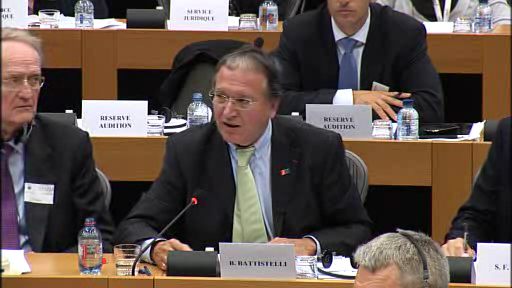
Photo via "European Parliament not fooled by hearing of the patent microcosm"
THE European Patent Office (EPO) has been controversial for quite some time. Not only EPO staff was complaining. The problem isn't SUEPO but is still Battistelli [pun intended] along with his buddies. The very fact that a clique of people managed to come into power with extreme force (Team Battistelli) is in itself a testament to the problems.
 All those years SUEPO was able to co-exist with the management, but it's only Battistelli that could not tolerate such staff unions. He added to his team a notorious aggressor who refuses to even acknowledge SUEPO's existence. He also hired notorious union busters, Control Risks.
Looking around some older material we found Senftl and Hardon v. EPO [PDF] (ILO-AT from 2010). There's a long history of scandals there and also high staff turnover (we recently wrote about brain drain, or people moving around or leaving; even the recruiters themselves may be leaving as Iris Kindl was appointed Director Procurement only this spring). Hardon, however, is one of the well known veterans, having worked there for many decades. This is what probably makes her a very effective staff representative and an attractive scapegoat to Battistelli. She has seen a lot over the many years.
One interesting finding that we've managed to net is this old press release from almost a decade and a half ago. It speaks of structural issues in the organisation. To quote the press release:
A Public Service Organisation out of control?
As has been widely reported in the last few days, the European Patent Office appears to consider itself not to be bound by European Directives. In the specific case mentioned there was an alleged contravention of the Directive on Biotechnology in relation to European Patent EP-B1 0 695 351.
The European Patent Office is not part of the European Union
Although originally intended to be the authority charged with the grant of patent rights for the European Community, the EPO was created outside the framework of the European Union. As a result, the European Patent Office is in many respects an "autonomous state", which is not bound by any of the directives of the EU unless it so chooses. The "Head of State" is the President, Ingo Kober. He is responsible solely to the Administrative Council, a body made up of representatives from the 19 contracting states who are party to the European Patent Convention. This body is not democratically elected and is accountable only to the respective national governments. As a body created by a separate international treaty this body is not directly bound to any national or international law other than the European Patent Convention, the EPC.
Further loosening of democratic control is contemplated
This Administrative Council is currently contemplating far-reaching changes to the Eurpoean Patent Convention. These changes will effectively mean that in future the Administrative Council can decide autonomously on the future direction of the law governing the award of patent rights in Europe, and the very law by which it is governed itself. No agreement by the European Parliament or any other publicly accountable European organisation will be needed and, as in all deliberations of the Administrative Council, many of which are held in secret session, there will be no participation of society at large. This opens the door to uncontrolled wide-ranging changes to the European Patent System. Recent events suggest that these changes may be against the interest of European citizens.
The Administrative Council already fails to defend the interests of the European public
The Administrative Council has put the Office under pressure to grant patents as fast as possible, without, however, creating the conditions that would make it possible to recruit the necessary staff. This means that the existing staff, already working to their full capacity, are being put under pressure to examine cases faster and faster. With less time being allowed to consider the complicated technical and legal questions which arise in patent examination, it is to be feared that the standards applied will drop. Statements in the press attributed to an EPO spokesman acknowledge that increasing production pressure can indeed lead to errors. See for example:
http://news.bbc.co.uk/hi/english/uk/scotland/newsid_653000/653067.stm
www.tagesthemen.de/archiv/2000/02/22/sendung/tt-2230/meldung/gene.html
This could in turn lead to a larger number of patents of dubious validity ("junk patents"), thus impeding fair and open competition in the European Market, and hence threatening the employment market in Europe. This is however simply the tip of the iceberg. Lack of legal security for staff threatens standards The EPO is not bound by many of the laws or regulations that most of the citizens of Europe take for granted, such as the European Convention on Human Rights.
Some examples:
- The Employment Law offers the staff extremely limited protection. Staff can be dismissed almost at will by the President and have no claims to unemployment pay or other social security payments:
- Basic legal rights are ignored. The President is the ultimate ruler of the EPO. He is judge, jury and executioner. His decisions on matters within the office are final. Any decision made by the President can be enacted immediately. There is no "stay of execution" pending the outcome of appeal hearings. Sanctions are arbitrary and harsh. This makes the staff extremely vulnerable to pressure from the management in order to meet demands, e.g. by increasing output to a level beyond which it is possible to assure sufficient attention to detail.
- European safety and health standards are not applied on EPO premises.
- Even criminal law is disregarded: In 1995 the then President of the EPO physically attacked and injured a staff member, the Administrative Council of the EPO subsequently refusing to lift the immunity of the President.
Conclusion
The Administrative Council has shown a tendancy to treat the office as a commercial entity rather than as the public service organisation it is. This results in the continuing demands for ever more granted patents, while refusing to increase the resources of the European Patent Office accordingly. SUEPO, the Staff Union of the EPO soundly condemns this development due to the risks it poses to the quality of patent rights granted in Europe. It is high time that steps are taken to change the structure of the Organisation making it accountable for its actions to the citizens of Europe and their elected representatives.
On June 19th the staff of the EPO in Munich striked (photos…) against the undermining of the European Patent System by the body entrusted with its governance, the Administrative Council. Simultaneously there was a demonstration held in Bern, in front of the Swiss Patent Office - home of Mr. Grossenbacher, the Chairman of the Administrative Council. National and individual interests (many of which financial) are dominating the decision making process and making it increasingly difficult for staff to maintain a high quality output of valid patents. The issue of governance of the EPO and its effect on the future of the European Patent System is a topic of heated debate.
[PDF] is still online and it says:
Suepo: What effects (advantages / risks) does this combination of functions in a national and European offices have?
Francis Hagel: There are pro's and con's in any governance system. Certainly the fact that members of the Administrative Council are heads of national patent offices interested in the transfer of workload from the EPO raises a conflict of interest when such transfer is discussed by the Council. This may provoke criticism. However, the question is : what is the alternative ? A significant advantage of the current system, on the other hand, can be seen in the fact that the members of the Council understand very well the patent system and the operation of patent offices. Replacing the heads of national patent offices by public officials unfamiliar with the patent system and the operation of patent system, or involving the EU institutions in the governance of the EPO, could entail serious risks for the EPO.
[PDF] the following:
3. Internal EPO structures
The Administrative Council runs the EPO together with the President. Most of its members work at national patent offices.
What effects does this combination of national and European offices have?
Professor Harhoff: It is undoubtedly good that the European Patent Organisation benefits from the experience of national institutions and experts. However, there are problems, on principle, with the fact that the EPC contracting states, or rather their national offices, profit financially from EPO-granted patents by virtue of their 50% share of the renewal fees, yet simultaneously would have to approve any measures leading to a greater focus on quality and thus to fewer patents. That is indeed an unsatisfactory situation requiring correction in the long term. The whole fee system is characterised by cross-subsidisation: expensive examination is partly financed by renewal fees. That of course creates incentives to grant as many patents as possible. The Academic Advisory Council report did in fact criticise this.
[PDF] (it's concluding with "The Central Executive Committee"). It is an interesting one that says:
(3) What should the relationship between the EU and the EPO look like?
[…]
From my experience over the last forty years, I can only warn against diluting that clear position, e.g. by making the EPO a subordinate EC agency. The Organisation would then forfeit its budgetary independence, which has so far ensured both Office and staff virtually ideal conditions in technical, accommodation and manpower terms. This would also put paid to any prospect of achieving a comprehensive and efficient European patent system including the post-grant phase as has been conclusively shown this past year by the EC's renewed failure to create a Community patent.