The patent microcosm is hopping mad and in denial over it
Summary: A closer look at the latest historic decision on software patents and other news serving to cement the end of software patents in the United States (provided the cases are appealed upwards)
THE USPTO is gradually departing from software patents, whereas the EPO goes the other way. Does that mean that elimination of software patents in the US would not be sufficient in extinguishing the scourge of software patents worldwide? Maybe. But at least progress is being made in the birthplace of software patents. Today's article binds together many bits of coverage, focusing in particular on the Court of Appeals for the Federal Circuit (CAFC).
There are many ways by which to weaken or thwart patent litigation. One such way, as
noted the other day, is blurred allegations. As
Patently-O put it, "Lyda appears as a narrow decision against an individual-inventor plaintiff, the decision is important because it establishes that a patent infringement complaint must provide factual allegations at the claim-element-by-claim-element level in order to avoid a dismissal on the pleadings."
Distracting From Haldane Robert Mayer
What is more interesting, however, is dismissal based on the two-step analysis -- something which has happened a lot since
Alice and we wrote about thrice since a decision was handed down by Judge Haldane Robert Mayer of CAFC. We are hardly shocked to discover the patent microcosm either refusing to write about it or simply attacking the judge, as we shall show later. Robert R. Sachs of
Bilski Blog seems to be among those who simply said nothing about it. Instead, quite a while after the decision from Judge Mayer, he instead
wrote about a bundle of cases in favour of software patents. To quote: "For patent prosecutors, MAZ, along with DDR, Enfish and McRo, suggests the value of discussing in the patent application specific problems in the prior art and linking aspects of the claimed invention to their solutions. The general trend over the past several years has been to say less in the background and summary of invention. That is still good advice, and these cases do not contradict that view, as the underlying patents provided very short and concise statements of the prior art problem, not lengthy expositions. Prosecutors that draft only a trivial background and little or no summary of the invention may end up removing an important basis for establishing eligibility and defeating an early dispositive motion. If the motivation for this approach is the risk that the background and summary will narrow the scope of the claims, I would say better a slightly narrowed patent than none at all."
David Kappos Still Lobbying
What is worth noting here is that patent attorneys and lawyers are still looking for ways to work
around the law and patent software
in spite of the rules. Here we have some patent law firms scrambling to find tricks for patenting and asserting software patents; see
"4 Tips For Overcoming 'Abstract Idea' Rejection" or (less relevant)
"Anything You Say Can and Will be Used Against You in a Court of Law". It's part of a pattern. They write many articles about it and even set up events on the subject. One new event from IAM, advertised just before the weekend, targets patent maximalists and features a corrupt judge, Rader, and an official-turned-lobbyist,
David Kappos. IAM 'magazine', one might note, evidently doesn't keep good track of judge names; they spell a key name with a typo, "Radar", not Rader. To quote the event's overview: "Are patents in the United States dead? Should US companies continue to file US patents? What are the right innovation policies for the United States? What is the right thing for small companies to do in patenting their innovation? How will investors look at patenting in the future? What is happening elsewhere in the world? Come and join this critical discussion with Radar, Kappos, Schramm, Cabeca and others."
Kappos is, in our view, the most corrupt public official in this domain, turning from a public official at the Patent Office into a corporate lobbyist for Microsoft, IBM, etc. Are they not at all regulating what people do after their service at the PTO? Is there no cool-off period? Nothing? Watch
this news article entitled "Kappos: McRO is CAFC’s “most important 101 case since Alice”". To quote:
"McRO gets to the core issues and for that reason I thought it’s clearly the most important 101 case the Federal Circuit has put out since Alice" - David Kappos"I didn’t see a tremendous amount of the principle or the reasoning in those previous cases," David Kappos, partner at Cravath Swaine & Moore
This doesn't disclose that he's also a lobbyist. Cravath Swaine & Moore is not his sole source of income.
CAFC said copyright should be enough for software, but this continues to be ignored by Kappos and the rest of the software patents boosters, who develop no software at all. They just lean on cases like
McRO even a month later.
PTAB is Still Invalidating a Lot of Software Patents
According to
this page from the USPTO and
an article about it, PTAB fees might soon go up. PTAB has played an important role in improving the USPTO (well, at least quality is improving), but a rise in fees would discourage appeals; the
same thing was attempted at the EPO. It has meanwhile turned out that
the (in)famous appeal from Kyle Bass (the patent microcosm calls “trolls” those invaliding patents, as in this case where they used to dub the appellant "reverse troll") was not successful. The appeal was not about software patents however.
Michael Loney of MIP
shows that PTAB continues to invalidate software patents at a steady pace; there are no signs of stopping or slowing down. There are charts in the page that says:
Managing IP reveals Patent Trial and Appeal Board filing figures for September and the third quarter, as well as ranking the top petitioners and patent owners for the first nine months of 2016. More PGRs than CBMs were filed for the first time ever in September
The third quarter has ended with 454 Patent Trial and Appeal Board (PTAB) petitions filed, down only slightly on the 459 petitions filed in the second quarter.
Expect this to carry on for quite some time because
SCOTUS certainly isn't overturning
Mayo and
Alice. As one article put it the other day (in the headline),
"The Supreme Court Refuses To Consider Patents Invalidated Under The Mayo/Alice Framework". It's just done with that and given how long it has been since
the Bilski case, it might take another half a decade before anything can really change (or reconsidered).
Copyrights -- Not Patents -- for Software
The main theme in this past week's news about patent was something along the lines of Haldane Robert Mayer's ruling, which we covered here several times before. He asserted that copyrights should be sufficient in the domain of software and a new article entitled
"Copyright Tools for Protecting Software" got published. SCOTUS "limited the field of software patentability," it says, hence software developers should focus on copyright, not patents. To quote from the article:
For businesses that run on software, protecting intellectual property is even more important than locking the office door at night. IP protection in the United States comes in many forms, including patents, copyrights, and trade secret laws. Patents have long been considered the gold standard in intellectual property, in large part because they protect inventive concepts and are not limited to specific expressions. However, software companies should think beyond patents in protecting their IP, especially since the Supreme Court in 2014's Alice Corp. v. CLS Bank International, 134 S. Ct. 2347, limited the field of software patentability, and the Post Grant Review system installed by the America Invents Act (Pub. L. 112-29) invalidates more software patents by the day.
Regarding the ruling from Haldane Robert Mayer, it was everywhere in the news and people also brought that up in our IRC channels. Consider articles such as
"A judge wants to make patent trolling a first amendment issue" (
The Verge) and
"WHAT DO SOFTWARE PATENTS AND ‘CHINATOWN DANCE ROCK’ HAVE IN COMMON? FREE SPEECH" (
Bloomberg). Also see Mike Masnick's
take on it over at TechDirt. It's titled "Prominent Pro-Patent Judge Issues Opinion Declaring All Software Patents Bad". It actually upset Bastian Best, a patent attorney from Germany. "Most people declaring "all <insert subject> are bad" should not be taken too seriously," he
wrote about this article and I told him that it sounded like had made a joke, along the lines of a famous saying from Alexandre Dumas: “All generalizations are dangerous, even this one.” (there are variants of this quote from other people)
In relation to another one of Best's tweets,
Benjamin Henrion wrote, "we believe you. Patent law is a religion..."
Anyway, here is what
TechDirt actually said in its article, having followed this subject very closely for many years:
Well here's an unexpected surprise. A lawsuit brought by the world's largest patent troll, Intellectual Ventures, and handled on appeal (as are all patent cases), by the notoriously awful Court of Appeals for the Federal Circuit (CAFC) may have actually killed off software patents. Really. Notably, the Supreme Court deserves a big assist here, for a series of rulings on patent-eligible subject matter, culminating in the Alice ruling. At the time, we noted that you could read the ruling to kill off software patents, even as the Supreme Court insisted that it did not. In short, the Supreme Court said that any patent that "does no more than require a generic computer to perform generic computer functions" is not patent eligible. But then it insisted that there was plenty of software that this wouldn't apply to. But it's actually pretty difficult to think of any examples -- which is why we were pretty sure at the time that Alice should represent the end for software patents, but bemoaned the Supreme Court not directly saying so, noting it would lead to lots of litigation. Still, the impact has been pretty widespread, with the Alice ruling being used both by the courts and the US Patent Office to reject lots and lots of software and business method patent claims.
But this latest ruling, from the very court that upended things nearly two decades ago in declaring software much more broadly patentable than anyone believed, may now be the nail in the coffin on software patents in the US. The headline, of course, is that the patents that Intellectual Ventures used against anti-virus firms Symantec and Trend Micro, were bunk, because they did not cover patent eligible subject matter. But the part that has everyone chattering is the concurring opinion by Judge Haldane Mayer, that says it's time to face facts: Alice killed software patents. And Mayer is not some newcomer. He's been at the Federal Circuit since the 1980s and was actually the chief judge in the late 90s/early 2000s when CAFC was at its worst in terms of expanding patent law. And it appears he's been born again into the anti-software patent world. It's... quite a conversion.
Yes, exactly, and this reversal is noteworthy, as we said here many times before. "The greatest expansion in what software is patentable," the above continues, "occurred when Judge Mayer was chief judge of the USCAFC. Judge Mayer oversaw the creation of software patents. Now Judge Mayer has written an opinion which fully agrees with the points made by any of the anti-software patent people, including me."
Hence the great significance of it. Not only is the pro-software patents court making a 180-degrees turn; it's even that particular judge.
A short post by Thom Holwerda
was succinctly (but right to the point) titled "US judge: end software patents, copyright is sufficient" and
bloggers like Pogson cited the above, stating: "Over on Tech Dirt, there’s TFA about a ruling of a court that could pound in the last nail of the coffin of “software patents”, you know, patents on stuff that’s not patentable because it looks new and shiny just because it’s coded into a computer…"
Readers have told us that
even Danish media covered it (we imagine a lot more all around the world); the translation of the headline is roughly
"Have software patents died?"
Combining the FTC study (to be covered later and separately) with the CAFC ruling that names software patents as well as patent trolls (the plaintiff was the world's biggest patent troll,
Intellectual Ventures), we can imagine that there were many depressed patent lawyers this past weekend. Here is another news headline:
"Circuit Court Judge Has Finally Had It With Software Patents" (from
Mother Jones). To quote Kevin Drum:
The interesting thing here is that this was written by a longtime judge for the Federal Circuit Court: Haldane Mayer, a Reagan appointee who is now on senior status. Apparently, Mayer has had enough. In a recent case involving a patent troll, he didn't feel like fiddling around on the edges of the Alice test handed down recently by the Supreme Court. He believes that Alice effectively does away with software patents entirely. Instead, software should be governed by copyright, as it was for decades before a series of vague rulings and the establishment of a new court accidentally created them in the 70s and 80s.
Mayer's analysis is just a concurring opinion and has no legal force. Still, it's encouraging that an experienced judge is saying stuff like this out loud. Maybe a few other will now follow suit. And maybe the Supreme Court will eventually agree. Maybe.
Getting Nasty and Attacking the Judge
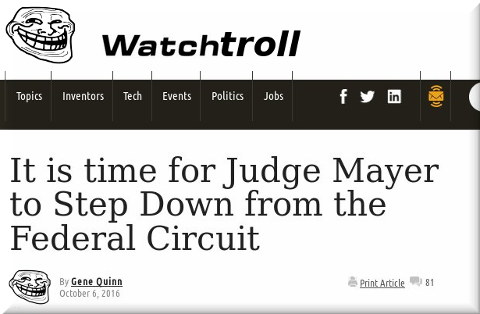
The judge above is now being attacked pretty viciously by Watchtroll. We expected this. Joff Wild, the editor in chief of IAM 'magazine', made it very clear to me that he's an adamant supporter of software patents and he had
no coverage of this key case until about a week later. These guys were looking for spin, we presume... but they were not alone. The patent microcosm, by attacking a judge who has demolished some software patents, is basically defending
a very nasty patent troll here. Is that a clever thing to do?
"Just When You Thought the Federal Circuit Was Softening Restrictions on Software Patents, the Tide Turns Again,"
wrote another outspoken patent maximalism site (which habitually mocks judges). To quote:
Intellectual Ventures I LLC ("IV") sued Symantec Corp. and Trend Micro (defendants) for infringement of various claims of three U.S. Patents (Nos. 6,460,050; 6,073,142; and 5,987,610). The District Court held the asserted claims of the '050 patent and the '142 patent to be ineligible under ۤ 101, and the asserted claim of the '610 patent to be eligible. The Federal Circuit affirmed as to the ineligibility of the asserted claims of the '050 patent and '142 patent, but reversed as to the asserted claim of the '610 patent, resulting in finding all asserted claims ineligible under ۤ 101.
Some reasoning applied during the two-step analysis, and in particular when finding that the patents are "directed to abstract ideas," is not clearly provided by the Federal Circuit. The analysis for each of the three patents is summarized below. This decision just muddies the waters following other recent patent-owner friendly decisions in which the Federal Circuit seemed to be creating more ways for software patents to survive.
The decision further includes quite an interesting concurrence in which First Amendment rights were discussed as being implicated with Software patents?? Further comments will be provided on the concurrence alone.
This article was relatively polite (for this site), but as expected, Watchtroll went truly nasty. "It did not took [sic] long for the software patent boosters to react to Free Speech clash,"
Henrion noted (also
see "it did not took long to react to the free speech clash.") and
this nasty piece was the accompanying link. Watchtroll has even exceeded our own expectations and he was
propped up by Patently-O and
by IAM 'magazine' (though we assume linking is not the same as endorsing). IAM said: "No holding back here from Gene (or the many other commenters) on the subject of Judge Mayer, Alice & software patents!" (linking to
this tweet)
"Well done," I told the patent microcosm, "for making yourselves look like an enemy of society and also the court system..."
Henrion
added that it happens "when someone is making your job irrelevant."
"So whether computer programmers think software should be patented is completely irrelevant,"
he remarked. Watchtroll (Gene Quinn) does not even know how computer programs work. I debated him over it in hundreds of tweets before he just ran away and blocked me (not that I said anything rude). "Let's continue the swpat discussion here,"
Henrion wrote, "it is fun to rehash the arguments with the other side" (even if it feeds the trolls, like Watchtroll).
If Watchtroll represents "the other side", then Mayer
et al would use
Alice even more frequently and crush software patents
for spite. Misleading headlines from the likes of Gene Quinn show us that the patent microcosm and software patents proponents aren't just liars but also morally corrupt. The patent microcosm and those boosters not only attack the Supreme Court (Justices) but also lie about and smear judges. So who's the rude side? By failing to distance itself from Gene Quinn and habitually contributing to Watchtroll's site, the patent microcosm associates itself with nasty behaviour. The patent microcosm has gotten so bad and rude -- because software patents are a dying breed -- that they falsely make
mental claims on judges (claiming them to be mentally deranged or ill), even
impotence. Mocking sexual health (by connotation at least) of judges is about as low as one can stoop. The patent microcosm and these software patents boosters do themselves a huge disservice here. See our recent article
"With Patent Law Firms Like These, No Wonder There's Distrust and Animosity".
Andre Rebentisch (FFII)
wrote: "Apparently judge-bashing is considered appropriate in the US as @ipwatchdog shows. Just gets awkward when they target European ones."
For those who are curious to know what Watchtroll wrote, here are some portions of it, calling for the judge to resign:
It has been obvious for some time now to any objective observer, but recent events make it such that it is time for someone to say it openly. Judge Haldane Robert Mayer, former Chief Judge of the United States Court of Appeals for the Federal Circuit, should step down and move quietly into retirement.
For years Judge Mayer has had his own – shall we say “unique” – view of patent law. He has made a habit out of writing his own rather eccentric anti-patent views into dissents and concurring opinions and then later citing to himself in those dissents and concurring opinions as if they were somehow authoritative. If an attorney were to do something like that they would wind up being sanctioned, as ultimately happened when the Federal Circuit rebuked attorney James Hicks for mischaracterizing prior holdings and rulings in a brief submitted to the Court. But when a Federal Circuit Judge does such things we all just shake our head and sigh.
[...]
Simply stated, the industry and the public deserve better than Judge Mayer. His anti-patent views seem to have matured into an irrational hatred that so cloud his judgment that he twists, exaggerates and misrepresents in order to attempt to impose his radical views into the law. There is no place for a judge like that. It is time for him to leave the Court. If he chooses not to step down it would seem appropriate for the Court to do what they would with an attorney who grossly exaggerates and mischaracterizes cases and rulings to the point of misrepresentation.
IAM, by the way, was hardly much better. It is in denial of course, and with a biased, belated headline too (almost a week late):
"No – the CAFC’s Justice Mayer has not just brought an end to software patents or anything close" (yes, the headline starts with the word "No", just to remind us it's
not really a news site). To quote: "Software patents are not about to be suddenly ripped up thanks to Mayer’s comments – if it wanted to, the Supreme Court could easily have done that by now. What is more plausible is that in writing his concurrence, Mayer is really speaking to an audience of his fellow judges and, perhaps alarmed by recent decisions like McRO, he’s attempting to place a brake on the string of recent pro-software patent decisions."
They are quoting Manny Schecter, chief software patents propagandist at IBM, as saying: "It is hard to understand why Judge Mayer would push the Federal Circuit "to acknowledge that Alice sounded the death knell for software patents" given that the Supreme Court in Alice did not refer specifically to software, appeared to be warding off this type of sweeping conclusion when it indicated that we must "tread carefully in construing this exclusionary principle lest it swallow all of patent law", and (contrary to Judge Mayer) stated: "There is no dispute that a computer is a tangible system (in €§101 terms, a “machine”), or that many computer-implemented claims are formally addressed to patent-eligible subject matter." Furthermore, let's not lose perspective. Judge Mayer is a single judge on the Federal Circuit, which we know to be deeply divided on this subject - recall the inability of the Federal Circuit to reach consensus in Alice when it reviewed the case en banc. My problem with Alice is not that it banned software patents (because it did not), but that its failure to provide clear guidance has resulted in a torrent of uncertainty."
Law Firms Said Nothing or Resorted to Misdirection
Well, finally, almost a week and a half later, one law firm covered the case, under the headline
"Judge Mayer Finds that Section 101 Bars Patents on Software". To quote:
In Intellectual Ventures v. Symantec, [2015-1769, 2015-1770, 2015-1771] (September 30, 2016), the Federal Circuit affirmed summary judgment that the asserted claims of the ‘050 and ‘142 patents were directed to ineligible subject matter and reversed the finding that the asserted claim of the ‘610 patent covered eligible subject matter.
At Step I of the Mayo/Alice Test for the ‘050, the Federal Circuit agreed that the ‘050 patent was directed to the abstract idea of filtering emails, noting that it it was long-prevalent practice for people receiving paper mail to look at an envelope and discard certain letters, without opening them, from sources from which they did not wish to receive mail based on characteristics of the mail. At Step II of the Mayo/Alice Test, the Federal Circuit rejected the argument that because the jury determined that the prior art did not anticipate or make obvious the claimed invention, the claims necessarily met Step II, noting the fact that the claims may not have been anticipated or obvious does not suggest that the idea of “determining” and “outputting” is not abstract, much less that its implementation is not routine and conventional.
All other law firms seem to be looking at other cases, as if the above never happened or isn't worth covering. This serves to confirm what we have been saying about cherry-picking. The following article by Matthew A. Ambros of Foley & Lardner [
1,
2] is an example of misdirection and here is
another example of it. From Joseph Robinson and Robert Schaffer
came another distracting piece, leaving in tact only the aforementioned attack on the judge (courtesy of Watchtroll himself).
Another utterly misleading bunch of articles whose authors live 3-4 weeks in the past (
McRO) and ignore the latest case can be found in [
1,
2] or the repeatedly bumped-up (in the news)
"Federal Circuit Strengthens Software, Business Method Patents" (behind paywall). One might get the impression from these that software patents are doing great, enjoying a resurgence, etc.
It is absolutely amazing that no legal firm that profits from patents (except from the one example above) speaks about the latest major case at CAFC. They talk about all
sort of other things that serve to distract their clients. Covering another case (old case, new article),
this one speaks about program running on a general-purpose mobile phone not being patentable. Like that wasn't already obvious...
Sob Stories
Last week the Wall Street-centric media posted
a pro-patents sob story/puff piece. "Patents for diagnostic methods and natural products have become difficult to obtain of late, although the U.S. law in this area is still evolving," the author stated.
They are speaking for monopolies, not for ordinary businesses. So did Mark Summerfield, who quit his job last month and
openly asked Watchtroll for some kind of attack piece on the judge. To quote: "Looking forward to your excoriation of Mayer's appalling concurring opinion in IV v Symantec. I assume it's on the way?"
Well,
personal attacks are Watchtroll's expertise. We wrote about this a couple of times on Tuesday, expecting some
ad hominem attacks from the 'usual suspects' and we were right. Henrion
said, "if the watchdog would be serious about expropriation, the article would not be about defending patents hein..."
"I can't speak for Gene, but I care more about my clients than money,"
Summerfield wrote, "which is why I just quit my job" (citing his blog post about it).
Speaking to others (Crouch in this case),
Henrion said about SCOTUS refusing to revisit software patentability that it's "another way to say to the patent community if they got the message in the first place?"
Mikko Hypponen,
writing about the latest ruling, said: "I can't wait for software patents to die. And I hold several software patents myself."
"Writing software is hard,"
Daniel Nazer (EFF) wrote. "Having a vague idea about software is easy. Software patents reward the latter and punish the former. End them."
"If copyrights were adequate,"
Henrion said, "why does Red hat so closely associated [sic] with OSS have so many hundreds of patents?"
We actually wrote about this several times in the past.
Linking to
this item, one
patent attorney wrote that "Uber Has a Big Alice Problem," as if anyone out there should care about
an evil company like Uber and sob for it.
We expect many pieces in the corporate media in the coming weeks, explaining why the CAFC's ruling has dealt a blow to "innovation" or some other myths. We can envision that such pieces would be composed by large corporations, their patent lawyers, or journalists who sparingly quote those two groups.
⬆
