
Bonum Certa Men Certa

Media Hostility Towards Patent Reform in the US, Software Patents on the Chopping Block

Remember that the EPO, a serial corrupter of the media, paid the Financial Times for puff pieces, e.g. regarding the UPC [1, 2]

Financial Times on patents
Contrary to the headline, Rana Foroohar advocates a worse US patent system


Summary: In spite of growing levels of productivity (or so-called 'innovation') after Alice, PTAB etc. voices of litigation -- not reason -- try to push things back to the golden era of patent trolls

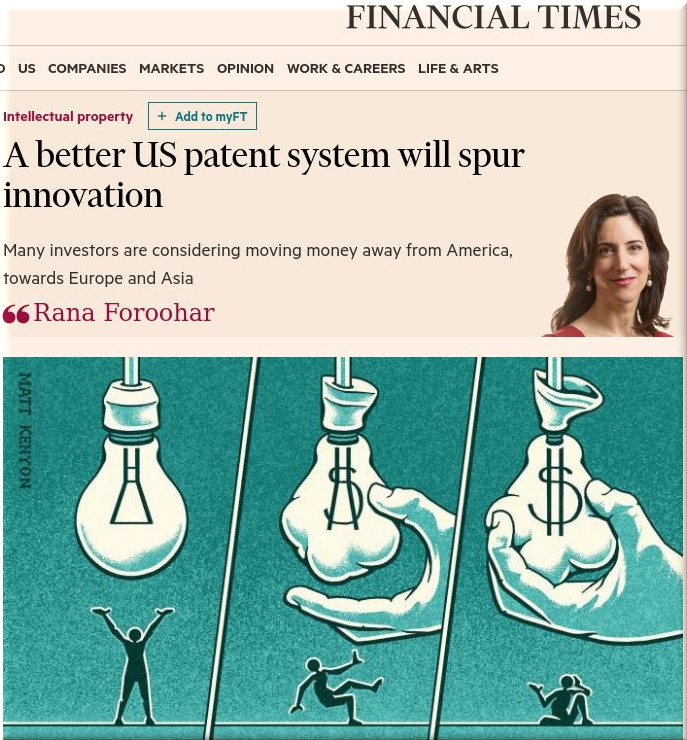
"Abetter US patent system will spur innovation," says a new headline from the Financial Times this weekend (behind paywall, use Google cache to bypass it). The title is very misleading. One may be tempted to think that it's pro-innovation, but it's actually pro-patent maximalism. It states that some "companies have business models that are very different from, say, life sciences companies or small software suppliers that depend on one or two patents. The iPhone, for example, incorporates technologies involving thousands of patents."


Many of these are hardware, design and software patents. And prices of phones have been artificially inflated, so some are incredibly expensive. Priced out of reach to most.

Here are some portions from Rana Foroohar's article, which is an attack on the status quo and a faint praise for corrupt people like Randall Rader (anti-PTAB, pro-trolls, pro-software patents) and officials-turned-lobbyists like David Kappos:

A number of companies began lobbying for even more anti-patent legislation. A worried Mr Kappos pushed back, but was eventually replaced by Michelle Lee — Google’s own former head of patent strategy. In recent years, the PTAB has become a “powerful shield” for those accused of patent infringement, leading former chief judge Randall Rader, who led the court in charge of patent appeals, to label it the “death squad” for IP.

Pushing back on patents has been great for Big Tech, which of course has its own IP to protect, but increasingly monetises data and IP created by others. But the US software supply chain, as well as life sciences, have been collateral damage. While the complexity of global business makes it tough to show clear causality between lax patent protection and the loss of innovation and jobs in the US, the trend lines do not look good. According to one study, the shifts in patent regulation have cost the US economy $1tn. Venture capital money into biotech is sharply down from 2015 to 2016.

Anecdotally many investors say they are considering moving money away from the US, towards Europe and Asia. That is worrisome, since these are exactly the kind of highly skilled jobs that the US should be looking to keep.

Still, the pendulum may be about to shift again. The Trump administration has nominated Andrei Iancu, an LA-based lawyer who has worked with clients in both pharma and Big Tech, to be head of the USPTO. The US Supreme Court will also soon hear a case questioning the legality of the entire non-court patent adjudication system.

It will be a chance for lawmakers to think about exactly what kind of digital ecosystem they want to create.


Foroohar went on to pushing the "China!" nonsense too. Like a megaphone of patent extremists.

"...now that the US Supreme Court €§ 101 is used to invalidate software patents every single week if not every single day it is getting difficult to deny a post-software patents reality in the US."What about software patents?

Well, Jeffrey Rowe, who says he "has more than 40 years of experience in all aspects of industrial design," wrote about the subject of software patents in the context of the USPTO. Having added Torvalds and Stallman videos to his article, he said this just before the weekend:

A couple years ago I got into a pretty heated discussion with a staffer from an engineering software company about whether software patents were still relevant (or is they ever were to begin with).

While proponents (usually with deep pockets) have touted their benefits, software patents have also been used in the software industry to suppress innovation, kill competition, generate undeserved royalties, and make patent attorneys rich. So I’ll ask again, are software patents still relevant?

It’s no secret that the engineering software business is extremely competitive, as it always has been. Without naming names, the engineering software business has also proven to be a very fertile and lucrative ground for lawsuits regarding patent infringement, reverse engineering, and outright copying and pasting blocks of code.


The latter thing is already covered by copyright law.

Incidentally, now that the US Supreme Court €§ 101 is used to invalidate software patents every single week if not every single day it is getting difficult to deny a post-software patents reality in the US.

Steve Lundberg, a longtime proponent of software patents (no, he doesn't write any software), will not cover all those cases wherein software patents collapse. Cherry-picking suits him better and the other day he covered a District Court case where a software patent remained in tact: [via Bastian Best]

The court denied defendant’s motion to dismiss on the ground that plaintiff’s network gaming patents encompassed unpatentable subject matter because the asserted claims were not directed toward an abstract idea.


If appealed upwards to the Court of Appeals for the Federal Circuit (CAFC), or even further up to the US Supreme Court, there's just about zero chance this patent will be upheld. But justice boils down to money in such a system, wherein patents are granted so easily and removing them is an expensive, laborious process which places all the burden on the defendant.

Want the "US patent system" to "spur innovation"? Then put an end to patent maximalism. Australia has done just that, having properly studied the subject (effects of patents on productivity).

Recent Techrights' Posts

Oligarchs and States Always Attempted to Obstruct Efforts to Expose Their Corruption
We commend the administrator who consistently and adamantly defend the freedom of speech
GNU/Linux Exceeding 5% in Guadeloupe According to statCounter
GNU/Linux "share" estimates in Guadeloupe
EPO People Power - Part XXXII - Little Hope That European Press Will Attempt to Expose Drug Abuse in Europe's Second-Largest Organisation
What does this tell us about the press in Europe?
 
Over at Tux Machines...
GNU/Linux news for the past day
IRC Proceedings: Monday, January 12, 2026
IRC logs for Monday, January 12, 2026
Gemini Links 13/01/2026: ScottoRang and Outage
Links for the day
GNU/Linux Exceeding 6% in Cape Verde
Windows is measured as down sharply
When It Comes to Health, Slop is a Flop and It Kills People
Chatbots will mostly die after many people die due to them
2026 Has Begun Well for GNU/Linux Users (and for Us)
A lot of the anti-Linux FUD we got accustomed to seeing some years ago became scarce
Links 12/01/2026: Vista 11 Exodus and Famicom/NES Game
Links for the day
Links 12/01/2026: Twitter (X) Being Blocked in More Countries, PTAB Besieged by Cheeto Appointees (Bad Patents Getting Through)
Links for the day
Links 12/01/2026: Brussels Plotting Exit From GAFAM (US), Carole Cadwalladr Explains "Peter Thiel's New Model Army"
Links for the day
Scheduled Maintenance Between 15th of January and Days to Follow, Free Software Foundation (FSF) Looking to Add 43 More Members by 16th of January
People who value Software Freedom should consider joining to support the FSF
Bracing for Microsoft Layoffs, Tired of Microsoft Lies, Microsoft Staff Wants Transparency, Not Face-Saving Coverup From Frank Shaw
totally made up stock price
GNU/Linux Estimated at Around 5% in Montserrat
another country where the "share" of GNU/Linux is now measured at 5%
Dr. Richard Stallman @ Georgia Tech Next Week
More Than One Week From Now
Three most controversial Australian authors linked to St Paul's, Coburg
Reprinted with permission from Daniel Pocock
Links 11/01/2026: Data Breaches and Recent (Early 2026) Political Developments
Links for the day
Gemini Links 12/01/2026: Insomniacs After School and Boycotting Amazon
Links for the day
Over at Tux Machines...
GNU/Linux news for the past day
IRC Proceedings: Sunday, January 11, 2026
IRC logs for Sunday, January 11, 2026
Brett Wilson LLP 'Dropping' the LLP, Is This Rebranding?
It's not a coincidence or a glitch, there was a formal change somewhere in the system
Can IBM Still Control the Narrative?
We'll see what comes out through the grapevine later this week
IBM SkillsBuild as Microsoft Training, Microsoft Vendor Lock-in, Microsoft Surveillance
Microsoft benefits from IBM's "training"
EPO People Power - Part XXXI - Almost No Crime is Possible Without Enablers and Complicit Colleagues
By the middle of January 2026 we'll have taken things up another gear
Aruba's GNU/Linux Adoption Seems to Have Reach All-Time High This Year
ChromeOS rose by a lot too
After the LLM Slop Frenzy...
In every way, slop is no better than spam
Links 11/01/2026: 'Nothing to Lose' in Iran and Kyiv Restores Electricity
Links for the day
Gemini Links 11/01/2026: "Late To The Party" and "Thinking About Software Licences"
Links for the day
Links 11/01/2026: Bob Weir and Stewart Cheifet Perish
Links for the day
Higher Adoption Rates of GNU/Linux in Cyprus in Recent Years
there are some Cypriots who are championing Free software
Microsoft's linkedin.com is Shrinking, Expect LinkedIn Layoffs to Carry on in 2026
Expect the mass layoffs and office closures to carry on there, maybe as early as next week
Gemini Links 11/01/2026: Scott Morgan and 'The Unix Way'
Links for the day
IBM to Be 'Reorganised'
The rich look for ways to 'monetise' what's left IBM
Dr. Andy Farnell Explains Why He'll Stop Sending E-mail to Microsoft and Gmail Users
The article is long and well worth reading
Over at Tux Machines...
GNU/Linux news for the past day
IRC Proceedings: Saturday, January 10, 2026
IRC logs for Saturday, January 10, 2026