SCOTUS (US Supreme Court) narrowed patent scope and judges are coming under attack for merely following SCOTUS
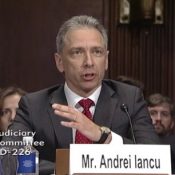
Summary: Donald Trump's man at the USPTO (Andrei Iancu, whose firm used to work for Trump) is disgracing the notion that a patent office follows courts' pattern of rulings; to make matters worse, SCOTUS appointments are nowadays made based on personal relationships/connections to billionaires (e.g. Gorsuch) rather than accurate/consistent rulings
AS A NEW month begins we look back at another good month -- a month in which courts generally continued to 'reform' or shall we say 'tame' the USPTO. There have been several rulings which due to lack of time we need to mention belatedly.
Let's begin by discussing yesterday's advertisements from
Patent Docs, a site of patent maximalists. They still focus on
questionable patents,
35 U.S.C. ۤ 102 (prior art), and the Intellectual Property Law Association of Chicago (IPLAC), basically a cabal of lawyers,
speaking of laughable concepts like "Reputation Risk Management".
Last weekend we noted that
Patent Docs had reached to point where it's publishing more advertisements than actual articles. In fact, actual articles have become almost rare there (maybe once in two or three days). Sometimes the articles are completely off-topic guest posts. We've surveyed and compared to months back. The only 'healthy' blog about patents (still as active as before) is
Patently-O; Watchtroll, IAM and others have ebbed away or gone completely inactive. The demise of Watchtroll started some time after May (a 30% decline in output) and IAM vanished off the radar at the end of August. Remember Bilski Blog? Once upon a time it published quite regularly. Nowadays it's lucky if it publishes something in a whole month. Here is what it
wrote some days ago in relation to
Maxell v Fandango (Maxell was
recently mentioned in another context). To quote Bilski Blog:
Earlier this month a federal court in California held as patent-ineligible all 28 asserted claims in three separate patents in Maxell v. Fandango Media, based on its analysis of only one “representative” claim. This was via a Rule 12(c) motion for judgment on the pleadings. The court had already found, via a Rule 12(b)(6) motion to dismiss before any claim construction, another claim from another patent to be drawn to patent-ineligible subject matter. It is disconcerting to see courts take such a glib approach to invalidating claims in this way, and it strikes me that this case is a great vehicle to use to discuss the notion of a “representative” claim.
Bilski Blog, being a blog of anti-
Alice patent maximalists, speaks of the above as though it's bad news, arguing that it is "disconcerting to see courts take such a glib approach to invalidating claims in this way..."
Actually, it's well overdue; the courts need to do something about patent maximalism and we're very gratified to see the past few years' developments. We hope for more of the same. It's no secret that the USPTO granted far too many patents for a number of years if not decades. Patent Trial and Appeal Board (PTAB) inter partes reviews (IPRs), part of AIA, have helped improve that somewhat, albeit not sufficiently. Now that we're past the ten millionth patent
Patently-O reveals another
incredibly stupid patents -- a reminder that software patents are still being granted by the Office. "It is basically a computers system that gamifies your life — comparing your life score to those of your neighbors, co-workers, or others,"
Patently-O wrote some days ago, adding the corresponding figures to demonstrate just how dumb this patent is. As we shall show further down, it does not seem as though the new leadership (new Director rather) is interested in tackling the issue; instead, it would rather exacerbate matters.
Just over a week ago Kansas City Business Journal
published "Lawsuit alleges company paid ag tech company $7M for 'worthless' patents" -- a symptom of an office that
would rather grant than properly examine applications. Applicants should live and learn. A lot of US patents are totally bogus (some bogus
to the extreme) and in retrospect some companies are entitled for compensation. This can't possibly inspire much confidence in the system.
Another site recently spoke of SolarWinds's IPO plans, asserting that "[t]he [software] company has 29 issued U.S. patents and 148 issued foreign patents, with expiration dates ranging from October 2026 to May 2036. The company also has 40 pending patent applications."
Likely all of these are bunk software patents. Do they care? Do they just aim to increase the total number rather than quality and validity?
Less than a fortnight ago
Watchtroll moaned that "Alice has become a train wreck for innovation. To be successful, patent practitioners must explain why the type of technology should not dictate whether there is enforceability."
This linked to the latest (at the time) patent maximalist
nonsense from Meredith Addy and it is titled
"Alice at Age Four: Time to Grow Up" (implying or at least insinuating that patent justice is some kind of immaturity). We don't want to rebut every single claim as that would take a lot of time and give more exposure to Watchtroll (those patent zealots would otherwise get little or no attention). "Grow up and face the fact software patents are unsuitable for purpose" was my response to them. It's just another one of their anti-
Alice rants and no new information (or news) is being offered to support the headline. Burman York (Bud) Mathis III, another anti-
Alice person who contributes to Watchtroll occasionally,
resumes the
CAFC bashing (
Federal Circuit smears). The
EPO became notorious for attacking judges, the
ITC ignores PTAB judges, and whenever the above people attack 35 U.S.C. ۤ 101 rather than the U.S. Patent and Trademark Office (e.g. for granting software patents in spite of 35 U.S.C. ۤ 101) they reinforce the view or perception that all they care about is money, not justice. We at
Techrights care about innovation and justice; we recognise that many patents are unjustly being granted and this harms innovation, sometimes quite profoundly.
"Patent rights are under attack," Watchtroll
wrote the following day, basically pointing out that Justices telling off and putting aside bogus patents is somehow an "attack". Actually, the patent trolls and aggressors are the attackers. Who is being attacked here? And by who? How very classic a reversal of narratives.
Are the people at Watchtroll even
trying to be honest with themselves? It certainly doesn't look like it.
We should probably point out that nothing is about to change. Nothing at
SCOTUS can revive software patents any time soon (or ever). The USPTO changing its guidelines won't impact what courts are saying, as we explained a week ago. Dennis Crouch's
latest outline of SCOTUS cases is encouraging in the sense that he too is willing to reveal nothing in the face of
Alice, which soon turns 4.5 years old.
Last night the patent maximalist Dennis Crouch
said he was "fairly disappointed with this decision by Chief Judge Prost" (CAFC) because she's not a patent maximlist like him. It's a serious problem when a bunch of flaming lawyers and trolls-friendly scholars think they 'own' the patent system (not actual innovators), just like taxi drivers assume they 'own' the roads. To quote his views in full: "I am fairly disappointed with this decision by Chief Judge Prost. The Federal Circuit flipped the jury’s infringement verdict based upon its revised claim construction. Nothing strange there, except that the court did so without actually construing the term in question. Seems improper to me."
Really? Improper? That's like saying, "I don't accept the judgment because you did it wrong!"
Such is the nature of patent maximalists however; we've been showing for years how they attacked PTAB and its judges, culminating in attacks on SCOTUS and CAFC earlier this year. If it keeps getting worse, sooner or later judges will get rather angry at these patent maximalists and rule against them just
for spite.
A lot can be said about
Techrights and its attitude, but we never attack judges unless they engage in clear misconduct like Rader and Gilstrap do. Judges have a job to do and in a society saturated with judge-bashing blowhards civility goes down the drain.
Looking at some recent decisions and outcomes (from courts, i.e. judges), we are very much encouraged. More US patents have been deemed "abstract" and even in district courts, which are less strict than CAFC in that regard. Here's
one from Delaware, the
busiest district for patent lawsuits:
Plaintiff Guada Technologies, LLC ("Guada") sued Defendant Vice Media, LLC ("Vice Media"), alleging infringement at least claim 1 of U.S. Patent No. 7,231,379 ("the '379 patent"). Vice Media then filed a motion to dismiss. Last week, Judge Richard G. Andrews of the U.S. District Court for the District of Delaware ruled that the claims are directed to an abstract idea under 35 U.S.C. ۤ 101, but that a factual issue remains as to whether the claims provide an inventive concept.
The '379 patent, entitled "Navigation in a hierarchical structured transaction processing system," relates at a high level to navigating through a hierarchical network of "choices" (e.g., transactions, or operations where information is accessed) to accomplish a goal. In such a network, choices are arranged as nodes in a graph structure. As an illustrative example, Figure 3 of the '379 patent is shown below, which is in the context of airline reservations.
In the ParkerVision case, as
revealed by the same site, the court asserted/called "unpatentable" (35 U.S.C. ۤۤ 102 & 103 cited) a patent not tolerated by CAFC either:
On September 13, 2018, the Federal Circuit affirmed three final written decisions of the U.S. Patent Trial and Appeal Board that held unpatentable various claims of U.S. Patent No. 6,091,940, owned by ParkerVision. The '940 patent, entitled "Method and System for Frequency Up-Conversion," relates to the frequency conversion of low-frequency baseband signals to higher-frequency (e.g., radio frequency or RF) signals.
Qualcomm filed three petitions for inter partes review challenging the '940 patent. The PTAB's (and later the Federal Circuit's) analysis split along whether the claims were apparatus or method claims.
[...]
The panel, which included Judges O'Malley, Reyna, and Taranto, was unmoved by ParkerVision's position...
[...]
The panel treated the method claims of the '940 patent in a wholly different manner, stating that Qualcomm failed to "present evidence and argument that a person of ordinary skill would have been motivated to operate Nozawa in a manner that satisfied the 'plurality of harmonics' limitation." Furthermore, Qualcomm did not advance any position whether Nozawa's device would actually output a periodic signal with a plurality of integer-multiple harmonics. Namely, the panel reiterated InTouch Techs. Inc. v. VGO Commc'ns, Inc., 751 F.3d 1327, 1346-1347 (Fed. Cir. 2014), that parties seeking to invalidate method patents must show that a skilled artisan would have been motivated to combine the teachings of the prior art references to achieve the claimed invention, and that the skilled artisan would have had a reasonable expectation of success in doing so. Instead, the panel wrote, "Qualcomm's petitions and accompanying expert testimony solely concerned whether the fundamental frequency itself is included in the meaning of 'harmonics.'"
In other words, with respect to apparatus claims, the Federal Circuit stated that if a prior art reference discloses an apparatus that is reasonably capable of operating as claimed, that reference could anticipate or render obvious the claims at issue. Additionally, when considering method claims, a reference is properly asserted, under 35 U.S.C. ۤۤ 102 & 103, when there is a clear motivation to combine the references and a demonstrated expectation of success by a skilled artisan.
Judges O'Malley, Reyna, and Taranto have generally been ruling just fine. Crouch once resorted to an ugly personal attack on Judge Reyna, but what else can be expected from patent maximalists who can't get their way?
Speaking of patent maximalists, Matthew Bultman (
Law360) recently wrote about another new Federal Circuit outcome. Abstract patents are rarely tolerated by the judges and
here's another example where
Alice gets cited:
The Federal Circuit on Monday upheld a finding that parts of four robotics patents were invalid under the U.S. Supreme Court's Alice test, preserving a victory for Invensys Systems Inc.
Another new
Alice-centric decision from this court was
mentioned just before the weekend: "Gust v Alphacap #FederalCircuit 9/28/18 reverses s 1927 atty fee award against NPE AlphaC and its lawfirm Gutride (joint/sev). DCt view of crowdfunding s/w patents Alice-ineligible but no settle. P's position "colorable." 1927 std="exacting." Firm's litigation acts not bad faith."
What's really noteworthy here is the consistency in which CAFC rejects abstract patents, citing
Alice. Back in 2016 CAFC did not always do this. Things changed for the better around 2017 when CAFC accepted just about zero software patents. We wrote about this several times last year.
Alice really took a strong(er) foothold at CAFC after
Judge Mayer had ruled against software patents in
Intellectual Ventures v Symantec. Nothing has been the same since. We hope things will stay the same. So do groups like HTIA, CCIA and the EFF.
Speaking of the EFF, days ago it named
"Stupid Patent of the Month" for September (
copy in TechDirt). It was unveiled by Daniel Nazer (EFF), who is rightly concerned that the patent office feeds patent trolls with software patents. To quote:
This month’s stupid patent describes an invention that will be familiar to many readers: a virtual reality (VR) system where participants can interact with a virtual world and each other. US Patent No. 6,409,599 is titled “Interactive virtual reality performance theater entertainment system.” Does the ’599 patent belong to the true inventors of VR? No. The patent itself acknowledges that VR already existed when the application was filed in mid-1999. Rather, it claims minor tweaks to existing VR systems such as having participants see pre-recorded videos. In our view, these tweaks were not new when the patent application was filed. Even if they were, minor additions to existing technology should not be enough for a patent.
The ’599 patent is owned by a company called Virtual Immersion Technologies, LLC. This company appears to have no other business except patent assertion. So far, it has filed 21 patent lawsuits, targeting a variety of companies ranging from small VR startups to large defense companies. It has brought infringement claims against VR porn, social VR systems, and VR laboratories.
Virtual reality was not new in mid-1999. The only supposedly new features of the ’599 patent are providing a live or prerecorded video of a live performer and enabling audio communication between the performer and a participant. Similar technology was infamously predicted in the Star Wars Holiday Special of 1978. In this sense, the patent is reminiscent of patents that take the form: “X, but on the Internet.” Here, the patent essentially claims video teleconferencing, but in virtual reality.
If this patent was to be properly (re)assessed, it would almost certainly be invalidated. Such patents are dropping like flies these days. Examiners ought to stop granting these already. The certainty associated with US patents would otherwise suffer.
Josh Landau (CCIA) is meanwhile
writing about patent trolls under the euphemistic label "NPEs":
NPEs Are Opportunistic Litigants
One finding in the paper is that, controlling for other characteristics, NPEs target defendants opportunistically—they look for defendants who either have a relatively high amount of cash or who have recently received positive cash shocks (e.g., a VC investment).
This seems reasonable—after all, why sue someone who can’t pay you anything? Except that it pairs with two other key findings in the paper. First, NPEs target cash-rich companies with smaller legal teams. And second, both large operating companies and smaller inventors who file patent infringement lawsuits don’t exhibit the same behavior with respect to targeting firms with high cash reserves and small legal teams. In fact, this behavior is not observed in any other type of litigation—only in NPE patent litigation.
In other words, NPEs and operating companies behave in fundamentally different ways as plaintiffs, ways that suggest that NPEs litigation strategies are not aimed at policing infringement but rather at targeting for financial return, regardless of the strength of the infringement case.1
When paired with the finding that NPE litigation has a negative impact on innovation at the targeted firm, this means that NPEs are more likely to target small innovators and particularly to target the small innovators who are most likely to succeed absent NPE intervention, behavior not seen as part of operating company litigation.
[...]
The evidence continues to make clear that NPEs are a tax on ingenuity and economic activity. Reforms like IPR and the Alice case have been effective in helping to reduce NPE activity.
So why are there efforts—including from U.S. Patent and Trademark Office Director Iancu—to minimize the effectiveness of these reforms?
He's not interested in reforms. He views them as a mistake.
Unlike his predecessor Michelle Lee, he's not even technical. Prior to Michelle Lee there was
David Kappos, who Eli Mazour (under the section "Expert Analysis")
speaks to in
Law360. IBM 'mole' in USPTO? He's now an IBM-funded lobbyist for software patents. He's serving the litigation lobby and he himself works for a law firm. Mazour says: "Almost a decade before Secretary of State Mike Pompeo embarked on a mission to bring “swagger” back to the U.S. State Department, David Kappos successfully brought it to the [USPTO]..."
He brought “swagger”? Really? It was a boon for patent trolls, that's all it was. Litigation soared.
The litigation 'industry' currently hope that Iancu will be another Kappos. This
new article by McKee, Voorhees & Sease, P.L.C. is titled
"Hope From The PTO Director" regarding
"Patent Eligibility" as if the sole goal of a Director is to endlessly broaden patent scope.
Forbes, we might add again, is giving a platform (even whole blogs!) to trolls and aggressors, brandishing patent propaganda every single day.
Forbes is a rag of billionaires who make a living by attacking society, so trolls' agenda seem compatible.
Watch how
patent troll David Pridham (
Dominion Harbor) calls the Director of the patent 'industry' "New Sheriff Aims To Stop Patent Thievery" (that's the headline). So Mr. Iancu found support... from patent trolls. That says quite a lot about him.
This patent troll appears to be hiding behind yet another one of its many shells, having taken patents from Microsoft's largest troll,
Intellectual Ventures.
Peter Keros
wrote about Dominion Assets LLC (we assume part of Dominion Harbor):
Expert testimony on patent royalties that is unsupported by evidence is excluded. Dominion Assets LLC v. Masimo Corp., Case No. 14-cv-03002 (N.D. Cal. Aug. 1, 2018). Plaintiff Dominion alleged infringement by Defendant Masimo of U.S. Patent Nos. 5,379,764 and 5,460,177, which are directed to radiation measurement techniques for blood concentration. Dominion presented expert testimony on a reasonable royalty. Masimo filed a motion to exclude the expert’s testimony as (1) failing to rely on a license agreement that is economically comparable to the patented invention, (2) failing to apportion damages to the allegedly infringing features, and (3) failing to tie the royalty rate to the facts of the case. The Court agreed with Masimo, excluding Dominion’s expert testimony on damages.
His blog colleague, Bryan Hart, wrote about Microsoft's troll Intellectual Ventures and its
latest CAFC ordeal:
In the recent case Intellectual Ventures I LLC v. T-Mobile USA, Inc., the Federal Circuit overturned a district court’s claim construction for reading in a limitation and upheld the district court’s invalidation for indefiniteness for including a subjective term.
[...]
To show a disavowal, a defendant is often better served by focusing on the elements of the prior art rather than parsing the language of the patentee’s responses. (It’s not clear whether this strategy was available to T-Mobile here.) Heavy scrutiny of the language of the patentee’s counterarguments can often be outweighed by other intrinsic evidence. The prior art can support a more compelling story: the patentee shrank the scope of its claims because it hadto, in order to escape prior art disclosing the disavowed element.
So the patent office kept 'producing' patents for patent trolls -- only for these patents to repeatedly get thrown out by courts. If the patent office wants to move in a positive direction, it will restrict the rules and lower the number of grants. Sometimes less is more (like higher quality or more legal certainty).
Here's a
new press release all about John Hallquist, who is (or was) a software developer. They keeping harping about "patents", but what good are those patents they speak of in this new press release? Probably worthless after
Alice, which according to Ryan Davis (
Law360)
keeps squashing such patents even in district courts. The article
"Menu Patent In Case Against Domino’s, Others Axed By Alice" (mostly behind paywall) says that "[t]he week before a series of trials were set to begin, a California federal judge has ruled that an online menu patent asserted against Domino’s Pizza Inc. and dozens of other..."
That's just more of the same.
Watch the anti-
Alice brigade, Mr. Gross in
this case, moaning about it: "No surprise, rather than give #patent owner a fair hearing at trial, D Ct judge in CA decides to lighten his caseload with a little "ALICE-AWAY ABSTRACT IDEA INVALIDATION" spray! quick, easy, no muss, no fuss, makes dockets PATENT clean!"
Go ahead and bash the court/s. Carry on. You'll just alienate judges. For merely applying the law, based on precedence and common sense, they receive abuse and scorn. All this ridicule is counterproductive and makes the atmosphere more toxic. Remember that Mr. Gross contributes to sites of patent trolls. He's close to patent trolls.
Notorious patent troll PersonalWeb Technologies LLC is apparently trolling news sites nowadays. Having run out of who to sue, now the troll is suing BuzzFeed. David Matthews (
Law360)
wrote about it as follows:
BuzzFeed Inc. has become the latest high-profile website to face an infringement suit over cloud storage patents from PersonalWeb Technologies LLC, a software developer that has filed dozens of similar suits...
The patents in question are highly notorious and they're likely to be squashed entirely some time in the future, preventing further extortion.
Going back to patent maximalists, here's a
recent rant about the Federal Circuit. The concept of "trade secrets" causes/introduces a problem akin to secret trials that the public cannot fully see or understand. Here is what Dennis Crouch wrote:
The Federal Circuit has been releasing a substantial number of sealed opinions that stem out of confidential briefs. The Court’s usual operating procedure is to issue the opinion in a sealed form along with an order to show-cause as to what aspects of the opinion (if any) need to remain under seal.
[...]
I’ll note here that the “rights” defined by Section 1835(b) appear purely procedural — the trade secret owner gets a chance to explain its position in an under-seal filing. It does not actually prevent the court from subsequently disclosing the alleged trade secret.
Crouch
has long attempted to slow PTAB down by endlessly ranting about decisions without written opinions. Will he betray the trade secret laws in an effort to discredit the court? It would backfire on his reputation if he tried...
Mind the pattern. From complaining about the law or lawmakers they have moved on to smearing courts and sometimes individual judges. Not nice...
The Federal Circuit or CAFC seems to have gotten even tougher on bogus patents (sometimes stricter than the Patent Trial and Appeal Board or PTAB), so the patent zealots will do more judge-bashing, as
Watchtroll did 10 days ago when it wrote: "The Federal Circuit recently issued an opinion affirming the Patent Trial and Appeal Board’s (“PTAB”) finding of obviousness of a hot-spot technology patent based on implicit disclosures in a prior art reference."
Two days later it was
looking for PTAB 'scandals', chastising judges for daring to change their minds. To quote: "The ’977 patent is directed to a dental implant comprising, inter alia, “a coronal region of the body, the coronal region having a frustoconical shape wherein a diameter of an apical end of the coronal region is larger than a diameter of acoronelend of the coronal region” (frustoconical limitation). The ’977 is governed under pre-AIA laws, and the undisputed critical date for purposed of pre-AIA 35 U.S.C. €§ 102(b) is May 23, 2003."
AIA changed the rules and SCOTUS changed all sorts of things, including patent scope. So whatever happened beforehand may no longer be of relevance. That's not a concept that's difficult to grasp. Law changes over time. It can evolve or devolve (depending on different people's perspectives). What worries us about the US is that Trump appointed a patent maximalist as Director. This Director seems not to respect courts and instead puts patent law firms first. He came from a patent law firm that
had worked for Trump.
Days ago we saw
this press release about two new US patents, one of which on "Methods for Decryption as a Service," i.e. a bunk software patent (maybe the other patent is also a software patent, but we haven't checked). What good are these bogus patents from Bluefin? Why did examiners grant such patents?
Here is
another press release about bunk, invalid software patents. Nothing to brag about, certainly not in a press release. Why does the USPTO play along with this? Section 101 among other sections would likely come into conflict.
If often seems as though the sole goal is to grant as many patents as possible, making the patent system almost impossible to navigate. Mind this
other new press release. "Patent Management Software Market to Witness Comprehensive Growth by 2028," according to Patent Management Software Market hoping to Witness Comprehensive Growth by 2028. No rebuttal necessary. Just the stupid headline. Pure marketing. They offer to help "manage" a pool of millions of patents, many of which of dubious validity. Over at Watchtroll, days ago Margaux Savee, Suni Sukduang and James Murphy
said that the USPTO updated its trial practice guide. Maybe they should update it to warn that many of the patents it grants are of no use in trials.
Speaking of Watchtroll,
this one from Thursday was rather funny. "Patented Innovations Create the Future," says Watchtroll, as if the innovations would not be made without those patents? That's like saying dead people create innovations because all people die eventually...
The latest nonsense from Watchtroll (yesterday) was titled
"Intellectual Property Considerations and Guidance for Start-Ups: Patents" (
link).
Well, "Start-Ups" don't need patents most of the time; they're most threatened by patents, albeit misled on those by patent law firms (looking to just make more 'sales').
The day prior to this Watchtroll wrote about
patents on fictional things,
taking note of stuff like 'flying cars' (there are only prototypes to that effect and they don't work well). To quote:
With the future of flying vehicles for personal transportation coming into more focus, we wanted to explore filings at the U.S. Patent and Trademark Office to see the current state of flying car technologies, both in the patent grants being issued by the UPSTO as well as in the patent applications being filed at the agency.
Will the patent office try to interject some excitement by granting patents on merely
theoretical things? Even things like spacecrafts from science fiction movies?
Taking stock of much of the above, it's sometimes depressing to see the patent office (especially its management) -- unlike courts -- falling into the very hands of those whom officials are supposed to govern/control. Iancu was never the right person for the job.
Watchtroll will no doubt strongly reject judges, bashing them routinely (even Crouch has joined this judge-bashing 'club'). Yesterday it squeezed out an exception to the norm,
highlighting a reversal by CAFC (overturning PTAB):
The Federal Circuit recently reversed a Patent Trial and Appeal Board (“Board”) inter partes review decision on nonobviousness, holding that the Board erred when it did not require Synvina, the patent owner, to come forward with evidence of nonobviousness (e.g., teaching away) once DuPont, the petitioner, established the prior art disclosed an overlapping range for a claimed result-effective variable. See E.I. du Pont de Nemours & Co. v. Synvina C.V., No. 2017-1977, 2018 U.S. App. LEXIS 26194 (Fed. Cir. Sept. 17, 2018) (Before Lourie, O’Malley, and Chen, J.) (Opinion for the court, Lourie, J.).
We wrote about this before. Several times in fact. Days prior to this Joseph Arshawsky
wrote about the Federal Circuit agreeing with PTAB, which is the norm really. PTAB has squashed yet more bogus patents and CAFC affirmed, as usual:
The Federal Circuit affirmed the PTAB’s final decision following inter partes review that claims 1-5 and 19 of the ’977 patent were unpatentable as anticipated (Nobel Biocare Services AG v. Instradent USA, Inc., September 13, 2018, Lourie, A.).
Federal Circuit coverage by Dennis Crouch -- if and when it does not involve mocking judges --
looks like this:
In this past summer’s Power Integrations v. Fairchild decision (Power Integrations I), the Federal Circuit held that the entire market value rule cannot be used to calculate infringement damages unless the patentee proves that the unpatented features in the accused product did not influence consumer demand. The patentee had not met that burden and so the $140 million verdict was vacated and remanded. Power Integrations, Inc. v. Fairchild Semiconductor Intl., Inc., 894 F.3d 1258 (Fed. Cir. June 3, 2018) (altered on rehearing)
On petition, the original panel has revised its opinion — but maintained its judgment vacating the damage award.
So nothing really changed. Generally speaking, nothing works in favour of software patents proponents and patent maximalists these days; except perhaps some public speeches by Iancu (albeit he's not a judge or a lawmaker).
Last but not least, check out
this post from Dennis Crouch. Billionaires with patents don't actually write their own patent applications, they just take credit for work of people whom they manage (e.g. Steve Jobs) or exploit/rob (e.g. Edison). This is what Crouch wrote:
This billionaire gets no respect! Gilbert Hyatt is the named invenetor [sic] on 70+ US patents and has 400+ pending patent applications “all of which were filed prior to June 8, 1995.” That date is critical because those “pre-GATT” applications will remain in force for 17-years from their issue date (if they ever issue). These applications claim priority back to the early 1970s. For the past 10 years, Hyatt has been trying to get his cases heard by the PTAB – but has been repeatedly foiled by PTO delays and unilateral reopening of prosecution. Here, the Federal Circuit sided with the PTO in Hyatt’s generalized challenge to this practice — finding portions of his his petition time-barred and that the substance of his challenge lacked merit.
[...]
The USPTO has been quite frustrated with Mr. Hyatt. It turns out though that the frustration – lets call it that – is mutual. Under Dir. Kappos, the PTO formed a special HYATT Unit that basically did nothing — refusing to examine his applications or hear pending PTAB appeals. In Hyatt v. USPTO, 797 F.3d 1374 (Fed. Cir. 2015), the Federal Circuit sided with the PTO on the special “requirements” the PTO had placed on HYATT applications that forced him to limit each patent family to 600 claims (absent a showing that more claims were necessary) and to identify the earliest priority date for each claim (with evidence). The PTO then re-opened prosecution (rather than hearing the appeals he had filed). And, the E.D.Va. district court sided with the PTO that re-opening prosecution was appropriate. Hyatt v. USPTO, 146 F. Supp. 3d 771 (E.D. Va. 2015).
Imagine what would happen if the USPTO dealt similarly with
all applicants, not just very rich people. Sadly, however, the current Director was
appointed by two billionaires. One is accused of corruption and sexual crimes; the other one of
graft. This basically says all one needs to know about today's USPTO leadership.
⬆
