
OUR previous post ended by citing Léon Dijkman's question about patent quality with emphasis on the USPTO and EPO (we have more on that in our daily links; other publishers have covered that but they only focused on the US).
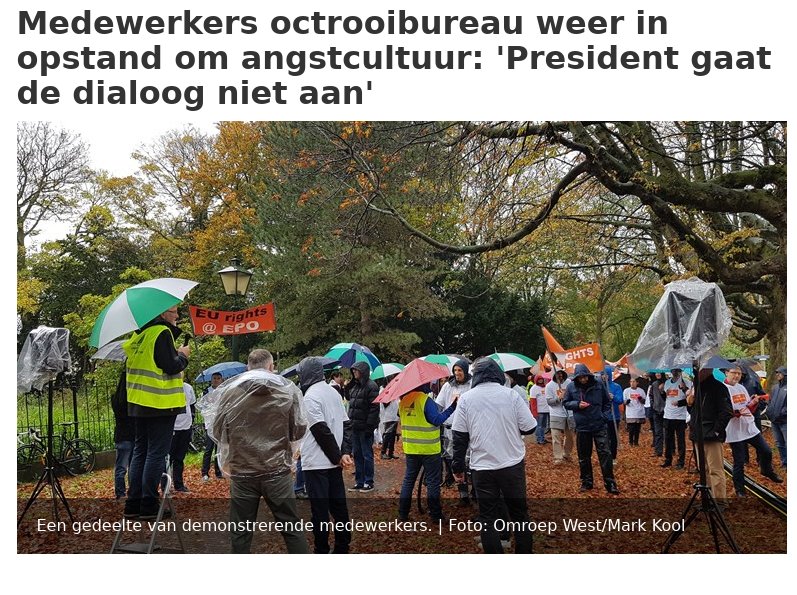
Back to sad old days at the European Patent Office. Last Thursday, hundreds of EPO staff members protested outside the Portuguese Embassy in The Hague against the lack of justice and deteriorating working conditions at the EPO. They are also concerned about the way the management is pushing for reforms without proper consultation of staff representatives.
It was the first time a protest was held in The Hague under the presidency of EPO president António Campinos, who has the Portuguese nationality. Last month, a demonstration was organized in Munich around the meeting of the Budget and Finance Committee.
[...]
Protesters in The Hague told the regional public broadcaster Omroep West that Campinos has failed to restore the social dialogue with staff members. One of them said: ‘This is because the team around the president is still the same. So even with a new president nothing changes.’ He or she only wanted to speak on condition of anonymity with Omroep West: ‘There is a culture of fear at the EPO. Even giving this interview makes me feel uncomfortable. If I am recognized on photos, this will surely have consequences at work. So we don’t want such photos to be published.’
Staff are particularly concerned about plans of the EPO to cut costs which, according to the Office, is inevitable for the long-term financial sustainability. This conclusion is based on the 2019 Financial Study, carried out by Mercer and Oliver Wyman. The aim of the study was ‘to identify to what extent funded and unfunded benefits in 2038 are covered by pension assets or available cash surplus’. The conclusion: the ‘Financial Study 2019 indicates a coverage gap in all but the Optimistic scenario in 2038 (…). As a crucial next step, potential measures should be identified which the EPO management can consider to close the gap and ensure financial sustainability of the Office. Suitable measures are required to reduce the benefit funding gap, increase the available cash surplus or deliver on a combination of both’.
[...]
Despite the criticism, the management seems determined to go ahead as planned, and has reportedly found an innovative way to hear what staff members think should be the way ahead. Instead of discussing measures with staff representatives in the CSC or the SUEPO, as would seem the most logical way in this highly complex issue, all staff members have received individual requests to tell the team managers which of the ten proposed measures to cut costs they would prefer. They can file their answers to their managers next week at the latest. It is only after this exercise that four representatives nominated from amongst elected LSC and CSC members are invited to discuss the proposals with four members of the senior management team.
Just heard that a huge number of newcomers joined the EPO Academy for examiners in October in The Hague: FIVE.
For youngsters working at EPO makes no sense: a repetitive work to be performed under very unhealthy time/production pressure and no attention to quality, a career with no perspective of personal development, under 5 years’ contracts with no guarantee of permanent employment and all this with the risk of being fired within a click of fingers at HR’s discretion: what a surprise that this does not the masses any longer.
Management has no interest in consulting Staff Representatives. As SRs work hard to understand the topics thrown at them within the short time given to them (reading the “Financial Study” requires a bit more than a week, understanding it, the methods used, where the numbers came from,… a lotlonger, yet Staff Representatives have done an excellent job in dissecting the “study” within such a short time), but the president wants to confront SR with “faits accomplis”. Budget and Finance Committee has already given the go ahead. The president already started telling staff members that now his hands are bound, as the member states representatives have voted yes on the set of measures. And he wants to divide staff, by telling staff representatives that staff has voted in favour…
There is no gap!
The EPOffice is a monopolist, the “concurrents” mentioned in the financial study as reason why fees cannot be increased cannot issue European Patents, they issue National Patents. To get the same coverage, the fees via the national routes would exceed the route via the EPOffice by far, without any assurance that you would get the same coverage in all of the states you’d actually choose to request a National Patent….
There is no doubt that EPO Examiners are presently under more productivity pressure than 10 years ago, and that has led to increased impatience with applicants, whilst at the same time Boards of appeal are less likely to reconsider the entire case de novo to give the applicant a fair second opportunity. In my experience Examiners are less helpful in explaining what scope of claim could be allowed, and they often adopt quite a negative mindset which is difficult to change. Sometimes it is clear that EPO Examiners are learning the sorts of tricks that opponents use in formulating very imaginative objections. Sometimes I think Examiners see it as some sort of argument, especially when they start refusing to allow amendments or raise entirely new unsearched matter objections for new amendments. That did not happen 10 years ago where things were much more friendly and cooperative, and Examiners did not use their discretion in such a forceful way. I would therefore say that the EPO has become a less friendly and more legalistic. In my experience it rarely grants claims which are too broad, but it does struggle with complicated cases which would require more depth of understanding and necessarily more Examiner time. However I suspect Examiners just don't have that extra time to give, and so in this respect standards have slipped.
It would be interesting to see how many patents are revoked or severely limited in oppositions before the EPO on the basis of documents which were not found during the initial search. No need to wait to see what happens in national courts. The latency time of those results is much too long.
That some examiners have after 10+ years never or very rarely refused an application does not show that quality is their prime concern. It is easier to grant by closing both eyes than to write a refusal. The points are all what matters!
When the former president boasts about the fact that under his tenure 82% more patents have been granted, and that the present one wants an increase of production of 20% any discussion about quality is quite rhetoric.
Given the time/action which is allowed to examiners, you cannot expect wonders. The new recruitment policy, and the departure at a more and more young age of experienced examiners will certainly not improve quality. But the rules of modern management are merciless, and the pseudo managers of the EPO are proud of their ideas.
The problem is that management dwells in so-called positive user satisfaction surveys, whereas the audit figures tell a different story, see the quality report above. Simply dwelling on past glory is not enough. If in the past, the EPO was renowned for its quality, present management is satisfied if the quality is considered better than that of the USPTO.
And in order to gain support from the AC, the present management gives a quite apocalyptic picture of the financial situation! That the premises underlying the new financial study are anything but reasoned or reasonable is a matter of fact. What do you expect?
What is "quality" depends on who you ask. Consider, for example, the "quality" of management, within the EPO, of amendments made after filing of a patent application.
An Opponent would say that the EPO is right to be ultra-strict. An Applicant would say that in being so strict, the EPO is wrong.
So what about a "neutral" observer, say, a judge who hears consolidated infringement/validity cases. That judge would presumably say that the EPO is at an optimal level of quality under Art 83, 84 and 123(2) when it accurately mediates between "fair" protection for Applicant and "reasonable" certainty for everybody else.
And EPO Quality Managers? Presumably they decree that no patent ever issued by the EPO should ever be revoked by a court, post-issue, for added matter. Which presumably dictates, in consequence, a FAILURE of quality standards at the EPO, through the loss of any balance between fair protection and reasonable legal certainty.
Or, to put it another way, how can it happen that the established case law of the EPO requires Applicant to prove a negative, and to a "beyond any doubt" level of proof, namely that the requested prosecution amendment does NOT add matter. What sort of "quality" does that case law force?
1. In my general experience, both US PTO and EPO examiners are competent, motivated, and helpful.
But the EPO system has a major advantage over the US system when an applicant encounters an intransigent examiner. If the US examiner is a primary examiner, there is essentially no review of that one person's action short of appeal unless that action is so outrageous that management can be persuaded to intervene. In the EPO, examination is by a three-person panel, so that even if the lead examiner is difficult, his/her colleagues may well keep extremes in check.
Also, it's possible to compare allowance rates for US examiners, through websites such as BigPatentData (though that is a subscription site) or the now no-longer-updated Examiner Ninja. If you look at a particular art unit (examining area), you may well see allowance rates varying by a factor of two between examiners. This should not be the case - these examiners are, more or less by definition, handling highly similar applications, randomly assigned, and the allowance rates should be similar. The US PTO has been very poor in dealing with this. The EPO examining division system seems to avoid this again by the use of three-examiner panels.
I'd like to see the US PTO make a concerted effort to review examiner statistics and try to "level the playing field" for applicants, so that your chances of allowance are not so dependent on the examiner you get. Three-person panels are almost certainly a non-starter, though.
2. One should use caution when comparing invalidation statistics between the US and Europe (or essentially anywhere else). In the US courts, patents are statutorily presumed valid and invalidation requires proof of invalidity by the "clear and convincing" standard. CAVEAT: the Patent Trial and Appeal Board in inter partes reexaminations applies the looser preponderance of the evidence standard. But, as I understand it, almost everywhere else, there is no presumption of validity, and so a patent can be more easily invalidated. So a higher invalidation rate in Germany, say, than in the US does not to me necessarily imply that EPO patents are getting weaker.
Dear Derek,
I do not want to take your illusions away, but the notional three men examining division only exists on the paper. Once the first examiner has signed, and there was no oral proceedings, there is little chance that the second member or the chairman will say anything against the decision taken by the primary examiner. If they would do so, they could be faced by retaliation by the primary examiner in their own cases. It is a sort of equilibrium between the various interests, the prime interest of each and every examiner being that the production targets are achieved.
Under ISO 2000 there has been a procedure called “CASE” in which divergences between the members of the division have to be recorded. There is no surprise that the result of CASE is that nearly 100% of the files are considered showing no defect whatsoever. Some directors/team managers have asked not to reach the level of 100% and to record some divergences, as it is not plausible that there are barely any problems, when the audit shows that conformity has reached a low level of €¾ of the “products”.
The new VP1 is pushing the introduction of a “Collaborative Quality Improvement” scheme, with the aim to force the divisions to discuss and record the discussions between the members of the divisions before granting a patent. As such the aim is to be fostered, but the downside is that the time and efforts spent on those discussions will not be rewarded at all. At the EPO the pilots work always very fine, but after roll-out, reality hits and the results are far from the expectations. This was the case with CASE (sorry for the pun).The “Collaborative Quality Improvement” scheme will be rolled out office wide. The result is foreseeable like for CASE.
In case of oppositions and of oral proceedings in examination, there is a better chance of collaboration between the members of the division. But there is no guarantee. In principle, all members see the annex to the summons, but it is not infrequent, that on the day of the oral proceedings the division has, after careful examination, a different opinion. This is not bad as such, and to be encouraged, but the work should not be done on the day of the oral proceeding, but well in advance. Reward for this preliminary, but important work, nil! This way of doing is legal, but goes to the detriment of the parties.
In the early days of the EPO, the aim was “Applicant friendliness”. With the present production pressure, this aim has become obsolete. What matters now is “Production friendliness” so that the nth plan of the upper management is fulfilled so that they obtain the bonus they think they deserve.
The most compelling evidence is the EPO's own quality report from 2018. Once you have delved through the extensive timeliness and user satisfaction data you find the following:
Figure 36: Percentage of patent grants found compliant by quality audits (page 41) 2016 - 85.4% 2017 - 84.7% 2018 - 76.6%
This shows that in 2018 there was a startling drop in the quality of patents granted by the EPO. According to the EPO's own data almost one in four patents that it granted in 2018 were not of suitable quality. That is astounding. The EPO seems almost to gloss over this data despite it being, to my mind, the most important aspect of patent examination. It prefers to focus on customer satisfaction and timeliness as measures of quality.
http://documents.epo.org/projects/babylon/eponet.nsf/0/79B3608B5B4D3F71C125842D0040675A/$File/quality_report_2018_en.pdf
Bad patents that are wrongly granted always attract the most attention. However, to get a rounded view of the quality of examination, you also need to consider good patent applications that are wrongly refused. I find this is a particular problem in US prosecution, where some intransigent examiners seem to see it as their role to come back with successively less plausible objections until the applicant runs out of patience or money.
One way to iron out individual inconsistencies would be to compare rates of grant / refusal / number of examination reports between different examiners working in the same technical field, if that is not already done.
#IPforSMEs hashtag. Responding to the EPO's Friday "SME" tweets, Benjamin Henrion wrote: "When you are hit by a patent troll, investment is threatened, and you face the risk to see your product ban from the market. Your propaganda is always going in the same direction..." (with #IPforSMEs at the end)
#IPforSMEs tweets every day or every other day for at least a year if not a couple of years. The mere volume of this nonsense makes it too overwhelming to confront. The old saying goes, repeat the lie or keep flinging crap at the wall; eventually something might 'stick'.
epo.org link). In respect to the dead we won't name the person, but the EPO is an opportunistic liar, as its managers are claiming to 'own' people whom they merely reward (i.e. give EPO money to, for PR stunts!), like a Nobel price winner and now this dead scientist. They actually use an old lady as some kind of trophy! Disgusting! It's almost like they dance on her grave to say, "look over here! Look away from protests! We own this dead lady because months ago we gave her gifts!"
European SMEs are reliant on the European patent system and have used it to successfully commercialise two-thirds of their patented inventions, a new report has said.
The report, compiled by the European Patent Office (EPO), was presented to SMEs and tech company representatives at a conference held in Dublin on November 4 and 5.
The conference, organised in conjunction with the Licensing Executives Society International (LESI), focused on the value of IP to high-growth firms.
According to the EPO, it drew 300 “high-level” participants, mostly from tech companies, start-ups, and SMEs.