
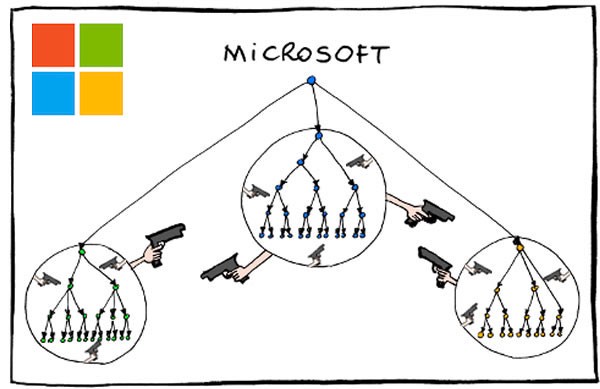
In my previous post, I covered how Microsoft and their partners have a vested interest in keeping their products artificially defective and complex. But I didn’t get a chance to dive as far as I would have liked into how Microsoft could go about intentionally keeping their solutions artificially defective or the negative impact that these methods seem to have elsewhere within their company. Without involving employees though, there are only a few ways that a company can intentionally create defective products without making it look intentional. Obviously, its not as simple as their employees dropping random ðŸâ© emojis into their code at night.
"In fact, as a former Microsoft employee myself, I can confirm that no one in this world hates defects and unnecessary complexity more than Microsoft employees and that great efforts are made to address such problems there. But, while the quality of an IT solution can absolutely reflect the quality and dedication of the engineers that made it, the quality of the environments where these solutions are produced are of equal importance and are reflected in the product just the same."Certainly, Microsoft could just as well be ignorant and inept with regard to quality software engineering best practices and just accidentally make $89 billion dollars per year. They could also just be dated, as this business model was much more justifiable in the 80’s and 90’s when they had no real competition and the productivity boost that their products offered at the time was unparalleled. Without an intricate understanding of quality engineering though, Microsoft, as a premier software development firm throughout the world, could not get to the level that they are presently at nor could they capitalize on such a dynamic that benefits off of artificially defective products to the degree that they do.
It goes without saying, but Microsoft doesn’t actually instruct their employees to create defective software. In fact, as a former Microsoft employee myself, I can confirm that no one in this world hates defects and unnecessary complexity more than Microsoft employees and that great efforts are made to address such problems there. But, while the quality of an IT solution can absolutely reflect the quality and dedication of the engineers that made it, the quality of the environments where these solutions are produced are of equal importance and are reflected in the product just the same. Along with hiring top talent, tech companies, as with others, can nurture their desired end result by adjusting their environment accordingly. This happens to be why modern technology companies tend to spend a significant amount of revenue tuning their work environment with extravagant office perks and progressive management practices.
"By reducing vendor headcount, they can increase workload of their employees at scale while reducing morale which can increase the probability of defects occurring within their products in turn."Regardless of how passionate and dedicated they may be, Microsoft employees, unlike Sr. leadership, have little to no influence on environmental variables such as headcount, workload, schedules, resources, morale, management, standards, or ideologies being leveraged; all of which influence the overall quality of their products. As such and just as companies can streamline their environment with this understanding in order to maximize quality, Microsoft can easily apply the same same logic inversely and make subtle changes to the aforementioned environmental variables in order to stifle quality. In doing this and almost as if they can turn a dial, Microsoft leadership can modulate the morale of employees at scale, increasing the tendency for them to be less motivated, more apathetic, less productive, and more error-prone without ever having to tell them to do anything but to do their best; all by simply making subtle changes to their environment.
For instance and since they depend heavily on vendors, which are almost as numerous as their full-time employees, leadership can easily modulate stress and pressure on their teams by increasing or reducing vendor headcount indiscriminately. It doesn’t matter how great of an employee they are, as people are worked harder and stretched thinner, they tend to cut corners in order to meet deadlines and among other things, they generally become more error-prone. By reducing vendor headcount, they can increase workload of their employees at scale while reducing morale which can increase the probability of defects occurring within their products in turn.
"...while employee layoffs always seem to make the news, Microsoft’s vendor attrition seldom generates any buzz and they can modulate pressure on remaining employees and vendors with impunity."On top of modulating the pressure on their employees with variable vendor resources, Microsoft can also limit the quality of their products to various degrees by limiting the quality of their environment elsewhere. Besides simply laying off a ton of QAs and SDETs, they can also leverage antiquated leadership that often come attached with antiquated organizational and managerial practices. This kind of leadership often results in frequent re-orgs, tenurocracy, thick management structures, change resistance, complex roles, and a rat race for a review system. When combined with adjusting their vendor headcount and lowering the bar with leadership, such practices can have a significant negative impact on productivity and morale which again can have a limiting effect in the overall quality of their products that they just would not have otherwise.
In comparison to having their employees complicit in the sabotage of their products, operating like this can be beneficial for several reasons. For starters, it would be impossible to keep a lid on such a foul if their employees were complicit in it. Conveniently though, making environmental changes in order to make your products artificially defective can be incredibly difficult to correlate, which also distances them from complicity in the matter from a legal perspective. Since so few people are well-versed on the subject of defect density, finding someone with a deep enough understanding of it in order to make such correlations can be quite challenging while also making a plea of ignorance to the subject incredibly easy, believable, and convenient; even for a software engineer. Also, while employee layoffs always seem to make the news, Microsoft’s vendor attrition seldom generates any buzz and they can modulate pressure on remaining employees and vendors with impunity. However, there are drawbacks inherent to operating like this.
"The Playstation 4 has outsold Xbox One 2:1, Windows Phone was a complete bust along with their Nokia acquisition, they’re having trouble giving away Windows 10 for free, their health band lasted three minutes, Consumer Reports recently pulled their recommendation for the Surface line of products, Groove is going away, and no one seems to give a damn about their soon to be released Invoke speaker."One unfortunate consequence of Microsoft optimizing their organization in order to make products that are more prone to defects is that doing so also makes their products less competitive in markets where innovation and quality take precedence over the influence of their partners, such as retail markets. To no surprise and presumably for this reason, Microsoft has been experiencing difficulty in reaching retail consumers. The Playstation 4 has outsold Xbox One 2:1, Windows Phone was a complete bust along with their Nokia acquisition, they’re having trouble giving away Windows 10 for free, their health band lasted three minutes, Consumer Reports recently pulled their recommendation for the Surface line of products, Groove is going away, and no one seems to give a damn about their soon to be released Invoke speaker.
In order to supplement their defective products in retail markets, Microsoft has to spend more on marketing as well as charging significantly more for support than the likes of Apple. For instance, Microsoft also had to give the NFL $400 million dollars to use their Surfaces for 5 years. Relative to their revenue in 2016, Microsoft spent 1/6th of their revenue on Marketing in comparison to Apple spending only 1/107th of their revenue. Also, a three year AppleCare hardware warranty with unlimited software support costs less than a call to Microsoft for a single Windows support case.


Further and by embracing their own solutions when better solutions are available, Microsoft also limits themselves in the same way that other businesses are limited by their products. Not only are Microsoft products more costly with regard to productivity loss, management, and support, there are much more productive and efficient tools available for such work which their competition is using. For a comparison, Apple employees equipped with Apple solutions generate 3x the amount of revenue per employee than Microsoft employees equipped with Microsoft solutions. Certainly, other environmental variables also contribute to this disparity, but the quality and efficiency of tools have a significant impact on the overall quality of the end product, just as the quality and efficiency of weapons influence the outcome of wars. This is yet another reason why IBM switched to Macs and why many startups are standardizing with Apple products to this day.
While most would consider Microsoft products to be a standard within industry, they are failing to see them for the monopoly that they are with the help of their partners. From the perspective of productivity software, they fit the profile quite well and there is not a realm of science that could justify the organizational moves and methodologies that Microsoft relies on outside their actions being that of a monopoly or of an inept company. Fortunately, as the IT industry improves its ability to engineer higher quality, more efficient, less expensive, and simpler solutions, Microsoft will eventually be forced to adapt or collapse. Credit where its due, they are trying incredibly hard to diversify their revenue outside of their partner network, but Microsoft’s many blunders throughout these efforts have forced them to revert back to their monopolistic tendencies and depend on artificially defective solutions in order to keep their partner network and investors happy, now more than ever.
"Without an incredibly high level understanding of engineering best practices, software defect density and the consequences of deviating from them, Microsoft wouldn’t have been able to operate at the level that they do, let alone realize and capitalize on their partner dynamic which is presently responsible for 95% of their revenue."In summary, this is just one of many ways that monopolies work and to no surprise, Microsoft seems to have a monopoly in the same industries that their partners thrive on. Working in the industry that they built, Microsoft cannot claim to be ignorant of the relationship between the quality of the environment and the quality of their products or of the stimulating effects that their defective software can have on their partners and their own business at the expense of industry as a whole. Without an incredibly high level understanding of engineering best practices, software defect density and the consequences of deviating from them, Microsoft wouldn’t have been able to operate at the level that they do, let alone realize and capitalize on their partner dynamic which is presently responsible for 95% of their revenue. To make such a claim would essentially be the equivalent of saying that they make $89 billion dollars per year by accident. ⬆