EditorsAbout the SiteComes vs. MicrosoftUsing This Web SiteSite ArchivesCredibility IndexOOXMLOpenDocumentPatentsNovellNews DigestSite NewsRSS

05.04.09

Microsoft’s ODF ‘Support’ is a Scam

Posted in Deception, Microsoft, Office Suites, Open XML, OpenDocument, Standard at 7:19 pm by Dr. Roy Schestowitz

Just a PR campaign

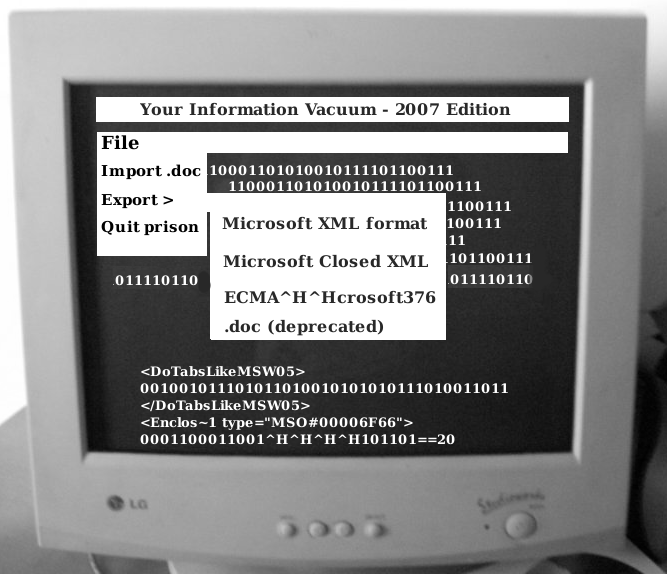
OOXML data vacuum

Summary: ODF support in Microsoft Office 2007 SP2 is a fail, fail, fail, and fail

Microsoft’s so-called ‘support’ for ODF is worse than no support at all. Why, who didn’t see that coming? The seminal analysis which is very comprehensive comes from an IBM employee, Rob Weir. Among the many things that he wrote:

We’ll probably also hear that 100% compatibility with legacy documents is critical to Microsoft users and that it is dangerous to try to save Excel formulas into interoperable ODF formulas because there is no guarantees that OpenOffice or any other ODF application will interpret them the same as Excel does. So one might try to claim that Microsoft is protecting their customers by preventing them from saving interoperable spreadsheet formulas. But we should note that fully-licensed Microsoft Office users have already been creating legacy documents in ODF format, using the Microsoft/CleverAge ODF Add-in. These paying Microsoft Office customers will now see their existing investment in ODF documents, created using Microsoft-sanctioned code, get corrupted when loaded in Excel 2007 SP2. Why are paying Microsoft customers who used ODF less important than Microsoft customers who used OOXML? That is the shocking thing here, the way in which users of the ODF Add-in are being sacrificed.

Groklaw too has made some fine arguments throughout the day (article and comments), so we won’t be repeating them. Here is just a portion:

I tried the updated Microsoft Office 2007 SP2, which supports ODF, or says it does. I created a document in Office 2007 SP2 and saved it as ODF. I got an ominous Microsoft warning that if I persisted, I might lose some formatting — “Document [name] may contain features that are not compatible with this format. Do you want to continue to save in this format?” — but it saved the document when I clicked Yes. I reasoned that OpenOffice, which I intended to use to test the result, does have the features I wanted. I had included one footnote, a photo, and a text block, all of which OpenOffice can do, but when I opened the saved document in OpenOffice, none of it looked right. You couldn’t read the footnote at all, because it’s cut horizontally in the middle of the text. You can see it’s there, but you can’t make out the words.

I thought most of the problems, and there were others, might be my fault though, because I’ve never used Office 2007 before, since I don’t own it, and I found it very confusing. Because I don’t own Office 2007, and I had limited access time to test on someone else’s, I looked around to see if anyone else was reporting results in the new SP2. I asked Groklaw members if they had tried it out yet and how it worked for them. A Groklaw member, Dobbo, did a test working on a spreadsheet with a client, and his experience was also a failure.

Regarding this Microsoft ODF “interoperability”, says one reader of ours: “[it] shows well how Microsoft sees interoperability. I suppose, with this, they can, in a very narrow and technical sense, claim ODF support. They certainly violate the spirit of ODF by not interoperating with other prominent implementations like OpenOffice.

“…Microsoft will make a lot of noise to pretend that it supports ODF and only give it a very bad name and discourage its use…”As we’ve warned right from the beginning, Microsoft will make a lot of noise to pretend that it supports ODF and only give it a very bad name and discourage its use while giving CIOs reasons never to dump Microsoft Office for lack of ODF support (no matter the level of support). Microsoft is doing it all in a hurry to just drop an “ODF” label on the box and then use the likes of Waggener Edstrom to make loads of noise (like never seen before) and associate Microsoft’s Office with ODF ‘support’.

If this rush job sounds like a familiar trick, it ought to. Rather than support ODF right from the start Microsoft hurried up with its phony format and shoved it down ISO’s throat using plenty of corruption. Alan Lord has just explained this pretty wellin his Web site:

Microsoft implemented OOXML (their XML based file format which is essentially a binary dump of the memory footprint of your document wrapped in an amazingly obscure and illegible XML schema) in Office 2007. You may have even received the odd file with a .docx or .xlsx extension. Then some kind of panic happened in MS and they decided that because Governments and other public bodies were asking for ODF (ISO/IEC 26300 Open Document Format supported by many applications including OpenOffice.org) they’d better get OOXML standardised too. So in a rush job, Microsoft’s specification publicist ECMA took the format used on Office 2007, got the developer documentation and wrote a bit more stuff around it and published it as ECMA 376. It then got submitted to the ISO for “fast tracking”.

As Tony Manco stated earlier, Microsoft now “wants to try and shape ODF, the same thing they tried to do with the Internet.”

Another anonymous reader described (hypothetically) what Microsoft will say next:

“Hey! Look! We support ODF too (kind of), so you can keep buying MS Office!”

OR

‘Of course. “See. ODF is broken, so use OOXML instead.”‘

Microsoft has already said that ODF files are "corrupt".

The anonymous reader adds: “The question is, are they doing this in a way that leaves them open for another EU investigation?

Truth be told, Microsoft’s pseudo ODF ‘support’ is placeholder to prevent defections away from Microsoft Office, so it is even worse than not supporting ODF at all. It creates an illusion and harms the reputation of ODF. It also stifles interoperability.

Microsoft’s stunt may be intended to drive people to OOXML and make ODF interoperability look poor. What is OOXML for anyway? Here is one good answer to this question:

If, they follow that statement through, it means OOXML will only work for compatibility with previous versions of office documents and this stops at MSOfiice 2007.

Of course it is easy to rewrite the charter, as it is only words. However, a charter sets the guideline and scope for one’s work, in agreement with a third party. That is why people do not like to alter the charter. Think about a charter like the consitution for the group, it can be amended if there is consensus, but should not be attempted with great caution, i.e., much greater care than amending a rule.

Microsoft’s business model is based strongly on making other people’s software unable to interact with Microsoft’s. Why would Microsoft change its ways now that it faces a crisis and may announce more layoffs tomorrow?

“In one piece of mail people were suggesting that Office had to work equally well with all browsers and that we shouldn’t force Office users to use our browser. This Is wrong and I wanted to correct this.”

Bill Gates [PDF]

OOXML patent issue prompt

Share this post: These icons link to social bookmarking sites where readers can share and discover new web pages.
  • Digg
  • del.icio.us
  • Reddit
  • co.mments
  • DZone
  • email
  • Google Bookmarks
  • LinkedIn
  • NewsVine
  • Print
  • Technorati
  • TwitThis
  • Facebook

If you liked this post, consider subscribing to the RSS feed or join us now at the IRC channels.

Pages that cross-reference this one

9 Comments

  1. David Gerard said,

    May 4, 2009 at 7:55 pm

    Gravatar

    Better than that: read this Microsoft press release. They promise *practical* interoperability. Before giving that fabulous line of red in Rob’s second table.

    Roy Schestowitz Reply:

    “If you can’t make it good, at least make it look good.”

    Bill Gates, Microsoft

  2. notzed said,

    May 4, 2009 at 9:39 pm

    Gravatar

    Really, as if m$ are going to spend any time and effort undercutting the one thing that makes them money – owning the file formats.

    Already a comment on Weir’s post suggests the ‘open source’ crowd could whip-up an importer that works around m$’s shitty exporter issues. If they do that, then all that they’ve worked for will be for nothing – just the crap with the web all over again, and another useless format which nobody can use reliably.

    Roy Schestowitz Reply:

    It’s RTF all over again.

  3. twitter said,

    May 4, 2009 at 11:50 pm

    Gravatar

    In the end, it’s not ODF that’s broken it’s Word and ignoring ODF is a critical mistake. People already hate Office 2007 and love Google Docs. People with Open Office can work with the DOC version people who use M$ Office also work with. Guess which word processor works with netbooks, the only kind of computer selling these days? The usual networking tricks are not working in M$’s favor this time. Instead of shelling out hundreds of dollars for a word processor, people are going to simply send docx to the trash. There are simply too many better and easier way to publish and collaborate than a clunky old desktop with expensive and buggy software. M$ is stuck in the 90s but the world has moved on. The more M$ breaks word, the faster people will leave it.

  4. Roy Schestowitz said,

    May 5, 2009 at 5:57 am

    Gravatar

    Here is another new take:

    Microsoft has opened the ODF door and will be pressured on better interoperability, so even my inner cynic has a hard time imagining interoperability will not improve. With Office 2007 SP2 and Wordpad in Windows 7 supporting ODF, the future looks bright for OpenDocument Format. Has Microsoft turned a new leaf? Microsoft’s recent investments in ODF, PDF, and web standards (in Internet Explorer 8) are probably more a function of government regulation or business demand than corporate goodwill.

    David Gerard Reply:

    Huh, OOOninja think anything’s better than nothing? Despite Microsoft’s best efforts to make it worse than nothing. We’ll see. Although they cleverly kept to the letter of the spec while maintaining a perfect lack of interoperability, I can’t see the promises in that press release from 2008 not coming back to bite them.

    Roy Schestowitz Reply:

    Huh, OOOninja think anything’s better than nothing?

    isn’t OOOninja tied to Sun somehow? I’d assume he has to be civil.

    David Gerard Reply:

    The author’s email address (the contact link at bottom) is @openoffice.org, so it’s an at least semi-official tips blog, yes.

What Else is New


  1. Red Hat Pays Microsoft-Linked Patent Troll Again, Refuses to Provide Details

    Another attack on GNU/Linux results in payment to trolls and silence from Red Hat, which keeps the FOSS community in the dark


  2. Microsoft Brings the Notion of Buying Games to End, Consumer Rights Groups Should Sue

    Not only is XBox eliminating the notion of owning and controlling one's console; new XBox paradigm aims to reduce one's control over purchased games, reducing buyers to temporary, transient consumers


  3. Links 24/5/2013: Fedora ‘Pidora’, CIvil Rights Debated in the US

    Links for the day


  4. Bill Gates Still Getting Richer Through For-Profit Investments, Now Wants to Brainwash Children in Schools in Favour of His Investments

    Some of the latest strategies used by the world's richest man to protect his investments and amass yet more money, adding to an ever-growing wealth while pretending it's a charity


  5. Microsoft Entryism and Its Effects on Corporate and Public Policy

    An aspect of Microsoft culture that ought not be overlooked because of its profound effect on society (private and public)


  6. Red Hat Should Follow Google's and Twitter's Footsteps on Patents to Avoid Becoming the Next Novell

    Red Hat continues to ignore my plea to defang the software patents it is applying for, potentially making them weaponised like Novell's and Sun's patents (e.g. Java at Oracle) upon buyout or another major event


  7. CAFC Decision Still Overridden by Overzealous Patent Lawyers in the Press, The Guardian and Other Corporate Press (CBS and AFP Included) Still Guard the Establishment

    Analysis of a sceptical kind of corporate press coverage regarding software patents in the US; great examples of how Microsoft- and Gates-funded press outlets tend to get it all wrong on the facts, smearing digital freedom fighters


  8. Software Patents Debate Still Open in New Zealand and the US

    In spite of distraction attempts, the debate over software patents continues to stress that there is a real danger


  9. WebM is No Ogg, It is Not Freedom-Respecting Anymore, Even in Countries That Have No Software Patents

    Why Google needs to fix the licence of VP9, or simply stop pretending that it should be the only de facto standard for multimedia


  10. Microsoft Violates Google Licences

    The champion of 'IP' and licensing (extortion) is not much of a champion after all, based on new reports, not just a lot of old ones


  11. Skype Teaches Us That All Microsoft Software Should be Assumed Spyware Unless Proven Otherwise

    The broader implications of Microsoft adding spying 'features' to Skype


  12. Links 23/5/2013: Threat to Civil Rights in UK, KDE 4.11 LTS

    Links for the day


  13. Links 22/5/2013: Debian GNU/Hurd, New Go Language Release

    Links for the day


  14. The FRAND Apple-Microsoft Conspiracy Attempts to Destroy Android/Linux, Ban Imports

    How Microsoft and Apple are using patents in bulk (sometimes acquired in unison, e.g. from Novell and Nortel) to artificially lower market saturation of the Android operating system or drive costs up


  15. Gates Foundation: Buying Influence for Bill's Ego and Bill's Profit

    New examples of power being acquired and investments (i.e. for profit) being funnelled into the beneficiaries


  16. Bill Gates Enters Financial Centres With His Goons Becoming US Budget Chief, Top Bankers

    How Bill Gates' staff is entering positions of financial power, indirectly giving Gates power over US (national and international) finance


  17. IBM Ignores Small Companies' Interests, Denies Patent Scope is a Problem, Focusing on Its Own Problems (Trolls) Instead

    How David Kappos and IBM (his longtime employer) continue to ignore the obvious problem which kills small businesses and everyone is complaining about


  18. The New York Times Publishes Factually-Flawed Patent Propaganda Benefiting Microsoft and Apple

    Eamonn Fingleton is rewriting history in the US' top newspaper, insinuating that patents contributed to the rise of software duopolists


  19. Software Patents Eligibility Likely to be Decided by SCOTUS

    Analyses suggest that an escalation by appeal to SCOTUS is likely to be the next stage in 'Bilski 2.0'


  20. Does Bill Gates Try to Flush GNU/Linux Down the Toilet in Kerala?

    Renting Microsoft software rather than using Free (as in freedom, or libre) software?


  21. Links 21/5/2013: Handbrake Turns 0.9.9, NetBSD 6.1

    Links for the day


  22. Links 20/5/2013: First Salifish Smartphone, Mageia 3 Released

    Links for the day


  23. Microsoft Corruption (Illegal Tenders) Stopped by European Court

    Microsoft cannot bypass public tenders, based on a ruling from a court of law in Europe


  24. Not Satire: Microsoft Wants to Show the World How Security is Done

    Software security 'standard' to be led by the company which made insecurity an acceptable engineering practice?


  25. Microsoft is Struggling to Maintain Industry 'Standards'

    With Microsoft's common carrier and browser share down considerably Microsoft finds itself increasingly irrelevant and it tries subversive means of making another comeback


  26. Microsoft Entryism and Bribery Get the Microsoft Way Implemented

    A recollection of very dirty tactics from Microsoft, which uses money to oppress, overthrow, and even hijack its opposition


  27. Patent Policy Laundering in the European Union and New Zealand

    How the so-called 'free' trade agreements help spread patent policy which favours software patents


  28. Ongoing Focus on Patent Litigation and Patent Trolls Reduces Focus on Software Patents

    The problem with increased focus on the players that use software patents litigiously and the litigation itself


  29. Andrew Y. Schroeder Shows That Patent Lawyers Are Sociopaths

    Bully and law misuser is trying to get his way with foul language, intimidation, and sheer lack of professionalism


  30. IBM-backed Book on 'Open Innovation'

    OpenForum Europe (OFE), which helps IBM's turf wars in Europe, releases a new book filled with its talking point


RSS 64x64RSS Feed: subscribe to the RSS feed for regular updates

Home iconSite Wiki: You can improve this site by helping the extension of the site's content

Chat iconIRC Channel: Come and chat with us in real time

Recent Posts