
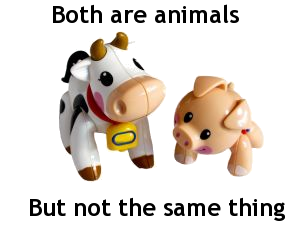
A SHORT WHILE ago we wrote about the deliberate confusion between counterfeiting and copyright infringement. The importance of this is very high because the mixture of totally separate notions (such as "IP" as umbrella term for copyrights, trademarks, and patents) is the source of much abuse. It enables an exploitative party to use particular laws that apply to one area of law in another area where such laws do not exist. According to an article we saw yesterday in TechDirt (put in daily links already), some companies are trying to extend the scope of copyright to mean "works like another thing" rather than be an exact copy of one specific rendition. This 'artistic' extension of copyrights is perhaps the sort of thing SCO, for example, would crave. We are glad to see that Glyn Moody has just addressed this subject, which he introduced as follows:
One of the many arguments against allowing patents for software (alongside the principle argument that software is made up of algorithms, which are essentially mathematics, which is pure knowledge and hence is not patentable) is the fact that software is anyway covered by copyright law. This means that others cannot simply copy your code, just as a novelist cannot simply copy large chunks of someone else's writing. But whether copyright law prevents others from copying the underlying ideas of that code by re-implementing them independently is another matter.
Google has been awarded a patent for displaying search results based on how you move your mouse cursor on the screen.
While it sounds initially bizarre, Google's plans are to monitor the movements of the cursor, such as when a user hovers over a certain ad or link to read a tooltip, and then provide relevant search results, and ads, based on that behaviour. It means that it does not require users to actually click a link to know that they were interested in it, opening a world of opportunity for even more focused ads, which are Google's main source of income.
Comments
Needs Sunlight
2010-07-28 12:43:34
Still missing from the discussions is acknowledgement of the fact that patents have to do with usage, not distribution, and are therefore a problem mostly unrelated to developers. Those with the largest stake in the matter and the most to lose are the end users, but they are mostly kept in the dark.
Dr. Roy Schestowitz
2010-07-28 13:17:11
I think there's a third option. I believe that solicitors sometimes use the term because it contains sound bites like "intellectual". It's like the thing Creationists try to do with "intelligent design" (encompassing everything from cosmology to chemistry, physics, spirituality, ethics, and biology).
We need to separate "IPR" and always break it down into its constituent components. You can't talk about them collectively.