EditorsAbout the SiteComes vs. MicrosoftUsing This Web SiteSite ArchivesCredibility IndexOOXMLOpenDocumentPatentsNovellNews DigestSite NewsRSS

10.25.10

Windows Profit Declines Sharply Because of Competition From GNU/Linux

Posted in Finance, GNU/Linux, Microsoft, Windows at 4:02 pm by Dr. Roy Schestowitz

Old building

Summary: Slowly but surely, Free software breaks Windows and other Microsoft platforms by lowering their market value and thus hurting Microsoft’s cashflow

ONE of our sceptical readers has raised an important matter in IRC yesterday. By looking back at some numbers he claims to have found more proof that Vista 7 does not succeed in the marketplace, contrary to these ludicrous claims that “Windows 7 might be a massive commercial success” (utter BS from Engadget, no offence intended). We’ll get to the pertinent details in a moment, not before pointing out that our informant from Sweden, Mikko, claims based on this article that “[S]ilverlight on the web is dead [...] Ballmer states that Silverlight is now pretty much strictly a client, non-cross platform thing, while explicitly stating that when it comes to doing something universal, “the world’s gone HTML5″.” So, we were right about Silverlight all along [1, 2, 3, 4], but that’s a separate story.

Mikko says he “thinks that there’s only bad journalism on Engadget” and we too wrote about the subject. Microsoft even gave this publication an expensive new laptop with Vista 7 (pre-beta) preinstalled so that it can praise Vista 7 before anyone else gets to see it. It’s an exercise of PR.

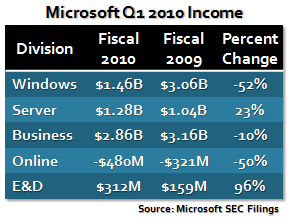
Windows undoubtedly has a margins problem. Mainstream publications that we cited recently say it clearly as it’s not hard to see. And looking at the source our reader cites, there is this MSFT analysis (Q1 of 2010) and one particular image that says it all. It’s all big minuses for Microsoft’s cash cows too.

Our reader responded by saying: “Record numbers of sales but 52% decline in income? Wow!

“If Microsoft’s sales have been flat of declining, it is no wonder they have gone from virtual dominance to 68% of all units today. 68% is a Vista 7 channel stuffing number, and the actual number is probably greater than that. That is, more than 32% of desktop computers are shipped without Windows…”

As we have shown before, Windows profits declined over the years. Profit fell by more than half based on the above, but income aside, revenue is down 39% too for Windows. That’s pretty shocking unless there’s a snag to be taken into account.

Our reader summarised by saying that “you can’t see the reports, sadly but the SEC will serve them to you… I was more interested in finding the number of licenses Microsoft has sold as a fraction of world PC shipments. Both are slippery numbers, with IDC providing most of the published PC shipment figures to Microsoft boosters and few hits on license numbers.” GNU/Linux is one cause of the stated declines. Microsoft is forced to lower prices to remain competitive. This may help explain the FUD attacks we’ve been seeing recently. One talking point is about GNU/Linux being “fragmented”, which is basically a negative word for “diverse”. “”Fragmented” is a proprietary spectacles view,” explained Groklaw some days ago in relation to Android, and “[p]eople say that about GNU/Linux too. But what they miss is this: you can do whatever you want. That is a wonderful feeling, and it leads to superfast development, not to mention a lot of fun.”

Share this post: These icons link to social bookmarking sites where readers can share and discover new web pages.
  • Digg
  • del.icio.us
  • Reddit
  • co.mments
  • DZone
  • email
  • Google Bookmarks
  • LinkedIn
  • NewsVine
  • Print
  • Technorati
  • TwitThis
  • Facebook

If you liked this post, consider subscribing to the RSS feed or join us now at the IRC channels.

Pages that cross-reference this one

11 Comments

  1. lightpriest said,

    October 26, 2010 at 4:20 am

    Gravatar

    Every Linux distro allows you to install a different kernel version or compile one of your own so you could add/remove support or even optimize it for your own needs.
    With package managers and different repositories you have the ability to install an older/newer version of some software if current is buggy or lack some features.
    You can even run the same software with different versions using chroot, if dependency is a problem.

    On Windows, you cannot replace the “Explorer” (shell), you cannot replace “Gena” (the login manager), but still – there are 4 major versions of Windows splitted amongst different SPs and each with its own problems/bugs. Different MSOffice versions sometimes don’t match each other making documents look funny. Different IIS versions have weird bugs, not to mention performance issues.
    Some laptop OEMs build drivers only for Vista/7, making it impossible to use XP with that laptop.

    If anything’s true about fragmentation is that every software has it.
    MS users suffer more from it. If you have a problem with a certain version of Windows you either need to pay for an upgrade, which breaks other stuff, wait for the company to build a fixed version or don’t use the feature you wanted at all.
    If that same problem occures on Linux, at worst you chroot.

    Fragmentation on Linux is an advantage, it was created that way. Fragmentation on Windows is how they do business.

    twitter Reply:

    Fragmentation, as you have noticed, is a non free software problem. Microsoft successfully labled non free Unix “fragmented” and they would like to project this on gnu/linux, bsd and other free software. They might have a point with Android because Google did not use a strong copy left license like GPL3 that would prevent Tivoisation and other non free monkey shines. Anyone can see that there is no such problem with gnu/linux because all of the same free software comes with ever distribution, with a few interesting exceptions that others have not picked up yet. Skype demonstates that it is easy enough to make non free software for gnu/linux distributions but the user is left helpless and dependent on Skype. All of these problems and more exist to a worse extent on Windows, of course. The issue is a typical Microsoft troll which inverts reality for the ignorant.

    It is better to talk about the fundamental issues of software freedom which clear the air quickly. More freedom and fewer restrictions are obviously better for everyone. “Fragmentation” does not exist where people are free to share. Most other software problems boil down to people being uncooperative and abusive towards their neighbors.

    Dr. Roy Schestowitz Reply:

    In UNIX, things are typically built upon accepted standards (not vendors), so the notion of “fragmentation” does not quite apply. The modular pieces interact quite nicely.

    twitter Reply:

    Irix, HPUX, AIX, Solaris, SCO, Next and others did incorporate some common and accepted standards but each owner had their selfish pieces that made “open” difficult. Irix had a journaling file system, for example but others did not. Free software has recreated the nice pieces of each and brought them together where they can all be enjoyed at once. I’m no expert in ancient Unix, but differences in C libraries made it difficult to port some work from Solaris to gnu/linux for me. Had all of the owners shared from the start, their hardware would now dominate the computing landscape. As things went, the survivors lost both their independent hardware and software efforts and now bow down before Intel and Microsoft. They were divided and annihilated.

  2. TemporalBeing said,

    October 26, 2010 at 12:12 pm

    Gravatar

    It’s coming to the end-game for Microsoft.

    Back when Windows 9x/Me was released, an upgrade cost $90USD, and the full version (everything!) was $199 at most. WinXP increased that slightly; I think upgrades were $120-130 range, but the full version (Pro) was still only about $199. With Vista, Microsoft more than doubled the cost. All of a sudden upgrades were $199, and the full version was $399! An inflated value that they kept for Win7, only they added the Family Pack (3-5 licenses) for a little more than that $199 upgrade price. Still, not really much of a deal.

    At least with Office they were smart enough not to change the price too significantly; but it’s still pricey; and Microsoft relies Office to drive sales of Windows. So as people and organizations have started moving off of Office, they now find themselves able to move off of Windows as well, or at least in a better position to do so.

    So, I expect that we are at the beginning of the exponential curve downwards of ousting Microsoft from the PC business. The same wave that pushed them to market dominance is now going to crush them.

    Dr. Roy Schestowitz Reply:

    They are moving into vapourware mode again.

  3. twitter said,

    October 28, 2010 at 10:44 pm

    Gravatar

    Vista 7 Failure! Despite wild raves by Microsoft boosters, first quarter numbers are not good for Microsoft. Barrons has a concise summary, with some caveats about deferred income and jubilation but little perspective.

    [16.2 billion in revenue] up 25% from a year ago. Operating income was $7.12 billion, up 59%; net income was $5.41 billion, up 51%; EPS was up 55%. Year ago period results included the deferral of $1.47 billion of revenue related to Windows 7 upgrades; adjusted for that factor, revenue was up 13% and operating income was up 20%, while net income was up 16% and EPS rose 19%.

    Sounds great, right? Not when compared to 2009 [2], the tail end of Vista failure. In 2009, the company had income of about 7 billion. So, there is little change from where Vista left them in 2009. In fact, the company is probably worse off because they managed to channel stuff 240 million Vista 7 licenses recently. Not much should be expected beyond that spurt.

    Predictably, Microsoft bills the deferral roller coaster as explosive growth. In this article, for example, claims “During Q1 FY10, before Windows 7 was released…” which is not true. Microsoft was already selling licenses for the new OS and had channel stuffed enough of them to cause a big dip when the revenue was “deferred”. A year later, we have some more channel stuffing billed as actual sales to make an apparent rise. The two year numbers tell the story more clearly but Microsoft boosters pretend to be unable to remember the numbers. Goldfish might do better.

    twitter Reply:

    Tech Crunch points out that Apple had $4 billion more revenue than Microsoft did. If we believe Microsoft when they tell us Windows 7 has been very successfull, the best selling OS EVAR, we have to conclude that Windows success makes no difference. Success or failure, Windows 7, just like Vista, has not made a bottom line difference to Microsoft.

  4. twitter said,

    October 30, 2010 at 1:47 pm

    Gravatar

    Pogson’s figures gave Microsoft more credit than they deserved because he took the company’s word. Microsoft claimed that 240 million coppies of Vista 7 had been shipped/sold. Pogson took that number and divided it by the number of computers shipped/sold in the year which was 350 million. Microsoft’s quarterly report claims only 150 million coppies. The discrepancy most likely comes from the fact that Microsoft pulled a Vista capable scam, promising free “upgrades”, long before they officially released Windows 7. The confusion is intentional, but they lied less to the SEC than they did to everyone else. 150/350 million is far less than Pogson gave the company credit for. XP has made up the majority of business purchases, because business has choices that normal people don’t, but it is probably fair to say that less than 60% of computers shipped with Windows last year.

    Poor Steve Ballmer only got a $670,000 bonus because results were so bad and even people at Information Week realize that Microsoft might not be around in five years.

    twitter Reply:

    The report referenced is actually a proxy report which has executive compensation and number of shares owned.

    Dr. Roy Schestowitz Reply:

    The bonus matters a lot less than Ballmer’s shares in the company. But a decline is symbolic. Ron Hovsepian’s bonus (Novell CEO) is almost 10 times that of Ballmer.

What Else is New


  1. Links 23/5/2012: printerd, Mageia 2 Released

    Links for the day


  2. Links 22/5/2012: Google/Motorola Deal Secured, Chrome Passes IE

    Links for the day


  3. Links - Explorer Goes Down, Oracle Judge is Coder


  4. Links 21/5/2012: Linux 3.4 Released, Dream Studio 12.04

    Links for the day


  5. Articles Against Software Patents and Patent Trolls

    An accumulation of recent articles on matters such as patent trolls, which mostly use software patents based on a recent survey


  6. New Zealand (NZ) Patent Debates Expand

    The kiwi (NZ) press turns its attention to a patent controversy other than the question of software patenting


  7. AOL Helps Microsoft Infiltrate, Harm Open Source Communities, Feeds Facebook With Google-Hostile Patents

    Microsoft is preying on AOL funds and patents


  8. 'Piracy' and 'Discount' Propaganda Used to Kick Free Software Out of Governments in Favour of Microsoft Deals

    A look at new tactics and moves which omit freedom and autonomy from nations foreign to Microsoft


  9. Sun: Interoperability More Important Than Patents

    An old position paper from Sun Microsystems helps shows a certain resistance to patents such as those which Oracle uses against Android


  10. In Motorola Case, Microsoft Boosters Use Slashdot for Anti-Linux/Android Patent Propaganda

    Covering what's right/correct -- not what's wrong/incorrect -- about the Microsoft case against Motorola/Android


  11. Microsoft Tax on Everything

    The company which hardly pays any tax is busy trying to tax GNU/Linux, Android, and all hardware in the OEM channel


  12. Links 19/5/2012: Mandriva Linux Freed, New Linux Mint RC

    Links for the day


  13. Apple Patent Wars Make Android Devices Less Attractive, Everyone Suffers

    Bits of patent news regarding Apple and its patents


  14. Defeat for Software Patents in the United Kingdom

    Wise words from a prominent Linux figure and news from the UK


  15. BSA and IDC Systematically Lie to the Public, Distort Press Coverage

    IDC and the Business Software Alliance (BSA) liaise once again in order to give ammunition to lobbyists of proprietary and copyright conglomerates


  16. Links 17/5/2012: “Bio Computer” Runs Linux, Raspberry Pi Grows

    Links for the day


  17. IRC Proceedings: May 11th-May 16th, 2012

    IRC logs for May 11th, 2012 (and subsequent days until May 16th)


  18. IRC Proceedings: May 5th-May 10th, 2012

    IRC logs for May 5th, 2012 (and subsequent days until May 10th)


  19. IRC Proceedings: April 29th-May 4th, 2012

    IRC logs for April 29th, 2012 (and subsequent days until May 4th)


  20. Android Under Patent Attacks From Nokia, Microsoft, and Oracle

    A roundup of patent news involving Android and the US patent/copyright system, which facilitates ridiculous patents or lawsuits over APIs


  21. Helping OpenSUSE is Helping Microsoft Tax GNU/Linux

    A short wave of calls to refrain from OpenSUSE promotion, which through the upstream is helping Microsoft, the sponsor


  22. Microsoft May Face Federal Action for Blocking Rival Web Browsers on ARM

    Mozilla's call for action is taken seriously by people at The Hill (Washington)


  23. Links 16/5/2012: 125,000 GNU/Linux Machines for Pakistani Students, Android 4.0 Rollouts

    Links for the day


  24. Links 15/5/2012: Linux 3.4 is Near, Mandriva to Have More Releases

    Links for the day


  25. Links - TPP Meeting Infiltrated, More Protest Needed.


  26. Europe Rules Against Monopolies on APIs

    The case against Android notwithstanding, the highest European court rules that APIs cannot be covered by copyrights


  27. Microsoft Versus Education

    A bit of news/commentary on Microsoft in education (indoctrination)


  28. Patents Are Never 'Open Source'

    The disinformation tactic which ascribes patents to FOSS as seen in the news


  29. Signs of Progress: Work for Microsoft, Get Ostracised From Panels/Public Consultations

    Convinced monopolist Microsoft has its moles' voice invalidated, based on the conflict of interest (Microsoft versus the public)


  30. Links 14/5/2012: Linux Kernel 3.3.5, Wine 1.5.4

    Links for the day


RSS 64x64RSS Feed: subscribe to the RSS feed for regular updates

Home iconSite Wiki: You can improve this site by helping the extension of the site's content

Chat iconIRC Channel: Come and chat with us in real time

Recent Posts