
Direct download as Ogg (12:12, 4.8 MB)
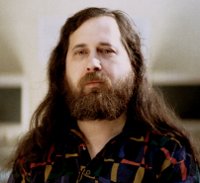 Dr. Richard Stallman: Well, how do I judge the reliability? To a large extent I look at the story, and I try to judge based on the other things I know whether this looks like it's bullshit or possible truth. Because there are news sources that I know often slant things, but that doesn't mean that I think that their statements of facts would wrong, because I expect that they would be caught if were wrong. I don't know of any news sources that I could say "that's a good one", because they all have their positions, they all want to say some things and not others. The question is, does it seem plausible that they would say falsehoods about facts? Because there is some embarrassment involved in getting caught in saying... in giving some news that wasn't true.
Many places are not likely to say things that are just false, but they may draw conclusions that don't really follow, or that reflect bias.
My next question is about the GPL. More recently there has been some exposure for what's known as the GPL.next, which Richard Fontana...
"Richard Fontana was interested in exploring some ideas, so he started a project to get suggestions about what to put in a copyleft licence."No, no, it isn't [called that] anymore. Basically, Richard Fontana was interested in exploring some ideas, so he started a project to get suggestions about what to put in a copyleft licence.
That name was not very nice because it implied that it would be the replacement, and of course for anyone to say "my work is going to replace your work" is a somewhat unfriendly thing to say, but that's not what he seems to really mean, so I hope that he finds some interesting ideas through this.
My next question is, what do you consider to be the most effective strategy for elimination of software patents in the United States and worldwide as well?
"If the US trade representative is visiting, or there are a thousand reasons to protest the visit of the US trade representative, what he wants is good for business and bad for people in every country including the US."Well, it depends on the country, because this is a matter of political activity and how to do that effectively varies from country to country. So I can't give authoritative advice to people in other countries; if I can even do so in the US, it wouldn't apply to other places. I can suggest possible approaches to try, you know, meet with officials, organise and make a protest in the street, have protests at events if any officials from that part of international agencies that favour software patents are coming, protest them. If the US Trade Representative is visiting -- there are a thousand reasons to protest the visit of the US Trade Representative; what he wants is good for business and bad for people in every country including the US. How you influence politics in your country, you'll know probably a lot better than I do. That's what it involves, very likely. But it may also involve legal action, if your country's courts could rule that software patents are not valid; that's very important. But what you need is to find a lawyer to argue that case.
Now, in the US, when an appeal is being heard, anyone can send a friend of the court brief, which is published presenting arguments to be considered. If you are in a country which has a practice like that, that can be helpful.
But there is one point about which direction is going to be useful.
If the country does not have software patents, then it will work simply to make it clear and firm that software patents are not allowed, and put this into legislation so that the patent office can't betray it. And you have to work hard making it ironclad, so that the patent office can't find an excuse to betray it. For instance, there are countries in which computer programs can't be patented, But the patent offices say, "we're not issuing patents on computer programs, we're issuing patents on techniques that can be used in computer programs." Now, we think that those treaties and laws were meant to prevent that, but the patent offices reinterpret them in a way that means that [law or treaty] becomes effectively void, and doesn't prevent any kind of patent that anyone would actually want to apply for. So you've got to be careful, you've got to study from a point a view, how could the patent office try to twist this?
"Congress can't legislate the existing patents into non-existence."However, there are countries which already have software patents, and in those countries restricting the issuance of software patents would still leave you with maybe hundreds of thousands of existing software patents. Well, if the courts ruled that software patents were never valid, they would all disappear. So there is some hope that that may eventually happen. But what could Congress do?
Congress can't legislate the existing patents into non-existence. What it could however do is legislate that patents are not infringed by developing, distributing or running software on general-purpose computer hardware if the hardware itself doesn't infringe. That way these patents would remain valid, and they could be applicable to hardware devices but not to software.
You see, patent systems don't generally divide patents into software patents and hardware patents; it's rather the patent would cover a certain idea, and maybe that idea is typically implemented in software, but the patent would also cover implementing it in hardware. My definition of a software patent is a patent that can prohibit programs. Because patents are not intrinsically labelled as software patents or hardware patents, you can't just say "we are going to prohibit software patents", you've got to define clearly what it is that's not going to be issued, or else legislate about where patents apply and where they don't apply.

| Show overview | Show title |
| Episode 66: Tim and Roy | TechBytes Episode 66: First of the Second Series |
| Episode 67: Tim and Roy | TechBytes Episode 67: Nokia Down, Android Up |
| Episode 68: Roy | TechBytes Episode 68: Solo With Patents, Apple Bans, and Android World Domination |
| Episode 69: Roy and Richard Stallman | TechBytes Episode 69: Richard Stallman on Restricted Boot (UEFI), Coreboot, GRUB, and Boot Freedom |
| Episode 70: Roy and Richard Stallman | TechBytes Episode 70: Richard Stallman on How Browsers and Social Networking Sites Facilitate Surveillance |
| Episode 71: Roy and Richard Stallman | TechBytes Episode 71: Richard Stallman on Surveillance, the NSA, and Mobile Phones |