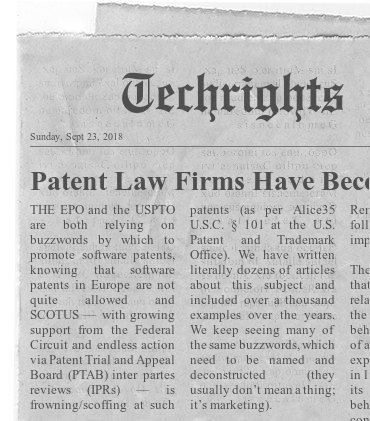
Summary: What we're observing, without much reluctance anymore, is that a lot of patent lawyers still push abstract software patents, desperately looking for new trendy terms or adjectives by which to make these seem non-abstract
THE
EPO and the
USPTO are both relying on buzzwords by which to promote software patents, knowing that
software patents in Europe are not quite allowed and
SCOTUS -- with growing support from the
Federal Circuit and endless action via Patent Trial and Appeal Board (PTAB) inter partes reviews (IPRs) -- is frowning/scoffing at such patents (as per
Alice/35 U.S.C. ۤ 101 at the U.S. Patent and Trademark Office). We have written literally dozens of articles about this subject and included over a thousand examples over the years. We keep seeing many of the same buzzwords, which need to be named and deconstructed (they usually don't mean a thing; it's marketing).
Over the past week (as in every other week) we've been tracking activity like software patenting. What makes it a tad tricky is the (mis)use of homonyms and synonyms, along with the above-mentioned buzzwords. The buzzwords change over time, with some of them aging out of existence and new ones being introduced (e.g. so-called 'fourth industrial revolution' or "4IR" as the EPO likes to call it). We don't want to mock or obsess over these buzzwords
too much. From what we can gather, EPO examiners are clever enough to spot this nonsense and have a good chuckle over it. This post will, instead, be a rundown of outline or recent articles which demonstrate what we're talking about.
Several days ago we saw
"FogChain Patent Secured Data Access Control"; if this sounds abstract, well... that's because it is. And the article is just self-promotional junk from Crypto Block Wire, LLC (the publisher). To quote:
FogChain Corp. is a futuristic, highly reputable company offering solutions to software development, testing, and deployment. The company is gratified to announce its most recent decision regarding filing for a new patent. The patent covers secured data access control utilizing localized cryptographic innovation.
Technological advancements in the blockchain industry have empowered secure distribution of digital information using cryptographic techniques. Consequently, secure and quick transactions, including other data adjustments, can take place in a more dynamic and economical manner. In particular, its decentralization endeavors may bring about absolute transparency and immutability of the data.
The patent’s underlying technology covers localized network typologies that are able to grant access control and data management capabilities. The technology can additionally provide particular network architecture models that accommodate and empower such functionalities.
How is that
not abstract? It's so obviously invalid based on Section 101 criteria. But they say "blockchain" and "innovation", so it must be very, very innovative. "Patent please!"
Remember that
all these "blockchain" patents are bunk software patents; we cannot stress this strongly and often enough. This sort of "blockchain" hype is everywhere this year, including in the domain of patents, wherein it's presented either in the context of patenting or management of patent data (sometimes both, sometimes interleaving to the point of revealing writers' inability to comprehend what they even write about or get told by law firms). Here is a fairly new article titled
"What would a blockchain patent war look like?"
The opening paragraphs
go like this:
Blockchain is perhaps the most hyped technology of the past five years. The technology that allows us to create trustless immutable shared ledgers promises to bring transparency and honesty to commerce by disintermediating and decentralizing functions that rely on trusted third parties today. The promise and the potential are almost as big as the hype.
While still the early days, there are several applications that have already launched on blockchains — the first being the Bitcoin cryptocurrency payment protocol. Bitcoin is just a unit of account on blockchain. And more recently, with the implementation of smart contracts, code that is shared across the whole blockchain to execute conditionally with irrefutable results, we have the possibility to tokenize many new financial constructs on blockchains.
It's all abstract; it's software.
Another new article, this one titled
"Mastercard Eyes Blockchain For B2B," promoted the misconception that large companies (such as Mastercard) applying for a patent means they intend to implement something rather than simply obstruct competition/disruption. We wrote about this in past years, even in relation to Mastercard. To quote:
Blockchain has been receiving attention well beyond cryptocurrencies, and the focus has shifted in part to patent filings. Though it may seem that China has dominated patent filing activity in recent weeks, a number of firms (not Alibaba) have been making their own way across the patent landscape.
In the latest news germane to intellectual property and blockchain, Mastercard has filed three patent applications with the U.S. Patent and Trademark Office, as reported this week. Amid those patent filings came details that the payments giant has developed a blockchain-based system, which aims to streamline high-volume B2B transactions. The patents are titled “Method and System for Recording Point-to-Point Transaction Processing.”
UseTheBitcoin (blog) then published a
rather poorly-researched item that attempts to rank large companies based on "Blockchain Patents", preceding the list with a logo of Microsoft. From the introduction:
Blockchain technology is one of the most trending topics in 2018. With blockchain becoming one of the most popular buzzwords today, every startup or established company wants to jump on the opportunity. This has led to the abundance of companies filing patent applications, hence triggering a potential blockchain race.
This year alone, several major companies applied for Blockchain-related patents. Like any other patent, a blockchain patent is a strict form of legal protection over an invention and the intellectual base of that invention. It’s a legal means for inventors to prevent others from making use of their invention.
Promotion of totally bogus software patents is likely to do no good, except for law firms; it's about databases. There are also those that pertain to computer vision (mathematics) and are
being promoted in press releases like this one which says: "This report provides insights into the development of facial recognition-related granted patents for automotive applications and offers a snapshot of facial recognition-based technology and application trends in the automotive industry."
Well, facial recognition is all software. I know this, having reviewed scholarly papers on this (even for leading international journals). Why are such patents still being hailed as worthwhile after
Alice? The mind boggles...
Campbell University is meanwhile calling algorithms "AI", failing to note that these buzzwords won't make these algorithms any less abstract and thus invalid as per Section 101. Here they are
advertising the event. Topics include "Patentable Subject Matter for Computer Related Inventions" and "Protecting AI Software & Protecting Inventions Created with the Help of AI" (two different things, but in both cases boiling down to mere algorithms). Their
calendar says they are giving "Continuing Legal Education (CLE) credit from the North Carolina Bar Association" by lying to people about software patents and telling them, even wrongly, that 'dressing up' algorithms as "AI" would be worth the time and money. This is a recipe for major disappointment as judges would throw out such patents.
Matt Acosta and Emilio Nicolas (Jackson Walker) have meanwhile
published in JD Supra (press releases platform for lawyers) something about surveillance in one's toothbrush. They are calling abstract things "smart" and "IoT" to make them seem patentable and desirable (they're neither). With a term like "Internet of Things" preceding/starting the headline, what could possibly go wrong? Putting the "Internet of Things" on just about
anything is supposed to make things sound new, amazing and novel.
We have meanwhile also noticed, from
South Africa for a change, the International Law Office (not what it sounds like) publishing a nonsensical piece with "fourth industrial revolution" (three buzzwords) and "IP protection" (three propaganda terms) in the headline. Louw Steyn and Dawid Prozesky use misleading propaganda words like "property" and "protection", conjoined/combined with "4IR" from the EPO, to promote the false perception that software patents have legitimacy (they lack that in courts, even in South Africa). In the body they also namedrop "artificial intelligence" (AI) and "additive manufacturing" (AM), not to mention "smart" (nowadays everything that does mass surveillance gets called "smart"). From
the introductory paragraph:
The so-called 'fourth industrial revolution' is in full swing. Fields such as artificial intelligence (AI) and additive manufacturing (AM) are no longer a thing of the future, but rather an increasing part of everyday life in the form of smart devices, driverless cars and automated assistants – to name a few examples. This revolution is generally centred on a fusion between physical and digital technologies.
The above is just a big "salad" of buzzwords -- something to be expected from a marketing department rather than a law firm. Sadly, however, many law firms have been decimated to just that. They just recite a lot of propaganda terms and trendy words like "smart" or "innovative". They don't like using terms like "software patents" anymore, knowing that examiners and judges would be instinctively inclined to reject like a reflex.
⬆
