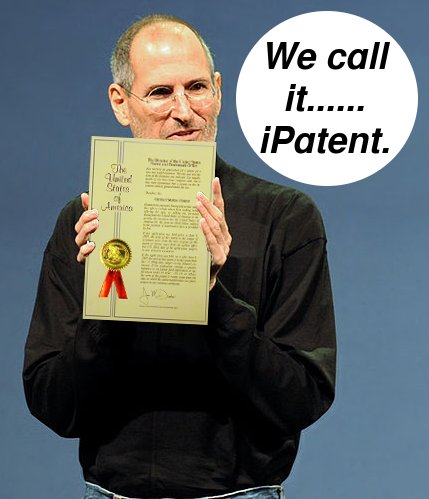
Original photo by Matt Buchanan; edited by Techrights
Summary: A look at how the Western press covers HTC's response to Apple's attack on the Linux-based Android; new cracks in patent systems worldwide
THE patent system disappoints most parties which are affected by it (but not all parties are created equal). This post takes a look at new examples.
Taiwan
The US press sensationalises HTC's response to Apple and makes it look like HTC is attacking rather than defending. Items that are liked in the West (notably
hypePads, hypePhones, and hypePods) are being used to evoke emotion. We are talking about headlines like:
There are many more examples like that. In this particular case, HTC is not the bad guy; Apple
attacked Linux/Android and even
Microsoft seems to have extorted it very, very recently.
Some headlines put it in better perspective (there are hundreds of headlines). How about
"HTC files lawsuit against Apple, calls for injunction" or even the clarification that it's a counter-attack and thus really defensive?
Katonda.com, which is a very good Web site, says that
"HTC Takes Revenge; Hits Apple" and adds:
Bruce Perens has written in detail about the problems of software patents, “Patents, originally created to stimulate innovation, may now be having the opposite effect, at least in the software industry. Plagued by an exponential growth in software patents, many of which are not valid, software vendors and developers must navigate a potential minefield to avoid patent infringement and future lawsuits. Coupled with strategies to exploit this confusion over patents, especially in standards setting organizations, it appears that software advancement will become stifled unless legal action is taken to resolve the situation...”
He further wrote ... “Patent royalties tend to create discrimination against small-to-medium-sized businesses developing any form of software, and especially against Open Source developers.
The largest businesses in an industry generally have patent cross-licenses with their peers, and thus they may ignore each other's patents while smaller businesses have no choice but to license those patents if they use them. As a result, there is a "tax" upon technology that small businesses must pay while the largest businesses are exempt.”
Software patents have become weapons for companies to fight with each other. This not only wastes valuable resources but also time of courts. Many activists and experts have been raising questions about the legality of software patents.
Many countries including India do no allow software patents.
The United States, Europe, and Japan are
trying to change India's laws so as to retard progress in India. Indians should explain to their peers why they need to reject so-called 'IP' for their advantage and long-term prosperity. Indian officials are likely to be incentivised (nice word for "bribed") to serve foreign interests rather than the local population. We saw that before and gave examples. Microsoft is among the culprits.
United States
With the exception of cases like
I4i vs Microsoft, we dislike almost everything about the USPTO's practices. It merely grants monopolies, mostly to large US-based companies, in order to exclude competitors from the market. How is that beneficial to progress, assuming competition drives innovation?
The following
new article is perhaps a repetition of old news. Either way, it ought to show why it is also in Microsoft's interest to lobby
against software patents.
Toronto-based i4i said yesterday that the U.S. Patent and Trademark Office has confirmed the validity of its software patent after Microsoft had asked that it be reviewed.
Throughout the case, Microsoft was accused and found guilty of
trial misconduct. A
Microsoft lawyer said some months ago that Microsoft "routinely produces and/or condones deficient investigations, covers up alleged misconduct, mischaracterizes evidence, refuses to preserve or provide pertinent facts and data, protects the perpetrators and retaliates against victims."
To clarify, Microsoft has
many other patent cases where it is the defendant, but given that
Microsoft has many software patents which it uses to bully rivals, this hardly makes Microsoft a victim of this system.
One area where the USPTO is trying to improve is the requirement of a written description as
mentioned quite recently. Here is a
patents-oriented Web site covering the subject:
USPTO Director David Kappos recently commented on the March 22, 2010 Federal Circuit en banc decision Ariad Pharmaceuticals v. Eli Lilly and concluded that the written description requirement remains alive and well and is an essential “backstop” against overclaiming. In the case, the Federal Circuit held that Section 112 of the Patent Act has a written description requirement that is separate and apart from the enablement requirement.
We will probably hear more about it in coming days.
Europe
Over in Europe, the major news at the moment is the EBoA decision which we covered and interpreted in [
1,
2]. Here is what sites that Google classifies as "news" had to say (some are sites for/by patent lawyers, which makes them biased and unlikely to qualify as "objective"):
i.
European Patent Office rules on software
The European Patent Office (EPO) has ended speculation about the extent to which software can be patented under the European Patent Convention with a decision handed down yesterday from its Enlarged Board of Appeal.
ii.
Europe clarifies its position on intellectual property
Yesterday, the Enlarged Board of Appeal of the European Patent Office (EPO) handed down its long-awaited 'opinion' on the extent to which software can be patented under the European Patent Convention.
iii.
European Patent Office silent on software patent question
No change: That's the result of an 18-month long appeals process that the president of the European Patent Office hoped would clarify the rules on whether software may be patented.
In October 2008, EPO President Alison Brimelow referred four questions on the patentability of software to the EPO's Enlarged Board of Appeal, its highest appeals court, on the grounds that a number of patent cases had reached "different decisions."
From pro-patents Web sites (maximalists) we have:
i.
Reactions to the EPO computer program patent decision roll in
ii.
Patenting Computer-Implemented-Inventions (CIIs) in the EPO
All in all, the EBoA's involvement was not at all satisfying, to put politely. The issues that existed ultimately remain. What will European SMBs (the majority) have to say?
⬆
"They [EPO examiners] claim that the organisation is decentralising and focusing on granting as many patents as possible to gain financially from fees generated." —Expatica, European Patent Office staff on strike
