
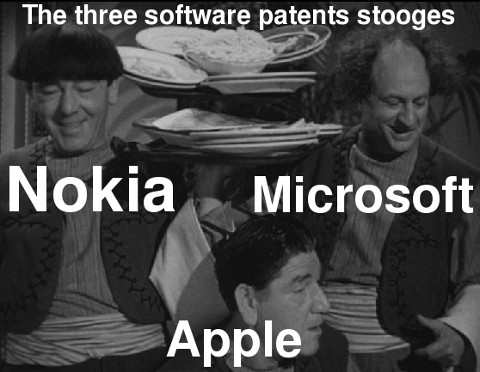
ONE of Microsoft's very latest 'export' commodities is software patents, which account for about 85% of its applications. How about that for a company whose co-founder said just two decades ago: “If people had understood how patents would be granted when most of today’s ideas were invented, and had taken out patents, the industry would be at a complete standstill today."
“Microsoft has for quite some time been a hindrance to progress.”According to this new article, Microsoft gets a patent on cleaning up spam. In other words, Microsoft is getting a monopoly on a technique that helps reduce levels of the very same spam its botnets are creating. Dean Drako, Barracuda's CEO, once said: "I would much rather spend my time and money and energy finding ways to make the Internet safer and better than bickering over patents."
Next time spam fills one's inbox, one needs to remember that Microsoft not only caused such spam but also suppressed spam prevention. How about that for a company whose co-founder said just 6 years ago: “Spam will be a thing of the past in two years’ time."
So here we have a company that not only stifles progress but also stifles productivity. No wonder Microsoft is distrusted in the software industry; it's not prejudice, it's deserved dispositions.
"Microsoft gets Songsmith patent," told us the Microsoft-sponsored TechFlash some days ago, so Microsoft is now stomping on music too. What would musicians and recreational music professionals say?
Apple is another patent aggressor that deserves no pardoning because it has been threatening Linux for a few years now (patent litigation threats) and finally sued Linux a couple of months ago. According to PatentlyApple.com (yes, Apple has fan sites even for its monopolies), "Apple Wins Strategic Multitouch & Music Tempo Workout Patents":
Apple has been granted a patent for a multi-touch system that compares finger arrangements at the beginning of multi-touch gestures and discriminates between neutral and spread-hand performances. Gestures by the neutral and spread-hand versions of each chord are then mapped to separate, but intuitively related cursor functions or sets of commands. Less-frequently performed functions and commands are typically assigned to the spread-hand chord, since spreading the hand from neutral takes deliberate effort. With these neutral and spread distinctions, a two-handed gesture set can be packed into a one-handed touch surface, or for two-handed touch surfaces, twice as many intuitively customizable gesture command sets can be accommodated.
The first product to result from an alliance between Finnish phone maker Nokia and software firm Microsoft has been launched.
The notion of Apple as a ruthless competitor in the technology marketplace isn't well established in the minds of consumers, but some industry watchers say that could change if the company's recent behavior continues.
Apple is engaged in conflict on multiple fronts: Google, Adobe, HTC, Ellen Degeneres and the tech blog Gizmodo have all felt its wrath in recent weeks. U.S. regulators are reportedly considering launching a full blown antitrust investigation into Apple's iPhone developer licensing tactics.
She is one of scores of young workers in the city of Suzhou who were poisoned by the chemical n-hexane, which they say was used to clean Apple components including iPhone touch screens.
Wu Mei – who, like the others, asked the Guardian to use her nickname – recalled her fear as her health suddenly deteriorated last spring.
“Perhaps they [Defensive Patent License] would benefit from looking at the prior art, if I may so call it, that Open Invention Network has done.”
--Pamela Jones, GroklawAnyway, going back to the subject of software patents, a couple of days ago we wrote about "The Defensive Patent License" after an article came from Julie Bort, the editor of Microsoft Subnet, which is IDG's Microsoft boosting section. She claimed in the title that it "makes patents less evil for open source," which is a lie or at least crafty deception (coming from Microsoft boosters, it's pretty much expected). Microsoft wants to have patent games with "open source", which prevents those patents from just being buried and puts "open source" at Microsoft's (and Apple's) mercy.
Groklaw's Pamela Jones wrote about that same Bort article: "Perhaps they would benefit from looking at the prior art, if I may so call it, that Open Invention Network has done. Here's their license agreement, for example. They might want to note particularly clause 5.4." Glyn wrote about that same article: "nice try, but misguided"
Finally, this brings us to GNU/Linux and Ubuntu in particular because of Canonical's software patents arrangement with MPEG-LA [1, 2]. The president of the FFII asked us to "point to the difference between Ubuntu OEM and the ISO you download from the net."
In general, we encourage people not to get Ubuntu from OEMs. Instead, people should get a computer without an operating system and install GNU/Linux on it themselves (or find OEMs that don't play this game with MPEG-LA). As one blogger put it:
Are Ubuntu users covered by H.264 license? It depends
[...]
So, the situation that those purchasing Ubuntu-based machines find themselves in is that unless the system comes shipped with H.264 support, then it’s unlikely that the system is licensed, which technically means that adding that support later would be unlicensed.
It’s unlikely that the MPEG LA would come kicking your door down as a home user, but as a business user this puts you in an awkward position.
Basically, the licensing is a mess.
I have published an analysis of the current situation concerning HTML 5 video codecs (Theora vs. H.264 vs. potentially VP8) on my blog, in the format of a three-part sequence of blog posts. The key conclusions are in the third post.
Here's a summary so you can quickly get the key messages from my blog without having to read the complete text of the three posts.
The key conclusion is this: "It takes licenses to thousands of patents in order to build a GSM phone, and at some point it may be required to license large numbers of patents to build a fully functional HTML web browser."
Having once founded the European NoSoftwarePatents campaign, I regret to say so but it seems to me that patent thickets are becoming such a big problem in connection with web technologies that the W3C [World Wide Web Consortium] will sooner or later have to turn HTML into a GSM-like standard. In order to build a GSM phone, vendors need licenses to thousands of different patents. So far, HTML is unencumbered by patent royalties but the W3C won't be able to uphold that principle without impeding innovation.
- Plug-ins are here to stay (for some more time at least):
My three-part sequence of blog posts predicts in its first part that media player plug-ins will continue to be relevant because an industry-wide consensus on Theora, an open-source codec, looks like a very long shot. In fact, it appears more likely that the browser makers will split up into three camps if Google proposes VP8 (which it acquired as a key asset of On2 Technologies) than convergence on a single video standard acceptable to everyone.
- Free and Open Source Software advocates make various points that aren't convincing:
The middle part of my sequence of blog posts looks at the points made by Free and Open Source Software developers and activists. While I'm very sympathetic to them, I can't help but disagree on some of what they say. They overstate the risk of increasing H.264 license fees, they suggest antitrust problems for which there is simply no valid theory under the law, and they downplay or even dismiss the possibility of patent enforcement against Theora and other open-source codecs on a basis that I, with my knowledge of the problems that patents can create, don't consider too convincing.
- Patent thickets:
In the third and final part of my blog post sequence, I describe the problem of patent thickets. Patent law doesn't require a patent to relate to a complete product. Instead, there are more than 1,100 patents worldwide just on the H.264 codec. It's not outside the realm of plausibility that some of those little steps, each of which constitutes a little monopoly, pose a problem to Theora and other current or future open-source codecs.
- Proponents of Theora have to perform at least some reasonable amount of patent clearance:
I believe the proponents of standardization on the basis of Theora would have to make at least some resonable effort to counter the claims made by Steve Jobs and others that there's uncertainty concerning the potential infringement of patents by Theora. If major players such as Google, a commercial browser maker such as Opera and a well-funded non-profit such as the Mozilla Foundation want to convince the skeptics, I believe they have to make reasonable best efforts to demonstrate that their technology is safe from a patent point of view. At least they should look at the patents held by MPEG LA and perform a well-reasoned and well-documented patent clearance with respect to those.
- Canonical (Ubuntu) and OpenOffice.org believe in mixed free/proprietary approach:
That third and final part of the post sequence also points out that Ubuntu maker Canonical has already chosen to obtain a license to H.264 and that the OpenOffice.org team has rejected demands from the Free Software Foundation to limit its official repository of OpenOffice extensions to those that are considered to be "Free Software": the OpenOffice.org team continues to welcome proprietary extensions (which could -- as I point out -- potentially also be patented). This seems to be the way things are heading under the software patent reality we face.
- MPEG LA statement:
In that third post I also quote an answer the MPEG LA patent pool firm gave me concerning H.264 and the ability for open-source projects (such as those led by the Mozilla Foundation) to license those standards. I conclude that the only way open-source projects can support H.264 is with proprietary plug-ins because otherwise the unlimited freedom to redistribute and incorporate program code into other projects would be incompatible with MPEG LA's licensing rules.
- The W3C probably can't uphold its royalty-free principle for too much longer:
The W3C's patent-free-or-at-least-royalty-free approach to standards may be reaching its limits now. As the third part of my post sequence explains, that may very well have been an option for some time but by now there are large corporations as well as patent trolls taking out patents related to technologies that are key to future web innovation. For HTML 5 it looks like there will simply not be an agreement on a standard video codec, but over time the W3C may feel forced to recognize that for the sake of progress it will have to accept patented standards as well. The conclusion I reach is this (quote from the third part of the sequence of posts):
"As the web advances in technological terms, and given that software patents are extremely unlikely to be abolished in the largest markets anytime soon, the W3C may in a matter of only a few years feel forced to revisit its standards policy. It takes licenses to thousands of patents in order to build a GSM phone, and at some point it may be required to license large numbers of patents to build a fully functional HTML web browser. I'm afraid it's only a question of when, not if it will happen."
The alternative would be the abolition of software patents, but as I mention in that post, that isn't realistically achievable for a lack of commitment by small and medium-sized companies.
Below please find a table of contents (links, headlines and subheads) of my three-part sequence of blog posts on this issue.
Florian
--
Part 1 -- The HTML 5 dimension:
- W3C requirement for patent-free (or at least royalty-free) standards
- Browser makers divided into two (if not three) camps
- Living in a multi-codec world
- Absent an agreement on a standard HTML 5 video codec, plug-ins will continue to be relevant
Part 2 -- Accusations flying in the aftermath of Steve Jobs' email:
- Are those patents holders dogs that bark but don't bite?
- Is there an antitrust problem?
- Is there a risk of H.264 becoming too expensive?
Part 3 -- Food for thought:
- The patent thicket problem
- The question of relative safety in patent terms
- The need for consensus in the HTML 5 standard-setting discussion
- The burden of proof in the HTML 5 standard-setting discussion
- Is H.264 licensing a practical alternative for FOSS?
- Canonical (Ubuntu) and OpenOffice are comfortable with proprietary extensions to free software
- Will the W3C at some point have to depart from its royalty-free standards policy?
- HTML may become like GSM, at some point requiring licenses to large numbers of patents
Comments
Needs Sunlight
2010-05-10 13:31:32
Dr. Roy Schestowitz
2010-05-10 14:00:00
--Microsoft
Needs Sunlight
2010-05-10 16:42:24