
In a previous part we provided a translation of "Prost auf das Monopol" ("Raise Your Glass to the Monopoly"), serving to show just how serious patent maximalism has become at the EPO because only numbers count -- a subject to be revisited in a separate post. There are ethical issues associated with patent maximalism which allows life itself to be monopolised by corporations.
[PDF])
Controversial and sovereign
The President of the European Patent Office wants reforms; the staff in Munich are up in arms
By CHRISTIAN THIELE
He played a major part in the contest between Siemens and Samsung. His name also comes up during the Farmers’ Pilgrimage at Altötting. And some of his staff only utter it when they unplug the telephone cord in the office. That’s how much of a topic of conversation he is – Benoît Battistelli, 63, and since 2010 Director of the European Patent Office (EPO) in Munich.
“The Black Colossus” – in the beginning, that was what the people of Munich called the building which the architects Gerkan, Marg and Partners planted on the west bank of the River Isar between 1975 and 1979. In the picturesque capital of Bavaria, the rather cool building is still today a contrast to the onion domes of the churches, the city’s fiery red tiled roofs and the blue and white of the sky.
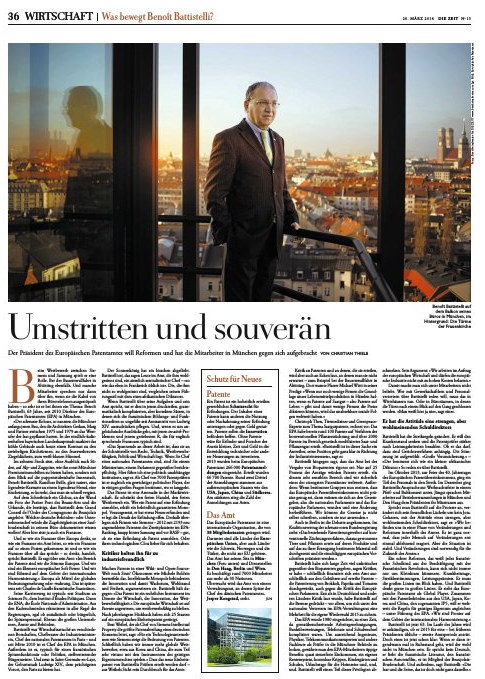
On the tenth floor, without a view to the south, to the summits of the Alpspitze and the Zugspitze, the view which most high-rated properties in Munich are keen to offer, but instead overlooking the dolls house backdrop of the Inner City, sits Benoît Battistelli, rimless glasses, smooth shaven, a somehow tie round his something shirt, an apparition, so neat and tidy that he rapidly gets forgotten.
On the desk is a globe, on the wall a photograph of the Beaux-Arts Bridge in Paris, and the document which confirms that Battistelli is a member of the Grand Council of the Order of the Companions of Beaujolais. What German civil service executive or corporate CEO would want the world to know that he belongs to a brotherhood of winebibbers by hanging a certificate up in his office? But, after all, this is a Frenchman.
And in the same way that a Frenchman thinks about Europe, in the same way a Frenchman runs his office, in the same way a Frenchman gets to be in such a position, and in the same way a Frenchman talks about everything, that’s the way Battistelli thinks, acts, and speaks. Talking about his position he says: “When it comes to patents, we are the voice of Europe. And we are an element of European Soft Power. And we are leaders in the field of international harmonization.” Europe as a means to increased global significance or belonging. Since the days of Charles de Gaulle at the latest, that has been the raison d’être of the French State.
His career path is typical: Starting off with studying political science at the Institut d’Ãâ°tudes Politiques, then the ENA, the Ãâ°cole Nationale d’Administration. It is from these executive hothouses that the governments mostly recruit their top personnel, regardless of whether they’re socialist or conservative, as do the big corporations, the public administration and the authorities.
Battistelli was the commercial attaché at a number of embassies, chief consultant to the Minister of Industry, head of the national patent office in Paris – and since mid-2010, head of the EPO in Munich. And in addition, typically for a leading French functionary or politician, he is also a deputy mayor, specifically of Saint-Germain-en-Laye, the birthplace of Louis XIV, the most sumptuous suburb Paris has to offer.
The Sun King has faded somewhat. People in the Office who are well inclined towards him say that Battistelli is a somewhat centralistic boss – “the way things usually are in France.” Those who are not so well inclined compare his management style to that of an African dictator.
When Battistelli talks about his job and his office, he does it in those grammatically complicated but correct sentences which could go straight to press, the style which the French educational and bureaucratic elite have cultivated ever since Louis XIV took office. And when it comes to using an Anglo-Saxon expression, with that tee-aitch problem and that rather grating R so typical of the English-speaking French.
“The exciting thing about this work is that it lies at the interface of law, technology, competitiveness, politics, and the economy. If you are the head of a national patent office, you are obliged to report to a ministry, or a parliament. Here I am leading a politically independent institution”, he says. As the boss of 7,000 patent examiners, he is also an important political player, and in a number of major matters it’s what he says that goes.
The patent is an anomaly in the market economy. It restricts free trade and free competition. Someone who applies for a patent for an invention receives an officially guaranteed monopoly. Subject, of course, to their having invented something new, and subject to their disclosing the details. That is why companies like Siemens, who with 2193 newly applied for patents in 2012 hold second place in the EPO ranking, just behind Samsung and ahead of BASF, think very carefully about putting their inventions up for a patent application; or whether they would rather play their technological aces closer to their chest.
Too industry-friendly, say the critics
Do patents still make sense in a Wiki and Open Source world? Economists like Michele Boldrin doubt it. Intellectual monopolies impede innovation, and therefore growth, welfare, and freedom, they argue. Battistelli believes the opposite: “The patent is a legal instrument in the service of the economy, of innovation, of the ability to compete.” His view is that the European economy is dependent on patents in order to remain competitive. After years of squabbling, 25 states have at last come together with a unified European patent.
Beat Weibel, who as head of Siemens Intellectual Property leads the biggest patent department of any German corporation, says: “For a technology company like Siemens, the importance of the patent is growing. Essentially, we are encountering more and more global competitors all the time, such as from Korea and China, who in part are very virtuous when it comes to playing the instruments of intellectual property.” The fact that the new uniform patent may be issued by Battistelli’s examiners, is in Weibel’s view, “a breakthrough for the Office.”
Critics of patents and of those who issue them, however, are making their voices heard where one would least expect them – for example, at the Farmers’ Pilgrimage at Altötting. Parish priest Michael Witti gave a warning in his sermon: “If we have just a few big companies holding the basis of our food production in their hands, if there are patents on seeds – in other words, patents on life – and therefore just a few companies who can dictate prices, it will have unforeseeable social consequences worldwide.”
Christoph Then, veterinarian and Greenpeace expert on the subject of seed patents, has done some sums: The EPO has already issued around 100 patents for methods of conventional crop cultivation, and more than 2000 in the field of genetically modified seeds and plants. “Battistelli is a driving force in this matter, and his position is very clearly in favour of the interests of industry”, he says.
By contrast, Battistelli says that the Office is rigorous when it comes to the issue of bio-patents: Only 25 percent of patent applications are granted. “In this very sensitive area we are undoubtedly one of the strictest patent offices worldwide. As well as that, if certain groups are now taking the view that the European Patent Convention is not precise enough, then they need to turn to the legislature, in other words the national parliaments and the European Parliament, and bring about changes that way. We cannot write the laws ourselves, only apply them.”
The debate has even reached Berlin. In the coalition agreement, the black-red Federal Government takes the view that: “The existing patenting prohibition on conventional methods of cultivation, on animals and plants derived from them, and on their products and on specific material used in their production should be upheld, and the pertinent European regulations made more precise.”
Battistelli has for a long time held a much less critical view of bio-patents, say critics. He is alleged to have waved through the patenting of broccoli, paprika, and tomatoes, even against criticism from the European Parliament; after all, his Office is financed exclusively from the fees from issued patents. It was only when criticism became louder in Germany and other countries that Battistelli put the brakes on, above all because he wanted to secure a majority among the national representatives on the EPO Administrative Council for his re-election in 2015.
The EPO was established in 1980, at a time when cross-border work permits, bank remittances, telephone calls, and school exchanges were still complicated matters. In order to attract enough engineers, physicists, telecommunications experts, and other specialists as examiners at the Munich Office, EPO staff were granted some plush benefits: Almost tax-free salaries, their own pension scheme, free crèches, kindergartens and schools, days off for trips home, and, and, and.... Battistelli wants to phase out some of these privileges. His argument: “We work at the behest of the European economy, and we should not burden European industry with excessive costs.”
That doesn’t make him popular with the staff. Anyone who wants to discuss Battistelli with trade unionists and personnel representatives has to do it in the bar. Or in the office, with the doors closed, after a quick look in the corridor. “You never know, here”, one person says.
He has the attitude of a strict but well-intentioned headmaster
Battistelli has changed the rules about striking. He wants to bring down the number of days taken off due to illness, and he wants to pay patent examiners more by their results. Whether he is allowed to do this will depend on the outcome of court cases. The mood is turbulent. “Great uncertainty and insecurity” – “He’s behaving like some little African dictator”; that’s how they talk about Battistelli.
In October 2013, to celebrate the 40th anniversary of the European Patent Convention, some of the staff went on strike. In December, Battistelli’s Christmas holiday speech was drowned by whistles and catcalls. Most recently, employees at staff meetings in Munich and The Hague have been expressing their distrust of the President.
If you talk to Battistelli about the protests, his friendly smile does not change a jot. Relaxed, with the attitude of a strict but well-intentioned headmaster, he says: “We are now in a time of changes and reforms within the Office. It is entirely normal for every person to react to change initially by rejecting it. But the situation is stable. And changes are necessary for the future of the Office.”
A real reformer, as every French schoolchild knows from learning about the French Revolution, cannot always simply be concerned with the inconsequential. Days off due to illness, strike votes, performance premiums – he needs to keep focused on the big picture. And Battistelli likes to think big. He sees the European Patent Office as a global player. Together with the patent authorities from the USA, Japan, Korea, and China, known as the IP5, he wants to equal up the rules for intellectual property worldwide – under the leadership of the EPO. “We are pioneers in the field of international harmonization.”
Battistelli is now 63. In the course of the year he will make it known whether he will put in a bid for a second term of office as from 2015, which has been usual with previous Presidents. But one thing is already clear: When he does go into retirement, it won’t be in Munich. He does not speak German, he loves French literature, French films, he is a member of the Beaujolais fraternity. And, in addition, says Battistelli: “The Isar and the Seine, they’re not quite the same.”
[illegible] his desk in Munich. In the background: the church towers of the Frauenkirche.
Protection for what’s new
Patents
A patent is a commercial protective right which is issued by a sovereign authority in respect of inventions. The proprietor of a patent can prohibit other people from using or imitating the invention, or allow it against payment. Patents are intended to help promote innovation. Without patents, there would be less incentive for inventors and researchers to invest time and money in the development of technical and other innovations. In 2013 there were 266,000 patent applications lodged with the European Patent Office, and 66,700 patents issued. Around two-thirds of the applications originate from countries outside Europe, such as the USA, Japan, China, and South Korea. The biggest increase was in the number from Asia.
The Office
The European Patent Office is an international organisation which is supported by 38 Member States. Among these are all the countries of the European Union, as well as countries such as Switzerland, Norway, and Turkey, which are not members of the EU. The Office is based in Munich (photo below) and has offices in The Hague, Berlin, and Vienna. It employs around 7,000 people from more than 30 nations. The Office is overseen by an Administrative Council, at the head of which is the chief of the Danish Patent Office, Jesper Kongstad.