Bonum Certa Men Certa

Virtual Injustice -- Part 12: Carl Josefsson – Down But Not Out!

Previously in the series:

  1. Virtual Injustice -- Part 1: António's Increasingly Wonky Legal Fudge Factory
  2. Virtual Injustice -- Part 2: The ViCo Oral Proceedings of 28 May 2021
  3. Virtual Injustice -- Part 3: All the President's Men…
  4. Virtual Injustice -- Part 4: Mihály Ficsor, the EPO's Hungarian “Fixer”
  5. Virtual Injustice -- Part 5: Benoît's “Friends” in Budapest
  6. Virtual Injustice -- Part 6: Best Buddies With António
  7. Virtual Injustice -- Part 7: Musical Chairs and Revolving Doors
  8. Virtual Injustice -- Part 8: A Well-Connected 'IP' Maximalist
  9. Virtual Injustice -- Part 9: Heli, the EPO's Nordic Ice-Queen
  10. Virtual Injustice -- Part 10: Vapid and Superficial Coverage in the 'IP' Blogosphere
  11. Virtual Injustice -- Part 11: Perceptive Comments and Caustic Criticism


Josefsson and Boards of Appeal
Something seems to be out of balance at the Boards of Appeal. Now what could that be?


Summary: António Campinos still controls Josefsson, who controls all the judges, so in effect all the legal cases (including some about European software patents) are manipulated by the Office the judges are supposed to judge

One of the main protagonists in the legal shenanigans which have bedevilled case no. G 1/21 is the President of the Boards of Appeal, Carl "Calle" Josefsson, who appears to have become a casualty of his own hubris.


Josefsson's role in the case was characterised by the arrogance and "hauteur" typical of the EPOnian senior managerial caste.

"His conduct was so outrageously out of order that it attracted a significant amount of public criticism."He insisted on taking charge of the proceedings and chairing the panel despite his obvious conflict of interest in the matter.

His conduct was so outrageously out of order that it attracted a significant amount of public criticism.

Partiality objections against Josefsson and other members of the originally appointed panel were raised in numerous "third party observations" [PDF] submitted to the Enlarged Board and in written submissions filed by the appellant on 27 April 2021. [PDF]

On 17 May, the Enlarged Board held an intermediate or "interlocutory" session to consider the objections which had been raised by the appellant.

The outcome of this interlocutory session was that Josefsson was deposed as chairman of the panel. One other member of the panel - Ingo Beckedorf – was also obliged to step down after he had admitted to the Enlarged Board that he had been personally involved in the drafting of the disputed provision concerning mandatory ViCo hearings.

At this point, one might be tempted to conclude that order had been restored and that there was nothing to worry about now.

"In reality, the removal of Josefsson from the proceedings has not solved the manifold problems which have dogged this procedure from the outset."After all, Josefsson had been replaced as chairman of the panel. Didn't this mean that he was safely sidelined from exerting any further influence over the proceedings? Where's the problem?

It's understandable that an uninformed observer might be tempted to draw such conclusions. However a closer study of the facts suggests that such optimism would be seriously misplaced.

In reality, the removal of Josefsson from the proceedings has not solved the manifold problems which have dogged this procedure from the outset.

By 17 May it was plain to all and sundry - including the other members of the Enlarged Board - that Josefsson's replacement had become necessary to avoid a complete meltdown of public confidence in the Boards of Appeal and the EPO in general.

However, on its own this corrective measure cannot be considered sufficient to remedy the further flaws in the procedure or to restore public confidence in the manner in which the Enlarged Board is dealing with the case.

To begin with, it seems that the Enlarged Board's interlocutory session of 17 May took place in the absence of the parties.

As noted by the pseudonymous poster "The fall of the EBA" in a comment on IPKat, the exclusion of the parties from this session seems to be a serious procedural violation:

Partiality might be discussed in a non-open OP before the EBA, but the first decision in which the chair of the BA [Josefsson] and his faithful servant [Beckedorf] were removed by their peers, was taken without the parties. This is a scandal on its own as even the discussion on partiality should be of contradictory [i.e. adversarial] nature.


The poster went on to criticise the refusal of the Enlarged Board to grant the appellant's request for the disclosure of the statements which Ritzka and Eliasson had made in response to the objections against them, describing this as "a further scandal":

The parties have the right to know why the members accused of partiality consider themselves this is not the case.


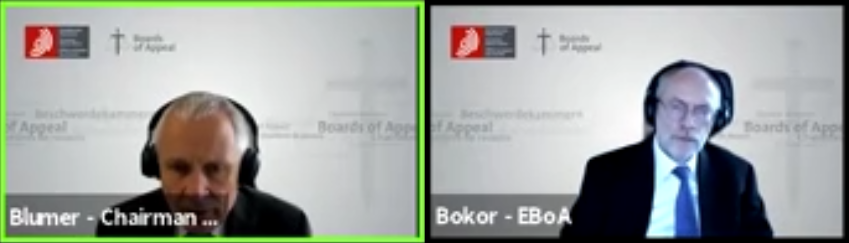
During the oral proceedings on 28 May, the Enlarged Board dismissed a further objection that the replacement members - namely, the new chairman Blumer (replacing Josefsson), and the new legal member Bokor (replacing Beckedorf) - had not been appointed in accordance with the applicable procedural rules for replacement.

On the basis of the currently available information, it would appear that the Enlarged Board simply chose not to admit these objections on some legal technicality so that it could avoid having to enter into an examination on the substance of the objections.

All in all, there is a perception among external observers that a question mark – or rather a series of question marks – remain hanging over the legality of the panel in its current composition.

Ritzka, Eliasson and van der Eijk
There seems to be a general consensus that partiality objections relating to Ritzka, Eliasson and van der Eijk have not been dealt with in a satisfactory manner.


In particular, there seems to be a general consensus that the partiality objections relating to certain members of the original panel - namely, Ritzka, Eliasson and van der EIjk - have not been dealt with in a satisfactory manner.

Blumer-and-Bokor
Were the replacement members, Blumer and Bokor appointed in accordance with the applicable procedural rules?


In addition to this, there are unresolved doubts about the legitimacy of the selection of Blumer and Bokor as the respective replacements for Josefsson and Beckedorf.

Aside from these well-founded concerns about the composition of the panel, observers have also pointed to another serious blunder committed by the Enlarged Board on 17 May when - claiming to be acting in the interests of "timeliness" - it stubbornly refused to contemplate any change to the original precipitous schedule which Josefsson had imposed on the proceedings in an attempt to rubber-stamp his own decision as quickly as possible.

"Had the Enlarged Board rescheduled the proceedings – as it should have done – that would not only have given the newly composed panel sufficient time to take proper stock of the case and have provided the appellant with an adequate opportunity to exercise its right to be heard."If the Enlarged Board had been acting in a truly independent manner free from subtle and hidden political pressures, it is clear that the only sensible course of action, following the interlocutory decision of 17 May and the sidelining of Josefsson, would have been to cancel the oral proceedings of 28 May and to re-appoint new oral proceedings at a later date.

Had the Enlarged Board rescheduled the proceedings – as it should have done – that would not only have given the newly composed panel sufficient time to take proper stock of the case and have provided the appellant with an adequate opportunity to exercise its right to be heard.

It would also have sent a clear signal that the newly composed panel wished to distance itself from Josefsson's scandalous conduct during the initial phase of the procedure and his cynically manipulative prioritisation of "speed" over "diligence".

It deserves to be pointed out that Josefsson had openly and brazenly acted in a manner which was in direct contradiction to a fundamental tenet of judicial conduct, "Nemo judex in causa sua".

This tenet is expressed in the following terms under item 9.2 of the Burgh House Principles:

"Judges shall not serve in a case with the subject-matter of which they have had any other form of association that may affect or may reasonably appear to affect their independence or impartiality".


On IPKat the pseudonymous "Proof of the pudding" commented as follows:

We can conclude that the President of the BoA must have overlooked this principle when (originally) deciding to serve in case G 1/21.

Frankly, it is hard to see how even the appearance of impartiality can now be restored in view of the fact that the EBA has not (completely) rescinded the decisions taken by the President of the BoA in G 1/21.


The failure of the Enlarged Board to draw a line in the sand and to distance itself in a clear and unambiguous manner from Josefsson's previous judicial misconduct means that, no matter what happens after his removal, the procedure remains tainted by his initial influence on it.

It also gives rise to a suspicion that Josefsson's removal from the procedure may have been agreed upon solely for the sake of "optics".

In other words, it is quite possible that his removal was nothing more than a tactical manoeuvre designed to mislead the public into believing that the Enlarged Board was prepared to deal with the case in a genuinely impartial and diligent manner.

Last but not least, there is the "elephant in the room" alluded to by a number of commentators on the IPKat blog, namely the gaping governance deficits arising from Benoît Battistelli's Boards of Appeal "reform" of 2016.

The events surrounding G 1/21 have exposed the deficiencies in this "reform" in practice and make it clear that the "reform" has diminished rather than enhanced the independence of the Boards.

As the poster "The fall of the EBA" put it in one of his comments on IPKat:

The whole way G 1/21 has been managed by the chair of the EBA shows amply that the BA [Board of Appeal] are anything but independent.

On top of it, the chair of the BA [Josefsson] only has the powers delegated to him by the president of the EPO.

There is not even the perception of the independence!


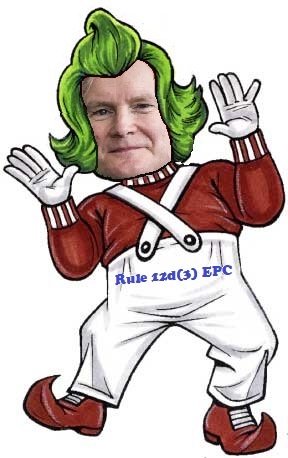
The essential point to be noted here is that, although Josefsson has been formally removed from the panel dealing with G 1/21, the Chief Oompa Loompa of the EPO's legal fudge factory still rules the roost in Haar by virtue of Rule 12d(3) EPC. (warning: epo.org link)

Chief-Oompa-Loompa-Josefsson
Chief Oompa Loompa Josefsson still rules the roost in Haar thanks to Rule 12d(3) EPC.


As explained in the postscriptum to the last series, Rule 12d(3) EPC - which is a key component of Battistelli’s 2016 “reform” - makes all internal members of the Enlarged Board dependent upon Josefsson’s goodwill for the purpose of obtaining a positive “opinion” on their reappointment.

"The events surrounding G 1/21 have exposed the deficiencies in this "reform" in practice and make it clear that the "reform" has diminished rather than enhanced the independence of the Boards."In other words, although Josefsson can no longer influence the outcome of the procedure directly, he still has considerable means at his disposal to influence it indirectly.

In the next part of the series we will summarise the current state of the procedure following the hearing of 28 May and speculate about what might - or might not - happen when the procedure resumes in July.

Recent Techrights' Posts

The Slop Presumption Rule
Tainting oneself can take one day
August 2026 Microsoft Layoffs Are "Secret Layoffs" or "Silent Layoffs"
It's all about secrecy, isn't it?
Newer Not Better: Treadmill Updates Cause Problems
after 2 years the un-updated machines still fine
SLAPP Censorship - Part 136 Out of 200: Lawyers That Get Paid to Mess About
They were already outnumbered and understaffed
 
Why Techrights Will Still be Active a Decade From Now
Techrights will carry on for many years to come
We Are Witnessing the End of IBM
IBM cannot find growth by moving downwards, by lowering standards
Over at Tux Machines...
GNU/Linux news for the past day
IRC Proceedings: Saturday, August 01, 2026
IRC logs for Saturday, August 01, 2026
Gemini Links 02/08/2026: Older Books, Esperanto Music History, and Slop Making Things Worse
Links for the day
Sharing and Empathy
Be more like Stallman, not Linus
Fedora 'Community' Became 100% IBM Staff, Drawing Up Policies Like CoC and CoI (Where the IBM is Excepted From Conflict of Interest Policies)
IBM has in effect killed Fedora
Gemini Links 01/08/2026: Planner Season is Upon Us, Slop "Apocalypse", and USENET
Links for the day
Cuts at IBM, Allegedly More Shutdowns to Come, CEO Visits Complicit Media to Promote Lies and Products That Will Never Exist (Misleading Shareholders)
IBM is collapsing
Links 01/08/2026: GAFAM Falling Deep Into Trillion in (Secret) Debt to Keep the Slop Bubble From Popping Already, Anger Over "FIFA’s World Cup Privatisation Plan"
Links for the day
The Cyber Show on the Slop Bubble
new article about the implosion of the slop bubble
Links 01/08/2026: New York Times Trying to Inflate the Slop Pyramid Scheme (at Cost to Its Own Reputation) and "Iran Appears to Be Blasting Amazon Data Centers Off the Map"
Links for the day
Positive Political Momentum
Daniel Pocock is taken seriously by many people who contact us privately
Google "AI" is Plagiarism, the Case of Richard Stallman (RMS)
Why would anyone choose LLM slop over the originals, curated and fact-checked by domain experts?
Explaining That Software Patents Are Neither Legal Nor Desirable
Many of our readers work in the legal sector
Over at Tux Machines...
GNU/Linux news for the past day
IRC Proceedings: Friday, July 31, 2026
IRC logs for Friday, July 31, 2026
Gemini Links 01/08/2026: Retirement, Bike Trips, Quake Stuff, Usenet Reborn
Links for the day
Links 31/07/2026: Microsoft Now Says Slop is Bad (LinkedIn Cracks Down on It), LinkedIn Narrows Down Size (No Expansion)
Links for the day
European Patent Office (EPO) Series: From Alicante to Munich: Another Smooth Ride
Campinos is intent on transforming what was originally envisaged as a temporary public office into his own permanent personal feather-bed
Daniel Pocock and the Important Observation About Threats of Cult-Like Behaviours (No Rationality, No Reason, Just "Mob Rule")
It's a threat to Europe's sovereignty
The "PIP Parade" of IBM's Lousy Management, Which Said "Blockchain" Was the Future
In a healthy company such a CEO would be punished for utterly wrong visions and predictions. Not at IBM...
SLAPP Censorship - Part 135 Out of 200: Limited Liability Partnership (LLP) That Does Not Disclose Financial Activities Before August
It certainly looks like they keep losing the remaining women that still exist in the firm
Links 31/07/2026: "Climate Cover-Up Continues" and Pesticides "Cook the Planet"
Links for the day
Datacentre 'Boom' Sceptics Aren't Luddites, They Recognise a Threat to Human Survival (Not Limited to Climate Change)
Archaeologists very well know that no species will survive forever
Microsoft's Claims Are Based on a Big Lie
the bubble is coming to its hard limits
Don't Lose Sight of the Impact of "End of 10" (Vista 10)
GNU/Linux has taken off fast
Microsoft's Debt Continues to Steadily Increase, Not Counting Hundreds of Billions in Secret/Hidden Debt
The mass layoffs will carry on, maybe labelled LITE
IBM is Circling Down the Drain, the 'Growth' Comes From Beancounting Tricks and Salary Cuts
IBM was down 2.17% yesterday
Microsoft's "Headcount" Distracts From How Big a Cull It Had This Month
It also speaks of numbers "[a]s of June 30" though the "buyouts" were effective July 1 and since then well over 10,000 workers have vanished
Over at Tux Machines...
GNU/Linux news for the past day
IRC Proceedings: Thursday, July 30, 2026
IRC logs for Thursday, July 30, 2026
Gemini Links 31/07/2026: Music, Journaling, and Longing
Links for the day