
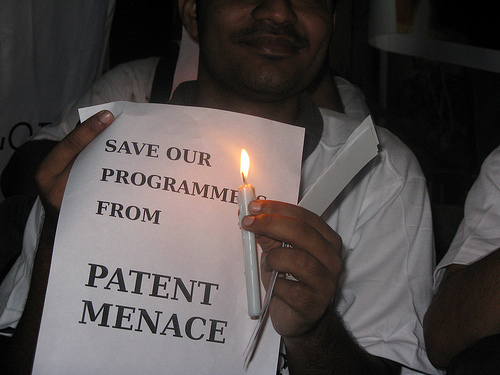
IN A CASE that we mentioned at the end of last week, Novell and Microsoft were among those sued by a patent troll. There is lots more information about it out there and Ars Technica offers decent coverage.
Microsoft, Symantec, and 20 other companies have been sued by a small Texas firm for patent infringement. The firm was granted patents in the mid-'90s over systems for governing application and data permissions, as well as ensuring application integrity, and is now seeking to bar the companies from making use of the patents. And some monetary damages would be nice, too.
The firm, Information Protection and Authentication of Texas (IPAT), owns two patents cited in its complaint, the latest of which is US patent 5,412,717, which was filed in May 1992 and granted on May 2, 1995. This is a continuation of a previous patent, US number 5,311,591, granted in May, 1994.
A Texas company has filed a patent infringement suit against 22 companies for violating patents issued in the mid-1990s regarding application integrity and security.
A computer backup recovery firm claims Intel, Microsoft, Hewlett-Packard, Dell, Acer, and others have aped its patent for quickly restoring a PC after data corruption.
Law360, New York (January 14, 2009) -- Yahoo Inc. is being sued for using technology in its online photo-sharing service that is allegedly protected by a patent belonging to IconFind Inc.
Application software, which is what most people think of first when the word software is mentioned, is commonly written using advanced programming software tools, which ease the task of converting a desired function into code. High-level human-readable code, whether produced in this way or written directly in a programming language, is known as source code and can be analysed by software programmers to understand the techniques used in the software. The source code must be compiled (converted to machine code) or interpreted to be run on a computer.
The Intellectual Property Office had previously recognized inventions that either solve technical problems external to a computer or solve "a technical problem within the computer" as potentially patentable inventions. The sea change of Symbian is that
"improving the operation of a computer by solving a problem arising from the way the computer was programmed - for example, a tendency to crash due to conflicting library program calls - can also be regarded as solving "a technical problem within the computer" if it leads to a more reliable computer. Thus, a program that results in a computer running faster or more reliably may be considered to provide a technical contribution even if the invention solely addresses a problem in the programming."

All software patents I have read so far are worthless. Yet the government approved monopoly. Especially when you live in Europe sign this petition:
http://stopsoftwarepatents.eu/
I cannot see how this invention is one that ought to be patentable, particularly given the recent decision of the United States Court of Appeals for the Federal Circuit in In re Bilski, which dealt a significant blow to the patentability of software and computer processes. Those familiar with the Bilski decision will recall that the Federal Circuit has now required that in order to protect software and computer processes we revert to what was done before the State Street decision, which is to focus on the machine and treating software as if it is not the invention but to patent the machine itself that has unique functionality thanks to some black magic provided by the unpatentable product (i.e., software) whose name cannot be uttered. In truth, many patent practitioners were never quite comfortable with State Street and have been doing this all along to cover the bases, but for those clients who wanted cheap software patents rather than paying $25,000+ for an application, Bilski pretty much killed your patents and applications, but I digress.
Sadly most of our thinking around legal protection of knowledge has been "derivative" in nature, a shoddy cut and paste job from the "mature IP systems" of the West. However, as the Bilski case shows, even these "mature IP systems" are having second thoughts on how they treat knowledge, or in this specific case, software patents. As I have argued in my previous blog entry, "The Practical Problem with Software Patents," the litigation-ridden path followed by US in granting software and business method patents is something we must avoid at all costs.
For a process to be patentable, it must involve a physical transformation to a different state or thing, or must be tied to a particular machine.
What does that mean? The court gave examples indicating that software would be patentable if it represented physical objects undergoing physical transformation. However, it expressly reserved judgment on the alternative test: whether a general-purpose computer was "a particular machine." If so, of course, all software processes would be patentable.
Not the brightest of lines, but the court didn't flinch from trying to draw one, despite arguments that patent lawyers would manage to circumvent any court-imposed limitations. The Bilski decision leaves a lot up in the air, but it affirms that judges will draw limits, even around patentable subject matter, and it offers a modest deflating of the patent bubble. It eliminates some of the worst excesses spawned by State Street without provoking a backlash. And it has breathed new life into public debate of where the limits should be. For those who care about how and where the line should be drawn, some colleagues and I have organized a conference at the Brookings Institution on January 14, the Limits of Abstract Patents in an Intangible Economy.
Just as the debate has come alive in the U.S., it has also resurfaced in Europe three years after a proposed directive on software patents went down to defeat in the European Parliament. The President of the European Patent Office has asked the EPO's Enlarged Board of Appeals to answer four questions about the patentability of computer programs. The European Patent Convention has always specifically precluded patents on certain abstract processes, including computer programs and business methods, but then in the next section it says that these exclusions only apply to computer programs, etc. "as such." So decades have been spent trying to figure out what "as such" really means and what kind of "technical" contribution is needed to pass muster.
For the 16th year in a row, IBM has topped the annual list of patent-happy American tech companies. The list tanks high-tech vendors by the number of patents they were awarded in the United States over the previous year.
Rambus, a designer of high-speed memory chips, may not use 12 of its patents to demand royalties from Micron Technology, a federal judge ruled. Judge Sue L. Robinson of United States District Court in Wilmington, Del., said the patents were unenforceable because Rambus destroyed documents, and called Rambus’s conduct “obstructive at best, misleading at worst.”
[Via Google Translate: The Czech EU presidency has opted for the next six months also in the areas of ICT and Citizens' lot. As regards the protection of "intellectual property" and the reorganization of the EU telecommunications market to the Czechs on the preparatory work of the French build.
The EU has 2009 at the European Year of Creativity exclaimed. That it will also ensure the protection of "intellectual property" goes, goes without saying
Thus, the Czech EU presidency in their list of priorities for the coming six months, under the item "Removal of trade barriers", the controversial anti-Piratierie ACTA agreement, which is currently behind closed doors of the EU Commission, U.S. negotiators and representatives of other major industrialized countries will be negotiated.]
It happens over and over again... if you can't innovate to compete, why not litigate to compete? Broadband Reports points out that Charter Communications is now suing Verizon for patent infringement relating to Verizon's FiOS fiber optic internet connections.
O2's complaint accuses the five companies of importing products containing LCD (liquid crystal display) screens that violate a series of patents owned by the company, the ITC said in a news release.
BoingBoing has the latest story of trademark insanity, where a "charity" focused on the rare, but apparently serious disease of Congenital Diaphragmatic Hernia (CDH), is trying to trademark the phrase "Congenital Diaphragmatic Hernia Awareness" and appears to be threatening other charities for using the phrase, and (according to this petition) has filed complaints to get fundraising stores shut down for using the phrase
"Let me make my position on the patentability of software clear. I believe that software per se should not be allowed patent protection. […] We take this position because it is the best policy for maintaining a healthy software industry, where innovation can prosper." —Douglas Brotz, Adobe Systems, Inc.