
Bonum Certa Men Certa

Thumbs up to Ubuntu for Removing a Part of Microsoft; TurboHercules Likely a Psystar-Type Microsoft Shell

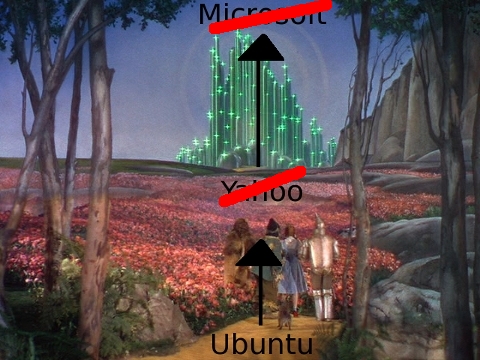
Ubuntu dumps Microsoft and Yahoo


Summary: An analysis combining Ubuntu's relationship with Microsoft proxies such as Yahoo! search and Mono; more on how TurboHercules may be connected to Microsoft and why IBM's response was tactless

SEVERAL days ago we argued that Canonical was making a serious mistake by sending Ubuntu users to Microsoft's datacentres [1, 2]. The good news is that Canonical has just changed its mind, but people keep wondering why.


However, for the final release, we will use Google as the default provider. I have asked the Ubuntu Desktop team to change the default back to Google as soon as reasonably possible, but certainly by final freeze on April 15th.

It was not our intention to "flap" between providers, but the underlying circumstances can change unpredictably. In this case, choosing Google will be familiar to everybody upgrading from 9.10 to 10.04 and the change will only be visible to those who have been part of the development cycle for 10.04.


Several people reckon that Canonical did this because of backlash relating to Microsoft, not habits (why else would habits be ignored when realigning/repositioning buttons, for example?). Others say that Google perhaps offered some money or Mark Shuttleworth had a change of heart (or intervention after someone had made this decision which he did not endorse). Either way, we might never find out the whole story and who was behind the decision, unless someone uploads some videos or internal discussions that reveal the anatomy of these decisions (both the old decision and the new one, which retracts and reverses the former).

Canonical's important decision has received a fair deal of coverage [1, 2, 3], mostly very encouraging. Ubuntu users are happy with this sudden reversal. The Source writes:

In any case, having Google as the default search engine is the best option, so I welcome the change. Whatever the convoluted dance-stepping offered to un-justify and then re-justify it.


Here is a new response to the removal of the GIMP:

The one other thing I did notice right off the bat was that the GIMP was gone. Why Canonical decided to leave out a very, if not the most important piece of software raises some questions. Canonical needs to spend less time on Google’s Chrome OS and more time on their own OS.


Some users remain dissatisfied with the decision to remove the GIMP [1, 2, 3]. In the news we have this for example:

The next major update of Ubuntu code named Ubuntu Lucid Lynx is scheduled to arrive in April 2010. This is going to be an LTS edition, which means updates will be available for three years in desktop and five years in Servers. Even though Ubuntu 10.04 is going to be an LTS release, a complete overhaul is on the cards. Lets take a peek at what's coming in Ubuntu 10.04 Lucid Lynx.

[...]

In another rather controversial move, Ubuntu is going to ditch GIMP. In Canonical's observation, most of the users don't ever use the advanced functionalities of GIMP and all their basic image manipulation needs are met with other applications. Again, you can always install GIMP with a few clicks using Ubuntu Software Centre, and so IMO, this is not going to be a big deal for most of us.


Then there is Ubuntu's Mono problem that Jeremy Allison warned about [1, 2, 3, 4, 5, 6, 7]. There is a new Ubuntu-based distribution without Mono. It addresses general distrust that Canonical turns its back to. More from the news:

[Canonical's] Carr wasn't hinting, however, about Ubuntu not including Mono, Novell's Microsoft .NET-compatible set of software tools, applications by default. While some open-source fans really dislike Mono, thanks in no small part to Novell's Microsoft partnership and Mono's reliance on .NET, if anything, Ubuntu seems to be incorporating more of Mono in its default distribution.


We remain a little concerned because Canonical's new COO, Matt Asay, is still defending hypePad (iPad) in another new blog post. As we pointed out yesterday, it's a disservice to his Ubuntu business. As TechDirt puts it:

As it's become clear that the iPad is more of a "content delivery vehicle" than an interactive device (and there's nothing wrong with that), people are quickly discovering how regional licensing issues and copyright may hold the device back in some areas.


We have shared many other explanations of why hypePad is bad [1, 2, 3, 4, 5, 6, 7, 8, 9, 10], so we won't be repeating the old arguments. Either way, Asay refers to source code in his blog, but he does not want to talk about Freedom (with a capital F) and what hypePad does to one's freedom. It's rather tragic because Ubuntu's added value ought to be more than just source code which is shared/co-developed with other companies. Ubuntu's leadership should be thinking about other marketing factors or at least not be represented by the views of Asay. It's distracting from GNU/Linux. Hostility or apathy towards Free software could put off Ubuntu users, at least a good majority of them.

“Hostility or apathy towards Free software could put off Ubuntu users, at least a good majority of them.”The hypePad is very revolutionary; it introduces the renting of a tablet and merely the renting of some text for it (and paying for the privilege to rent what once could be owned). No wonder Big Media companies give it so much coverage. They love the idea. Xbox is similar to that, but it's a console.

Fortunately to some people who decided to pay hundreds of dollars to rent an hypePad, there is a way out of Apple's prison. Within less than a day hypePad got jailbroken.

Apple's iPad has already been jailbroken, using a variation of the iPhone method and demonstrating just how much the two devices have in common.

The hack was completed in less than 24 hours. In theory it enables the owner to install everything from Wi-Fi scanners to pornography - applications Apple disapproves of - though for the moment it just allows a remote terminal connection.


Another new complaint about Asay comes from The Source, which writes about his response to IBM:

Be careful now – if you want to excuse IBM by pointing out that they can chose to enforce patents outside of the 500 named (let’s assume they listed the 2 by mistake and will retract them), then you must in turn acknowledge that projects like Mono and Moonlight which range far far beyond the standardized core are in explict danger as well.

I do not think IBM is legally out-of-bounds here, no more than I think Microsoft would legally be out-of-bounds to shut down vast portions of Mono and Moonlight now or in the future. (Perhaps after Novell is bought out and agreements are no longer renewed?)

I’m just surprised Mr. Asay finds this an encouraging development for Open Source.


Ubuntu GNU/Linux currently claims 12 million users worldwide and with this privileged position comes responsibility to represent GNU/Linux properly. Ubuntu stands on the shoulders of giants (other people's labour). According to some recent surveys that are geography dependent, about a third of GNU/Linux users -- at least on standard desktops/laptops -- use Ubuntu (source: Linux Journal, 2010). Fedora has many users too.

Since the subject of IBM was brought up, here is a quick roundup of what we wrote about TurboHercules so far:

  1. Microsoft Proxy Attack on GNU/Linux Continues With TurboHercules
  2. Eye on Security: Windows Malware, Emergency Patches, and BeyondTrust's CEO from Microsoft
  3. IBM Uses Software Patents Aggressively
  4. IBM's Day of Shame
  5. IBM Will Never be the Same After Taking Software Patents Out of Its Holster


Groklaw believes that it's just another Psystar. We agree to the extent that this quite likely has Microsoft involvement (we wrote this a month ago). It was weeks ago that sources told this to us privately, after we had raised suspicions. Our criticism of IBM is not for threatening (Groklaw suggests suing) TurboHercules, but for using software patents, including some that were part of an "open-source pledge" [1, 2, 3, 4, 5, 6]. Florian Mueller, who we do not consider to be a friend of Free software (he lobbied against the GPL for example), is having a day trip with this one.

The free and open source software community in Europe is going after IBM for using its patents against an open source project by a French company called TurboHercules. “IBM is using patent warfare in order to protect its highly lucrative mainframe monopoly,” open source advocate Florian Mueller wrote on his blog Tuesday. “The Hercules project is anything but anti-IBM. Hercules just wants to provide customers with an interesting and much-needed choice.”


IBM screwed up very badly by attempting to use software patents and it is trying to undo the damage right now [1, 2]. All in all, IBM is not an enemy of GNU/Linux, but it is not a true friend, either (it's a selfish interest). It needs to be scrutinised, but not shunned. Here is IBM's spin:

IBM may be using a further clause from the original pledge which says that they reserve the right to terminate the pledge if any company "files a lawsuit asserting patents or other intellectual property rights against open source software". TurboHercules filed an antitrust complaint with the European Commission last month, and IBM may be considering that as a move that qualifies for revocation of the pledge in this case.


As one person points out:

One thing is for sure, IBM is certainly a friend of the Patent Office.


Indeed. With IBM's Kappos at the top of the USPTO, there's almost 'incest' in there.

Jim Zemlin, who is working for IBM (indirectly), is not an impartial observer and he helps IBM spin the incident in the two Linux Foundation Web sites.

Jim,

There’s been recent interest in IBM’s “500 patent” pledge made in 2005 and how it applies today. It’s always important to get the facts, and the words of the pledge itself are the facts we need.

“The pledge will benefit any Open Source Software. Open Source Software is any computer software program whose source code is published and available for inspection and use by anyone, and is made available under a license agreement that permits recipients to copy, modify and distribute the program’s source code without payment of fees or royalties. All licenses certified by opensource.org and listed on their website as of 01/11/2005 are Open Source Software licenses for the purpose of this pledge.

“IBM hereby commits not to assert any of the 500 U.S. patents listed below, as well as all counterparts of these patents issued in other countries, against the development, use or distribution of Open Source Software.”

IBM stands by this 2005 Non-Assertion Pledge today as strongly as it did then. IBM will not sue for the infringement of any of those 500 patents by any Open Source Software.

Thanks.

Daniel Frye VP, Open Systems Development IBM Linux Technology Center


Given that IBM funds the Linux Foundation (and is among the founding members of OSDL), this is not too shocking at all. Jim Zemlin has always been an IBM stickler. He really ought to at least criticise IBM's use of software patents, but he can't. As The H puts it, "Linux Foundation say 'breathe easy' on IBM patents"

This is rather funny. It's like IBM saying, "be easy on IBM."

In any event, IBM is currently celebrating the 10th anniversary of GNU/Linux for the mainframe. What a timing!

2010 marks the 10th anniversary of Linux for the mainframe. Here, Knowledge Center contributor Bill Claybrook delves into the 10-year history of Linux for the mainframe, discussing its first deployments, advantages and appropriate workloads, as well as its current market outlook, cost of ownership and available applications. He also offers advice on how you can determine if Linux for the mainframe is the right choice for your data center's server virtualization project.

The year was 1999. It was the beginning of Linux for the mainframe. IBM and SUSE (which was later acquired by Novell in 2004) began working on a version of Linux for the mainframe. By 2000, the first enterprise-ready, fully supported version was available: SUSE Linux Enterprise Server for S/390. The first large, important customer was Telia, a Scandinavian telecommunications company. This year, 2010, is the 10th anniversary of Linux for the mainframe. The value propositions for Linux for the mainframe that were important in 2000 are still important today.


They ought to move to Red Hat.

In other important news, Slashdot has caught IBM patenting optimisation.

jamie(really) writes "IBM appears to want to patent optimizing programs by trial and error, which in the history of programming has, of course, never been done. Certainly, all my optimizations have been the result of good planning. Well done IBM for coming up with this clever idea. What is claimed is: 'A method for developing a computer program product, the method comprising: evaluating one or more refactoring actions to determine a performance attribute; associating the performance attribute with a refactoring action used in computer code; and undoing the refactoring action of the computer code based on the performance attribute. The method of claim 1 wherein the undoing refactoring is performed when the performance attribute indicates a negative performance effect of the computer code.'"


IBM ought to stop patenting software. Better yet--IBM should use its connections in the USPTO to stop software patents as a whole. As long as IBM refuses to do this, the Big Blue may be a friend of "Linux", but it is not a friend of Free software; one just cannot be a friend of Free software and software patents at the same time.

IBM logo twist


Comments

Recent Techrights' Posts

Claim That Finance and HR at IBM Already Work on the Next Wave of IBM Layoffs, Media Silence Persists
The media is still telling misleading nonsense about IBM layoffs (like some fantasy about 'rehiring' thousands for "AI")
 
Over at Tux Machines...
GNU/Linux news for the past day
IRC Proceedings: Tuesday, December 16, 2025
IRC logs for Tuesday, December 16, 2025
Firefox and Mozilla Commit Suicide With Slop, Market Share Falls to New Low
Mozilla just isn't a serious company anymore
"The Register Hot Seat" is Just More Paid-for SPAM Promoting a Pyramid Scheme to Readers of The Register MS
The main issue is that The Register MS is, as usual, begging for and bagging money to promote a pyramid scheme that will end up very badly and hurt a lot of people
Red Hat Wastes Money on Slop and on Slop Pushers While Laying Off Red Hat Staff
In order to manipulate the share price IBM is peddling vapourware
Getting Back on Top of Exclusive Articles, Leaks, Whistleblowing
We still have some material to publish about Microsoft OSI and various other rogue institutions
Links 17/12/2025: User Data Compromised in SoundCloud and Efforts to Release Jimmy Lai for the 'Crime' of Journalism
Links for the day
Gemiini Links 17/12/2025: Wrongs, "Wokeness", and 3D-Printable Accessible USB Input Device
Links for the day
The Register MS Does the "AI" Keyword Stuffing Because It Gets Paid to Do "AI" Keyword Stuffing
They are in effect profiting from legitimisation and promotion of a Ponzi scheme
Blogs to Read (or Even Binge on) When You Look for a Daring and Different Perspective
If you have free time and want to check out interesting old articles/posts, consider these people
Paying the Price for IBM's Leadership Buying Worthless Companies With Capital It Doesn't Have
For some people the last day at the company is Christmas Eve
When Malformed RSS or Atom Feeds Clog Up (or Even Crash) Programs
RSS readers are an excellent way to keep on top of news online
Publication Plans for the Coming Weeks
We've begun this week with many articles and plan to carry on until tomorrow
EPO People Power - Part XIV - EPO Management Living in Fantasy Land
wrongly assumes that any crime committed by the EPO will always be brushed aside
Secret Code is Undesirable
If someone wants you to use proprietary software, say no. Secret code is even worse.
Google News Still Has an LLM Slop Problem (With Slop Images Too), But Google Itself is a Pusher of Slop
If Google keeps shilling and selling slop as "AI", and moreover if people keep hating slop (there's growing awareness of this problem), then at the end Google will suffer greatly
Gemini Links 16/12/2025: Bingo Card and i586 in 2025
Links for the day
Links 16/12/2025: Security and Conflict (No Territorial Concessions in Ukraine)
Links for the day
With Half of December Over, FSF Two-Thirds of the Way Towards Funding Goal
If you can share some money this month, the FSF should be a priority
A Lot of People Don't Want "Smart" (Things That Spy, Stop Working, Cannot be Repaired Easily)
They also don't want slop disguised as "intelligence"
Links 16/12/2025: More GAFAM (Now Amazon) Layoffs and iRobot Chapter 11
Links for the day
Over at Tux Machines...
GNU/Linux news for the past day
IRC Proceedings: Monday, December 15, 2025
IRC logs for Monday, December 15, 2025
Claims of More IBM Layoffs a Week Before 'Christmas Week'
Of course, as usual, nobody in the media says anything
Wrapping Up and Ending "Slopwatch"
An "end-of-life" improvement
Gemini Links 15/12/2025: How We Lost Communication to Entertainment, Dichotomy Between the Real and the Digital
Links for the day
The New Chief Editor at The Register MS is a Microsofter, Now They Increase Microsoft Coverage and Add Microsoft Slant to 'Linux' Coverage
Did Microsoft pay some more?
GAFAM "doesn't depend on any sort of lock-in, humans just don't want to be free anymore," according to MinceR
As many readers are aware, our criticism of UEFI (restricted boot in particular) attracted a lot of online harassment against us, including stalking and libel
IBM Layoffs in India and IBM's CEO Spins His Lack of Market Share as a Strength
If this leadership carries on, the only red left at IBM won't be Red Hat but a red stain
Links 15/12/2025: "Life in Prison" for Criticising China, Tikhanovskaya Says 'Pressure Works'
Links for the day
Due to 'Secure Boot' (An Anti-Security Measure, a Kill Switch) Computer Users Are Afraid of GNU/Linux
This is what Microsoft wanted
'Crypto' 'Currencies' Are a Ponzi Scheme. So Is "AI". Both Destroy the Planet, Not Just the Economy.
Believe it or not, millions of these GPUs just sit there boxed, unopened, unconnected, unused
The Register MS Has Just Been Paid to Promote the Ponzi Scheme Some More ("AI" Keyword Stuffing)
This won't end well for The Register MS
Microsoft Colonialism in Africa is Not Sustainable
Microsoft's situation in Nigeria is not
Perpetuating the Lie of "No Red Hat Layoffs" Because of the Bluewashing (Red Hat Became Just "IBM")
Many Red Hat employees were pushed out and/or removed lately
EPO People Power - Part XIII - If the EPO's Chief Propagandist (Berenguer) Told the Police He Was a Spanish Tourist (or Similar) or That He Does Not Reside in Munich, Then He May Have Lied to the Police (in Addition to Doing Cocaine in Public)
Lying to the police in Germany is a criminal offense
Links 15/12/2025: Chromebooks as Work Machines, "Americans [Who] Moved to Australia" to Avoid Cheeto
Links for the day
Breaking Your Proprietary Router in the Name of "Security"
Each time they "patch" the router something that previously worked OK is likely to just break
IBM May be Breaking the Law to Silence Staff It Laid Off
Observation to add regarding IBM layoffs
Demonisation Attacks on Richard Matthew Stallman (RMS) - Including Antisemitic Attacks - Have Not Worked
Name-calling doesn't work
Slop ("AI") Will Replace People and Take Away Jobs, Say the Slopfarms With Fake (LLM-Generated) Text and Slop Images
"AI" often means slave labour in a poor country
More Than a Million Bytes Should be Enough for Most Computer Programs
Who said computing would improve over time?
Over at Tux Machines...
GNU/Linux news for the past day
IRC Proceedings: Sunday, December 14, 2025
IRC logs for Sunday, December 14, 2025
Another "AI" (Slop) Use Cases Turns Out to be a Fraud
Those who talk about this fraud get SLAPPed
They Say Rules Are Made to be Broken, at Microsoft That Became an Imperative (e.g. Accounting Fraud, Bribery and So on)
Its biggest client is itself
In Russia, Microsoft is Already a Dying Breed Online
A lot of Europe also dumps Microsoft. Europe is a big revenue source of Microsoft.
The Future of News on the World Wide Web
No "greener pastures" on the Web
𝐈𝐁𝐌 𝐂𝐄𝐎 𝐀𝐫𝐯𝐢𝐧𝐝 𝐊𝐫𝐢𝐬𝐡𝐧𝐚: Proof That at IBM People Fall Upwards
IBM is collapsing
EPO People Power - Part XII - The Mobbing Got So Bad People Were Unable to Work
What's at stake here isn't just the EPO or the patent system