
EditorsAbout the SiteComes vs. MicrosoftUsing This Web SiteSite ArchivesCredibility IndexOOXMLOpenDocumentPatentsNovellNews DigestSite NewsRSS

09.24.10

Who Needs Windows Back Doors When It’s So Insecure?

Posted in Asia, Microsoft, Security, Windows at 3:11 pm by Dr. Roy Schestowitz

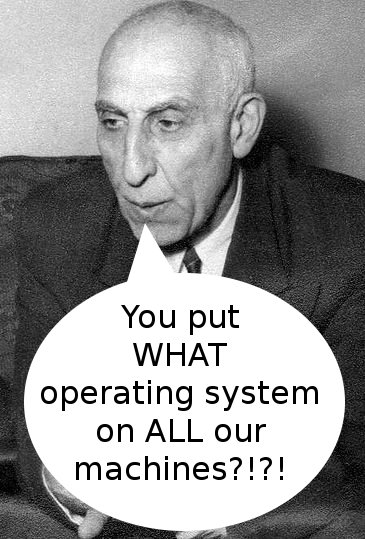
Mohammad Mosaddeq

Summary: Stuxnet is allegedly part of a plan to infect computer systems in Iran for political reasons, according to an increasing body of evidence

SO, it’s starting to look like Stuxnet [1, 2, 3, 4, 5, 6, 7, 8, 9, 10] was part of a plot to derail Iran’s nuclear programme [1, 2]. Stuxnet makes use of zero-day Windows vulnerabilities rather than back doors. Will governments finally realise that foreign governments can use Windows against them? Software freedom is essential to one’s autonomy.

The debate about Stuxnet and Iran is only starting. So far we’ve come across the following reports (there are many more):

i. Advanced Computer Worm Was Specifically Designed to Attack Iranian Nuclear Reactor, Experts Say

The sophisticated computer worm called Stuxnet, which has been targeting industrial operations around the world, was likely designed to take out Iran’s new Bushehr nuclear reactor, cybersecurity experts say. It’s the first known cyber-super-weapon designed to destroy a real-world target, reports the Christian Science Monitor.

Researchers studying the worm say it was built by an advanced attacker with plentiful resources — possibly a nation-state. Initially, experts thought it was designed for industrial espionage, but upon examining its code, they now think it was built for sabotage.

ii. Synchronize Your OpenOffice Documents With Google Docs, Zoho And WebDAV Servers Using Ooo2gd

iii. Microsoft confirms it missed Stuxnet print spooler ‘zero-day’

Contrary to reports, a bug that Microsoft patched last week had been publicly discussed a year and a half ago, security researchers said this week.

Microsoft confirmed Wednesday that it overlooked the vulnerability when it was revealed last year.

The vulnerability in Windows Print Spooler service was one of four exploited by Stuxnet, a worm that some have suggested was crafted to sabotage an Iranian nuclear reactor.

iv. Stuxnet virus may be aimed at Iran nuclear reactor

A highly sophisticated computer worm that has spread through Iran, Indonesia and India was built to destroy operations at one target: possibly Iran’s Bushehr nuclear reactor.

That’s the emerging consensus of security experts who have examined the Stuxnet worm. In recent weeks, they’ve broken the cryptographic code behind the software and taken a look at how the worm operates in test environments. Researchers studying the worm all agree that Stuxnet was built by a very sophisticated and capable attacker, possibly a nation state, and it was designed to destroy something big.

[...]

One of the things that Langner discovered is that when Stuxnet finally identifies its target, it makes changes to a piece of Siemens code called Organisational Block 35. This Siemens component monitors critical factory operations, things that need a response within 100 milliseconds. By messing with Operational Block 35, Stuxnet could easily cause a refinery’s centrifuge to malfunction, but it could be used to hit other targets too, Byres said. “The only thing I can say is that it is something designed to go bang,” he said.

Whoever created Stuxnet developed four previously unknown zero-day attacks and a peer-to-peer communications system, compromised digital certificates belonging to Realtek Semiconductor and JMicron Technology, and displayed extensive knowledge of industrial systems. This is not something that your run-of-the-mill hacker can pull off. Many security researchers think that it would take the resources of a nation state to accomplish.

[...]

Now that the Stuxnet attack is public, the industrial control systems industry has come of age in an uncomfortable way. And clearly it will have more things to worry about. “The problem is not Stuxnet. Stuxnet is history,” said Langner. “The problem is the next generation of malware that will follow.”

Any politically-motived Windows worm shows that technology and politics cannot be separated and they come at a high cost to the public (a side effect). Some people point fingers at Israeli hackers.

Malware believed to be targeting Iran’s Bushehr nuclear power plant may have been created by Israeli hackers

[...]

However Graham Cluley, senior consultant with the online security company Sophos, warned against jumping to conclusions about the target of the attack, saying “sensationalist” headlines were “a worry”. Clulely is wary of reports linking Stuxnet with Israel: “It’s very hard to prove 100% who created a piece of malware, unless you are able to gather evidence from the computer they created it on – or if someone admits it, of course.”

But he said that its characteristics did not suggest a lone group. “I think we need to be careful about pointing fingers without proof, and I think it’s more appropriate – if true – to call this a state-sponsored cyber attack rather than cyber terrorism.”

Stuxnet works by exploiting previously unknown security holes in Microsoft’s Windows operating system. It then seeks out a component called Simatic WinCC, manufactured by Siemens, which controls critical factory operations. The malware even uses a stolen cryptographic key belonging to the Taiwanese semiconductor manufacturer RealTek to validate itself in high-security factory systems.

Should the whole world be flooded with Windows worms just because of political altercations of few nations? Should a better operating system like GNU/Linux be used to mitigate international threats. When does the cyber threat become greater than nuclear threats in an age when everything from food production to energy extraction [1, 2] and travel depends on connected computers? Without energy and transportation, food cannot be grown, cultivated, and delivered; that is where the most fundamental needs can or cannot be met, especially at times of natural disaster or war, so leaving one’s critical systems (that’s almost any system) under Microsoft’s reign is a strategic blunder. Proprietary software is subjected to the sovereignty of its sole maker.

Share this post: These icons link to social bookmarking sites where readers can share and discover new web pages.
  • Digg
  • del.icio.us
  • Reddit
  • co.mments
  • DZone
  • email
  • Google Bookmarks
  • LinkedIn
  • NewsVine
  • Print
  • Technorati
  • TwitThis
  • Facebook

If you liked this post, consider subscribing to the RSS feed or join us now at the IRC channels.

Pages that cross-reference this one

What Else is New


  1. The Reality Distortion Field of Patent Lawyers Helps Impede Abolition of Software Patents

    How widespread coverage and talking points from the tiny minority which is patent lawyers have contributed to biased and at times utterly distorted reporting on the subject of software patents around the world


  2. Eugene Kaspersky Says Patents Harm Innovation

    Some more criticism of the patent system and software patents in particular, courtesy of Eugene Kaspersky


  3. UEFI Restricted Boot Good for Microsoft Agenda, Not for Security

    News and analysis of UEFI 'secure boot' (lockdown), including the new role played by the Microsoft-funded SUSE


  4. Anniversaries

    Sites that deal with patents and with FUD as well as their respective ages


  5. EFF, Newegg, and the Canadian Patent System All Take a Stance Against Software Patents

    Hostility towards the practice of patenting software is seen in a nonprofit organisation, a corporation, and a government branch responsible for patenting


  6. Microsoft's Fake 'Open Source' Front is "Pushing Software Patents" (Updated)

    Microsoft's front group which pretends to support Free/Open Source software (FOSS) is using a guest post to entertain the idea of software patents inside Free/Open Source software


  7. Links 17/5/2013: 0.9 Billion Android Activations, New Devices, Android Studio

    Links for the day


  8. Links 16/5/2013: Firefox 21 Out, Android 4.3 Foreseen

    Links for the day


  9. More Android FUD From Former Microsoft Staff in CBS

    New examples of anti-Android sentiments being spread by the Apple- and Microsoft-funded media conglomerate, CBS, which pays current and former Microsoft staff to act as "journalists"


  10. Where Fear of FOSS Comes From

    More Microsoft ties to some of the latest FUD about Free/Open Source software (FOSS)


  11. Microsoft Skype Messaging Surveillance Not the Main Issue, Audio Recording (Bugging) and Computer Hijacking Are

    Debates about the dangers of Skype focus on one of the least dangerous aspects of Skype


  12. Links 15/5/2013: Android 4.3, Antergos Debuts

    Links for the day


  13. Man From Microsoft Runs the Ubuntu Project Now

    How the leadership of Ubuntu has changed and how it may relate to some strategic decisions inside the project


  14. Has Microsoft Irreversibly Taken Over ZDNet (CBS) to Disseminate Its Lies?

    ZDNet promotes Microsoft in the editorial sections, not just in the ads, and it employs Microsoft people who habitually also censor commenters for expressing views that may upset the customers (advertisers like Microsoft)


  15. Microsoft is Attacking Boston Over Brand Ideology

    Another hypocritical attack of Microsoft against Google, this time in Boston


  16. Software Patents Reality Distortion Field

    How press coverage of software patents in the EU and New Zealand (NZ) varies depending on the source; allegations that the US press tries to dismiss end of software patents by twisting an outcome of a major trial


  17. Links 14/5/2013: Android Growth Explosion

    Links for the day


  18. Links 13/5/2013: New Linux/Open Source Documentary, Lots More About International Space Station

    Links for the day


  19. Prominent GNU/Linux/KDE Developer Jonathan Riddell Complains About UEFI Restricted Boot, Calling it "a giant Microsoft conspiracy to make installing Linux more faffy than it already is."

    UEFI abuses continue, but Microsoft PR, lies, and attempts to silence the media go a long way, ensuring evidence gets insufficient coverage


  20. Facebook and Microsoft Get Closer, Now Reaching Their Relationship's Peak as Facebook Declines

    Facebook starts leaning on Microsoft for help now that its users (products) no longer log in and give data (content) to consume advertisements (Facebook's real clients) as much as they used to


  21. Dr. Ravitch: Gates Foundation Underwrites Almost Every Organisation in its Quest to Control American Education

    More complaints about yet more rogue influence that is masqueraded as "public interest" or "for education" (whilst in fact having the opposite effect)


  22. Formerly Microsoft, But New FUD

    Microsoft FUD by proxy; or, how the old claims that FOSS is complex and dangerous are now coming from firms created by people from Microsoft Corp.


  23. Matt Asay is Wrong, Microsoft Does Sue (SLAPP Action), Doesn't Just Threaten

    Misleading article helps portray the aggressor as a negotiator, using patently false claims that are easily disprovable


  24. Todd Simpson From Mozilla Joined an Angry Patent Troll, IBM Tries to Warp Debate About Software Patents to Focus Just on Trolls

    Revisiting the stance of FOSS proponents on software patents and patent trolls; Mozilla, IBM, Red Hat, and Nokia (also before Microsoft takeover) discussed


  25. Unitary Patent Impediments Covertly Addressed by EU Member Governments

    The UK is modifying its law to accommodate takeover of national interests by foreign interests which may usher in software patents among other nasty elements of protectionism (primarily exported by multinational corporations from across the Atlantic ocean)


  26. Software Patents May Have Just Died in the United States, According to Some Pundits and Experts

    The collection of opinions from notable figures and sources that analysed the CAFC decision regarding a software patent in the US


  27. People Power Works in India, Microsoft Deal Partly Crushed After AICTE Comes Under Fire

    Weakening of a Microsoft pact after intervention by freedom-respecting software advocates in India and abroad


  28. IRC Proceedings: May 5th, 2013-May 11th, 2013

    IRC logs for May 5th, 2013 (and subsequent days until May 11th, 2013)


  29. IRC Proceedings: April 28th, 2013-May 4th, 2013

    IRC logs for April 28th, 2013 (and subsequent days until May 4th, 2013)


  30. IRC Proceedings: April 21st, 2013-April 27th, 2013

    IRC logs for April 21st, 2013 (and subsequent days until April 27th, 2013)


RSS 64x64RSS Feed: subscribe to the RSS feed for regular updates

Home iconSite Wiki: You can improve this site by helping the extension of the site's content

Chat iconIRC Channel: Come and chat with us in real time

Recent Posts