
Bonum Certa Men Certa

Groups Like 'No Patents on Seeds!' and 'Friends of the Earth Germany' Respond to Bayer's GMO Patents (Previously Monsanto) in Light of EPO's Watered-Down Decision

Another lesser-noticed scandal is the belated reaffirmation that the Boards still lack their much-needed independence, as noted only in blog comments (what's left of them after filtering by the litigation 'industry')

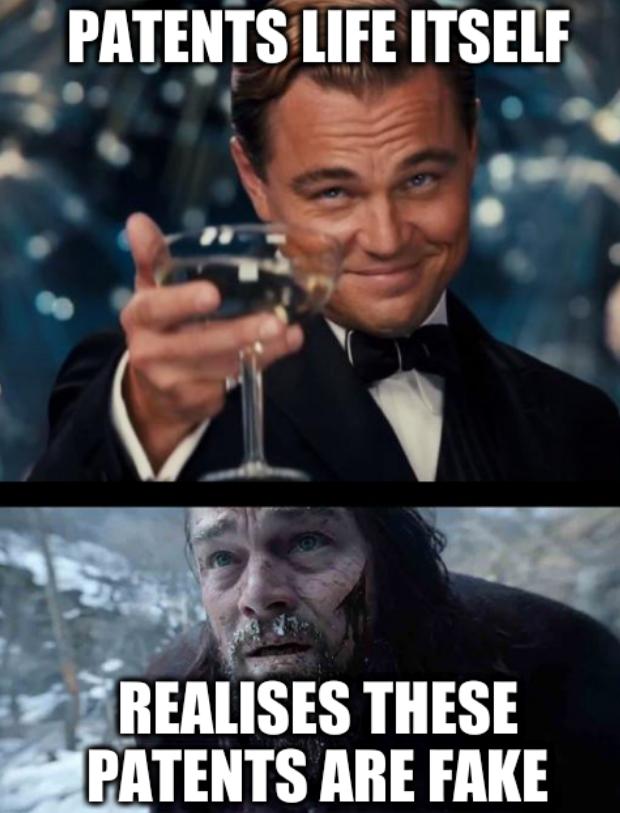
Leo: Patents life itself; Realises these patents are fake


Summary: The EPO went one step closer toward the ban on patents which pertain to nature and life itself; but we must ensure that the loopholes too get closed, preventing a bunch of toxic monopolies from claiming exclusive 'rights' over our food

NOT much remains to be said about what happened yesterday, probably somewhere in Haar (yes, Haar).


We focused on the "technical" GMO loophole, reminding readers of seed privateering by Benoît Battistelli et al. They facilitated the monopolisation of life and nature. That's how morally bankrupt those people are...

"They facilitated the monopolisation of life and nature. That's how morally bankrupt those people are..."Well, posted in EUbusiness (as a press release) was the following important statement, which overcomes some spin and face-saving nonsense that was posted on a Friday morning amid pandemic [1, 2]. When few people notice...

The Board concluded that plants and animals obtained by 'essentially biological processes' are not patentable, with the exception of patent applications filed before July 2017. This verdict is in line with the interpretation of European patent law as decided by the 38 member states of the EPO in 2017. No Patents on Seeds! welcomes the verdict but is also demanding further political decisions to close still existing loopholes. Access to biological diversity needed for further breeding must not be controlled, hampered or blocked by any patents.

"For more than ten years we have been fighting against patents such as those on broccoli, tomatoes, peppers, melons and cereals. Therefore, we welcome this verdict in the name of the European public, gardeners, farmers and consumers. Knowledge of methods of breeding plants and animals continues to evolve as a common good from the activities of farmers and breeders over centuries, it is not invented by industry. In future, conventionally bred plants and animals have to be kept available for further breeding," Martha Mertens says for Friends of the Earth Germany.

"We hope the new verdict will help to put an end to a decade of complete legal absurdity and chaotic decision-making at the EPO. However, there is still a huge risk that big corporations, such as Bayer (previously Monsanto) will try to abuse patent law to take control of our daily food," says Katherine Dolan for ARCHE NOAH. "The problem is not yet solved. Further political decisions still have to be taken to close the existing loopholes."

Indeed, there are still reasons for concern. As a recent report from No Patents on Seeds! shows, clear definitions are needed to distinguish patentable technical inventions from the random processes used in conventional breeding in order for existing prohibitions to be effective. Unless there are adequate definitions, 'technical toppings' such as those describing random mutations, can still be used to claim plants and animals as 'inventions'. There are several examples showing how companies easily escape the current prohibitions, e.g. European patents on barley and beer, melons or lettuce.


"Proceedings in examination and opposition which were stayed while the referral was pending will be gradually resumed," said another site, which mostly reproduced the waffle from the EPO's President António Campinos. Here it is:

The Enlarged Board of Appeal, the highest level of judicial authority at the European Patent Office (EPO), issued its opinion G 3/19 on questions related to the patentability of plants and animals.

The opinion, triggered by a referral from the President of the EPO in April 2019, concludes that plants and animals exclusively obtained by means of an essentially biological process are excluded from patentability under the European Patent Convention.

Speaking on the case, António Campinos said, ‘I strongly welcome the opinion of the Enlarged Board of Appeal. It will bring greater legal certainty for patent applicants, and the general public, on what is a sensitive and complex issue that has legal, societal and economic implications.'

The Office will act in accordance with the clarifications provided in the Enlarged Board's opinion and implement them in its examination practice in close consultation with stakeholders. Proceedings in examination and opposition which were stayed while the referral was pending will be gradually resumed.


And behind paywall there was this:

Plants and animals exclusively obtained by essentially biological processes are not patentable, says the Enlarged Board of Appeal of the European Patent Office (EPO).


What about GMO? Not a word. Like loopholes for granting software patents in Europe, loopholes that were borrowed by the USPTO to bypass 35 U.S.C. €§ 101, there are still ways to get patents on life and nature, provided one perturbs genetic chains somewhat. So much work remains to be done to end this injustice. We'll watch out for further press coverage, if any emerges, on this particular matter.

In blogs we have observed some 'sanitised' (filtered/censored) debate about this. We assume particular views are seen as impermissible and removed before they can even be made visible (i.e. the usual gatekeeping). Comments from people other than me are also being censored, I've learned. So it's a distorted scope/optics, gamed for somebody's commercial gain.

Kluwer Patent blogger said that this "decision, triggered by a referral from EPO president António Campino in April 2019, is the latest and not unlikely the final one in a debate which has been running for years about the issue."

António Campinos gamed this. We'll come to that in a moment. Campinos is just another 'orange tyrant', narrowing the reach of judges (or "so-called judges," to use Donald Trump's words).

Some historical context is also given there (the original post); but nothing too inquisitive. Nothing to "rock the boat" so to speak...

The first comment said: "I wonder how the German Federal Constitutional Court would react if the legislators came up with a law requiring the constitution to be interpreted in a particular manner, contrary to earlier decisions of the FCC. That is effectively the situation which the EBA has indicated is an acceptable one."

"Concerned observer" then made this important point:

Whilst this decision might bring “greater legal certainty” with respect to the patentability of plants, it generates numerous other areas of legal uncertainty.

Firstly, how can the Boards of Appeal of the EPO demonstrate that they are an INDEPENDENT judicial instance, as required, for example, by TRIPS?

The members of the Boards of Appeal are subject to the disciplinary and reappointment authority of the AC. This calls into question whether it is possible for any decision of a Board of Appeal that finds an absence of conflict (in the sense of Article 164(2) EPC) to avoid perceptions of partiality in favour of the AC … who will, of course, have authored the allegedly “conflicting” Implementing Regulation.

Secondly, as the EBA correctly observes, the Court of Justice of the EU has not yet interpreted Article 4(1)(b) of the Biotech Directive. Thus, in view of the appeal decision in the Taste of Nature case, Article 267 TFEU means that any “final” judicial instance that is inclined to reach a contrary conclusion (that is, to reach the same conclusion as in G 3/19) MUST make a preliminary reference to the CJEU.

Thus, given that the Boards of Appeal have previously decided that they are unable to participate in the preliminary reference procedure, how can the Boards apply the ruling in G 3/19 without contravening EU law?

In other words, the ruling in G 3/19, whilst “resolving” a point of law that will be of relevance to a vanishingly small percentage of applicants, has simultaneously drawn attention to fundamental weakness of the EPC that now require urgent attention. Perhaps this can serve as a reminder of the danger of unintended consequences.


The German Federal Constitutional Court is still dealing with some profound issues related to this.

That first commenter soon responded: "Maybe it is a Machiavellian plot by the EBA – writing a decision which is apparently in line with the wishes of the President and the EU legislators but is phrased to cause such an outcry that the system of the boards of appeal has to be revised once and for all, taking the boards out of reach of the EPOffice..."

The latest comment said: "What happened to any notion of Stare decisis! Nothing in the Vienna Convention about “dynamic” interpretation."

So other than the question about patents on life we now grapple again with questions of constitutionality and independence of judges. This decision likely opened another can of worms (again).

Looking at old comments from Litigation Kat, 4 at this moment of time (including 2 new ones), the first one said: "It will be interesting to see how independent from the president and the AC the members of the BoA and of the EboA are under the new performance evaluation system which has a direct influence on their reappointment."

Same issue again.

Someone called "Leave the Boards in peace!!" "Attentive Observer") then said a bunch of stuff, followed by (new comment):

The referral was indeed considered admissible. The decision is likely to cause questions about the independence of the boards of appeal to become even louder. http://documents.epo.org/projects/babylon/eponet.nsf/0/44CCAF7944B9BF42C12585680031505A/$File/G_3-19_opinion_EBoA_20200514_en.pdf


So one can see the pattern; people focus on what this means to Battistelli's illegal attack on judges, which is apparently the subject of at least one case sitting before the German Federal Constitutional Court (FCC). Expect this debate to carry on for a while. And it remains to be seen how -- if at all -- the Office adopts/adapts to this decision.

To better understand why this decision was so controversial one needs to also see the latest post's comments here (what's left of them; worth preserving):

Anon Y Mouse Thursday, 14 May 2020 at 19:44:00 BST

Note that the referral was only deemed to be admissible after the Enlarged Board itself rewrote the questions to make them admissible. This seems highly irregular.

Note also the following rather astonishing findings:

at II.5: "the scenario presented in the first question would, if followed to its logical conclusion, effectively give the Administrative Council, as the authority empowered by the EPC to adopt the Implementing Regulations, a “carte blanche” to deviate from established case law and give a particular meaning to any Article of the EPC by means of the Rules of the Implementing Regulations. This would open the door to the possibility of circumventing the statutory procedures for amending the Convention itself, namely by way of a diplomatic conference pursuant to Article 172 EPC or by unanimous vote in the Administrative Council pursuant to Articles 33(1)(b) and 35(3) EPC."

and at II.6:"Question 2 already contains, in thinly disguised form, the answer that it seeks".

Thus, it seems that despite these formal deficiencies in the President's original questions, which both (a) told the EBoA the answer that it "should" give; and (b) had potentially far-reaching implications allowing the AC and President to circumvent the EPC, the EBoA nevertheless did not throw out the case, but rather *rewrote the President's questions for him* in order to find them admissible and give him (most of) the answer that he wanted.

Merpel seems quite right in these circumstances to doubt whether the EBoA is truly able to stand up to an overweening President and craven Administrative Council...

[...]

broccoli Friday, 15 May 2020 at 12:21:00 BST

At the end of the day the Enlarged Board must take into account the changing intentions of the national states and EU and real policy considerations behind a prohibition. There is no reason to allow patenting of the products of essentially biological processes apart from legalistic analysis of the EPC. The EU and national governments have not taken this position, and so the Enlarged Board must be accepting of this reality.

[...]

DevilsAdvocate Friday, 15 May 2020 at 12:41:00 BST

The problem with this argument is there is an established way of changing the law and that is by changing the articles of the EPC. If it is truly the intent of the relevant states, then doing it that way shouldn't be so hard should it?

[...]

broccoli Friday, 15 May 2020 at 14:30:00 BST

Hi DevilsAdvocate

Case law evolves and that is what is happening, and diplomatic conferences to change the EPC happen only every 30 years or so. This way is easier, and realistically the only way to do as a practical reality. I don't see the national states objecting in any way, and let's be honest the situation of having the process prohibited and the product of the process allowable was very unsatisfactory

[...]

Proof of the pudding Friday, 15 May 2020 at 15:22:00 BST I agree with Devil's Advocate. The ultimate outcome is identical (in the sense of no retroactive effect) to what would have happened if the Biotech Directive or Article 53(b) EPC had instead been amended. So what, after all that, was the point of avoiding the straightforward option and instead pressing ahead with a course of action that now raises serious questions about the (lack of) independence of the EBA?

Sadly, that is not the only way in which this decision is likely to inflict long-term damage on the EPO. For example, there is also the fact that Article 164(2) EPC has been rendered otiose, as it is IMPOSSIBLE for any conflict to arise between an Article and an Implementing Regulation if the Boards adopt a "dynamic" interpretation of the Article that is based upon the "legislator's intent" as reflected in the Implementing Regulation. A sad day indeed for the rule of law.

[...]

Anonymous Friday, 15 May 2020 at 14:13:00 BST

Here is something I don't understand. The EBOA disapproved of the questions in the form that the President set out, because the logical conclusion was that it would allow the President to circumvent the EPC by amending the Rules to "give a particular meaning to any Article of the EPC".

But isn't that just what they've allowed him to do?


There may be more comments; we can certainly see that, based on the RSS feed, at least 6 comments were deleted in recent days.

Long story short, admissibility played a role here, as in the very question about Haar. We omit the corresponding post, which is just the usual cheerleading for EPO management from AstraZeneca's legal team. The media -- even blogs -- is so compromised in this domain. It has been captured.

Leo: I own nature; nature owns me

Recent Techrights' Posts

Evri (HermesUK) is Now Run by Bots and Hallucinating Scammers
Years ago they virtually removed support and tried chatbots instead
Clown Storage Without Backups
Setting up several reliable copies of the data, plus several off-site backups (this data is nowhere as sensitive as medical data), should only cost a few grand
 
Linux Losing Interest in Users' Freedom, Pursues DRM Instead
"Linux" is (or was, as GNU/Linux) meant to empower - not artificially restrict - the users
GNU/Linux in Ecuador and Colombia: Growing, Still Below International Average
locals turn away from Windows and try GNU/Linux instead
IBM is Dead or Dying. Now It Asks Workers to 'Resign' Voluntarily.
To save face, to pretend no layoffs are happening (as it might alarm shareholders) [...] We keep hearing more and more stories like that
Links 18/08/2026: Sergey Brin Controlling State Policies, "Dario Amodei's (Anthropic) Wife Is Closely Linked to Jeffrey Epstein"
Links for the day
SBS News Interviews Daniel Pocock
The locals say this PR stunt (by the bigot, Farage) was a waste of money
Clownflare Sees One in 7 Web Requests in Libya Originating From GNU/Linux
GNU/Linux has taken a (foot)hold there
Openwashing and Manifestos Composed in Private by Dictators With Deliberately Addictive (and Subsidised, Bundled) 'Tech'
It's long, so make a cuppa first
SLAPP Censorship - Part 153 Out of 200: Decades of Debt, Weaponising Borrowed Money to Try to Put Their Critics in Debt
they've always had a financial report by now
Over at Tux Machines...
GNU/Linux news for the past day
IRC Proceedings: Monday, August 17, 2026
IRC logs for Monday, August 17, 2026
Gemini Links 18/08/2026: Solar Power, Kipple and Impermanence, Catastrophe Ethics
Links for the day
Less Technology, More Life
Technology is being associated (sometimes rightly) with physical and mental problems
Google Search Has Gotten Worse (a Lot Worse)
getting worse
Birthday in 80 Days
we'll start decorating and party online with our community
Loans and Massive Debt at Microsoft, This Won't End Well.
Microsoft running out of money to pay salaries (to the point of paying people for 'voluntary' layoffs) is a positive sign?
Gemini Links 17/08/2026: Life in Plain Text, Mimicking KARL, Release of Jugulans, Avoiding Slop
Links for the day
FreeCAD is Becoming Slop-ware, Use LibreCAD Instead
It has regular releases and "Qt5 is mandatory" now [...] they at least audit what they add
Cuba and Venezuela High in Adoption of GNU/Linux
some of the "communist" nations
Links 17/08/2026: Myanmar’s Cholera Outbreak, China Sends Commercial Vessels Through Arctic
Links for the day
GAFAM Loyalty Has Come to an End, Morale Low, People Whose Future is Uncertain Choose to Become "Lifers"
morale is low and there's no loyalty anymore
SLAPP Censorship - Part 152 Out of 200: Injunctions Do Not Cover Criticism, They Have Scope
self-incriminating communications
Clownflare Sees About Quarter of Web Requests in Ireland Coming From GNU/Linux
Well, in Ireland it seems like many people adopted GNU/Linux
Clownflare: In Australia and New Zealand GNU/Linux Peaks at Over 10% During Working Hours
That right there is interesting in its own right
Slowing Down by Intention
At the moment we have 6 or 7 ongoing series
Gemini Links 17/08/2026: Chamboree, Partial Solar Eclipse, Lady Macbeth
Links for the day
Links 17/08/2026: "Bluesky Is Down Again!" and "Anti-Social Media"
Links for the day
Over at Tux Machines...
GNU/Linux news for the past day
IRC Proceedings: Sunday, August 16, 2026
IRC logs for Sunday, August 16, 2026
A Vortex of Beacons (or "Bluetooth Everywhere" Vision)
If someone (or someones) calls you paranoid for taking about "beacon"-like functionality, there will be no lack of authoritative citations (e.g. Web links) they can be provided to prove them wrong
Falkland Islands: GNU/Linux Elevated to 6%
GNU/Linux usage seems to have increased a lot there
Links 16/08/2026: Reading Outside, Going Offline More, and Art of Computer Programming
Links for the day
The Question of Patience
Is there a lesson here somewhere?
IBM May be Sued for Mass Layoffs Via PIPs
Some whole threads (with all the long comments in them) recently got nuked by thelayoff.com
Links 16/08/2026: Ceuta Reports Social Control Media Used as a Weapon
Links for the day
Links 16/08/2026: Europe in Crisis of Droughts While Energy- and Water-Consuming, Pollution-Emitting Chatbots Are Spread by GAFAM (US) to Keep a Ponzi Scheme Going
Links for the day
GNU/Linux is a Platform for Work (Usage Surges in Daytime)
GNU/Linux 15% in daytime
We Need Rain, Not Chatbots
There's no "anti-AI" (it's not even AI), there's opposition to fraud, to plagiarism, and to companies that profit more when there's global warning (caused in part by their business activities)
SLAPP Censorship - Part 151 Out of 200: Dealing With Sleazy People and Companies That Steal (While Employing These Sleazy People)
we offer a quick summary and we're reflecting
Over at Tux Machines...
GNU/Linux news for the past day
IRC Proceedings: Saturday, August 15, 2026
IRC logs for Saturday, August 15, 2026
Gemini Links 16/08/2026: Sterrenkijker Releases, Solar Gemini Server
Links for the day