
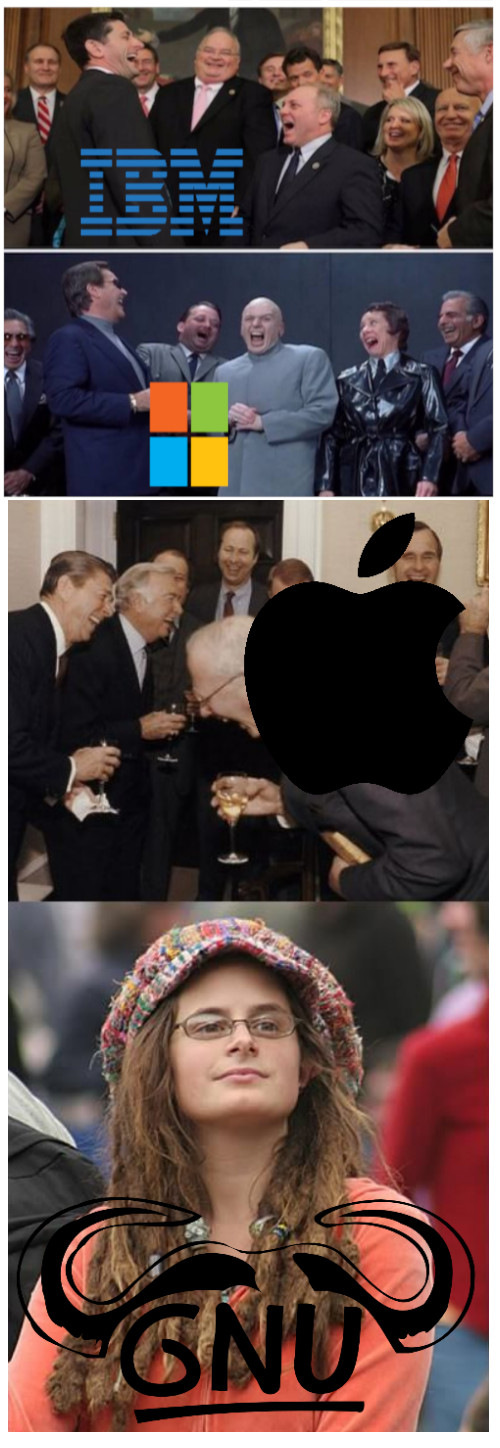
THE history of UNIX goes half a century back; GNU goes more than 35 years back (way more than Linux) and there are various related concepts such as POSIX. We also recently learned about the role Richard Stallman had played in BSD becoming free. Back when the FSF was very young and even before it existed there were already a number of important movements set in motion.
"We also recently learned about the role Richard Stallman had played in BSD becoming free.""LPF is some kind of FFII predecessor," the FFII's President told us in IRC earlier today, pointing to this Wikipedia page which says:
League for Programming Freedom (LPF) was founded in 1989 by Richard Stallman to unite free software developers as well as developers of proprietary software to fight against software patents and the extension of the scope of copyright. Their logo is the Statue of Liberty holding a floppy disk and tape spool.
"There tends to be this urge or a tendency to measure the importance or "success" of people and institutions based on money and brand recognition."Some people still wrongly measure the relevance of organisations based on how much money they have in the bank. The Linux Foundation operates at a loss and wastes lots of money on ridiculous and self-harming (to Linux) things while raising money from literal sellout. Is that "success"? Becoming a de facto lobbying/pressure group for companies that predominantly produce proprietary software?
 When lots of hackers (programmers) joined the Free software movement they didn't do so for money as much as for recognition/fame for making the world a better place and for helping fellow engineers. GNU or the GNU Project (many pertinent projects) is a lot bigger than Linux, yet many people wrongly call GNU programs "Linux commands".
The concept of "world domination" (used a lot by "Linux" types) has always baffled me somewhat. I mean, what is the real and ultimate goal? Liberating people? Or just "market share"? The biggest market share (on the client side) now goes to Android, which has Linux in it. Does that mean that people now enjoy freedom?
"When lots of hackers (programmers) joined the Free software movement they didn't do so for money as much as for recognition/fame for making the world a better place and for helping fellow engineers."It's convenient to think of everything in corporate terms that are easily measurable (revenue, number of clients/users etc.), but for GNU types the whole paradigm is inherently and profoundly different. Focus more on freedom and less on "market share"; some would argue that "market share" tells us how many people now enjoy or have access to software freedom, but in practice (as the example of Android/AOSP shows) it's an optimistic oversimplification.
People in the GNU/Linux world are sometimes accused of barking at new users, having long discouraged widespread adoption ("market share") of the operating system. In practice, however, they guard against turning GNU/Linux into yet another DRM platform (such as Chrome OS) and in theory they have good intentions (without a lack of exceptions here and there; elitism is a problem in the technical context, just as it is in racial or nationalist contexts).
"People in the GNU/Linux world are sometimes accused of barking at new users, having long discouraged widespread adoption ("market share") of the operating system."To change the world compromises may be needed here and there, but too many concessions lead to assimilation that devalues and 'dilutes' any potential change/reform. Richard Stallman is often maligned/mocked as too 'backwards' (not adopting the latest buzzwords and hype) or unproductively stubborn just because he still stands for the same standards he adhered to when GNU was born. People who do or say bad things about him typically turn out to be hostile towards GNU and whatever GNU stands for. It would be conceited to completely disregard their gripes and complaints (they want proprietary games, "apps", Clown Computing and Facebook), but what they strive to have is just another corporate brand, typically "Linux" (with the same characteristics of whatever comes out of Apple and Microsoft). ⬆