
General Consultative Committee (GCC) Discusses Working Conditions of Employees of the European Patent Office (EPO)
On the agenda: Salary Erosion Procedure, Breastfeeding Policy, New Amicale Framework, Public Holidays 2027
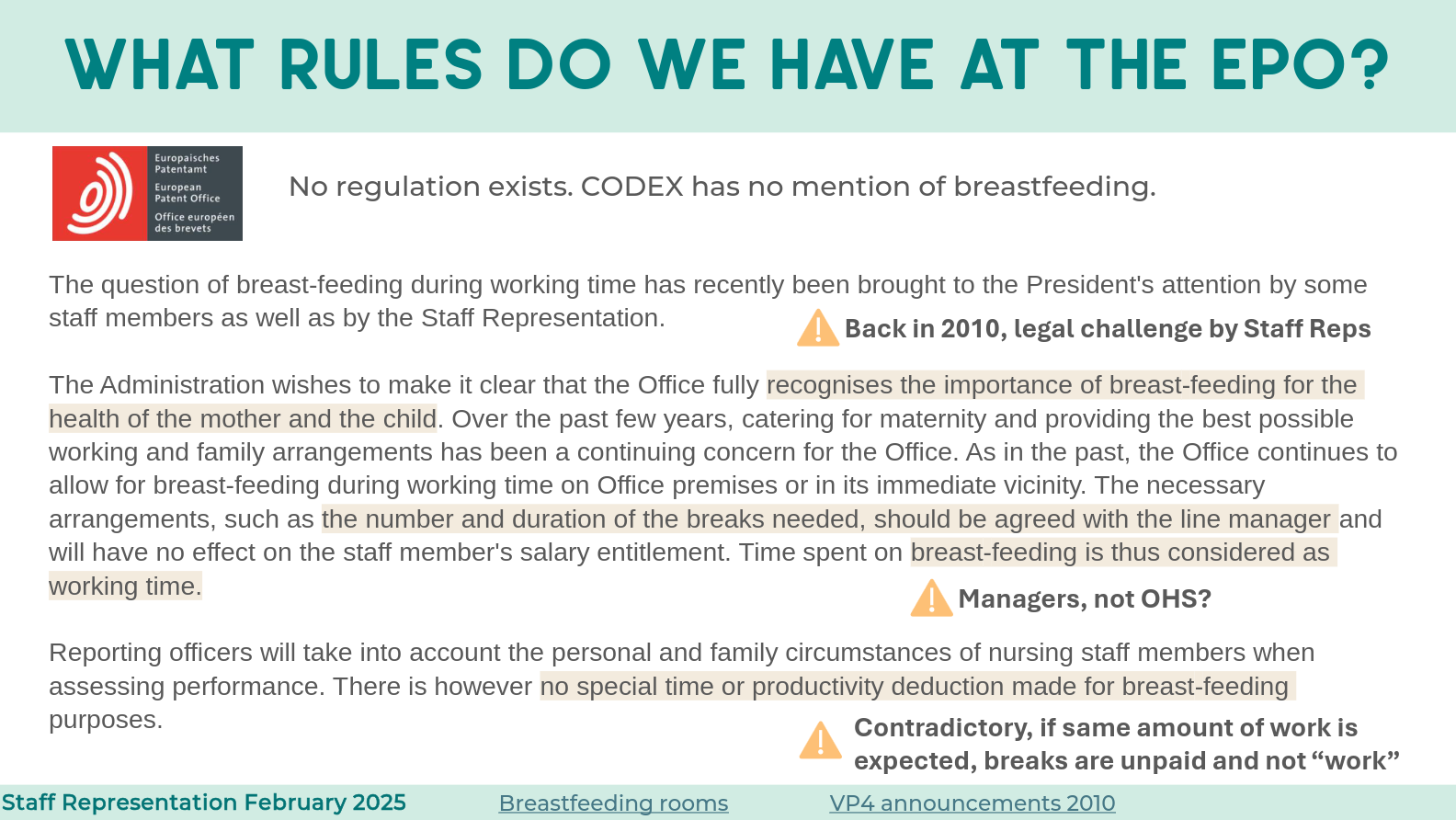
Last summer we showed disputes over treatment of women at the European Patent Office. Now there are perpetual strikes (more on that tomorrow) and the issues of 2025 remain applicable this year.
A report was issued a few days ago by the Central Staff Committee, based on meetings held earlier this year. Today we merely reproduce it all for GemText, HTML, and plain text bulletins:
Zentraler Personalausschuss
Central Staff Committee
Le Comité Central du PersonnelMunich, 26-05-2026
sc26036cpReport on the GCC meetings of
24 February and 23 April 2025Dear Colleagues,
The General Consultative Committee (GCC) met by videoconference on 24 February and 23 April 2026. The following items were on the agenda of the meetings and the CSC members of the GCC raised their concerns and tried to get further clarifications:
• Orientations for a new salary adjustment procedure pursuant to Article 12(2) of the Implementing Rule for Article 64 of the Service Regulations - for consultation GCC/DOC 04/2026
• Procedure for adjusting the remuneration of employees of the European Patent Office – Amendments to Article 64 of the Service Regulations and the Implementing Rule for Article 64 of the Service Regulations for permanent and other employees of the EPO – for consultation GCC/DOC 05/2026
• Breastfeeding policy – for consultation GCC/DOC 06/2026
• Circular No. 435 - Public holidays 2027 – for consultation GCC/DOC 07/2026
• Circular No. 436 - New Amicale Framework – for consultation GCC/DOC 08/2026
• Office-wide organisational adjustments 2026 – stream 3 – for information GCC/DOC 9/2026
The CSC members of the GCC provided the following opinions on the new salary adjustment procedure:
• Opinion on GCC/DOC 04/2026
• Opinion on GCC/DOC 05/2026
Read more in the GCC minutes of 24 February. The minutes of the GCC of 23 April are still pending approval.
The other detailed comments and opinions by the CSC members of the GCC are annexed to this paper.
Sincerely yours,
The Central Staff Committee
Opinion of the Staff Representation on the Breastfeeding Policy
GCC/DOC 06/2026The Staff Representation welcomes the introduction of a breastfeeding policy as a positive and necessary step. It responds to long-standing requests from staff representation and addresses an important gap in the Office’s framework supporting parents returning to work, in line with principles reflected in ILOAT case law.
However, while the objective of the proposal is supported, the current draft raises concerns in terms of legal certainty, clarity, consistency, and practical implementation.
1. Legal form and robustness of the policy
The Staff Representation notes that the policy is planned to be introduced via an intranet page, without any legal anchoring in a circular or in the Service Regulations.
While the reasons for not amending the Service Regulations are understood, it remains unclear why no circular could be introduced. A policy limited to an intranet publication, even when accompanied by FAQs, has a lower legal value than a circular or regulatory provision. It may be modified without formal consultation and without notification to staff or their representatives. This raises concerns regarding the long-term robustness, stability, and enforceability of the rights foreseen.
In this context, the Staff Representation considers that Circular 364, which is regularly updated and already governs equal opportunities in areas such as maternity leave and part-time work, would constitute an appropriate legal anchor. In addition, Circular 366, relating to performance management, is also a suitable instrument in which to include relevant provisions. Anchoring breastfeeding rights in these circulars would significantly improve legal certainty.
2. Clarity of the policy provisions
The current drafting lacks sufficient precision in several key areas. For example, the policy states that breastfeeding breaks;
“will be deducted from the employee's available time capacity and reflected in their production goals, where relevant.”The absence of a definition of when this would not be considered relevant introduces ambiguity and opens the door to divergent interpretations. The administration noted that this wording was used to reflect that for staff outside of examination, production goals may not be defined, and therefore this statement may not be relevant for them. This should be indicated, to ensure clarity, and that line managers do not misinterpret the wording.
Furthermore, the role of the line manager is central to the implementation of the policy but remains insufficiently defined. For example, the policy states that;
“The specific arrangements regarding the number and duration of breaks within the defined two-hour daily limit will be agreed between the employee and their line manager, taking into account the employee's individual circumstances and the interests of the service.”
The reliance on managerial discretion is not accompanied by clear guidance or safeguards. There is no indication of how consistency of application will be ensured across teams, directorates, and sites. This lack of clarity creates a tangible risk of unequal treatment, depending on local practices and individual managerial interpretation.
The policy also states that;
“primary caregivers breastfeeding or expressing milk are entitled to up to two hours per day of paid breastfeeding breaks until the child reaches 12 months”Such wording creates uncertainty for staff as to whether they are always entitled to the full 2 hours. In addition, when paired with the reference to the interests of the service cited above, it may further give line managers the impression that they can encourage the staff member to take less than the full two hour entitlement, particularly when capacity is needed within a team. For staff in the precarious position of having a fixed-term contract, it is especially necessary that they are protected from such actions. The administration stated that this “flexibility” in the wording was intended only for staff, in that they are not forced to take two hours if their daily breastfeeding or expressing takes less time, and that they can opt for taking, for example, only 1 hour per day. Staff representation believe that it is important that this specificity is included in the information available for staff and managers.
3. Implementation and transparency
Important practical elements necessary for the effective implementation of the policy have not been included in the documentation submitted for consultation.
In particular:
• The planned guidelines for managers have not been shared;
• The designation of a clear HR point of contact is not specified;
• The handling of information between HR and line management is not described;
• The implementation in internal systems (e.g. MyFips) and how the provision of time budget is to be given remains unclear.
The absence of these elements means that both staff and managers currently lack the necessary tools to apply the policy in a consistent and transparent manner. The Staff Representation therefore questions why these supporting documents were not submitted alongside the policy for consultation, and were answered that many additional documents and processes had yet to be finalised.
During the technical meetings, the administration said that they may not find a feasible way in which to allocate time budget so that the working capacity and productivity of an examiner staff member is accurate in the dashboards on which both they and their managers rely to track progress. They said that the line manager can always do a gap analysis during the reporting periods. However, gap analysis is used for periods of unexpected, unplanned absences, and therefore is not suitable, or sufficient for the case of breastfeeding breaks. The staff representation noted at least three other examples of time budget allocation for examiners; staff representatives, Amicale committee members, and training time allocated via codes, and stated that any of these means should be implemented also for breastfeeding staff.
4. Consultation of relevant bodies
The Staff Representation notes that relevant health and safety bodies, in particular LOHSEC and COHSEC, do not appear to have been meaningfully consulted, despite the clear implications of the policy for working conditions and health-related matters.
Given the nature of the policy, a more comprehensive consultation process involving these bodies would have been appropriate.
5. Practical issues related to in-office requirements
Over the last 18 months, a growing focus group of staff was formed who have or had experience with breastfeeding at the Office. These staff members have provided staff representation with invaluable advice and information on their needs and on what support measures would create an environment that makes the return to work compatible with continued breastfeeding of their child.
During these discussions with staff, the main reoccurring input was of significant issues regarding the compatibility of breastfeeding, especially in cases of medical complaints, with the in-office requirement threshold system. In addition, feedback from colleagues indicates that the procedures currently applied in some cases have not met acceptable standards and have raised concerns regarding the Office’s duty of care. This is due to inaccurate and inconsistent information being given about the process for granting exceptions to the in-office requirements, indicating a need for training and guidance of staff in different departments to ensure consistent provision of support.
Since this issue has been repeatedly identified as a key concern in relation to the breastfeeding policy, Staff Representation considers that there remains a need to address these shortcomings in cooperation with HR, Health & Safety services, and the Legal Department.
Conclusion and recommendations
In summary, the Staff Representation fully supports the objective of introducing a breastfeeding policy, and the planned timeline to introduce the policy in May 2026. However, as is often the case, the implementation details are crucial for ensuring that a policy is applied as intended. The current proposal remains below expectations in terms of legal certainty, clarity, and operational guidance.
We note that the policy as it stands presents a risk that:
• the policy will be applied inconsistently,
• staff will face uncertainty in exercising their rights, and
• line managers will be left to define the rules in practice.
The Staff Representation therefore recommends:
• Anchoring the policy in a more robust legal framework, in particular through the inclusion of relevant provisions in Circulars 364 and 366;
• Providing clear, binding, and accessible guidance document to managers and staff, ensuring consistent application across the Office;
• Submitting the full implementation package, including FAQs and operational instructions, for consultation with staff representation prior to any changes being made;
• Addressing the process for granting in-office exceptions, to ensure that it meets appropriate standards and fulfils the Office’s duty of care.
This revised approach would ensure that the policy effectively delivers on its objective of supporting staff during this important period, while guaranteeing fairness, clarity, and legal certainty.
Note on GCC/DOC 07/2026:
Circular No. 435 – Public holidays 2027According to Article 59(2)(b) ServRegs, the President of the Office, after consulting the relevant joint committee, shall lay down the list of public holidays applicable to each place of employment. This obligation is further specified in Rule 4(a) of Circular No. 22, which requires that the President of the Offices determines the paid holidays referred to in Article 59(2)(b) ServRegs before the end of each year after consulting the relevant joint committee. Rule 4(b) additionally provides that, in the interest of the Office, the President may decide to close the Office between Christmas and New Year and/or on a Monday or Friday where a public holiday falls on a Tuesday or Thursday respectively. Staff shall take any type of authorised leave during such closures. The President determines the Office closure days before the end of each year after consulting the relevant joint committee. These provisions consistently emphasise that consultation must take place prior to the adoption of the annual decision.
The relevant joint committee is the General Consultative Committee (GCC), whose agenda routinely includes the proposed regulations on public holidays for the following year. The annual regulations regarding public holidays and Office closure days have led to numerous disputes between staff and the EPOrg, some of which have been taken to the ILOAT. While Judgment 5177 now establishes that the practice whereby compensation hours will be deducted for the Office closure days in the event that a staff member does not register leave is lawful in principle, the consultation obligations have not been restricted in any way. The repeated reference to consultation in the applicable provisions underlines the importance attached to this procedural step. In its Opinion 2023/084, the Appeals Committee even emphasised that Rule 4(b) of Circular No. 22 does not imply any automatism of the President’s decision. The President should each year make a reasoned decision as to whether and why the Office should be closed. The Appeals Committee even made several recommendations to the President as to which reasons why the closure is necessary should be subject-matter of the consultation of the GCC.
Under these circumstances, the President should therefore have exercised particular care when consulting the GCC. According to Article 38 ServRegs, the President is the Chair of the GCC. However, he made use of his power to delegate this function of Chair to VP 5. In any case, the acting Chair should have ensured, during the obligatory consultation of the GCC, that the process was conducted properly. The Chair, however, opened the consultation on document GCC/DOC 07/2026 by giving an “executive summary” of the consultation before any member of the GCC or representative of the Office had taken the floor. In his “executive summary”, the Chair stated what the representative of the Office would say, and how the CSC members of the GCC would react on the presentation. He further even said which proposals would be made by the CSC members and how the Office would react to such proposals. By stating his intention that this a priori “executive summary” is meant to save time, the Chair made it unmistakably clear that this was not, by any means,
a humorous introduction or a joke. Under these circumstances, the CSC members noted that the Office was not interested in their opinion and neither be willing to make amendments to the document based on any comments that CSC members would make. The Chair tried to explain that he made the a priori “executive summary” in his function of the Chair and not as representative of the Office. He reiterated that he wanted to summarise what he thought the CSC members would say. After the CSC members had made no further comments under these conditions, the Chair then closed the consultation on this document.
The CSC members of the GCC consider that it is the duty of the President to consult the GCC on the regulations regarding public holidays and Office closure days for 2027. It is the President’s duty to listen or to exchange views on a proposal for a corresponding circular. The CSC members of the GCC conclude that the consultation requirement, as laid down in Article 59(2)(b) ServRegs and Circular No. 22, has not been fulfilled in substance.
The CSC members of the GCC
Opinion GCC/DOC 08/2026
Circular No. 436 – New Amicale FrameworkWe welcome the administration’s willingness to engage with AMICALE clubs, AMICALE branches, and Staff Representatives, as well as its initial openness to adjusting the draft Agreement in response to staff feedback. This reflects a constructive and cooperative spirit that is both acknowledged and appreciated.
That said, shortcomings in communication must be addressed. Communication has been inadequate, falling far below the level of clarity and transparency required for a reform of this magnitude. Despite repeated information sessions, many clubs remain insufficiently informed, fostering uncertainty and eroding confidence. Redirecting clubs to seek clarification individually from the administration does not remedy this systemic deficit; it merely shifts the burden onto those already affected.
More troubling, however, is the administration’s decision to abandon the path of joint agreement in favour of unilateral action. Munich and Vienna signed the Agreement in good faith, relying on explicit assurances that the Implementation Rules, an integral part of the framework, would follow. The Hague and Berlin, by contrast, took the prudent and entirely justified position that such rules should be available prior to signature. Instead of addressing these legitimate concerns through continued dialogue, the administration chose to impose a Circular outside the agreed framework. This is not a procedural nuance, it is a substantive departure from the principles of partnership and mutual trust.
Trust, once undermined, cannot simply be invoked; it must be upheld through consistent and transparent conduct. In this case, it has been weakened by a process that prioritised speed over accountability. Given that the AMICALE reform has been under discussion for years, any claim of urgency is unconvincing. A measured delay to finalise and openly present the Implementation Rules would have been both reasonable and necessary. The decision to proceed regardless calls into question the administration’s commitment to genuine consultation.
The consequences are already evident. In The Hague and Berlin, the continuation of AMICALE activities is no longer assured. This is not an unintended side effect, it is the predictable outcome of a process that has sidelined key stakeholders and diminished confidence in the reform itself.
Moreover, it was explicitly stated in earlier discussions that the Implementation Rules would not affect the clubs. The subsequent reference to a Club Manual suggests otherwise, raising substantive concerns about potential overregulation and procedural inconsistency. The absence of prior consultation or visibility regarding both the Implementation Rules and the Club Manual sits uneasily with earlier commitments to openness and inclusiveness, and inevitably prompts questions as to the rationale behind this lack of transparency.
The administration has explained that the Implementation Rules remain unfinished, as they are intended to evolve in light of practical experience. As for the Club Manual, it has been presented as a guidance tool, reportedly introduced at the request of clubs seeking greater clarity and legal certainty.
Given the constructive beginnings of this reform, the administration had a clear opportunity to build a durable and trust-based partnership. It chose not to do so. Continuing the dialogue and seeking agreement with all branches, including those that withheld their signature, would have strengthened both the process and its outcome. Instead, the current approach has compromised trust, weakened legitimacy, and placed the future of Amicale activities at risk.
This is not merely regrettable—it is avoidable, and it should be recognised as such.
Additionally, we wish to underline the following points:
The internal audit of AMICALE did not recommend a comprehensive overhaul of the organisation, nor did it call for its internalisation; i.e. a reduction of its autonomy combined with an increase in administrative burden.
Nevertheless, no fewer than 25 meetings were held with the administration on this matter involving AMICALE representatives. While certain exchanges were constructive, the process as a whole proved exhausting and ultimately unsustainable for those involved. Staff Representation was brought into the discussions only at a very late stage, and even then primarily through technical meetings. Earlier involvement, coupled with full access to all relevant information and documentation, would have significantly improved the prospects of reaching a balanced and widely supported agreement.
Transparency regarding the implementing guidelines, particularly on the crucial issue of time allocation, was notably lacking. A straightforward and reasonable request to extend time budget provisions to non-examiners was rejected, a position that runs counter to the principles of equality, diversity, and inclusion.
The previous AMICALE The Hague committee, composed of ten members with a combined experience exceeding 100 years in managing AMICALE activities, subsequently stepped down en masse. While the reasons are multifaceted, it is clear that the administration’s unwillingness to engage meaningfully on the allocation of resources played a decisive role in this outcome.
At the same time, the Office allocates substantial time resources to colleagues involved in Campus Days. By contrast, the four AMICALE committees combined are granted only minimal time budgets to support an entire year of activities. This imbalance is difficult to justify.
AMICALE The Hague operates year-round and plays a vital role in sustaining the social fabric of the Office in The Hague. The consequences of the current approach are therefore likely to be deeply detrimental to the local community.
AMICALE Berlin was unable to sign the agreement not only because the full set of documents was not made available, as noted above, but also because it was bound by its own governance rules. A general assembly could not be convened within the imposed timeframe to secure staff approval. The timeline set by the Office therefore made it effectively impossible, from a legal standpoint, for AMICALE Berlin to agree.
Furthermore, members of the AMICALE committee reported feeling under pressure, following statements suggesting that failure to sign the agreement could result in the dissolution of AMICALE or a reduction in financial support. Such remarks are incompatible with a climate of trust-based dialogue.
In conclusion, the AMICALE reform has been presented as an exercise in social dialogue. In practice, however, the process has fallen short of this standard. A genuinely constructive approach, one aimed at achieving balanced and mutually acceptable solutions, was not sustained through to the end.
We prefer not to comment on otherwise clearly stated views as above. █