
Bonum Certa Men Certa

Benoît Battistelli and Elodie Bergot Have Just Ensured That EPO Will Get Even More Corrupt

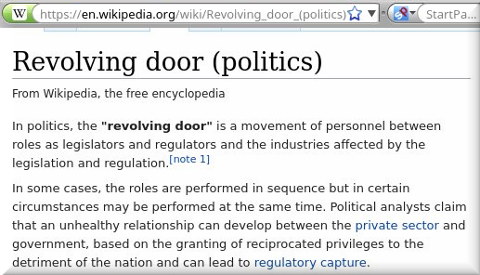
Examiners can come and go, with doors revolving ahead and behind them

Revolving door (politics)
Reference: Revolving door (politics)


Summary: Revolving door-type tactics will become more widespread at the EPO now that the management (Battistelli and his cronies) hires for low cost rather than skills/quality and minimises staff retention; this is yet another reason to dread anything like the UPC, which prioritises litigation over examination

EARLIER today we wrote about how the EPO moved on to corrupting academia, not just the media. And Bristows repeats the lies today. Team UPC loves it! Lies are OK to them as long as they're good for their bottom line. A few hours ago EPO boosted LSE's Antoine Dechezlepretre, who helped the EPO and Team UPC disseminate these lies.


Bristows we had very low expectations from (they would even fabricate/falsify things when that suits them), but now that the EPO bribes the media for puff pieces and does similar things with universities we must pause and think what the EPO has become. It's a real threat to democracy, to society, and to science. The EPO is no longer harmful just to the EPO and to industry. It's also toxic to academia, to media, and to the reputation of Europe.

Novagraaf's Robert Balsters almost drank the Kool-Aid. Earlier today he perpetuated the myth that UPC is just a matter of time (delay). It’ll never happen though. Perhaps even he and his firm (Balsters) have come to realise this. "First Brexit," he wrote, "then the UK and German general elections and now a case pending in the German Federal Constitutional Court have delayed the implementation date of the Unitary Patent and Unified Patent Court (UPC). Is this Europe-wide right ever going to come into being?"

Probably not. An additional issue (that he has not mentioned) is the EPO crisis, as well as the underlying points raised in the constitutional complaint. These are sometimes overlapping. One cannot discuss the UPC without relating to the EPO crisis, which is a very profound crisis. It's not just a "social" conflict but also a technical problem, which itself causes much of this "social" conflict.

As it turns out, many unskilled examiners are being hired on the cheap and much of the work is being passed to unproven algorithms which have, provably, not yielded good results. EPO insiders already speak about (anonymously, for obvious reasons).

As alluded to earlier today, things are about to get worse in a couple of months or even 6-7 weeks. As an insider explained to me a few hours ago: "Ms Bergot announced her intention to have 100% (yes, you read right: ONE HUNDRED percent) of time-limited contracts for newcomers starting from 1st January 2018 !!! [...] Many unanswered questions remain, such as - What will be the impact on the ability to recruit highly educated employees from all member states (knowing that the competition to attract the best ones is now global)? [...] What will be the pressure on the new employees, for their performance? [...] What will be the impact on the quality of their work? [...] What will be the financial impact, particularly on the pension fund if there is a high turnover? [...] How is the Office going to minimize the risk of corruption, which is precisely what permanent employment with advantageous working packages is supposed to prevent?"

As it turns out, WIPR is already covering this and it has solicited comments about this from the patent microcosm: (EIP, Bird & Bird etc.)

Benoît Battistelli, the president of the European Patent Office (EPO), has proposed an employment plan to recruit staff on renewable contracts of five years.

During a budget and finance commitee meeting in October in Munich, Battistelli and Elodie Bergot, principal director of human resources, added a motion to discuss permanent employment at the EPO to the agenda document.

A spokesperson for the EPO said that the office is in a “unique situation” with 97% of its staff hired on a permanent basis.

[...]

David Brinck, partner at EIP, said: the reputation of the EPO is founded on the quality and experience of its patent examiners.

“It must be a concern that moving to fixed-term contracts would hamper the recruitment of high-quality examiners and also potentially result in a high turnover of examiners with the position of EPO examiner eventually being seen as a CV filler rather than a worthy vocation in itself.”

Wouter Pors, partner at Bird & Bird, added that the EPO needs stability to be able to fill the current gaps.

“Given the uncertainty that employees have experienced in recent years, this is not the right moment to introduce flexibility. It is unlikely that highly educated professionals will give up their current employment for a future at the EPO which may be perceived as uncertain,” he cautioned.


Pors pretends to already know that Campinos will Fix Everything at the EPO. "Pors believes that perhaps in a year from now," it says, "when the new management has restored trust among the EPO employees, a plan like this could be introduced successfully."

He said the same about UPC (always "real soon" or "next year"), but failing even as a UPC propagandist [1, 2, 3] there's little reason to trust anything he says. The entire plan is terrifying because it means that examination will be assigned to machines and operators with insufficient background (to judge or assist these machines). This is all wrong and a hallmark of the EPO's disregard for academia (except when the EPO can pay it for some propaganda).

Meanwhile, over at IP Kat, these 'machines' continue to be discussed, using buzzwords such as AI (which is vastly overrated and nothing new):

"AI renders knowledge workers redundant."

We'll see this headline a few more times over the coming years. But it's not always realistic about the outcomes. Patent search is very amenable to moving many tasks to AI implementations. one well, it should free examiners up to spend more time on examinations, if costs are to be kept at the current level, or to reduce costs for users, if examiner workload is to be kept constant. Both seem like positive outcomes.


"Curious that IPkat is interested in EPO again," the next comment said. "Merpel should however know EPO examiners are not allowed to comment on the Office."

Well, except anonymously.

"EPO management isn't falling into an old pattern of seeking salvation in fashionable tech they fail to understand," said the next comment. To quote:

In my humble experience, little separates AI from NI (Natural Idiocy). It's true that there have been impressive improvements in some fields, like image recognition and automated translation, but even in those fields those improvements have only been achieved by force-feeding computers with phenomenal amounts of information, and I doubt that such an investment is yet economical or even possible in such a specialised field as patent searching. In any case, it still remains very much a matter of GIGO (garbage in - garbage out) and, AFAIK, in low tech fields like mechanics, the EPO databases are still quite corrupted by crappy OCR scans of old prior art (which can still be very much relevant in those fields: I've known cases where the killer prior art was over a century old).

I'm also slightly perplexed by the assumption that AI is put to better use in search than in examination: maybe AI would be less subject to hindsight bias than a human examiner when applying the Problem-Solution Approach, or determining whether something could be "directly and unambiguously derived" from a disclosure, don't you think?

Anyway, before starting to wonder whether android examiners would dream of electric mousetraps, perhaps we should employ a dose of realism and ask ourselves whether EPO management isn't falling into an old pattern of seeking salvation in fashionable tech they fail to understand, underestimating the challenges to implement it, and spending valuable resources into external consultancies in exchange of underwhelming results...


On the EPO, said the next comment, certain practices "are liable to render the patent office not fit for purpose."

It also said that "EPO management is falling into the trap of pressing ahead with unproven technology without fully appreciating the possible implications."

Here is the full comment:


It seems that you and I are in agreement. If you re-read my comment, it is clear that I only placed "off limits" those practices that are liable to render the patent office not fit for purpose.

I am in no way suggesting that investing in new technologies or adopting new ways of working is a bad thing. Instead, what I am saying is that all modernisation / efficiency drives must not render the EPO no longer fit for purpose.

On this point, I am afraid that I share Kant's concerns that "the purpose of semi-automatic search is to de-skill the task of patent searching so as to enable the highly skilled and experienced examiners to be replaced by unskilled workers on short term contracts". I would be delighted to be proved wrong. However, even if there is no diabolical plot behind the reforms are being, I suspect that Glad to be out of the madhouse is correct to wonder whether the EPO management is falling into the trap of pressing ahead with unproven technology without fully appreciating the possible implications.


The next comment had to be posted twice because it did not get through the first time (due to length):


The old EPOQUE databases have long since reached their design limits. They have improved on that, but some limits will remain. ANSERA is based on modern database structure, which is much more flexible. ANSERA was and is therefore ncessary.

Re. search approach: EPOQUE with INTERNAL and XFULL is very classification oriented. In ANSERA, classification symbol limitations often do not work, or are even working faultily.

Re. question 7: this is a perception bias. Newcomers still do get training in EPOQUE. But.... - tools training for newcomers has reduced from 7 weeks to 2 weeks, and encompasses more tools than before. The correct teaching is left to the tutor. Who has to meet high preocution values, and has NOT received training how to train. so newcomers get to lock themselves up and have to find something relevant. Understanding the classification systematic isn't easy, and prone to errors, leading to searches in irrelevant fields. If done correctly, your documents would all be highly relevant. With ANSERA you get a google effect: many seemingly relevant documents, but very hard to filter down to the most relevant ones. Just like google gives some 20 relevant result pages. So you'd have to scroll through MANY more documents to see all relevant ones. Which ANSERA is rather unsuitable for, and transfering large amounts to the better document tool is still impractical. So people look at the top 70 documents or so, according to some random evaluation algorithm.

And because finding documents loosely relevant is easy with ANSERA, non-engineers think it is the better tool. A real engineer gets frustrated, because getting the relevant documents out of the heap of close fields is impossible. But if you got the mention of how to use classification symbol searches only once within a haystack of other information in a new environment, retrieving this how-to when you need to is not something your brain will remember, so you pick some documents out of the large stack, and miss THE relevant classification symbol completely. And since Quality Nominees get only 2 hours to do this check, including understanding the application, evaluating if the cited documents have been evaluated correctly (X/Y; technical features), checking clarity issues, ..., no time remains to read up on the seach strategy, or even do a quick and dirty search in the correct classification symbol. And without better documents, there is no reason to mark a low quality search in the quality recording tool.

To recap: ANSERA itself is a wonderful tool. If the broken features get repaired. They are making great progress. But neither ANSERA itself nor EPOQUE are automated.

The useability of the automated pre-search (of which one element uses ANSERA) is extremely dependent on field and the specfic application you want to search. It made progress, then they had new versions which ais, for my field, a setback. Other fields improved.

Re question 5: I presume sometime external users of EPOQUE/INTERNAL/XFULL will also get access to ANSERA. But that access is very limited to patent offices, or the cut-down version EspaceNet offers.


The latest comment says this:


Fair comments. My experiences are reflected in your analysis. The new system is a bit of a black box which gives me results - but are they the best? In areas where classification systems are necessary and searching means looking at a lot of similar documents, finding small details isn’t easy.. Details of gear boxes which have gears, springs, fixed gears, internal gears etc. generate very general terms which may be closely located within almost every document. Finding the right conglomeration isn’t easy with a simple full text search for terms. A difficulty is that the Epoque system still gives very good results and probably better than Ansera - for the moment.


Having already seen IP Kat nuking all comments (about 40 of them), we do try to keep a record of them. A lot of these are coming from EPO insiders, who are otherwise difficult to hear from (they are afraid of getting caught by the regime of terror at Eponia).

Recent Techrights' Posts

Things Will Only Get Better (as We Go Backwards)
It only gets better. If you go back in time.
UK High Court Shows SRA is Totally Useless in Curbing SLAPPs, This Has Impact on Our Reporting on the SRA Next Week
We'll carry on our coverage and soon finish the current series that so we can get on with more time-sensitive ones
 
Gemini Links 22/09/2026: Scout Night, Cybernetic Capitalism, and Thoughts on Companies Forcing People to Adopt Plagiarism Engines
Links for the day
Links 22/09/2026: "An Arsenal of Surveillance" and Slop Bots Suggest Starting Wars
Links for the day
SLAPP Censorship - Part 193 Out of 200: Breaks GNU and Linux, Tries to Silence Critics, Loses All Money, Looks for Microsoft Allies and Sponsors
The latest emotional knee-jerk reactions serve to confirm what we have long said
Over at Tux Machines...
GNU/Linux news for the past day
IRC Proceedings: Monday, September 21, 2026
IRC logs for Monday, September 21, 2026
Links 21/09/2026: "Lies of the Hey Hi (AI) Industry" and Solar Power Is Getting Cheap
Links for the day
Gemini Links 21/09/2026: Equinox and Beginner's Guide to Gemini
Links for the day
Links 21/09/2026: "Back On My Bicycle" and American Regime's War on Media Escalates Further
Links for the day
SLAPP Censorship - Part 192 Out of 200: The Hired Guns of Garrett and Graveley Sent Us USB Sticks (One to Me, One to My Wife) Showing Lozza Talking to Garrett About Censoring/Deplatforming Techrights the Same Time Graveley Was Copy-Pasting Garrett's Lawsuit
Next year we plan to bring this matter to the Court of Appeal
Linux Kernel Becoming a Slopfest - Part 6 - Seeing Who Contaminates Linux With Slop (And Also Admits It)
Today we begin looking at some culprits
2026: The Year Galleries Realised the Need to Flag or Cull Slop Images
Society needs to shun slopfarms, people who use LLM slop (for anything at all), companies that use bots (which they dub "agents"), and so-called 'coders' who volley garbage into project and software hubs
Software Freedom Day Celebrated in 5 or 6 Continent
Software Freedom Day (SFD) 2026 was big this year
SLAPP Censorship - Part 191 Out of 200: Garrett, Graveley and Lozza
They talk to and coordinate with one another
Over at Tux Machines...
GNU/Linux news for the past day
IRC Proceedings: Sunday, September 20, 2026
IRC logs for Sunday, September 20, 2026
Gemini Links 21/09/2026: Digital Hoarder, GTD, Minimalism vs Digital Minimalism, Rejection of LLMs
Links for the day
Links 20/09/2026: "Google Now Asking For Users’ Video Selfies" and Energy Prices Set to Rise
Links for the day
Enjoy the Giving/Sharing, Not Taking
We've long supported what we believed in, even with the little money we had
Links 20/09/2026: Amazon Layoffs, Flock 'Buyouts' (Silent Layoffs)
Links for the day
USCIS and Microsoft Rumours: Curbs on Lowering Salaries by Importing Cheaper Replacements?
It seems like Microsoft's mass layoffs and efforts to cheapen the workforce face obstacles
Gemini Links 20/09/2026: "Music While Working" and Radio Silence
Links for the day
Clownflare Data From Canada
We've like to think many people are attempting to install GNU/Linux over the weekend
SLAPP Censorship - Part 190 Out of 200: Plagiarism, Back Doors, and Sabotage of Linux
This can go on for a decade or longer
Linux Kernel Becoming a Slopfest - Part 5 - Kernel Dependency on Plagiarism Giant Microsoft is a Death Blow to Any Kernel
Microsoft is bringing copyright-infringing slop into Linux
GNU/Linux Has Grown a Lot Lately
Based on Clownflare
Over at Tux Machines...
GNU/Linux news for the past day
IRC Proceedings: Saturday, September 19, 2026
IRC logs for Saturday, September 19, 2026