
European Patent Office (EPO) Series: The EPO Transparency Gap
Previous Parts:
Part 30
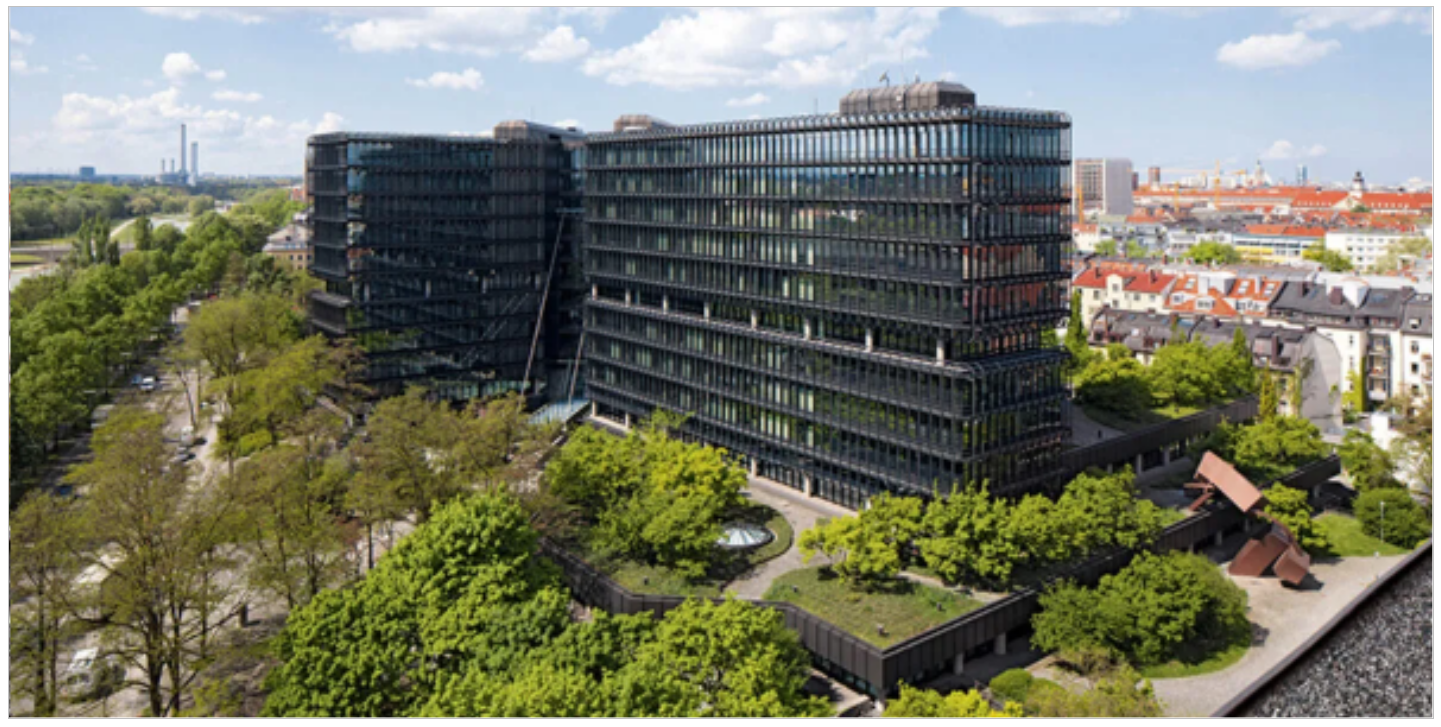
EPO headquarters in Munich as seen from the neighbouring German Patent & Trademark Office. Behind the glass façade of the EPO's flagship Isar Building lurks an institution which suffers from serious governance deficits, not least of which is a remarkable "transparency gap".
In the last part we recalled how the current EUIPO executive director João Negrão became embroiled in a controversy back in 2023 when questions were raised about whether his extensive programme of "duty missions" had become intertwined with his election campaign. In particular, Negrão came under scrutiny during a hearing before the Legal Affairs (JURI) Committee of the European Parliament when a question about the "integrity" of his campaign was asked by Danish Renew MEP Karen Melchior. In addition to this, allegations about improper use of EUIPO "duty missions" for electioneering purposes were included in a complaint submitted to the EU Anti-Fraud Office (OLAF).
These matters were reported on in detail by the French investigative outlet Medipart in an article published in January 2024 under the title "Intellectual property: the European agency out of control".
But however much "out of control" one might consider the EU trademark agency in Alicante to be, the EUIPO nevertheless remains under the jurisdiction of EU law.
As such, it is subject to something which – on paper at least – resembles a "rule-of-law" framework with a system of checks and balances. How well that system works in practice may be open to debate but the fact remains that the actions of senior EUIPO officials can be subjected to at least some rudimentary form of external scrutiny.
Members of the European Parliament (MEPs) are able to submit questions about EUIPO governance to the European Commission. Senior EUIPO officials and candidates for the top management positions can be summoned to appear before parliamentary committees where they face live questioning by MEPs. Suspicions of budgetary fraud, corruption or serious misconduct can be reported to the EU Anti-Fraud Office (OLAF) for investigation.
And, last but not least, the EUIPO is subject to EU regulations concerning public access to documents, thereby providing stakeholders, journalists and ordinary citizens with an official statutory mechanism for obtaining disclosure of important internal documents and information.
To give a concrete example of this, back in 2018 and 2019, two prominent "freedom of information" activists associated with the portal AsktheEU.org – namely Luisa Izuzquiza and the late Helen Darbishire – submitted requests for information about travel expenses of the executive director of EUIPO (at that time none other than António Campinos).
The responses to the respective requests "for the period 1 January 2016 to 31 December 2016 inclusive" and "for the period 1 January 2017 to 31 December 2018 inclusive" contained detailed information about the executive director's travel expenses for the periods in question.
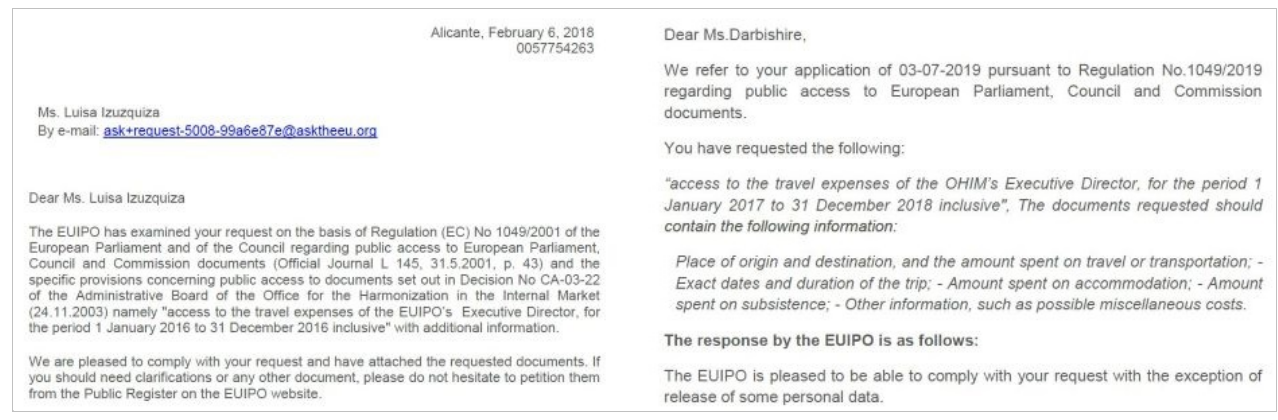
Extracts from correspondence dealing with the requests from Luisa Izuzquiza and Helen Darbshire for information about travel expenses of the executive director of EUIPO.
However, in the "parallel universe" of the European Patent Organisation it's a completely different story.
Despite the "European" tag in the organisation's name, the European Union has no jurisdiction over the European Patent Organisation. Apart from anything else, this means that the EPO President doesn't have to be concerned about the prospect of being summoned to appear before a committee of the European Parliament where he might have to face a grilling by MEPs.
Should any ordinary European citizens – such as transparency activists or journalists – contemplate a fact-finding investigation into EPO affairs they would be unlikely to get very far. Any requests seeking information about the costs of the EPO President's recent "missions" would be predestined to run into an impenetrable stone wall of bureaucratic silence.
It needs to be borne in mind here that when the European Patent Convention (EPC) was drafted back in the early 1970's the right of citizens to access records and data held by public bodies – generally referred to as "freedom of information" (FoI) – was not as strongly established in European law as it is today.
Thus – primarily for historical reasons – the EPC doesn't contain any provisions relating to the public's right of access to its official records and data.
That in itself would not be problematic if the legal framework governing the organisation had been revised during the intervening decades to keep step with the development of transparency and FoI legislation in the outside world. But it hasn't…
The consequence of this is that "freedom of Information" remains an entirely alien concept in the legal no-man's land of EPOnia. Neither the managerial elite on the upper floors of EPO headquarters at the Isar Building in Munich nor their purported overseers on the Administrative Council show any inclination to move the organisation closer to the standards of transparency that have long since become established at comparable national and international public authorities.
A question arises in this regard about the apparent lack of action on the part of the ministers of the national governments. After all, this is where the buck concerning EPO governance is supposed to stop as reflected in Article 4a of the revised EPC 2000 which stipulates that "[a] conference of ministers of the Contracting States responsible for patent matters shall meet at least every five years to discuss issues pertaining to the Organisation and to the European patent system".
However, the fact of the matter is that this provision of the EPC exists only on paper. Despite the fact that the revised EPC 2000 entered into force in December 2007, almost two decades later no ministerial conference has ever been convened. The official explanation for this is apparently that the Administrative Council in its wisdom has decided that there are no issues at the EPO requiring ministerial attention.
One might have thought that, in line with normal democratic practice, the ministers – rather than the civil servants sitting on the Administrative Council – would get to decide that. But apparently when it comes to questions of EPO governance the civil servant tail is allowed to wag the ministerial dog.
And so it has come to pass that, judged by contemporary European standards, the administrative culture of the EPO remains one of extreme opacity. It should not be overlooked that this is a highly convenient arrangement for the organisation's senior officials because it effectively shields them from any meaningful external scrutiny.
In addition to being exempt from any kind of bothersome "freedom of information" regulations, the President of the Office enjoys diplomatic immunity which affords him more or less total protection from criminal prosecution.
The only earthly authority to which Campinos is subject is the Administrative Council and the EPO's governing body is notorious for being "asleep at the wheel" when it comes to exercising control over its presidential appointees.
As head of the European Patent Office, António Campinos operates in a legal no-man's land and enjoys diplomatic immunity which affords him almost total protection from criminal prosecution.
The only earthly authority to which Campinos is subject is the Administrative Council and the EPO's governing body is notorious for being "asleep at the wheel" when it comes to exercising control over its presidential appointees.
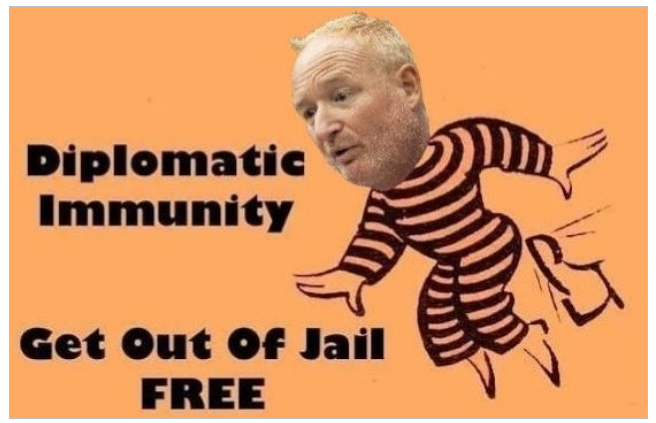
As head of the European Patent Office, António Campinos operates in a legal no-man's land and enjoys diplomatic immunity which affords him almost total protection from criminal prosecution. The only earthly authority to which Campinos is subject is the Administrative Council and the EPO's governing body is notorious for being "asleep at the wheel" when it comes to exercising control over its presidential appointees.
With regard to questions concerning the funding of his reappointment campaign, it is clear that Campinos does not have to worry about being subjected to any meaningful scrutiny or having to face any unpleasant consequences in the highly unlikely event of any official misconduct being established.
It is no exaggeration to say that the EPO's "transparency gap" grants the President of the Office a blank cheque in the form of more or less unfettered access to public funds which he can use to pursue his own private ambitions.
It seems to be entirely legitimate to ask whether the expenditure of official EPO funds by an incumbent President for the purpose of enhancing his prospects of remaining in office is an appropriate use of the organisation's resources. But this is a question that none those responsible for the organisation's governance appear to be interested in asking.
As we shall see in the next part, even if the Administrative Council were to decide against granting Campinos a rubber-stamped reappointment for a third mandate, the more or less unrestricted access to the budgetary resources of the EPO which the incumbent President enjoys would place him in the pole position should the Council decide to launch a competitive selection process. █