
European Patent Office (EPO) Series: The Portuguese Talent For Bureaucratic Empire Building
Previous Parts:
Part 38
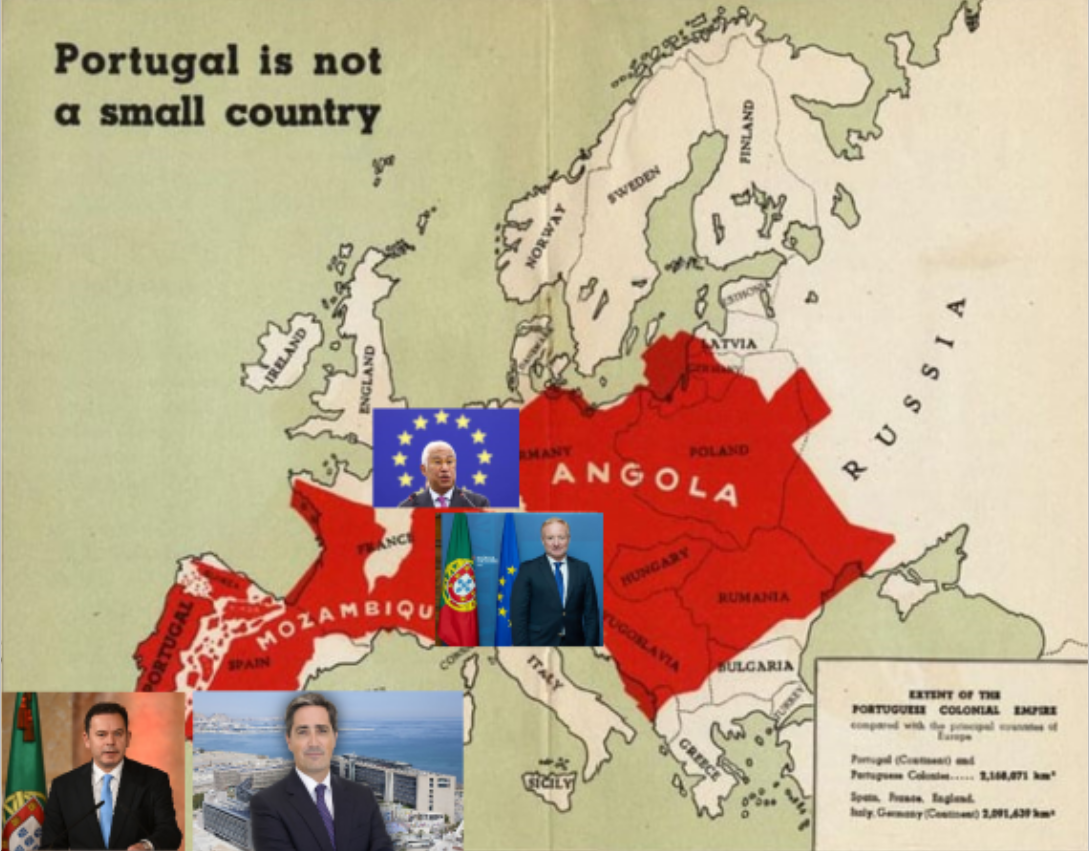
Modern-day Portugal has become surprisingly adept at what might be called bureaucratic empire building – not by means of maritime expeditions and planting flags, but by occupying influential positions within international institutions. Clockwise from the top: António Costa, President of the European Council in Brussels; António Campinos, President of the EPO in Munich; João Negrão, Executive Director of the EUIPO in Alicante; and Luís Montenegro, current Prime Minister of Portugal.
At first glance modern-day Portugal seems like a small insignificant country on the Atlantic periphery of the continent with one of the "least advanced economies" within the European Union. Indeed, in recent times some commentators have described it in rather unkind terms as a "laundromat" for the ill-gotten gains of Angolan kleptocrats.
But it should not be forgotten that, from a historical perspective, Portugal was once a formidable colonial power. The Conquest of Ceuta on 21 August 1415 led by Henry the Navigator marked the beginning of the Portuguese Empire, which at its height stretched from Brazil in South America across the African continent, to trading outposts in Goa on India's west coast and Macau on the edge of China.
For a country of modest population, Portugal assembled an extensive network of overseas territories, built less on overwhelming military force than on navigation, commerce and a talent for establishing strategic footholds.
Despite the loss of Brazil in the 1820s, Portugal managed to hold on to much of its empire well into the twentieth century. Under the authoritarian Estado Novo regime of António de Oliveira Salazar, Lisbon resisted the global tide of decolonisation insisting that its overseas territories were integral provinces of Portugal rather than colonies. The Salazar regime embraced and promoted the doctrine of "Lusotropicalism" which claimed that because of the distinctive character of its imperialism Portugal was not a conventional European colonial power with overseas possessions but rather a multicultural and multiracial nation-state spread across continents.
One of the best-known propaganda images of the Salazar regime is a poster from the 1930s with the title "Portugal não é um país pequeno" (Translation: "Portugal is not a small country"). The poster shows an outline of the country's overseas territories superimposed across a map of Europe. Portugal itself occupies a small area on the western edge of Europe, while its colonies – drawn to the same scale – are spread across the continent stretching roughly from Scandinavia to the Mediterranean and eastward into Eastern Europe.
By making Portugal's overseas possessions appear to cover Europe, the Salazar regime transformed a factual comparison of land area into a powerful symbolic claim that Portugal despite its apparently small size remained a significant global power.
By the early 1970s, Portugal stood as the last European colonial power still fighting wars to retain control of its overseas territories. However, in April 1974 the Carnation Revolution brought an abrupt end to an imperial chapter of Portuguese history that had lasted over five centuries. Decolonisation followed quickly as the new democratically elected government granted independence to Guinea-Bissau (1974), and Mozambique, Angola, Cape Verde, and São Tomé and Príncipe (1975).
As its empire was consigned to the history books, Portugal reinvented itself as a modern European democracy. Membership of the European Economic Community in 1986 accelerated economic and institutional development, while later participation in the European Union placed the country firmly within the mainstream of European integration.
Despite its small size, modern-day Portugal has demonstrated a remarkable ability to punch above its weight on the international stage. Its diplomats, civil servants and international lawyers have acquired a reputation for consensus-building and multilingual competence. The election of António Guterres as Secretary-General of the United Nations is perhaps the most visible example of Portuguese success in the international diplomatic arena, illustrating how a relatively small peripheral European nation can produce figures of global stature.
Closer to home, Portuguese officials have also come to play a significant role in the EU. As we explained in the earlier parts of this series, the former Portuguese Prime Minister António Costa managed to navigate his way out of a domestic political storm sailing on triumphantly through the corridors of power in Brussels to become President of the European Council in 2024. In the words of James Plaskitt, the former British MP for Warwick and Leamington, this was a sign that, after 40 years of EU membership, Portugal had moved from the periphery to the centre.
The colonial empire may have disappeared half a century ago, but the Portuguese aptitude for navigating complex international structures appears to be very much alive. In the meantime, the nautical maps have been replaced by organisational charts, colonial governors by executive directors, maritime routes by reporting lines and overseas provinces by networks of committees, working groups and management boards.
Modern-day Portugal has become surprisingly adept at what might be called bureaucratic empire building – not by means of maritime expeditions and planting flags, but by occupying influential positions within international institutions. Perhaps the country's most intriguing modern export is not wine, cork or footballers, but senior "IP" administrators.
As we have already seen in this series, António-Serge de Pinho Campinos the head of the Portuguese INPI proved himself to be a consummate master of the "rigged game" in 2010 when he succeeded in manoeuvring himself into the top job at the OHIM (now known as EUIPO) in Alicante. On that occasion Campinos managed to persuade his amigos on the Administrative Board of the EU's trademark agency to nominate him as the sole candidate on a "shortlist of one" for submission to the EU's Council of Ministers.
We note here in passing that, by a curious irony of history, the father of António Campinos, Joaquim Jorge de Pinho Campinos, played a prominent role in the winding-down of the Portuguese colonial empire after the Carnation Revolution. The elder Campinos was a professor of law and political science and a founder member of the CIA-funded Socialist Party (PS). For fourteen years, between 1960 and 1974, Jorge Campinos lived in political exile in Poitiers, a university town in the Nouvelle-Aquitaine region of western France, where his son António was born in October 1968.
As we have already reported in an earlier part of this series, António Campinos moved from Alicante to Munich in 2018 to become President of the European Patent Office, Europe's second largest intergovernmental organisation. This appointment placed a Portuguese national at the helm of an international institution employing several thousand staff and serving a current total of 40 member states.
Meanwhile, back in Alicante João Negrão – another Portuguese national and erstwhile protégé of Campinos – would eventually assume the leadership of EUIPO after the dethronement of Christian Archambeau who had succeeded Campinos in 2018.
In a speech to EUIPO staff on 27th November 2022, Archambeau claimed that the decision to remove him reflected “the ugly side of politics, power games, and self-interest, initiated in Munich and Madrid". In the given context, "Munich" was generally recognised as referring to political interference by the EPO President (and former EUIPO Director) António Campinos.
Whatever about the alleged role of Campinos in the unseating of Archambeau, it is well documented that during the subsequent succession race the EPO President engaged in vigorous lobbying for his compatriot João Negrão which triggered a complaint from the French Minister for Finance and Economic Affairs, Bruno Le Maire.
References/documents: 2023-05-22 MIP - EUIPO Election
Negrão's success in securing the position of EUIPO Executive Director reinforced Portugal's prominence within Europe's "IP" institutions and was widely acclaimed within Portuguese legal and administrative circles as evidence of the country's ability to produce internationally respected public administrators.
For most Portuguese observers, the appointments of Campinos and Negrão have been regarded as a source of national pride. For a country that once governed territories scattered across several continents, there is a certain satisfaction in seeing its officials once again administering sprawling multinational systems – in this case systems of trade marks and patents rather than spice routes and colonial ports.
It is worth emphasising here that these appointments have not come about by mere chance. On the contrary, as Negrão candidly admitted during questioning before the Legal Affairs (JURI) Committee of the European Parliament on 27th June 2023, his campaign for the position of EUIPO Executive Director was supported and coordinated by the Portuguese government: "I can tell you that I am a candidate supported officially by the government of Portugal. The campaign is done by the government of Portugal, by the Portuguese authorities."
A few years earlier in November 2020 when Negrão was appointed as President of the EUIPO Boards of Appeal an official communiqué issued by the Portuguese Ministry of Foreign Affairs confirmed that his candidacy had "received strong support and commitment from the Portuguese Government, through a diplomatic campaign coordinated by the Ministry of Foreign Affairs, which also involved the Ministry of Justice and the National Institute of Industrial Property (INPI)". That communiqué was published on the official website of the XXII Portuguese government, a Socialist Party (PS) minority government led by Prime Minister António Costa.
References/documents: 2020-11-10 PT Communique Negrao
Likewise, in July 2023, following the announcement of Negrão's appointment as Executive Director of the EUIPO another official communiqué headlined "Portugal wins election to head the EU Intellectual Property Office" stated that Negrão's candidacy had been "heavily backed by the Portuguese Government through an active diplomatic campaign in all EU member states and the various European institutions".
References/documents: 2023-07-12 Portugal wins EUIPO election
The July 2023 communiqué was published on the official website of the XXIII Portuguese government, the Socialist Party (PS) majority government led by Prime Minister António Costa which collapsed later that year on 7th November 2023 as a consequence of "Operation Influencer".
The communiqué doesn't explain what exactly is meant by "the various European institutions" and the reader is left to speculate as to whether this might also include the vigorous lobbying for Negrão carried out by EPO President António Campinos.
Portugal’s success in securing senior executive appointments at the EUIPO and the EPO is a notable example of how countries seek to strengthen their influence within European intergovernmental institutions. There is nothing inherently reproachable in this: governments naturally advocate for their nationals and work to build networks and positions of influence across the upper echelons of international organisations. In this respect Portugal is no different from the other member states of the EU and EPO, all of which jockey for visibility, influence and strategic positions when the opportunities arise. What matters here is that such appointments are made through proper and fair procedures and that those selected are suitably qualified to discharge their responsibilities effectively.
Unfortunately, when it comes to Campinos and Negrão there are legitimate questions that can be asked about the procedures which led to their respective appointments.
In the case of Campinos, he secured his appointment as head of the OHIM in 2010 by means of what could be legitimately described as "a non-competitive selection procedure" that relied on a "shortlist of one". The procedure which led to his election as EPO President in 2017 seems to have been another "rigged game" characterised by "the illusion of choice".
In the case of Negrão there are well-founded suspicions that the selection procedures which contributed to his remarkable "career progression" at the EUIPO in Alicante were tainted by influence-peddling and cronyism.
When it comes to the current efforts of Campinos to secure reappointment for a third term, his track record as President of the EPO during his first two terms would normally be enough to give rise to serious reservations about a further extension of tenure.
In addition to this, there are other reasons to question his suitability for such a prominent position in an intergovernmental organisation. We are referring here to the persistent rumours about "substance abuse" that continue to circulate in relation to Campinos and his "inner circle" of Alicantian amigos. These rumours were given additional impetus last year following the arrest of the EPO's former "spin doctor" Luís Berenguer Giménez for cocaine consumption in public at the 2025 Munich Oktoberfest.
In the next part we will look at how the election of Campinos as EPO President in October 2017 was greeted with official acclaim in his home country and we will examine the question as to whether he can still expect the same level of endorsement and support from the Portuguese political establishment in 2026. █