
Open source is bigger and more diverse than ever before. With that success comes challenges, some new and some old, but all of them on a larger scale than ever before.
As we grow and convene more people and viewpoints, the conversations will get more difficult. In some ways, that’s good--vigorous discussions help us clarify our shared understanding and pushing the boundaries helps us find where those boundaries are. We evolve appropriately to meet the needs of a changing world.
But the challenges of cross-cultural discourse amongst people with strong convictions are readily apparent. This has come into stark relief, over the last two years, across contentious elections and experiments in licensing. We need to provide a safe and productive environment for the communities we convene. The world of open source is large and diverse. We appreciate the continued efforts of the people who were here at the beginning and recognize that while many new people have joined the community, many more do not feel like they’d be welcome participants--and we are lesser for it.
Stallman was followed in the 1990s by Eric Raymond, whose essay ‘The Cathedral and the Bazaar’ served as a call to arms for what he began to term the ‘open-source’ software movement, accompanying the release of his open-source operating system Linux. With open source, the source code (written instructions) of the software is openly published for anyone to use for free. The socially understood price, however, is that if you make improvements, you need to publish those improvements back to the code so that others can take advantage of them. Instead of the proprietary software licensing model of companies like Microsoft, open-source companies like Red Hat made their money from selling services and solutions to enhance the open-source software implementation.
[...]
The organisation of the future may or may not live on a blockchain, but without question blockchain holds the potential to make that future organisation more effective. One of the challenges of decentralised decision-making is the loss of coordination of activities. In complex systems this can lead to gridlock and chaos, as nobody knows what the rest of the organisation is doing or how their work fits in with the greater whole, sometimes leading people to working cross-purposes.
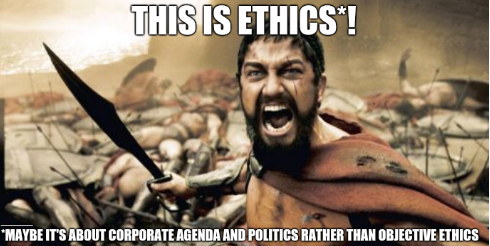
These days the Free and Open Source Software community is seeing its theoretical foundations somewhat challenged. First, there are those who would like to see the official definition of Open Source changed so that it matches their marketing and lobbying needs. It is a rather complex issue here, on which I will likely write about some time in the future. There are also those who have a business model issue as (much) bigger companies seem happy to distribute their own, Open Source licensed software on their platform (read: cloud platforms) but do not necessarily enable an effective revenue sharing across the ecosystem. Next, there is a growing momentum towards what is sometimes referred to as “ethical” open source licenses. By inserting the compliance or adherence to more or less specific ethical norm, these licenses would supposedly force their recipients to accept these norms by using the software distributed under these licenses. In other words, if a license comes with the obligation for me or for my employer to comply with human rights, I can no longer use nor distribute the software if I know or suspect I’m not respecting the norms contained within the declaration of Human Rights as expressed by the United Nations.
Complying with human rights, however, may be the best case scenario here. Other cases include a general “Do No Evil” clause, which by definition is impossible to comply with. Practically, it disregards the abyss of “Evil” both individuals and corporations or governments are capable of doing to the point of being a metaphysical absurdity. In the case of the Human Rights clause, one would have to believe that it would be scrupulously followed by entities and people who are already in violation of human rights…
More troubling is the question of who sets what’s good and evil. In the case of human rights, there’s some loose consensus about its importance and about its moral values in countries that are mostly western and democratic. The rest of the world has many examples of daily, ongoing and continuous violations of human rights. In other words, ethical standards are important, but ethical standards work and can be enforced within organizations. Within Free and Open Source Software Licenses they raise troubling questions.
Enter the case of Eric S. Raymond (aka ESR). Eric S. Raymond, co-founder of the Open Source Initiative, the man who initially coined the terms “Open Source” and the author of the seminal “the Cathedral and the Bazaar” book, was discussing how he felt such ethical open source licenses were in direct violation with specific points of the Open Source Definition. In the course of this discussion, things became heated. As a result, Eric Raymond got moderated out of the mailing lists of the organization he co-founded. His last posts were indeed somewhat rude, but not out of the ordinary level of a heated exchange on a mailing list. Eric did end up publishing a good post summarizing an other wise precise and relevant chain of thoughts.
I hope this moderation was done as a temporary measure in order to bring some peace to the discussion. Be that as it may the discussion reveals a troubling tendency at the level of the Open Source Initiative: some people would like to turn Open Source and Hacker’s ethos into something it is not, a political movement that is only very partially about software and a lot about liberal ideas.
The Open Source Initiative (OSI) is the governing body of the definition of what it means to be Open Source and which licenses are accepted as Open Source licenses. It coined the modern use of the term “open source” and maintains the Open Source Definition.
Right now there is a group of people who want to take over OSI and change the Open Source Definition to include ethical clauses. These clauses include things such as prohibitions on human rights abuses. Presently such licenses violate the Open Source Definition.