
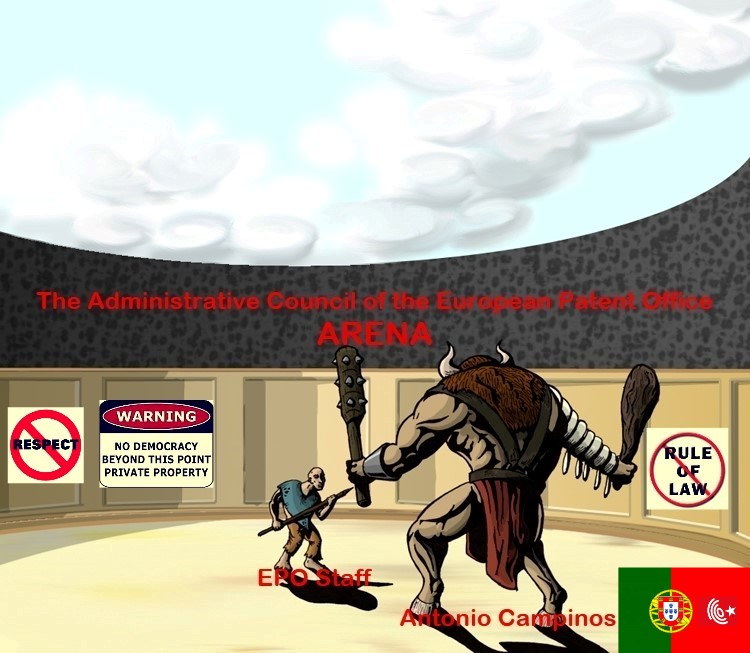
THE STAFF of the European Patent Office (EPO) is disappointed to see yet more evidence that Battistelli remains 'in power' through his friend António Campinos, whom he left in charge. From Friday:
Munich, 13.09.2019 sc19121cp - 0.2.1/0.3.2
Internal appeals against strike regulations
In his Communiqué No.19 of 3 September 2019 Mr Campinos celebrates the majority opinions of the Appeals Committee that validated the Office’s approach to the right to strike. Mr Campinos fails to consider the solid minority opinions. The decisions will be appealed at the ILOAT.
A bit of “evolutionary history” is often helpful to understand the present.
Changing the rules during the game...
Early in 2013 the SUEPO trade union called for an office-wide action plan 1. This was in response to outstanding concerns of staff, specifically concerning performance management (abolition of warning letters), well-being (house arrests for sick staff), the career system (reduction of the budget), a ban on mass emails, and the investigation guidelines.
The answer of Mr Battistelli was to submit during the on-going conflict a proposal on strike regulations (CA/D 5/13 and Circular 347) which made striking much more difficult by:
- restricting the allowed nature and duration of a strike;
- restricting the allowed grounds for a strike2 (to only relate to “conditions of employment”);
- introducing a 1/20th deduction of monthly salary per day (instead of 1/30th);
- allowing small, non-statutory, ad-hoc groups to bypass unions and initiate strike ballots; and
- preventing a strike ballot being organised by others than the Administration.
Mr Battistelli pretended in front of the Administrative Council3 that the purpose of these amendments was to fill a legal vacuum and that, for the first time in EPO history, the newly introduced Article 30a ServRegs would recognise the right to strike. The then VP5 declared that: “[t]he new regulations had been proposed considering general legal principles, European rights and ILOAT standards.”
Interestingly, and somewhat contradictorily, the Administration argued before the Appeals Committee that it did not consider ILO Convention 151 on Labour Relations to be binding on the EPOrg. However, the right to strike emanates from the fundamental right to freedom of association, a right already recognised in Article 30 ServRegs. In contrast, Article 30a almost voids the right to strike and thus attacks our right to freedom of association. ____ 1 “Note to all staff: meeting with the President on 16 May 2013” (sc13074cp) 2 “Strike for climate not possible at the EPO”, CSC Intranet publication of 19 August 2019 3 “Draft minutes of the 136th meeting of the Administrative Council” (CA/64/13), attended by Mr Campinos (CA/52/13 Rev. 1) in his capacity as Head of the OHIM (now EUIPO) and Mr Christoph Ernst (now VP5) as Head of the German Delegation
... and threatening staff on strike on 2 July 2013
On 1 July 2013, the new regulations entered into force4. SUEPO informed staff that Circular 347 was unlawful. SUEPO explained that already in February 2013 its action plan had been successfully balloted, with a credible quorum and an overwhelming majority in all places of employment, for actions until 1 September 2013. Several hundred staff members declared themselves on strike on 2 July 20135. On 9 July 2013, Ms Bergot (PD4.3) sent letters to them in which she refused to recognise the claimed industrial action as a strike and asserted that the staff members had been on unauthorised absence and were liable to disciplinary measures.
The rise of (anonymous) calls for the strike
Towards the end of 2013 (anonymous) groups of staff started organising themselves and circulating petitions to initiate strike ballots. The LIFER call for strike (6 September 2013) was a major success culminating in a massive vote of no confidence in Mr Battistelli who then tried to avoid this situation again in view of the Administrative Council meeting of June 2014 when his re-election would be on the agenda.
To this end, Mr Battistelli refused to organise the ballot for the subsequent IFLRE call for strike (24 October 2013) on the spurious ground that there should be a “one-month cooling-off period”. The ballot for the PEACES call for strike (23 January 2014) was postponed by unduly accusing an expert of the staff representation of breach of data protection. The ballot of the UNITY call for strike (16 May 2014) was deliberately postponed until it was not possible to organise it anymore.
In conclusion, history teaches us that the strike regulations were designed to give the President means to thwart staff’s attempts to contest reforms.
Six years later, in the Appeals Committee
The unlawfulness of the strike regulations (2 July 2013), the brutality of their enforcement (requisitions) and their wrong application (for IFLRE, PEACES, UNITY) triggered a significant number of appeals. Six years later the matter was finally treated by the Appeals Committee.
In his Communiqué, Mr Campinos celebrates the majority opinions of the Appeals Committee (ApC) that validated the Office’s approach to the right to strike. Mr Campinos fails to consider the solid minority opinions and the fact that the Chair of the ApC sided with the nominees of the Administration6.
Among others, we are concerned that the majority found “requisitions in the event of strike to be lawful in relation to opposition proceedings and other tasks which cannot be taken over by a colleague at short notice”. We remind you that an unavoidable consequence of a strike is to cause some work disruption, if the strike is to be effective.
_____ 4 “New Circular 347”, VP4 Communiqué of 28 June 2013 5 “Feedback on 2 July 2013 strike”, SUEPO publication (su13092cp) 6 We regret that the Chair was appointed by the President without consulting us. We always pleaded for an appointment based on a joint proposal involving Staff Representation.
Will Mr Campinos question the past?
When the new strike regulations were discussed in the Administrative Council in June 2013 Mr Christoph Ernst, who was head of the German delegation at the time, advised the EPO “to evaluate the rules within one or two years to ensure that the intended aims had indeed been reached.” Such evaluation never took place. Mr Ernst is now Vice-President “Legal Affairs” (VP5) and it is his duty to advise the President. Labour law does not, however, fall anymore under his remit since it has been transferred to Ms Bergot (PD4.3).
Now, Mr Campinos announces that “the right to strike will be revisited in the framework of upcoming discussions between the Office and the unions”.
We acknowledge that Mr Campinos shows readiness to organise meetings but, unfortunately, we also see a marked reluctance to question the past (and partly present) disastrous practice. The concerns of staff, repeatedly expressed since 2013, are still on the agenda, and there is much room for substantial progress.
Next steps
In addition to discussing this topic with the President, his decisions on the strike appeals will be brought to the ILOAT soon. Staff will be informed accordingly.
The Central Staff Committee
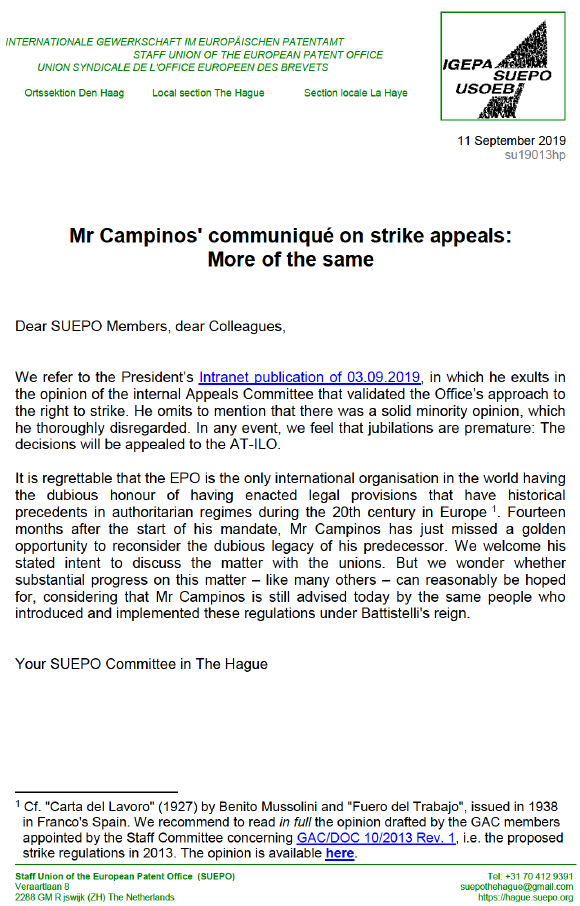
Mr Campinos has just missed a golden opportunity to reconsider the dubious legacy of his predecessor.
Internal appeals against strike regulations
03.09.2019
Outcome confirms validity of the Office's regulatory framework
Dear Colleagues,
The right to strike is a widely recognised principle, and in the EPO specifically set out in Article 30a of the ServRegs. Recently, the Appeals Committee issued several opinions involving the legal framework regulating the right to strike. On the merits, the Office has endorsed the recommendation of the majority of the Committee in these opinions.
While the opinions concern individual appeals, they also address the legality of certain aspects of the regulatory framework, as adopted by the Administrative Council on 1 July 2013 (CA/D 5/13), and I would like to share with you some of the general findings.
Most importantly, it can be noted that the Committee's majority considered that the rules regarding strike - to the extent they were relevant for the assessment of the individual appeals - are lawful. In particular, it validated the lawfulness of:
€· The rule of 1/20th deduction of monthly salary per day of participation in strike as it applies within the context of absences from working days;
€· The decision to allow smaller ad hoc groups to initiate strike ballots;
€· The Office bearing the subsequent responsibility to organise a strike ballot, with the Supervisory Committee providing adequate safeguard.
As regards the Office's obligation to organise strike ballots, it was considered that a decision by the President to postpone a ballot must be both justified and proportionate. In the case of one strike initiative in 2014, this was found not to be the case (UNITY), while in two others (PEACES and IFLRE) data protection issues and the need for a "cooling-off period", respectively, was considered lawful. With regard to the latter case, I believe the outcome of the most recent call for strike confirmed that constructive discussions may indeed take place during such a period, and make strike unnecessary.
It has also been confirmed that requisitions in the event of strike are lawful, provided they are imposed in a proportionate manner. A distinction was drawn between the type of oral proceedings concerned, and in the cases at hand, the Committee unanimously considered the requisition orders issued in relation to oral proceedings in examination not to be proportionate. However, in relation to opposition proceedings and other tasks which cannot be taken over by a colleague at short notice, the requisition orders were considered to be lawful.
To conclude, these findings confirm the validity of the Office's regulatory framework regarding the right to strike and the protections it offers. Nevertheless, as mentioned in the Strategic Plan for 2023, the right to strike will be revisited in the framework of upcoming discussions between the Office and the unions. I look forward to constructive and conducive discussions in this regard.
António Campinos
President
--------------------
What is happening at EPO?
Antonio Campinos President of the European Patent Office and ex EU top official endorses Battistelli's strike rules inspired by fascist bills.
Was he not elected to re-establish social dialogue and respect the rule of law?
---------------------