
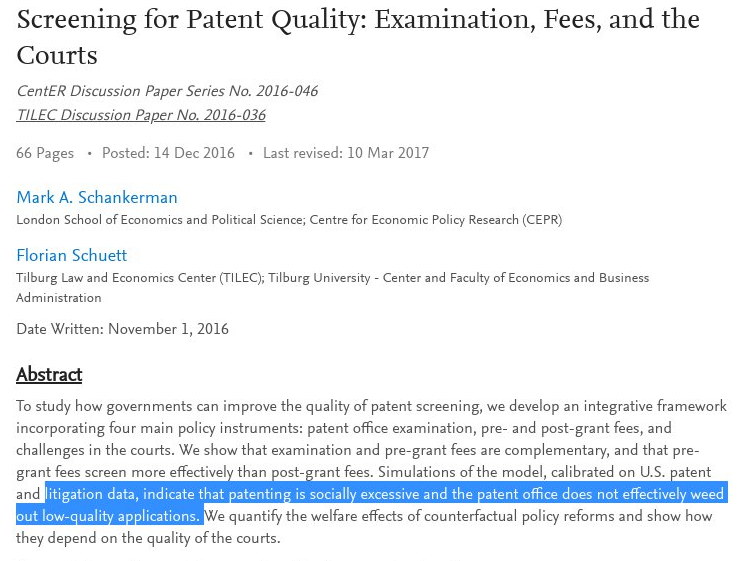
Screening for Patent Quality: Examination, Fees, and the Courts
BACK in 2006 when this site was born (I had already been writing about patents for a number of years before that) our focus was on software patents in the US and their impact on GNU/Linux. In 2007 we broadened our scope a bit; we looked at USPTO-granted patents that affected not only GNU/Linux and covered various other threats to GNU/Linux, for example OOXML (proprietary, pseudo 'standards'). It was only in 2007 that we started talking about software patents in Europe, in light of the 2005 directive (predating this site) and whatever followed. Back then the UPC (not yet known as UPC) was a concept, not an actual thing. It became known (renamed) as "EU"/"Community" Patent and later came words like "unitary" and "unified" (who would ever oppose unity, union, unison and so on?). In 2008 we started focusing on what Brimelow had done, especially loopholes "as such"; seeing the great harms caused by software patents in the US, we were baffled by this policy. It wasn't until Battistelli came to the helm that software patents were granted in droves. António Campinos may call them "AI" or "4IR" or whatever, but we know what these are. Even the US would not allow such patents (35 U.S.C. €§ 101 would prevent them going far down the legal pipeline).
"Even the US would not allow such patents (35 U.S.C. ۤ 101 would prevent them going far down the legal pipeline)."The decline of patent quality in Europe isn't a problem but a growing crisis. Some of the most ridiculous patents motivated us to start a European "stupid patent of the month" series -- a series we didn't keep going for very long (lack of time and resources are to blame). Fake patents are being granted by the European Patent Office (EPO) -- maybe more so than by NPOs -- and in Germany some of these patents are proving to be of use to nobody but lawyers. They also have negative impact on climate. Renewables Now covered what we had seen in 4 sites beforehand (including a press release) when it said (earlier this week, yesterday to be precise):
A court in Germany has handed a victory to Huawei Technologies Co Ltd in one patent infringement case brought by Israel-based photovoltaic (PV) inverter supplier SolarEdge Technologies Inc (NASDAQ:SEDG), while deferring the hearing for another case due to insufficient evidence.
The Chinese company informed last week that the Mannheim regional court had dismissed SolarEdge's lawsuit against Huawei over infringement on the patent regarding optimiser and inverter architecture.
"Shouldn’t there be some exemptions where public interest (e.g. climate crisis) conflicts with patents?"The EPO is rapidly becoming INPI -- an NPO that doesn't bother with examination. SUEPO warned about this as long as 3 years ago. Now, with CQI, the EPO is getting closer to this. When all applications are presumed valid the majority of European Patents may prove to be presumed invalid. Francois Pochart, Lionel Martin and Thierry Lautier (August Debouzy, France) have just published this piece about "Implementation Of Opposition Proceedings Against A French Patent". Promoted in Mondaq, the piece says that "[a]s it stands, those opposition proceedings [are] at the crossroads between the EPO opposition proceeding (reserved for EPO professional representatives)..."
Here's how it works:
From a strategic point of view, the opposition will be an additional tool for third parties. We will therefore be able to consider the best choice to make against a French patent: (i) file an opposition before the French PTO, (ii) bring an action for a declaration of invalidity before the Paris First Instance Court or (iii) wait to be summoned for infringement before the Paris First Instance Court to file a counterclaim for a declaration of invalidity. In this respect, it may be noted that, as it stands, the action for invalidity would take precedence over the opposition (the opposition being suspended if an action for invalidity is pending, Article R. 613-44-7, 2€°) and that it is not yet clearly provided that the alleged infringer may intervene in a pending opposition (Article R. 411-32 only refers to a "voluntary intervention" at the appeal stage, but without regulating it). It may also be noted that the parties would have the opportunity to jointly request the suspension of the opposition proceedings for a period of one year (more precisely, "for a period of four months renewable twice", Article R. 613-44-7 paragraph 2), which could be used to negotiate - this is the cooling-off period that is already known in trademark matters.
It can already be noted that the proposed proceedings provide a strong incentive to oppose French patents through a straw man, preferably located abroad. Indeed, an opposition via a straw man, made possible by the absence of interest to act (Articles L. 613-23 and R. 613-44), allows the real opponent to avoid an authority of res judicata in the event of subsequent action for invalidity (Article R. 615-1 A). In addition, the fact that the straw man resides abroad also allows the real opponent to artificially extend several delays in the opposition proceeding by two months (Article R. 411-43).
With regard to the transitional provisions, while the entry into force of the provisions relating to the opposition proceedings is scheduled for 1st April 2020, the taking into account of inventive step during the examination proceedings should only take place on 22 May 2020 (i.e. one year after the promulgation of the PACTE law). This means that only patent applications filed on or after May 22, 2020 will benefit from an inventive step examination. Given the usual time limits for examination before the French PTO, the first French patents granted after an inventive step examination will therefore probably be granted from 2023 onwards. Consequently, French patents granted before 2023 - without examination of inventive step before the French PTO - could be the subject of an opposition including inventive step as a ground for opposition. For a patent whose written opinion attached to the preliminary search report (delegated by the French PTO to the EPO) mentions a lack of inventive step, it would then be "easy" to file an opposition on the basis of the preliminary search report alone. To avoid such a case, applicants ought to "regularize" the scope of their securities, either by amending the claims or filing a divisional application just before grant 5, or by filing a request for limitation shortly after grant (being specified that opposition proceedings would then prevail over limitation).
In other words, both potential opponents of French patents and patent holders - and especially the latter - must prepare now for the implementation of those opposition proceedings.
"UPCA languished to its death."So what have EPO zealots and litigation zealots been pursuing? An alternative legal system where judges can be appointed for lenience and presumption of EP validity.
Thankfully, as of this moment, all these efforts have failed rather badly. Seeing the low quality of patents and lack of legal oversight at the EPO (in Haar, not even Munich anymore), progress has been halted since 2017. UPCA languished to its death. Dr. Thorsten Bausch has just said that "the UPCA would have to be amended in order to allow the UK to still become (or stay) a member. Even Margot Fröhlinger, who can certainly not be accused of being overly UPCA-sceptic, conceded that much..."
Is she still around at all? Fröhlinger's name shows up just about nowhere anymore. She lied to people all around the world for many years, speaking the two famous lies about the UK and even worse. Bausch has also compared UPC promises to Berlin Airport, as we did last week. Here's what he said earlier (yesterday evening): [via]
Yet perhaps it is possible that a court “common to the Contracting Member States” may also be common to the Contracting Member States and the UK, at least if and when the UK accepts that it is “subject to the same obligations under Union law as any national court of the Contracting Member States” to the extent that patents are concerned. And in any case, there is no doubt that where there is a political will, there will be a way. A report by the Policy Department for Citizens’ Rights and Constitutional Affairs, which was commissioned by the JURI committee of the European Parliament also came to the conclusion that ââ¬Å¾it seems not per se legally impossible that the UK can stay within the UPCA, even when not an EU Member State“. Of course, there are some ifs and buts, but the big message of this opinion work is clear – nothing is impossible.
But would a UPC including judges from non-member states, domiciled in part outside the EU and established by an international treaty not again be “an international court which is outside the institutional and judicial framework of the European Union” which the CJEU rejected in its opinion C1/09? Well, let’s leave this question for another day and consider instead the (political) realities of the day.
It seems to me that all adamant supporters of the UK’s participation in the UPCA should now better be busy canvassing for their respective most promising local candidate of Labour, LibDem, SNP or the Green party to avoid the worst, and I have no doubt that many of them will. But if they are unable to convince the majority of their countrymen that Brexit is not such a great idea and the Conservatives win the general election in December, then the odds are indeed that the UK will leave the EU on 31.1.2020. Which means, at least in my view, that the UPCA would have to be amended in order to allow the UK to still become (or stay) a member. Even Margot Fröhlinger, who can certainly not be accused of being overly UPCA-sceptic, conceded that much, and the literal wording of Article 1 leaves no other option, as I think.
[...]
Thus, the UK intends to stay part of the UPCA during the “implementation” (transition) period, which ends on 31.12.2020 according to the currently agreed version of the UK Withdrawal Agreement. But what will happen thereafter? Beyond this is subject to negotiations does not sound to me like a very strong commitment. And who knows which surprises the UK-US negotiations about a much desired Free Trade Agreement will still bring us. In view thereof, would it really be sensible for Germany to ratify the UPCA in early 2020, provided that the Federal Constitutional Court dismisses the constitutional complaint? In this case, the Mr. Ramsay and the UPC Preparatory Committee would resume its preparations, judges, including judges from the UK, would be appointed etc. – and just about when the court is ready, the UK might (have to) exit the UPCA again, namely if the “negotiations” alluded to by the UK representative fail. And then we have the salad.
I consider that it is exactly such a nightmare scenario that has prompted the German Ministry of Justice to state that Germany will ratify the UPCA “in a responsible fashion”. Which can only mean that we first need clarity about the political will in regard to the UPC from both the EU side and the UK side post Brexit (if Brexit happens at all – hope dies last), before Germany will (or at least) should deposit its instrument of ratification. Any other procedure would be pretty hazardous.
Therefore, I would now be bold enough to dare bet that the new Berlin airport will open before the UPCA enters into force. Just to recap: The opening of the BER airport was originally foreseen for 2011, which date has meanwhile shifted to 31.10.2020. Conversely, the UPCA was signed on 19 February 2013, thus I would not be surprised if we were to see the UPC’s opening around 2022, perhaps even later. It might still open earlier than Stuttgart 21, though, if this is a consolation for any one. The opening of Stuttgart 21 was originally planned for 2019, which date first shifted to 2021 and now to 2025.
It is sad to say that the UPC is a topic upon which one hardly ever sees balanced reporting. Without wanting to be too cynical, I have noticed that an awful lot of the “unbalanced” (ie speculative and/or presumptuous) reporting derives from quarters that have a direct financial interest in the success of the UPC project. Whilst this is perhaps to be expected, I find it extremely disheartening that those outside of such quarters (including individuals and organisations that only really have an enthusiasm for the IDEA of a unitary patent and court) tend not to recognise the “unbalanced” reporting for what it is. For example, my experience is that wildly optimistic (and presumptuous) predictions regarding the timing and content of the BVerfG’s ruling on the constitutional complaint have largely been reported / accepted without even the slightest suggestion of a raised eyebrow.
Looking back on earlier UPC-related articles on this blog, it strikes me that the strategy adopted by UPC proponents has been remarkably similar to tactics adopted by many modern politicians: namely, keep going with arguments that suit your cause even in the face of developments and/or overwhelming evidence which mean that your arguments do not hold water. The main argument that I am thinking of here is the alleged ability of the UK to participate in the UPC post-Brexit… where is has long been evident to me that the proponents of the UPC simply have no answer to questions relating to compliance with EU law (and, in particular, Article 267 TFEU and the principle of sincere cooperation). Given the refusal to engage with such questions, despite the alarming implications of those questions for the viability of the UPC system, I can only conclude that the strategy adopted by UPC proponents aims not at winning hearts and minds but instead at establishing a fait accompli that they hope the CJEU will be reluctant to dismantle… irrespective of the threats posed by the UPC to the integrity of the EU legal order.
Perhaps I can inject a note of realism here.
Firstly, the BVerfG has not yet decided the four EPO-related cases that have a higher rank in the 2019 list of cases to be decided by the 2nd senate. All of those cases were listed for decision in 2017 and 2018 (and two were listed for decision in 2016). Given their relevance to the case relating to the UPC, it would make sense for the BVerfG to decide the EPO-related cases first. Since 2016, of the cases assigned to Dr Huber, only between one and three appearing on the preview for a particular year have been decided in that year. Assuming that the BVerfG will decide the cases in a logical order, and at its customary rate, it is reasonable to conclude that even the prediction of someone as well informed as Dr Huber should be taken with a pinch of salt (ie as perhaps more of an optimistic than a realistic prediction). Thus, a decision within the first quarter of 2020 cannot be guaranteed.
Secondly, if Mr Johnson secures a majority in Parliament, it is safe to say that he is very unlikely to request either a further extension to the Article 50 deadline OR an extension of the “implementation period”. In practical terms, this outcome would significantly increase the likelihood of a “no-deal” Brexit, either in February 2020 or January 2021.
Especially given the glacial pace of the BVerfG, as well as the current position of the German government, does anyone seriously believe that the UPC will be up-and-running BEFORE January 2021? Last I checked, not even Mr Ramsey was that optimistic (http://patentblog.kluweriplaw.com/2019/11/28/if-german-complaint-is-dismissed-unified-patent-court-could-be-operation-early-2021/).
Thus, upon a realistic assessment, the chances of the UPC ever opening for business are not as high as some might (still!) be trying to lead us to believe. However, as you note, it seems that only pedants such as you and I worry about the legality of retaining the UK in the UPC system post-Brexit. I can therefore make a prediction relating to the UPC in which I have almost 100% confidence … namely, unless and until the constitutional complaint is upheld, the majority of the patent profession in Europe will continue to hold an unrealistic view on the prospects for the UPC. I await with interest to establish whether this prediction proves to be accurate.