
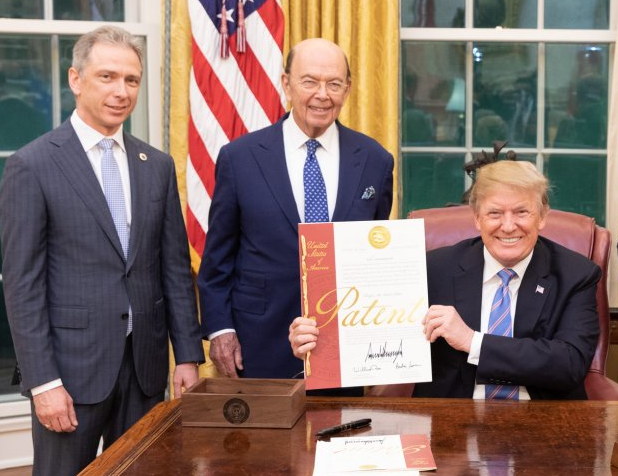
THE deplorable "2019 Revised Patent Subject Matter Eligibility Guidance" from Iancu is thankfully backfiring. The vast majority of comments received so far strongly oppose it and the judges at the Federal Circuit fire back at Trump's 'circus clown' Iancu, seeing that this attorney tries to overrule all of their decisions with a stroke of a pen. He also weakens Patent Trial and Appeal Board (PTAB) inter partes reviews (IPRs) -- an issue not overlooked by anybody. Does he try to become an 'American Battistelli'? Certainly.
IN THE UNITED STATES PATENT AND TRADEMARK OFFICE ________________________
2019 Revised Patent Subject Matter Eligibility Guidance ________________________
Docket No. PTO-P-2018-0053 ________________________
COMMENTS OF THE INTERNET ASSOCIATION ________________________
William G. Jenks Jenks IP Law PLLC 1629 K ST NW, Suite 300 Washington, DC 20006
March 8, 2019
TABLE OF CONTENTS
[...]
I. Commenter’s Interest And Initial Statement
The Internet Association is the unified voice of the Internet economy, representing the interests of America’s leading Internet companies and their global community of users.1 The Association is dedicated to advancing public policy solutions to strengthen and protect Internet freedom, foster innovation and economic growth, and empower users. The members of the Internet Association have extensive experience with the application of the abstract idea exception in patent examination, litigation, and post-grant review proceedings.
The Internet Association applauds the USPTO for its continued serious examination of the contours of patent eligibility. The Federal Circuit continues to develop caselaw that informs the eligibility inquiry. But the Office has “the primary responsibility for sifting out unpatentable material” through examination.2 It is fitting, therefore, that the Office periodically updates its guidance to better ensure that issued patents conform with the limits on eligibility set by the courts. The USPTO’s new Section 101 Guidance is a promising start that, with modification, will help the Office fulfill its role in the patent system.3
Structurally, the Guidance preserves the two-step test provided in Alice and Mayo. This structure is necessary if the Office is to maintain a strong correlation between the courts’ development of ineligibility law and the Office’s examination of patents under Section 101. But the Guidance also creates a structural bias against ineligibility rejections when the claims-at issue do not fit neatly into the categories provided. The Office should reconsider. There should not be any structural bias disfavoring (or favoring) a particular rejection. The merits of the individual case should singularly control any eligibility decision made by Office personnel.
Regarding substance, the Guidance incorporates lessons from some of the Federal Circuit’s leading cases but the Office should expand its approach to capture the full scope of eligibility law. In particular, the Guidance should (1) more fully explain how claims directed to data collection, manipulation, and display are to be treated and (2) better incorporate the caselaw’s reliance on improved technology in Step 2A. The Office should also reconsider its reliance on “hypothetical” examples. The Office would do better to build real caselaw into the Guidance.
_____ 1 The Internet Association’s members include Airbnb, Amazon, Ancestry, Coinbase, DoorDash, Dropbox, eBay, Etsy, Eventbrite, Expedia, Facebook, Google, Groupon, Handy, HomeAway, IAC, Intuit, Letgo, LinkedIn, Lyft, Match Group, Microsoft, Pandora, PayPal, Pinterest, Postmates, Quicken Loans, Rackspace, Rakuten, Reddit, Snap Inc., Spotify, Stripe, SurveyMonkey, Thumbtack, TransferWise, TripAdvisor, Turo, Twilio, Twitter, Uber, Upwork, Vivid Seats, Yelp, Zenefits, and Zillow Group.
2 Graham v. John Deere Co. of Kansas City, 383 U.S. 1, 18 (1966).
3 2019 Revised Patent Subject Matter Eligibility Guidance Dkt. No. PTO-P-2018-0053, 84 Fed. Reg. 50 (Jan. 7, 2019) (“Section 101 Guidance” or “Guidance”).
II. The Section 101 Guidance Properly Relies On The Alice/Mayo Structure, But It Should Be Clarified To Better Show How The Substantive Caselaw Principles Are To Be Applied
The Guidance maintains the Office’s use of the Alice/Mayo two-step test.4 That is altogether fitting. The USPTO should resist any calls for changes to that basic structure. The Federal Circuit’s increased emphasis on what claims are “directed to” under Step 2A warrants the Office’s review and elucidation of that area. Commenters generally support the revised approach but suggest that the Office provide additional clarification in particular areas to reduce Examiner misunderstandings when applying the Guidance.
A. The Guidance should clarify and further elucidate the Office’s approach to claims reciting data collection, manipulation, and display under Step 2A
The Guidance limits the categories of “key concepts” that are “abstract ideas” to: (a) mathematical concepts, (b) certain methods of organizing human activity, which includes several subcategories, and (c) mental processes.5
The essential clarification needed is that data collection, manipulation, and display fall either within the mathematical concepts category or form a fourth abstract-ideas category. The “mathematical concepts” category, if interpreted in the strictest sense, may not capture the breadth of caselaw, which extends the abstract idea exception to “‘collecting information, analyzing it, and displaying certain results of the collection and analysis.’”6 These data claims appear in a large number of eligibility cases, and the Guidance should explicitly recognize that claims reciting data (or information) collection, manipulation, and display are also within the “groupings of subject matter” that have been “identified by the courts as abstract ideas.”7
In SAP America, for example, claims focused on “selecting certain information, analyzing it using mathematical techniques, and reporting or displaying the results of the analysis” were “directed to abstract ideas.”8 The Court explained that each of these aspects, “[i]nformation as such,” “collecting information,” “analyzing information,” and “presenting the results” without more, was directed to an abstract idea.9 McRO was distinguished because the “claimed improvement [in the McRO claims] was to how the physical display operated (to
_____ 4 Section 101 Guidance at 50, col.3. 5 Section 101 Guidance at 52, cols. 1-3. 6 SAP America, Inc. v. InvestPic, LLC, 898 F.3d 1161, 1167 (Fed. Cir. 2018). (quoting Elec. Power Grp. v. Alstom S.A., 830 F.3d 1350, 1353 (Fed. Cir. 2016)). 7 Section 101 Guidance at 52, col. 1. 8 SAP America, 898 F.3d at 1167. 9 Id.
produce better quality images)” and not “to a mathematical technique with no improved display mechanism.”10
SAP America is not an isolated case. The principles therein have been invoked and followed in multiple, precedential, Federal Circuit decisions holding other data-manipulation claims to be directed to abstract ideas.11 These decisions include precedential cases not cited in the Guidance;12 and at least one precedential case issued after the Guidance.13 These principles should, therefore, be more fully explained in the Guidance—including identifying the appropriate category for such claims–to ensure that they are accounted for during examination.
B. The Section 101 Guidance should be modified to better reflect the caselaw’s emphasis on improved technology
The Supreme Court identified two potential categories of patent-eligible subject matter in its Alice decision: Claims that (1) “purport to improve the functioning of the computer itself” or (2) “effect an improvement in any other technology or technical field” could be more than a simple recitation of the abstract idea applied on a computer.14
The Guidance properly relies on the Supreme Court’s view to link eligible subject matter to improvement in the functioning of a computer or other technical field.15 But the Guidance appears to stretch too far beyond the Alice safe harbors when it extends eligibility to the mere use
_____ 10 Id. 11 See, e.g., Interval Licensing LLC v. AOL, Inc., 896 F.3d 1335, 1346 (Fed. Cir. 2018) (“In sum, the recited claims are directed to an abstract idea because they consist of generic and conventional information acquisition and organization steps that are connected to, but do not convert, the abstract idea—displaying a second set of data without interfering with a first set of data—into a particular conception of how to carry out that concept.”). 12 See, e.g., Intellectual Ventures I LLC v. Capital One Fin. Corp., 850 F.3d 1332, 1340 (Fed. Cir. 2017) (“We find that, under step one, the claims [at issue] are abstract. We conclude that the patent claims are, at their core, directed to the abstract idea of collecting, displaying, and manipulating data.”); FairWarning IP, LLC v. Iatric Sys., Inc., 839 F.3d 1089, 1093 (Fed. Cir. 2016) (Explaining that “the ‘realm of abstract ideas’ includes ‘collecting information, including when limited to particular content,’ ‘analyzing information,’ and ‘presenting the results … of collecting and analyzing information.’”); see also Two-Way Media Ltd. v. Comcast Cable Commc'ns, LLC, 874 F.3d 1329, 1338 (Fed. Cir. 2017), cert. denied, 139 S. Ct. 378, 202 L. Ed. 2d 288 (2018); Elec. Power Grp. v. Alstom S.A., 830 F.3d 1350, 1353 (Fed. Cir. 2016). 13 Univ. of Fl. Research Foundation, Inc. v. General Electric Co., No. 2018-1284, slip op. at 10 (Fed. Cir. Feb. 26, 2019) (“[C]laim 1 is directed to the abstract idea of ‘collecting, analyzing, manipulating, and displaying data.’”). 14 Alice Corp. Pty. v. CLS Bank Int’l, 573 U.S. 208, 225 (2014). 15 Section 101 Guidance at 55, col. 1.
of a judicial exception “in conjunction with a machine or manufacture” or in “a transformation or reduction of a particular article.”16
The Guidance should more closely tie “practical application”—the lynchpin of eligibility analysis in the Guidance—to technological improvement, which is present in all or nearly all the Federal Circuit’s Step-2A cases. The Guidance cites Eibel Process and Diehr to support its additional eligible categories. Eibel Process is linked to use in conjunction with a machine; Diehr to use in a transformation of an article.17 In both cases, the eligible invention claimed improved the technology at issue. In Eibel, the claimed Fourdrinier machine made paper at a pace much faster than prior machines, and the claims, the Court noted, were “for an improvement on a machine.”18 Similarly, the Supreme Court has made clear that “the claims in Diehr were patent eligible because they improved an existing technological process.”19 Thus, mere incorporation of a machine or transformation in the claim does not justify a rule requiring the claims be eligible under the cases cited.
C. The Section 101 Guidance should recognize the legal distinction between claims reciting a result or function without specifying the mechanism that achieves that result or function and claims that recite a technological advance
The Supreme Court has long distinguished claims that merely recite a result achieved from those that specify the method and mechanism for achieving that result. For example, Samuel Morse famously invented and patented the telegraph. But one of his claims failed because it merely recited “electro-magnetism, however developed, for making or printing intelligible characters, letters, or signs, at any distances, being a new application of that power.”20 The claim was “void” because it covered “an effect produced by the use of electromagnetism, distinct from the process or machinery necessary to produce it.”21 The Supreme Court has relied on this key principle while determining subject matter eligibility for centuries.22
The Federal Circuit has repeatedly relied on the same distinction in its post-Alice eligibility analysis. Claims that merely recite a desired result are more likely directed to an abstract idea. For example, in Internet Patents, which is not cited or discussed in the Guidance, the Federal Circuit held ineligible a claim that merely recited a desired “effect or result
_____ 16 Id. (punctuation removed). 17 Id. 18 Eibel Process Co. v. Minnesota & Ontario Paper Co., 261 U.S. 45, 55, 70 (1923). 19 Alice Corp., 573 U.S. at 223. 20 O’Reilly v. Morse, 56 U.S. 62, 86 (1853). 21 Id. at 120; see also The Telephone Cases, 126 U.S. 1, 534 (1888) (quoting Morse). 22 See, e.g., Bilski v. Kappos, 561 U.S. 593, 649 (2010); Mayo, 132 S. Ct. at 1301; Parker v. Flook, 437 U.S. 584, 592 (1978); Gottschalk v. Benson, 409 U.S. 63, 68-69 (1972); The Telephone Cases, 126 U.S. at 534.
dissociated from any method by which [the result] is accomplished.”23 The “character of the claimed invention [was] an abstract idea” because the claim-at-issue contained “no restriction on how the result is accomplished.”24 Thus, the claim was “not directed to patent-eligible subject matter.”25
Multiple precedential Federal Circuit cases rely on this principle to show that claims reciting a mere result or function are more likely directed to abstract ideas.26 On the other hand, claims that recite both a result or function and “an improvement of an existing technology” are typically “directed to” the technological improvement.27
III.The Guidance Should Incorporate And Explain Caselaw
The Section 101 Guidance sets forth the basic steps of examination under caselaw principles. But it fails to incorporate this caselaw directly. The cases are relegated to footnotes with brief parentheticals. This does little to help Examiners understand the distinctions between what is and is not an eligible “practical application.” It is primarily claims that recite the use of abstract ideas to improve the use of machines or to improve industrial processes that are patent eligible in the cases cited.
Given the complexity of the subject matter, the Office can increase the utility of the Guidance by testing the claims and facts of actual cases against each step set forth in the
_____ 23 Internet Patents Corp. v. Active Network, Inc., 790 F.3d 1343, 1348 (Fed. Cir. 2015). 24 Internet Patents, 790 F.3d at 1348. 25 Id. 26 Smart Sys. Innovations, LLC v. Chicago Transit Auth., 873 F.3d 1364, 1371 (Fed. Cir. 2017) (Under Alice step one, courts “‘look to whether the claims ... focus on a specific means or method that improves the relevant technology or are instead directed to a result or effect that itself is the abstract idea.’”) (quoting McRO at 1313); Apple, Inc. v. Ameranth, Inc., 842 F.3d 1229, 1244 (Fed. Cir. 2016) (“Generally, a claim that merely describes an effect or result dissociated from any method by which it is accomplished is not directed to patent-eligible subject matter.”) (internal marks and brackets omitted); Affinity Labs of Texas, LLC v. DIRECTV, LLC, 838 F.3d 1253, 1265 (Fed. Cir. 2016) (Under “the principles emerging from the developing body of law on abstract ideas under section 101, this court has noted that claims that are so result-focused, so functional, as to effectively cover any solution to an identified problem are frequently held ineligible under section 101.”) (internal marks omitted); Intellectual Ventures I LLC v. Symantec Corp., 838 F.3d 1307, 1316 (Fed. Cir. 2016). 27 McRO, Inc. v. Bandai Namco Games Am. Inc., 837 F.3d 1299, 1316 (Fed. Cir. 2016) (“[C]laim 1 is directed to a patentable, technological improvement over the existing, manual 3–D animation techniques. The claim uses the limited rules in a process specifically designed to achieve an improved technological result in conventional industry practice. Claim 1 of the '576 patent, therefore, is not directed to an abstract idea.”) (citations omitted); see also Enfish, LLC v. Microsoft Corp., 822 F.3d 1327, 1336 (Fed. Cir. 2016) (claims “directed to a specific improvement to the way computers operate” eligible).
Guidance. It would also be helpful to explain how the arguments were presented by the parties and either accepted or rejected by the Court. The resulting case studies can then be an integral part of the Guidance and used in place of the “hypothetical” examples the USPTO has provided on its website.28
IV.Examiners Should Retain The Authority To Reject Claims As Ineligible Under Section 101 Without Seeking Director Approval
The Internet Association believes that one structural change—unrelated to the test for eligibility itself—is needed in the new Section 101 Guidance.
The Section 101 Guidance places too high a burden on Examiners that believe a claim is ineligible even if it does not fit neatly into the subject matter categories provided. Presented with such claims, the Examiner must seek out and receive the approval of their Technology Center Director before issuing a rejection.29 This is in addition to the ordinary, proper requirement that the Examiner provide justification supporting the invocation of the abstract idea exception.
Directors are generally multiple levels above an Examiner in the chain of command—and they face numerous demands on their time—making it difficult and time consuming for the Examiner to seek and receive their approval. Fulfilling such a requirement is much harder than, for example, seeking approval from a Supervisory Patent Examiner. There is also no indication that the Examiner will receive the requisite time needed to seek and obtain this approval. Without extra time and under the USPTO’s current press of business, this would add pressure on the examining corps to issue claims that they deem ineligible.30 At a minimum, the Agency should allocate so-called “other time” to ameliorate this bias.
Requiring Director approval thus creates an artificial bias in the examination process that favors not testing the eligibility of patent claims. To the extent a bias should be built into the system, it should favor testing the contours of eligibility law in the USPTO—where applicants have appeal rights both within the Office and to the courts—over issuing categories of potentially ineligible claims unchallenged. Such claims may, if issued, eventually be found ineligible by the courts but only after causing enormous damage through years-long litigation. As between the patent owner and the public, the patent owner is best situated and incentivized to
_____ 28 See Subject Matter Eligibility Examples: Abstract Ideas, available at https://www.uspto.gov/sites/default/files/documents/101_examples_37to42_20190107.pdf. 29 Section 101 Guidance at 57, col. 1. 30 See, e.g., Michael D. Frakes & Melissa Wasserman, Is the Time Allocated to Review Patent Applications Inducing Examiners to Grant Invalid Patents? Evidence from Micro-Level Application Data, Review of Economics and Statistics (forthcoming) 4, available at https://scholarship.law.duke.edu/faculty_scholarship/3646 (“Importantly, our findings demonstrate … that examiners appear to be operating at the point where time constraints indeed bind.”).
seek a definitive eligibility ruling in cases deemed ineligible through the ordinary examination process.
To be clear, the Internet Association is not suggesting a bias be added in either direction. But any structural bias—including the present bias against Examiner Section 101 rejections—should be removed. Finally, in a footnote, the Guidance suggests a similar burden heightening will be applied to the PTAB judges.31 Commenters likewise oppose the bias created by the process sketched out therein.
V. Conclusion
The Internet Association again applauds the USPTO for its continued serious examination of the contours of patent eligibility law. The Internet Association believes that the USPTO’s approach of considering all views will lead to clearer Guidance and thanks the USPTO for the opportunity to provide its views.
_____ 31 Section 101 Guidance at 57 n.42.
In the link below you will find a recent video (in French) about France Telecom scandalous HR practices and the soon to come prominent court case.
https://www.youtube.com/watch?v=acbmXxL7yXA
Many of the obnoxious HR techniques which were applied at FT – with the despicable effects on staff health reported upon broadly – were also applied at the EPO during Battistelli’s era.
With no surprise, the results of such policies at EPO were similar to those at France Telecom, see : https://www.politico.eu/article/labor-relations-turn-toxic-in-the-european-patent-office/
Obviously the issue of quality at EPO depends first and foremost on the kind of HR policies applied to staff, which presently continue to generate a very negative social atmosphere.
All HR top managers who were behind such despicable HR policies have been maintained in their positions since the arrival of Mr Campinos 10 months ago.
As long as management by pressure and fear goes on and put staff under undue pressure for more production vs. quality, nothing will change. The sweet story-telling of Mr Campinos is fooling no one since he takes no concrete actions to reverse the unhealthy work pressure.
Inevitably more social damages hence quality issues are thus in sight.