
Only Germany Objected to Salary Adjustment (Reduction) Procedure of "Team Campinos"

Before the weekend the Central Staff Committee at the EPO wrote to tell staff what happened in the meeting of delegates. A "flash report on the Administrative Council of 30 June and 1 July 2026" was circulated to say their "interventions were accompanied by this printed handout." In a nutshell:
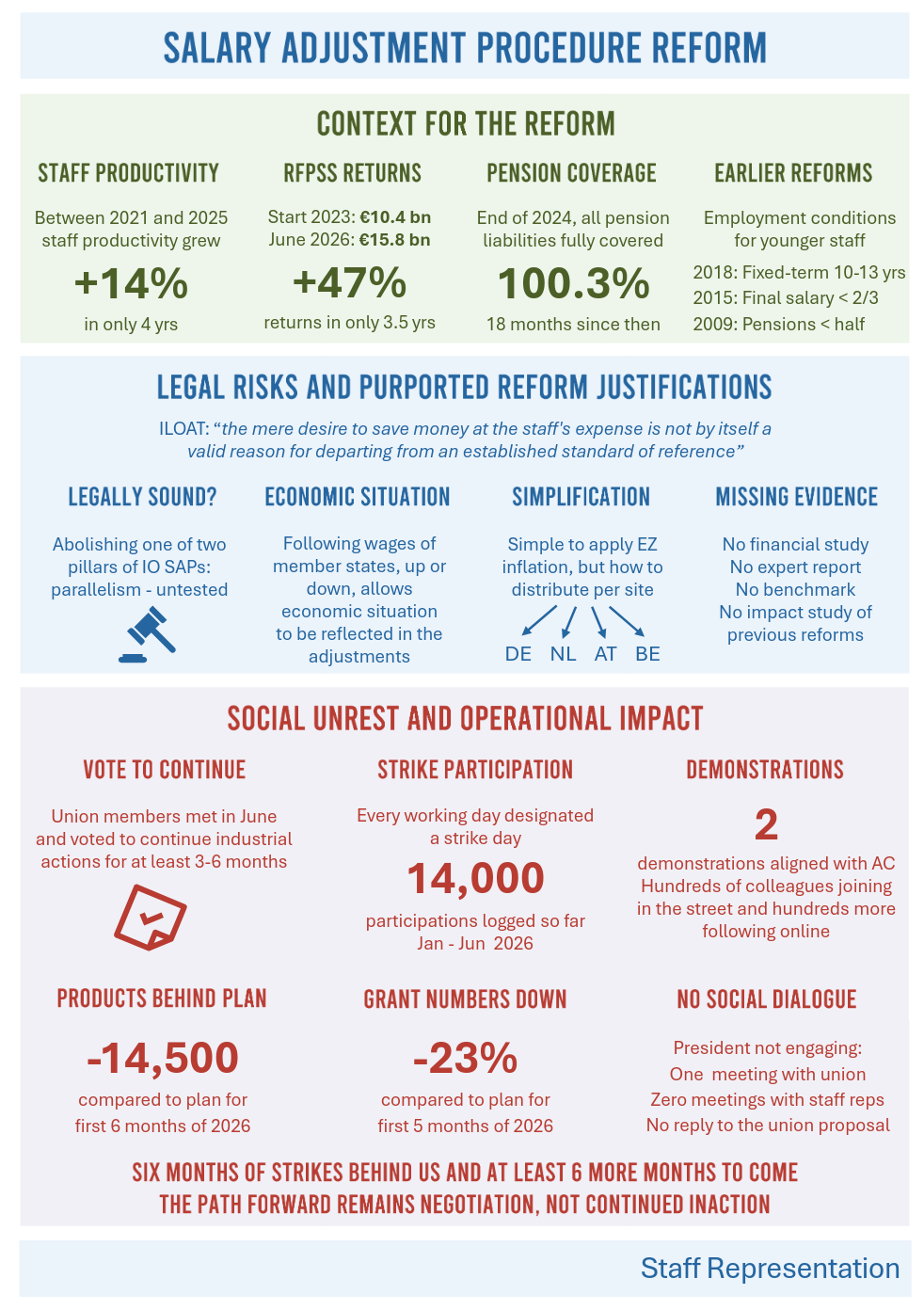
"We would like to thank everyone who participated in Friday’s strike anchor day, the SUEPO demonstration of 30 June," they said, "and in the industrial actions. We inform that the SUEPO action plans continue." (Maybe next year too)
This is a regime of occupation, deriving consent from manipulation of delegates, not from the citizenry.
Here is the full report, which says only Germany obstructed the unjust measure.
Zentraler Personalausschuss
Central Staff Committee
Le Comité Central du PersonnelThe Hague, 02-07-2026
sc26048cp
Flash Report from the Administrative Council (AC/187)
on the Salary Adjustment ProcedureDear Colleagues,
On June 30th, the Administrative Council adopted the new salary adjustment procedure by 37 votes in favour, 1 against (Germany), 1 abstention (Croatia), and 1 non-voter (Slovenia). Disappointingly, but also coming as no surprise, the majority of delegations supported the proposal, emphasising its simplicity, predictability and contribution to the Office's long-term financial sustainability. Germany considered that the proposal did not go far enough and again called for salary reductions of up to 15% through a salary freeze, while Croatia abstained, questioning the principle of automatic salary adjustment altogether.
On behalf of the Staff Representation, we reminded delegates why staff continue to oppose this reform. We presented the context in which it is being introduced: productivity has increased by 14% in four years, the RFPSS has grown to €15.9 billion, pension liabilities became fully funded at the end of 2024 and are now overfunded, and earlier reforms have already substantially reduced the long-term employment conditions of younger generations of staff. We questioned the financial necessity of introducing a further €1.3 billion reduction in remuneration on top of the €2 billion already generated by the current salary adjustment procedure. We also highlighted the absence of any financial study, independent expert assessment or benchmarking to justify the reform, together with the legal risks arising from abandoning the principle of parallelism with the salary evolution of national civil servants.
The administration continued to defend the proposal as a simpler and more predictable system that would improve financial sustainability while maintaining purchasing power. VP4 acknowledged the impact of the industrial actions but sought to minimise it, stating that approximately 10,000 examiner days had been lost in 6 months, corresponding to around 1.5% of annual examiner capacity. At the same time, she confirmed that production had declined and that the industrial actions had affected output, meaning that previous targets set for 2026 and 2027 would need to be revised. The administration also maintained that extensive discussions had taken place with staff representatives and rejected suggestions that staff concerns had been ignored.
The Staff Representation sees the situation differently. Six months of sustained industrial action, more than 14,000 strike participations, declining production and repeated calls for negotiations have still resulted in no meaningful engagement by the President. The vote today therefore closes one chapter, but not the wider dispute. The concerns expressed by staff extend well beyond the salary adjustment procedure itself and relate to the continuing deterioration of the employment conditions, unreasonable work pressure, in particular for the staff on fixed-term contracts, and lack of consideration of staff opinion at the Office.
At the end of the meeting, we once again urged the President to enter into dialogue with the staff representatives and SUEPO. The sense of resignation that has now taken hold is poison for the European Patent Organisation. The EPO thrives on the commitment of its staff. However, this commitment is gradually being lost. We have made it clear that we are prepared to engage in dialogue.
We would like to thank everyone who participated in Fridays strike anchor day, yesterday's demonstration, and in the continuing industrial actions. Your commitment ensured that the delegates could not ignore the level of concern among staff. The path forward remains the same: initiation of meaningful negotiations on issues impacting staff and to restore social peace.
Kind regards,
Your Central Staff Committee
They give no explanation of the breakdown, nor do they offer what can be used to explain the general leanings; our guess is that Germany, which stands to benefit the most from the EPO "cash cow" (monopoly), wants to at least be seen as fair. When a microstate like San Marino has a vote as potent as Germany's, however, the lobbying focuses on the former. This is why "Team Campinos" or "Team Cocaine" can get its way. This is a crisis for Europe. █