
European Patent Office (EPO) Series: Streamlining the Decision-Making Process
Previous Parts:
Part 34
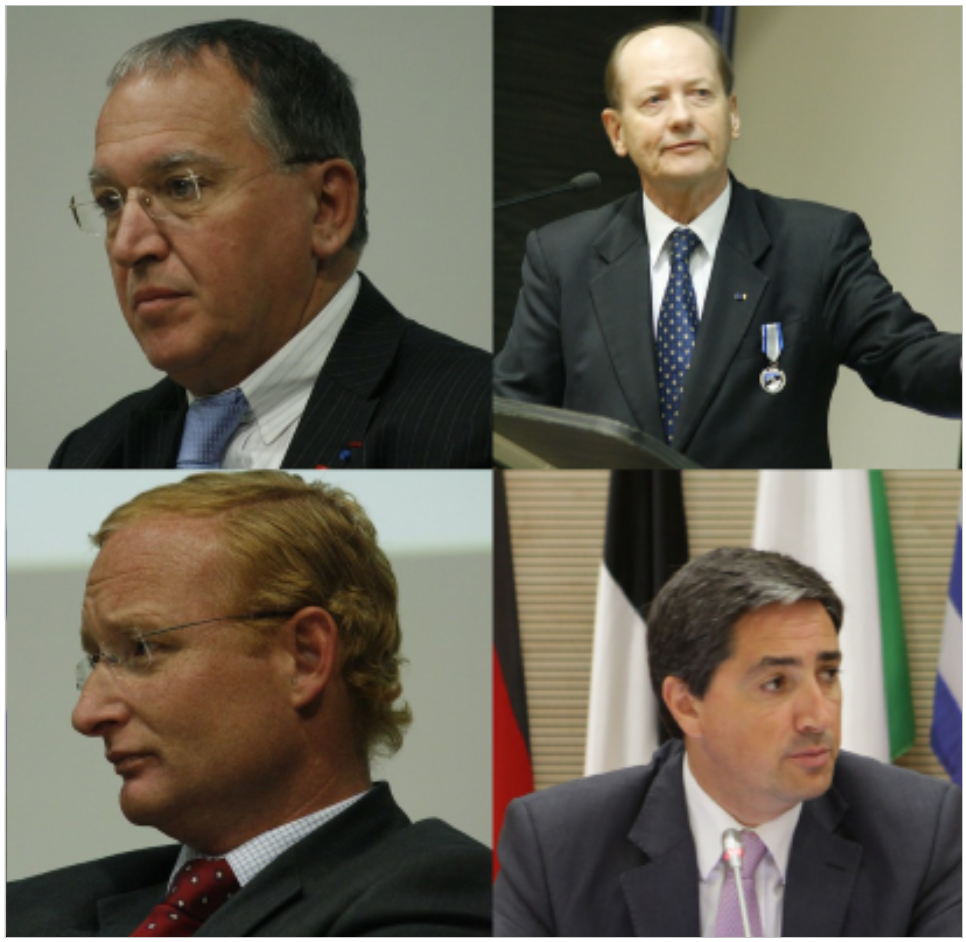
Clockwise from top left: Benoît Battistelli, Martti Enäjärvi, João Negrão and António Campinos were members of a "select committee" of high-level European "IP officials" that visited Matti Päts in Tallinn in January 2010 to discuss "development trends of both EPO and OHIM".
In the last part we took a detailed look at the selection procedure which led to the appointment of António Campinos as OHIM President in 2018.
The manner in which that procedure was conducted is perhaps not so surprising when one considers the composition of the OHIM Administrative Board at the time in question, in particular the presence of Benoît Battistelli (France), Martti Enäjärvi (Finland) and Matti Päts (Estonia).
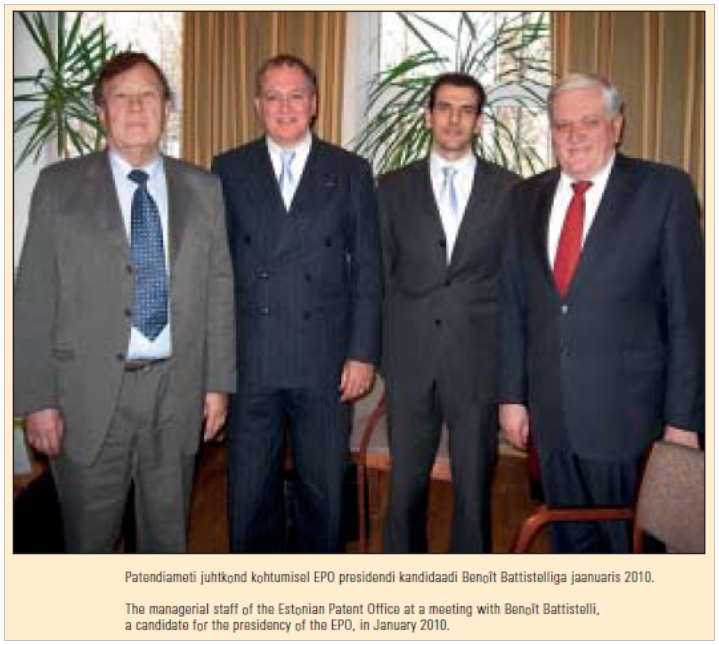
A photo showing Benoît Battistelli and Gilles Requena flanked by Matti Päts (on the left) and his deputy Toomas Lumi (on the right) on the occasion of a meeting which took place in Talinn in January 2010.
All of the aforementioned individuals had participated in a meeting which took place in January 2010 in the Estonian capital, Talinn, as part of Battistelli's Baltic Crusade. It is a matter of official record that at that meeting – which was also attended by António Campinos and João Negrão – the discussion centred on "development trends of both EPO and OHIM". Subsequent events suggest that the main purpose of the meeting was to agree on a common line to be followed with regard to filling the top positions at both the EPO and OHIM.
Some time later in April 2010, as the OHIM Administrative Board prepared to draw up the shortlist of candidates for the position of the agency's President the recent protracted election shenanigans at the EPO in Munich would have been fresh in the minds of the national delegates, many of whom participated in both governing bodies.
It is recalled here that about two months earlier, following the failure to break the deadlock in the EPO election procedure at an extraordinary Council meeting convened at the beginning of February 2010, the IPKat website had expressed the view that the ongoing inability to arrive at an agreed outcome made the EPO's Administrative Council look "increasingly ridiculous".
The head of the Estonian delegation, Matti Päts, expressed his view of the situation at the EPO in a foreword to the 2009 Annual Report of the Estonian Patent Office (published some time in the first quarter of 2010):
"The representatives of the Estonian Patent Office as the members of the Administrative Council of the European Patent Organisation took part in the elections of the new president of the European Patent Office at the regular meeting of the Administrative Council in December 2009. There were four candidates – from Switzerland, Denmark, France and Sweden.Despite several votings nobody got the required majority of votes.
A large office needs a president and firm management, but it is difficult to tell how to achieve it. Here democracy reveals some obstacles."
Many of the other OHIM Administrative Board members – who like Päts doubled as EPO Administrative Council delegates – had witnessed the EPO election circus at first hand. It is quite likely that they shared a collective desire to avoid a repeat performance when it came to filling the top position in Alicante and were eager to find some way to circumvent what Päts regarded as the "obstacles" inherent in a rules-based democratic system.
Confronted with the problem of how to "streamline" the decision-making process in Alicante, a solution was finally found that would enable the OHIM Administrative Board to complete its selection procedure in a fraction of the time required by the EPO Administrative Council and with far less effort on the part of all concerned.
The novel and innovative solution which Campinos and his amigos settled upon was to agree on "shortlist of one" – with the "one" in this case being none other than the chairman of the Administrative Board, namely António Campinos himself.
The fact that this clever little administrative trick effectively pre-empted and usurped the decision-making authority of the Council of Ministers didn't seem to trouble anybody. From a formal legal perspective, there was nothing unlawful about it because the Board's rules of procedure permitted the nomination of a single candidate as long as the nomination was supported by a three-quarters majority.
It would appear that OHIM "insiders" considered the deployment of the "shortlist of one" in the 2010 presidential appointment procedure to have been such a success that it soon established itself as the solution of choice – or perhaps more accurately, "the solution of no choice" – when came to filling top jobs in Alicante.
This form of "streamlined" decision-making was still in regular use a decade later in 2020, when João Negrão secured his appointment as President of the EUIPO Boards of Appeal.
Source: 2020.11.10 [PT] Communiqué regarding João Negrão
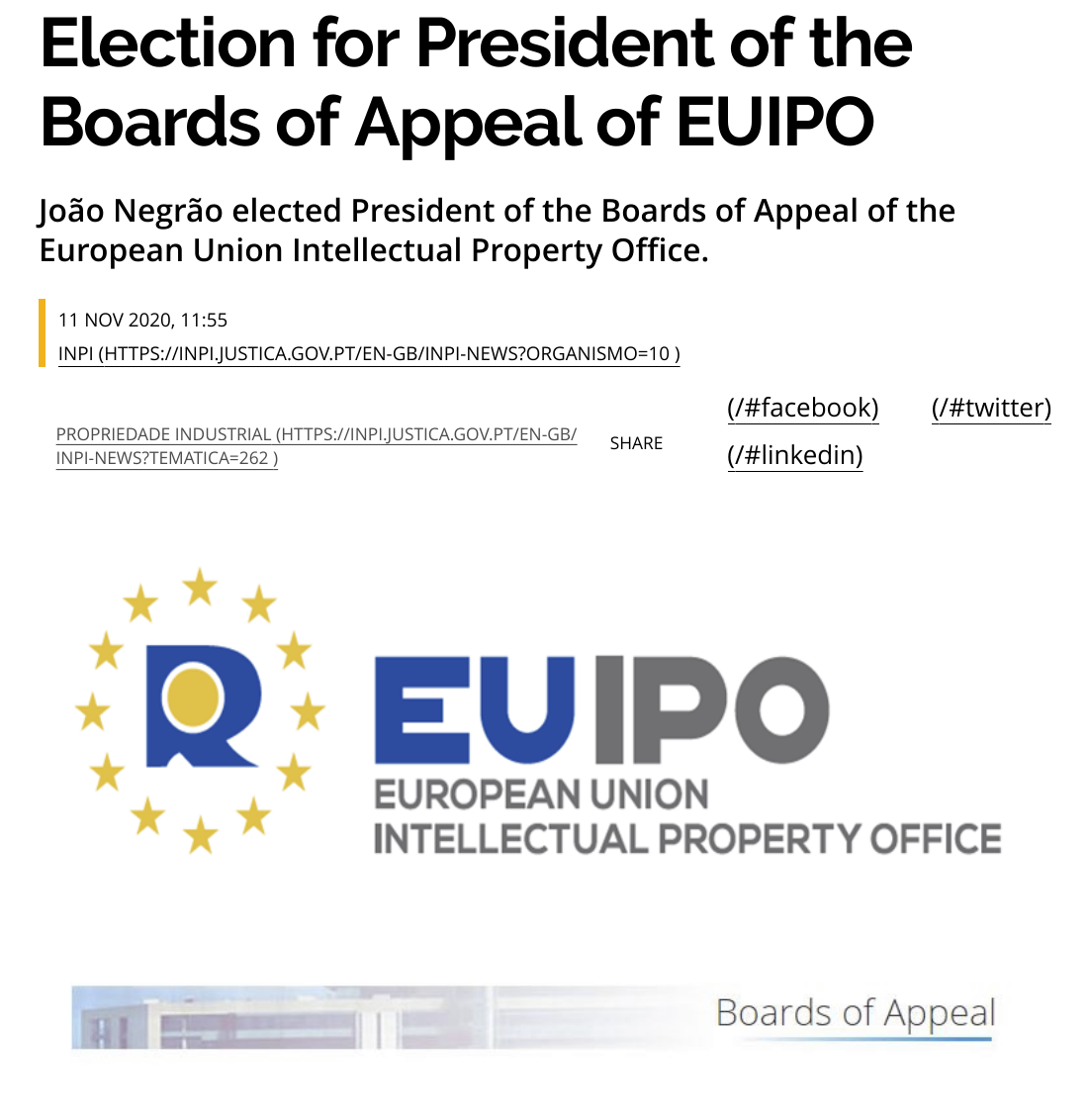
On that occasion Negrão was one of 17 applicants for the position but he somehow managed to end up as the sole candidate on the shortlist prepared by the Management Board in June 2020 for submission to the Council of Ministers.
Some months later, in Negrão's home country Portugal the official confirmation of his appointment by the Council of Ministers was a cause for celebration.
To mark the occasion a communiqué issued by the Ministry of Foreign Affairs was published on the official website of the XXII Portuguese government, a Socialist Party (PS) minority government led by Prime Minister António Costa.
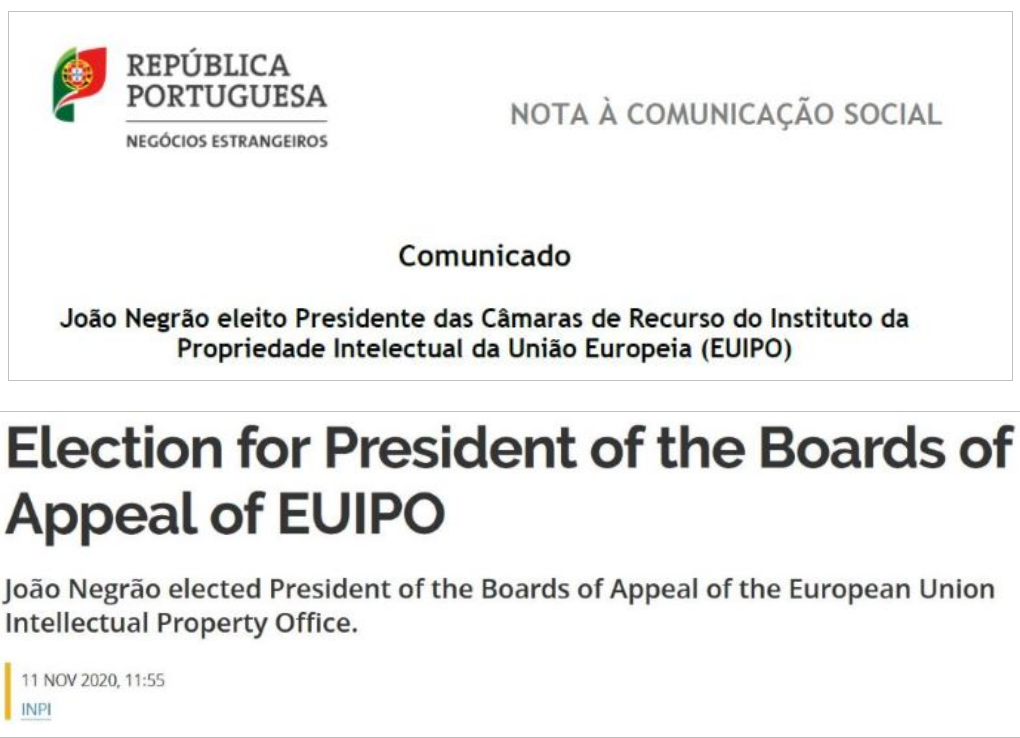
A communiqué issued by the Ministry of Foreign Affairs announcing the confirmation of Negrão's appointment as President of the EUIPO Boards of Appeal appeared on the official website of the Portuguese government. The contents of the communiqué were reproduced in an English translation on the official website of the Portuguese National Institute of Industrial Property (INPI)
The contents of the government communiqué were reproduced in an English translation on the official website of the Portuguese National Institute of Industrial Property (INPI):
The Portuguese João Negrão was appointed today for the position of President of the Boards of Appeal of the European Union Intellectual Property Office (EUIPO). The selection process was in progress since 2019 and considered 17 candidates from 8 Member States and counted with the strong support and commitment of the Portuguese Government, on a diplomatic campaign coordinated by the Ministry of Foreign Affairs and also involving the Ministry of Justice and the Portuguese National Institute of Industrial Property (INPI).
Throughout the process, the undisputed merit and the wide experience of the candidate were reflected in the very significant vote by the Member States, represented on the EUIPO Board of Directors, in which João Negrão got 27 out of 30 votes. His appointment was adopted by the Council of the European Union unanimously today.
The jurist João Negrão has more than 20 years of experience in the area of industrial property, both at national and European level, having held duties as Director of International Relations, Legal Affairs and Promotion of Innovation at INPI between 2008 and 2010. Since 2011, he was Director of International Cooperation and Legal Affairs at EUIPO.
With this appointment, Portugal consolidates the high profile it has taken in the last ten years in the area of intellectual property and patents, which translates into the election of Portuguese for the highest positions in the European agencies of Alicante (EUIPO) and Munich (European Patent Office).
As we shall see in the next part, Negrão's sponsors in the Portuguese political establishment may have regarded the "rubber-stamped" confirmation of his appointment by the Council of Ministers as a cause for celebration but not everybody else was happy about the manner in which the selection procedure had been conducted. █