
Bonum Certa Men Certa

IAM Encourages Patent Aggression, CCIA Highlights Cost of Being Accused of Infringement, Professor Tun-Jen Chiang Explores Free Speech Aspects of Patents

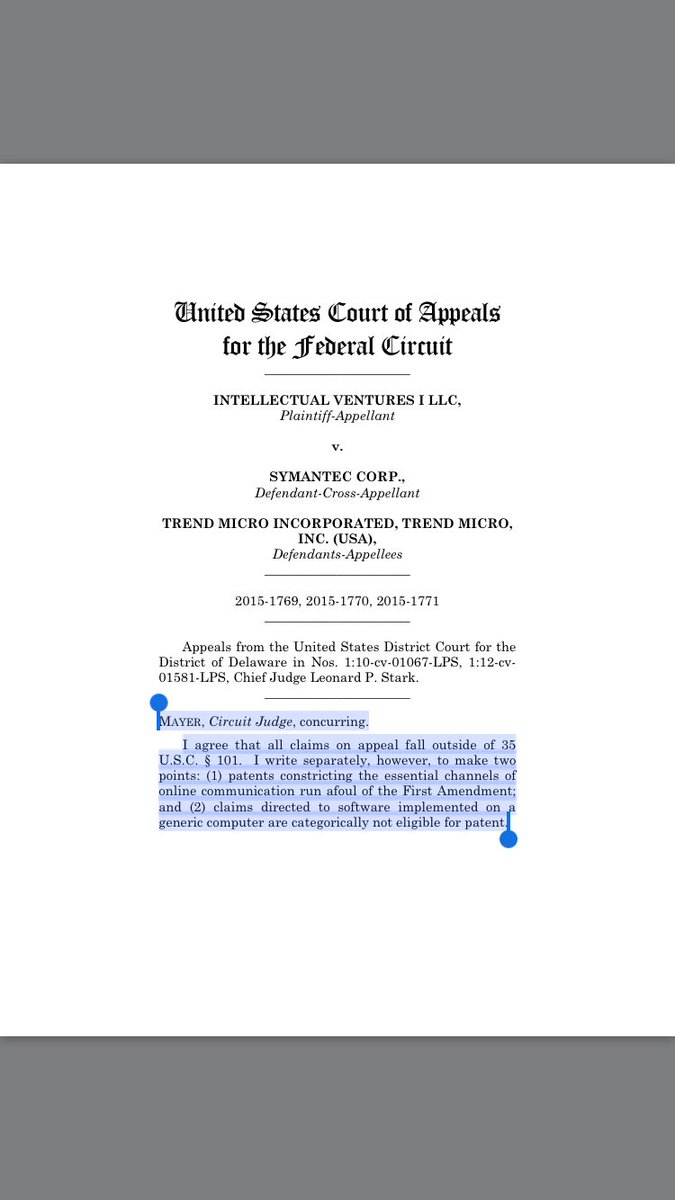
The First Amendment in the United States is contradictory to the notion of code patents (decision from the Court of Appeals for the Federal Circuit, CAFC)

Opinion on IV


Opinion on IV


Summary: A few items of interest which pertain to patent litigation and shakedown, in effect highlighting lesser-explored aspects of legal landscapes wherein being accused alone can cost one dearly

THE patent litigation culture that had become so prevalent in the US before the courts (and to a lesser degree the USPTO) put the brakes on it cost the economy many billions of dollars. Lawyers, trolls and few failing companies had made a lot of money but produced nothing of value. We risk seeing the same thing happening in Europe if EPO management gets its way.

"Software developers do not need patents. It's an improper and truly unnecessary instrument of law."IAM spent well over a decade promoting a patent litigation culture everywhere in the world. This is IAM's bread and butter. What IAM meant by "webinar" the other day is marketing/lobbying. The word "licensing" refers to blackmail, extortion, and coercion with patents (otherwise a lawsuit gets filed). By contrast, the CCIA (Josh Landau in this case) bemoaned the situation, insisting that "[i]n Defending Against Patent Litigation, Even A Win Is A Loss" (except for the lawyers).

To quote:

So what we have is a lawsuit where, based on the statements in the complaint, the patent may not be valid, and where public information strongly suggests that the patent isn’t infringed.

Nonetheless, the Big Ten Network will have to spend money defending themselves from the lawsuit. And baseless patent assertions don’t just hurt large tech companies—they hit everyone, from entertainment companies like the BTN or Disney, to retailers and restaurants like Walmart and White Castle.

These suits, even if the defendant is successful in defending themselves, cost money. According to AIPLA’s 2017 survey, the median cost just to start defending a case with less than $1,000,000 at stake is around $25,000, and the median cost to get through the motions stage is around $250,000. If there’s more at stake? A case with more than $25,000,000 at risk might cost you around $140,000 just to get started, with the cost through the motions stage on the order of $1,700,000. That’s not even to get to trial.

All to defend yourself against a lawsuit that never should have occurred, based on a patent that never should have issued.


Tun-Jen Chiang has just outed/promoted "Patents and Free Speech," a paper which discusses how patents affect the First Amendment in the United States. It's no secret that computer code (in the case of software patents) is akin to poetry or speech and thus invokes questions pertaining to the First Amendment. CAFC ruled so specifically (about 2 years ago) while rejecting Microsoft's patent troll, Intellectual Ventures. From this new introduction to Professor Chiang's paper:

Scholars have long argued that copyright and trademark law have the potential to violate the First Amendment right to free speech. But in Patents and Free Speech (forthcoming in the Georgetown Law Journal), Professor Tun-Jen Chiang explains that patents can similarly restrict free speech, and that they pose an even greater threat to speech than copyrights and trademarks because patent law lacks the doctrinal safeguards that have developed in that area.

Professor Chiang convincingly argues that patents frequently violate the First Amendment and provides numerous examples of patents that could restrict speech. For example, he uncovered one patent (U.S. Patent No. 6,311,211) claiming a “method of operating an advocacy network” by “sending an advocacy message” to various users. He argues that such “advocacy emails are core political speech that the First Amendment is supposed to protect. A statute or regulation that prohibited groups from sending advocacy emails would be a blatant First Amendment violation.”

Perhaps the strongest counterargument to the conclusion that patents often violate free speech is that private enforcement of property rights is generally not subject to First Amendment scrutiny, because the First Amendment only applies to acts of the government, not private individuals. Although Professor Chiang has previously concluded that this argument largely justifies copyright law’s exemption from the First Amendment, he does not come to the same conclusion for patent law for two reasons.


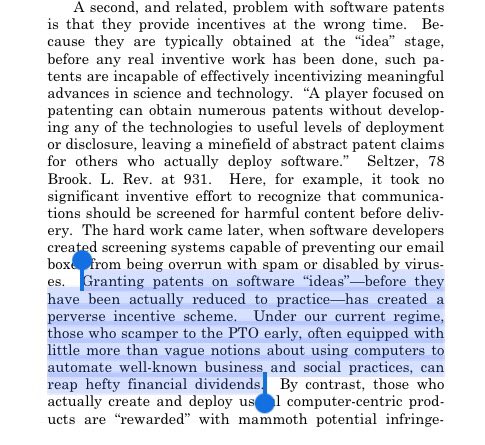
When it comes to copyright law, one's ability to speak freely depends on one's originality. But rephrasing things can help dodge plagiarism/infringement claims, whereas with patents that is not quite possible. This means that when it comes to patents the risk to one's free speech, e.g. in the code sense, is seriously jeopardised. Code is already covered by copyright law, so for the most part plagiarism is a problem that's sufficiently tackled without patents. Software developers do not need patents. It's an improper and truly unnecessary instrument of law.

Recent Techrights' Posts

How We Do Techrights (and What's Changing Next Week)
Many former news sites no longer yield much non-meaningless news (not anymore); there's a gap to be filled
Links 12/07/2026: Palantir Unrest and Wireshark 4.6.7
Links for the day
Links 12/07/2026: New Instrument Time and PalmOS Experiences in 2026
Links for the day
Red Hat Staff Says IBM Policy Has Stigmatised Him as a Tool and a Slopper With Plagiarism Tools
IBM is killing Red Hat with slop
Freedom of Choice or Freedom Versus Choice (or When All Choices Are Incompatible With Freedom)
When some business asserts that it gives people different options, then it can rightly argue that it offers some choices, but that is not the same as freedom
Techrights IRC Turns 5 Without a “Code of Conduct”, “Code of Conduct Committee”, and All Those Bureaucratic Nightmares
18+ years if one counts our time in Freenode as well
Why U No Use AI???
Many hype waves come and go
There Are Still Slopfarms in Google News
Google is trying to participate in if not lead this pyramid scheme
The Cyber Show Explains How Slop and Promotion of Slop is About Taking Control Away From Computer Users
"On making a trustworthy machine"
Keeping Available the Site at All Times
Informal arrangements and crowdfunding keep our work available despite resistance (including from people who break the law)
What If "Era of AI" and "AI Revolution" (Fake News) Never Happened?
So how much longer before the bust (or bubble-burst)?
GNU/Linux Approaches 5% in Australia
5% by year's end?
Europe/EU is Moving Towards Independence, Fast to Adopt Free Software
More and more states (governments, public sector) in Germany are dumping Microsoft
GNU/Linux Grows at the Expense of Windows
People who want to get work done already left Windows
Tux Machines Growing as a Volunteers-Run Site
Historically the site did not have many original stories, but this changed as the audience grew and the site gained more recognition
Links 12/07/2026: European Commission Versus ‘Addictive Design’, "Google Loses Final Appeal Over $4.7 Billion EU Android Antitrust Fine"
Links for the day
GNU/Linux Market Share Increases Some More Today, statCounter Measures It at 7.3%
Will more such thresholds and records be broken?
Gemini Links 12/07/2026: Studying Languages and 2026 Old Computer Challenge (OCC)
Links for the day
EPO "Cocaine Communication Manager" - Part XIII - At the EPO, Cocaine Addicts and Their Friends Are "Protected Class"
What does that tell us about the EPO?
Increasing Output by Focusing on Originals
It's probably more important to carry on with these than it is to keep abreast of non-crucial news
Amid Strikes and Industrial Actions, Young Professionals at the European Patent Office (EPO) Kept on 'Short Leash', According to the Local Staff Committee The Hague
Issues affecting Young Professionals
Over at Tux Machines...
GNU/Linux news for the past day
IRC Proceedings: Saturday, July 11, 2026
IRC logs for Saturday, July 11, 2026
Blogs May be Making a Comeback (They're Not Fediverse, They Are Joined by RSS Feeds)
Don't fake expansion where none existed
ChromeOS and GNU/Linux in the United Kingdom Reach 11%
the UK shows signs of digital maturity
Corporate Media: Blame the People Who Enter the Abandoned IBM Buildings, Not IBM for Abandoning Workers in Pursuit of IT Sweatshops
When the media spreads falsehoods stocks can go up (a lot higher), but at whose expense and how long for?
Canonical is Selling Microsoft, It Pays The Register MS to Sell Microsoft
It's all about money to them. And they call this journalism.
When Red Hat's HR Becomes the Same as IBM's HR (Bluewashing)
Red Hat keeps sacking very experienced engineers and adding temporary interns
GNU/Linux Growing in East Asia
Assuming this is more or less accurate, we could use a plausible explanation
SUEPO Munich Report on the Recent EPO Demonstration and Rolling Strikes That Continue to Grow
"increasing registrations for the 'rolling strikes' running until autumn"
Over a Week After Microsoft Discontinued Some XBox Models It Apparently Exits Some Markets Altogether
We seem to be witnessing the end of XBox
Gemini Links 11/07/2026: Old Computer challenge, Poems, Antenna, and More
Links for the day
Links 11/07/2026: "Trademark wars of Influencer Culture", Xinuos Uses Copyrights Versus UNIX
Links for the day
North America: GNU/Linux Measured at 10%
To better understand what contributes to the gains
Following Corrections and Adjustments statCounter Sees GNU/Linux at 7.1%, an All-Time High
There is a lot of layoffs at Microsoft this month
Over at Tux Machines...
GNU/Linux news for the past day
IRC Proceedings: Friday, July 10, 2026
IRC logs for Friday, July 10, 2026
Links 11/07/2026: Wednesday-Saturday News Catch-up
Links for the day
Prioritising High-Importance News
In order to fully catch up with news we'll not publish many new articles until next week